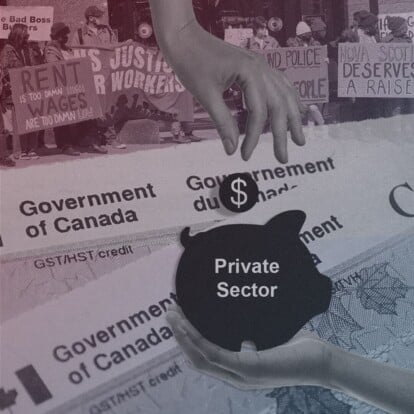
From gas to groceries to housing, the price of getting by is soaring.
And what’s been the response of Canada’s elite? They’re trying to make you poorer.
That’s not an exaggeration. To rein in inflation, the Bank of Canada’s literal approach is to keep your wages down.
Here’s how it works: for the last ten months, Canada’s central bank has repeatedly raised interest rates.
Their goal is to put a chill on borrowing and spending, which will throw people out of jobs and make workers insecure enough to stop asking for raises—even if it plunges the country into a recession.
To justify this approach, the Bank of Canada, Bay Street, and the business press have been repeating an old story: that inflation is caused by greedy workers overheating the economy.
In a report last July, they warned about the danger of the so-called wage-price spiral no less than 13 times.
A month later, the Bank of Canada’s senior deputy governor complained about those pesky workers: [they are] “looking at the rate of inflation and what it’s doing to their purchasing power, their budgets, and they’re looking at the same tight labour markets and they’re thinking ‘I need a raise.”
Of course, the deputy governor is not exactly feeling the squeeze. She makes $400,000 a year, while the Governor of the Bank of Canada Tiff Macklem makes $600,000.
There’s just one problem with their story: it’s not true.
Wages in the last month may have been up by 5%, but with inflation still at 6.8%, wages haven’t even kept pace. That means your real wages have actually fallen.
But that hasn’t stopped the governor from counselling corporate leaders to keep workers pay in check.
And in November, he spelled out the need to get unemployment up.
“…We need to rebalance the labour market. This will be a difficult adjustment…Higher interest rates will help cool spending and the demand for labour in the economy.”
That’s bank speak for: there’s gonna be blood on the floor.
Far from being neutral technocrats, these central bankers are paid-up members of Canada’s elite, waging a class war against workers.
Their right-wing economic doctrine holds that it’s beneficial to keep a high number of people out of jobs – the so-called “natural rate” of unemployment.
A centry and a half ago, Karl Marx gave this a much more honest name: the “reserve army of labour.”
A large pool of unemployed people keeps other workers on edge and disciplined, undermining their ability to demand higher wages.
So if inflation isn’t caused by greedy workers, what is causing it?
While wages have gone down, something has gone up: corporate profits.
After tax profits are the highest they’ve been in 60 years, as a percentage of GDP.
In oil and gas, banking, real estate, mining, and supermarket chains, corporations have made a killing.
Taking advantage of supply shortages, pent up demand, and their monopoly power, they’ve set prices well above their costs.
A report by economist Jim Stanford shows that not, coincidentally, these same sectors were also the source of the fastest price increases.
That confirms that the dominant cause of the recent surge in inflation isn’t workers wages, but rising corporate profits.
Strangely, though, this hasn’t aroused the same concern from the Bank of Canada.
In that report from July, how many times were profits mentioned?
Zero.
And things are set to get worse.
As interest rates start to bite even more, the country is on course for a deliberately-engineered recession.
We’ve been here before. In the early 1990s, the Bank of Canada’s aggressive interest rates hikes threw hundreds of thousands out of work and destroyed people’s lives.
But if corporate profits are the culprit, it’s time they bear the cost. We should:
regulate prices to stop big business from jacking them up
Invest in renewables, housing, and transit to make life more affordable
And go after corporations with taxes to claw back their obscene profits
Because if they’re fighting a class war, it’s about time we do.

The Breach’s investigations don’t just inform our readers—they force the powerful to react.
An exposé on blood plasma privatization led to national headlines. Our revelations about the government’s cozy connections to Big Pharma sparked a parliamentary probe. A report on high-tech price-fixing by mega landlords resulted in a criminal investigation.
From activists to elected officials, people are using The Breach’s journalism to push for transformative change.
– Dru Oja Jay, Board President, The Breach