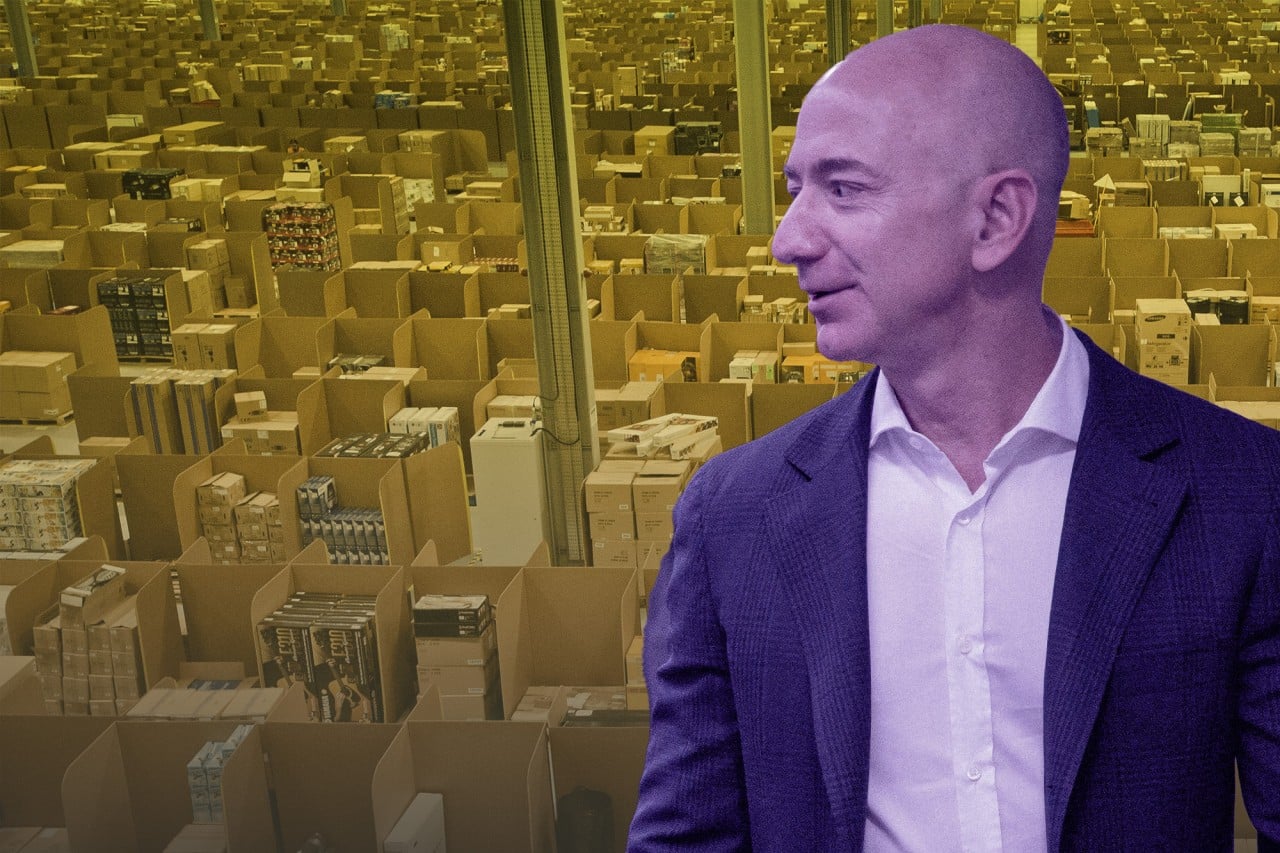
Amazon has a message for its army of precarious workers worldwide: dare to unionize and you will be punished.
After failing to thwart a historic unionization drive in Quebec, Amazon is now shuttering all its operations in the province, laying off nearly 2,000 workers.
The move is a brazen attempt to punish workers in the province who achieved what many thought impossible. In May 2024, about 300 workers at the Laval warehouse successfully unionized—a historic first in Canada—despite facing two years of anti-union tactics, intimidation, and surveillance. What’s more, they were set to become the first Amazon workers anywhere in the world to secure a collective agreement.
For Amazon’s Jeff Bezos, this move isn’t just about crushing the Laval workers and their union; it’s a direct assault on the entire global working class. It marks a growing offensive by corporations and the capitalist class who are trying to put workers in their place with austerity measures and attacks on labour organizing.
Here in Quebec, Amazon’s move leaves 1,700 workers—many of them immigrants, international students, and people with families—jobless in the midst of rising unemployment and a worsening cost-of-living crisis.
Meanwhile, the tech oligarch Bezos continues to amass unimaginable wealth, with his fortune now exceeding $200 billion.
Amazon feared a ‘breakthrough’ for workers in Quebec
Amazon’s time in Quebec has been brief—but marked by worker resistance throughout.
The company opened its first fulfillment centre in Lachine in 2020 and quickly expanded to seven facilities across the province. In the winter of 2022, workers at the Lachine warehouse launched the first sustained campaign to improve working conditions. In response, Amazon resorted to union-busting tactics, including pressuring workers not to sign union cards. These actions were later deemed unlawful in a Quebec labour ruling.
While that campaign didn’t end in union certification, the breakthrough came in May 2024 at the Laval facility—the first Amazon warehouse in Quebec and Canada to successfully unionize.
The victory didn’t come easy. As a labour organizer who for a time worked undercover at that warehouse, I saw Amazon’s exploitation, surveillance, and relentless anti-union intimidation firsthand.
What sets the Laval case apart from unionization drives in other parts of the world is a unique provision in Quebec’s labour code: employers are legally required to reach a first collective agreement with a union, once it exists. If negotiations then stall, the dispute goes to arbitration.
This has given Laval workers a powerful tool not available in other jurisdictions.
In the United States, for example, Amazon workers in Staten Island—whose historic union victory inspired workers globally—have been left without a contract for more than two years now. Amazon has refused to even come to the negotiating table.
A first collective agreement in Laval would have represented a major breakthrough for Amazon workers worldwide, potentially inspiring more than 1.5 million employees, and set a precedent the company was desperate to avoid.
Amazon has claimed that its decision to leave Quebec is driven by costs and profitability, not union activity. But the company has long valued its market dominance over profits. And it has always been willing to wield that monopolistic power to crush workers’ rights, even at the cost of short-term financial gains.
The real motives behind the corporate giant’s recent announcement are clear: this is an aggressive “shock and awe” campaign designed not only to discipline workers here but to send a message of intimidation across its global operations.
Amazon’s actions in Quebec, announced just two days after Jeff Bezos and other tech oligarchs stood alongside Donald Trump during his inauguration, are emblematic of a dangerous trend.
As more and more of our economy is controlled by wealthy corporations and oligarchs that run them, the fight for workers’ rights is about the future of our democracy.
Our solidarity and fightback are even more profound in this period. This is not just their fight—it’s a fight for all of us.

‘We need an outlet, a source of information that is credible, that is progressive, that we can cling to and believe in’
David Suzuki
Want to support journalism you can believe in? Become a sustainer today.
Corporate Power | Pierre Poilievre is cozying up to Canada’s far-right broligarchs

Labour | These Canadian workers have Amazon scared

Amazon Labour Union | Turning the tide at Amazon

9 comments
Comments are closed.

Bezos and his BFF Nazi-supporting cocksuckers can do whatever they want, just not with my money.
This is a surprising move by Amazon! It’s interesting to see how unionization efforts are being met with such drastic actions. I hope this sparks more discussions about workers’ rights.
Where the Laval Amazon employer were aware of the risk of this closure? The syndicate should have warn them.
Unions destroy the incentive to work. They promote and protect the lazy and incompetent. This has been my life experience, so I don’t blame Amazon at all.
Only one way to get to the tech bros like Bezos. Quit Prime, support workers rights.
I only hope that Amazon workers will continue to organize. I firmly believe in the notion “united we stand”. Best wishes to those who do so. All I can do is NOT support Amazon by buying elsewhere.
Worker’s unity is the solution. Unite everywhere and let such corporates wind up from everywhere except their own garage from where they started.
Good work Breachmedia. These corporate assaults on workers is retrograde. It is more than an assault on democracy it is a direct assault on humanity itself. The human is the universe become conscious of itself and is the arrowhead of evolution of the presence of the divine in matter. Global humanity is rising and corporate balls and chains can only slow the emergence of the inevitable. Keep up the good work.
“… Quebecers will still have the same product selection and delivery speeds. Orders will be dispatched from other Amazon fulfillment centres throughout Canada and delivered by third-party providers in Quebec.” (Financial Post)
Surely, Quebec should protect the rights of workers by taxing Amazon shipments crossing provincial boundaries. It’s possible with beer and wine, but can it be done for other goods?