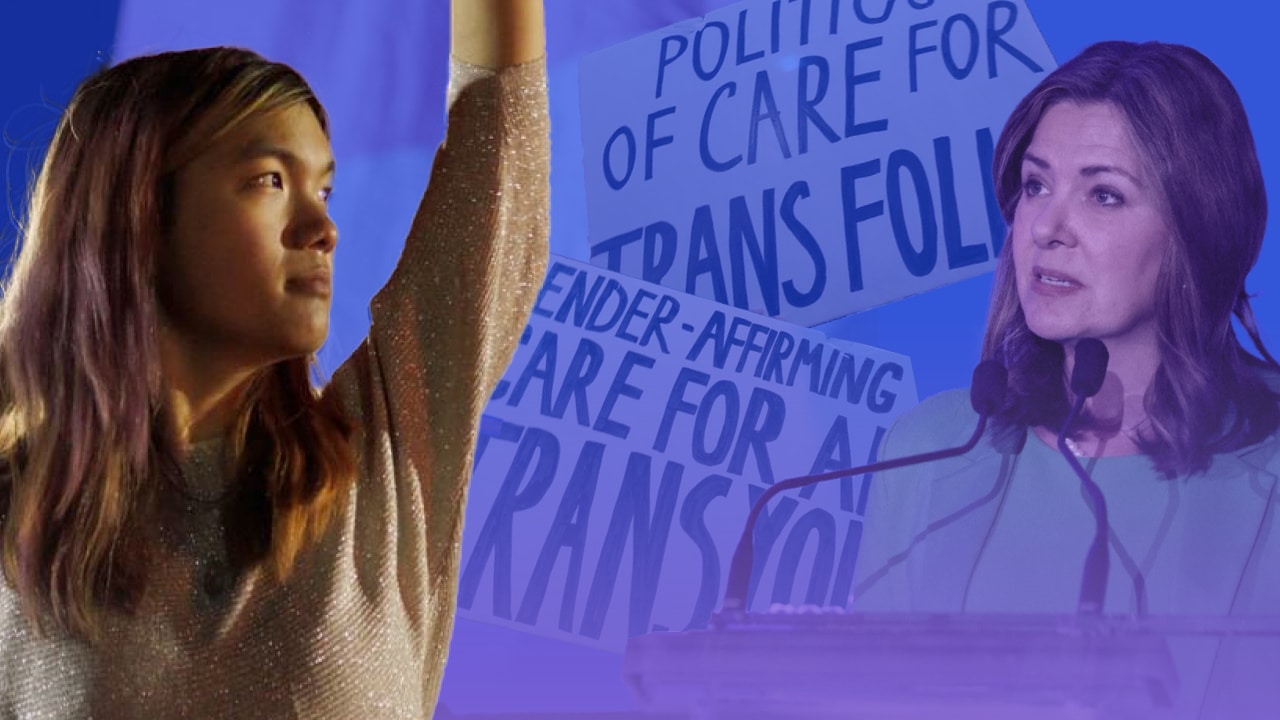
Katia Lo Innes: Welcome to The Breach Show, featuring sharp analysis on politics and social movements in Canada. I’m your host, Katia Lo Innes. Last week, Alberta premier Danielle Smith announced a sweeping set of policies under the banner of gender identity and parental rights. They represent the latest and most extreme attack on trans rights in Canada.
To speak with us about this development and the current rise of transphobia, our guest today is Celeste Trianon. Celeste is a trans activist, law student, and legal clinic coordinator based in Montreal. She is the creator of the Quebec Trans ID Clinic, a virtual drop-in service for individuals wishing to change their legal name and gender marker, and has also done pop-up clinics in Nova Scotia. Welcome to the show, Celeste.
Celeste Trianon: Thank you very much.
UCP government proposes extreme anti-trans bill
Lo Innes: Let’s just start by talking about Alberta. Can you break down for us what policy changes Danielle Smith’s UCP government is bringing in?
Trianon: Yeah, but just to preface everything, this is the biggest attack on young people’s human rights that Canada has seen in the 21st century. It is by far one of the biggest attacks on health care, on education, and on so many other things that are happening all at the same time, all in the name of appealing to a disinformation-loving base.
First and foremost are health care bans, measures taken specifically against the scientific consensus, in order to forbid the use of hormone therapy, puberty blockers, etc.—medication has been proven to be life-saving and that can reduce lifetime suicidal ideation by over 75 per cent when taken by trans youth. They’re trying to remove that. They’re also trying to remove access to gender-affirming surgeries for minors, which, of course has become a hot-button topic in politics, but de facto has practically never been given except for mastectomies, which do contain a lower degree of risk.
That’s for healthcare. For education, there’s even more prejudice-based policies. For example, denying trans youth—and only trans youth—the right to use a name of their choice, the pronouns of their choice, etc., before age 16, unless their parents explicitly consent, which de facto is a parental veto. And even for older teens, they still will require parent notification, which is also going to lead to situations where youth and young people are being forcibly outed to their parents, putting them at risk in extreme circumstances for homelessness.

Of course, you also have other aspects that do not just impact trans people such as trying to forbid the teaching of any sexual education, which includes information about child abuse, consent, all these fundamental concepts. That is also being attacked. And finally, there’s also prejudice-based attacks on trans women’s participation in sports, which, at the end of the day, shouldn’t be regulated by politicians, it should be regulated by sport agencies and associations themselves.
Lo Innes: It’s definitely a very severe and draconian policy. It is a very, very severe limiting on the rights of young people.
I grew up in Ontario and I remember when the Ford government was announcing they were going to have cuts on sex education, and there was a huge outcry and even the fact that sex education is now opt-in in Alberta, that’s being buried under all of this. It’s just a very, very bad policy change.
Trianon: Exactly.
Lo Innes: Just to recap for people listening, the big ones are: banning all gender-affirming surgeries, top and bottom, for minors age 17 and under; prohibiting puberty blockers and hormone therapy for youth 15 and under unless they’ve started the treatment; parental consent for any pronoun or name change under 18. Then also the ban on trans girls and women athletes from participating in competitive sports.
So she unveiled these policies in this very strange seven-minute-long video.
It’s full of twangy guitar music, she’s standing in front of a painting of the Prairies, and there’s a lot of stock footage of teens hanging out. Let me just play you a clip from the end of the video.
Danielle Smith: I understand how controversial and divisive discussions on topics of sexuality and gender can be, especially when these conversations involve children. I would therefore ask that as we work through implementing these policies that we, as adults in this province, do all we can to depoliticize the discussion, and focus on the well-being of the children involved.
Lo Innes: My first reaction was, “I truly cannot believe they spent money on this.” What was your reaction to what Smith is saying?
Polarization, not depoliticization
Trianon: It’s understandable that politicians want to have children’s best interests at heart. But at the end of the day, Danielle Smith’s policies run completely contrary to that. Kids’ best interests, teenagers’ best interests, are something which do not necessarily hinge on politicians’ decisions. Instead, it hinges on science and hinges on so much more as well, making sure all young people get the well-being that they deserve, have all of the conditions necessary for them to be able to grow up and thrive and later down the line, as adults. These are things which can vary from one kid to one kid, one teen to another, and then Danielle Smith’s policies run completely contrary to that.
It’s not depoliticization, it is instead polarization. It is an attack, an assault on young people’s human rights, that is probably not going to withstand a Charter challenge: that I’m going to say almost certainly. It’s, in a way, draconian, and runs completely contrary to [the Charter]. If Danielle Smith wanted to depoliticize the discussion, she would leave it up to doctors to administer health care, education professionals to administer education, and perhaps leave it up to sex therapists and other professionals who already know at what age is appropriate to talk about a given topic.
Lo Innes: It’s even just ironic the choice of word, “depoliticization,” that she’s using in this massive video, that she’s obviously spent a lot of resources on, which is the exact opposite of depoliticizing. She’s very much politicizing it and making it a tenant of her premiership.
Trianon: Exactly. Danielle Smith will most likely be remembered for this. It’s because of how egregious the attack is.
There’s been protests against her all across the country, from Kelowna, all the way to Newfoundland. There’s been protests against Danielle Smith’s policies everywhere and everywhere Danielle Smith has gone. There’s one in Ottawa on Monday, in Toronto on Tuesday. For obvious reasons, people are angry, and rightfully so.
‘Pandora’s box’
Lo Innes: This is obviously something that’s not just impacting people in Alberta, it’s going to impact people across Canada.
You’ve created this map that comprehensively tracks the policies by each province that impact trans people, which people can see on your websites celeste.lgbt, which I’ll make sure to link in the description.
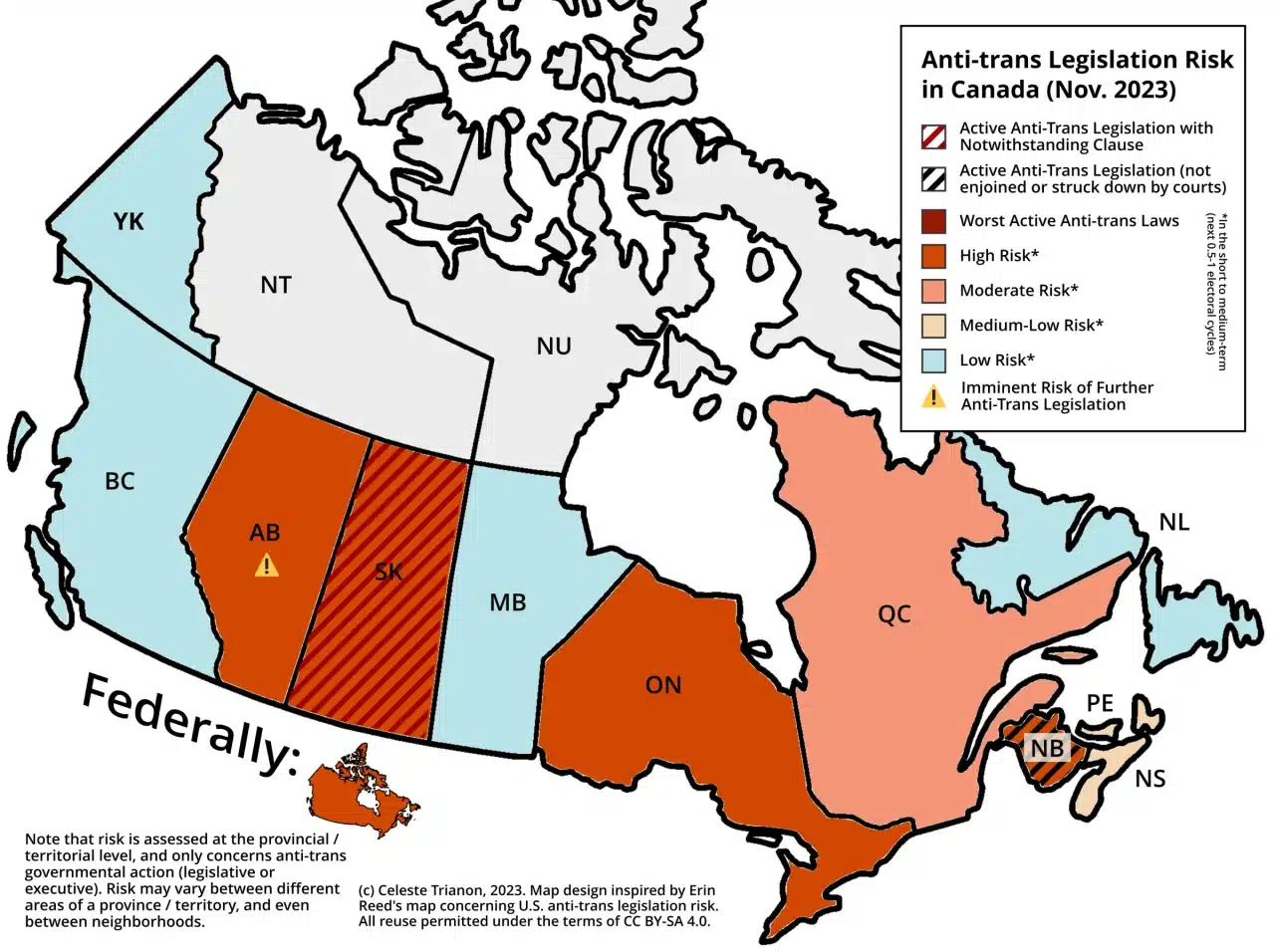
What are the implications of what’s happening in Alberta for the rest of trans people in Canada?
Trianon: I’d say first and foremost, Danielle Smith has managed to open up Pandora’s box. We’re seeing Pierre Poilievre and the federal Conservatives starting to openly look inside and try to take its contents out.
These policies are not going to stick only to Alberta. One thing’s for sure, there’s going to be an increasing division between different Canadian jurisdictions, provinces, with regards to trans-affirming policies and anti-trans policies.
For example, we might end up seeing anti-trans health care policies implemented in Saskatchewan and New Brunswick and jurisdictions where there are more conservative premiers and legislative assemblies. That is, of course, going to be a pretty significant risk.
There’s also a likelihood that trans migration—trans people moving between one province and another—that’s going to change. For example, talking about trans people, especially trans youth and their families being forced to move from say, Alberta into B.C. or from Saskatchewan, Manitoba. We’re gonna see more cross-provincial migration caused specifically by anti-trans legislation.
It is really frightening and parallels what’s been happening in the U.S. with most people fleeing anti-trans states. I believe right now more than 80 per cent of the trans population of Florida is trying to quit the state, which goes to show how much these draconian policies, which, I’m not sure if apartheid would be a good comparison, but I believe we’re getting pretty close to that, at least in regards to trans issues. It would push people to move elsewhere. It is why Canada has had an influx of trans people moving from one country to another, including from the U.S., as well as from countries like both from countries from the Global South, and the so-called Global North.
We’re seeing the consequences so much more widely, and I’m afraid of where that is going to bring us if the federal Conservatives end up getting elected, and there are federal anti-trans policies and legislation introduced. That would set a horrible precedent.
Lo Innes: I didn’t know people in Florida were trying to move, I knew that there was a travel advisory in Florida that the Canadian government had issued, which is interesting, considering how things are shaping up.
Migrations due to provincial repressive policies have happened, I think in the case of Quebec with Bill 21, the hijabi bill.
Trianon: Even if it’s just on a case-by-case basis, for example, teachers move to Ontario because they can no longer teach in Quebec as a hijabi person. That is, even though it is at a more micro scale, at the same time, it is setting a dangerous precedent for what comes next.
Lo Innes: On the topic of precedents, just for people listening, who might not be aware that there have been anti-trans bills in New Brunswick, and also Saskatchewan. Alberta’s policies come only a few months after Saskatchewan’s policies. Their Conservative premier Scott Moe passed the “Parents Rights’ Bill,” which bans students from using their chosen name or preferred pronouns at school without parental consent.
His government was able to push for this policy using section 33 of the Canadian Charter of Rights and Freedoms, which is known by policy nerds as “the notwithstanding clause.” It allows governments to override parts of the charter including articles on human rights. Using the clause was taboo for a very long time, but it’s recently been put to use almost exclusively by Conservative premiers. Doug Ford used it twice, and recently in 2022, to try to force Ontario education workers back to work.
So, Celeste, given that Moe has been able to push his legislation forward, using the notwithstanding clause, what do you think are the odds of Smith doing so, too?
Trianon: I’d say Smith if wants any chance of that legislation standing the test of the courts, especially as organizations such as Skipping Stone and Egale Canada are already committing to suing, they will need to use the notwithstanding clause for any chance, because this is exactly legislation the Charter was designed to prevent.
We’re talking about the same legislation, the same family as Canada’s historical anti-Asian migration acts, the oppressive policies under the so-called Indian Act and other such oppressive legislation designed specifically to treat minorities as second-class citizens. The Charter was introduced as a means to prevent that.
But now we’re seeing more and more with Quebec’s Bill 21 and 96, with Bill 137 in Saskatchewan and now with Alberta’s policies, we’re likely going to start seeing this dismantling of the rule of law and of the very way democracy has been sustained over the last 40-something years, all over the rights of minorities, and especially the rights of young people.
Lo Innes: We can see all these Conservative premiers are enacting it to attack minority rights, attack workers’ rights, attack the rights of trans people, which is, as you mentioned, very scary.
This would be not the first time that Alberta has used it, because it was used to try to block gay marriage a couple of years ago.
I want to loop back to something we talked about a bit earlier, when we were talking about Florida and the fact that a lot of these policies in Canada are being influenced or coming in the wake of America’s anti-trans and anti-2SLGBTQ+ laws.
According to the Trans Legislation Tracker, a whooping 503 bills were introduced last year, that’s more than one bill per day. That’s compared to 148 bills the year before. Only 85 of those bills were actually passed—”only 85”— but it’s a startling jump from what we’ve seen before.
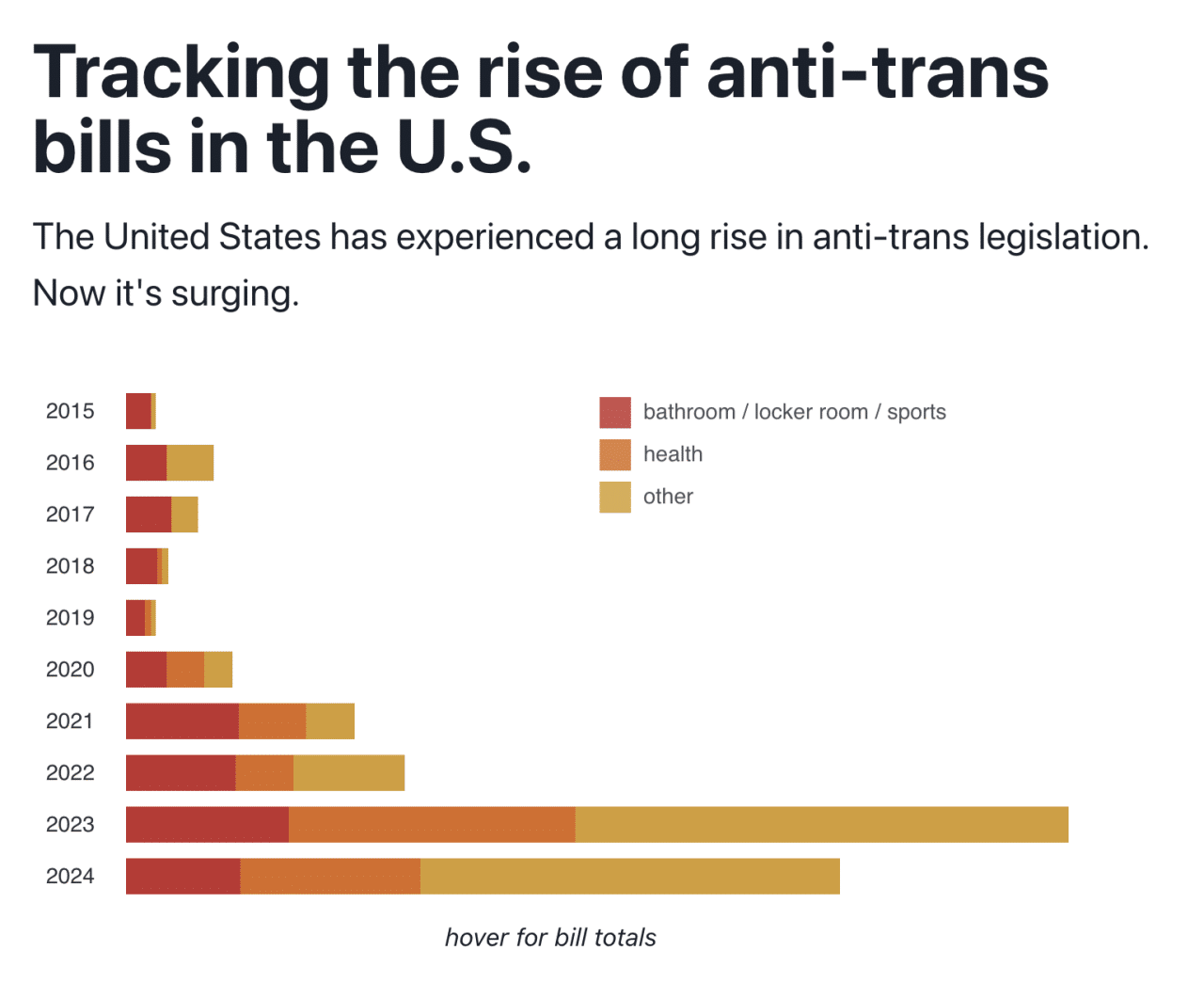
Celeste, how does what’s happening in America affect us here in Canada? Or are there also any homegrown anti-trans developments happening in Canada anyway?
Trianon: I’d say there’s a lot of foreign influence on Canadian anti-trans politics, whether it be from the U.S. or from the U.K. or from many other countries. Oftentimes, the one element that’s the most shared between Canada and these other countries is the rhetoric.
The rhetoric used by anti-trans groups is very similar. You should not be really able to catch on, but they’ve managed to create a vocabulary, a set of keywords that managed to, in a way, buy away the hearts of unsuspecting parents and make sure that they would be vocally opposed to trans right despite that being clearly against their kids’ best interests.
For example, we’re talking about words such as “indoctrination,” “gender ideology,’ and “grooming.” They’ve only become mainstream in the last two years, really and it’s because of American far-right groups using these terms more and more, and these terms are now getting picked up by the media, etc., up to a point where nowadays, it’s become an inescapable mainstay of anti-trans politics.
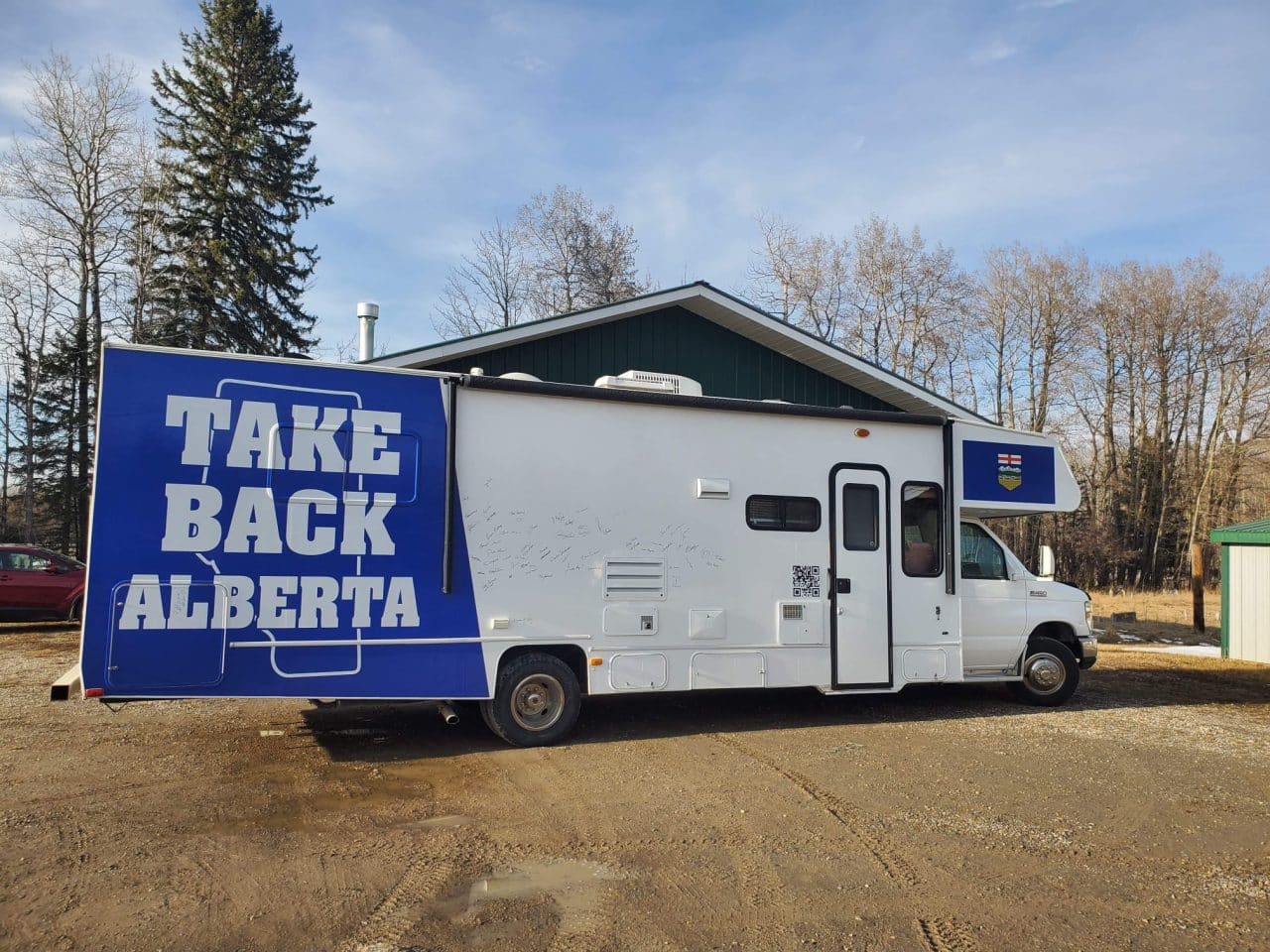
That’s why you see groups such as Take Back Alberta, such as Save Canada, such as Action for Canada, these groups which all take on the same rhetoric, the same language to push similar policies. So even though the Canadian legislative context is different, nonetheless, they’re using tactics to push for the same things.
Lo Innes: These are also tactics that I think we’ve seen in the ’60s and ’70s, when there was a gay and lesbian rights movement. There was a lot of pushback in America and Canada about queer people being teachers, and there was the exact same rhetoric of grooming, and seeing queer people as being predatory towards children. So it’s kind of mirroring and coming back. It’s coming back in vogue, unfortunately.
Trianon: Sadly, and that’s just saying, too, a lot of groups that have been at the centre of all of this are actually Canadian homegrown groups, as well. There are people who are actively trying to influence Canadian politics to impose what could indeed be considered an American-style theocracy, which is really frightening if you’re asking me.
Take Back Alberta’s hold on the UCP
Lo Innes: It’s very frightening. I watched a clip of Danielle Smith on CTV’s Power Play with Vassy Kapelos and even in that interview, the host asked Danielle Smith, if this was a decision made, because groups like Take Back Alberta are becoming such strong factions within UCP, and they’re pushing farther right and right within the party. As we’ve also seen, and in Alberta, and in B.C., and across Canada, we also have parties like the NDP that are pushing closer to the centre, as a way to kind of balance out, in a sense, the far-right turn that the Conservatives are having, leaving that not a lot on the left, which is very scary.
Trianon: Take Back Alberta has basically control now over the UCP grassroots, so I’m pretty sure they have played a major role in making sure that Danielle Smith would pass such policies, even though she was traditionally known as libertarian, and not someone who you’d expect to pass these policies. So it probably was also a move of self-preservation on her part, sadly, one that would end up causing great harm to young people.
Lo Innes: It’s very interesting that she has been historically very libertarian and is going forward with this policy that requires a lot of government intervention and oversight.
On the topic of things that are homegrown, we’re both based in Quebec. For those of you listening who aren’t in Quebec, three years ago, in 2021, the CAQ government tried to pass Bill 2. So this was a family law bill that was actually pretty broad and had a lot of laws and reforms around family law and surrogacy, but also gender identity. And this bill was immediately decried as transphobic. Because it was.
It would require individuals wishing to change the sex assigned on their birth certificate to undergo bottom surgery, among other provisions. But the transphobic elements of Bill 2 weren’t passed or included in the final bill. There was a huge mobilization, Celeste, of which you were a part. And yeah, transphobic elements were struck from the law.
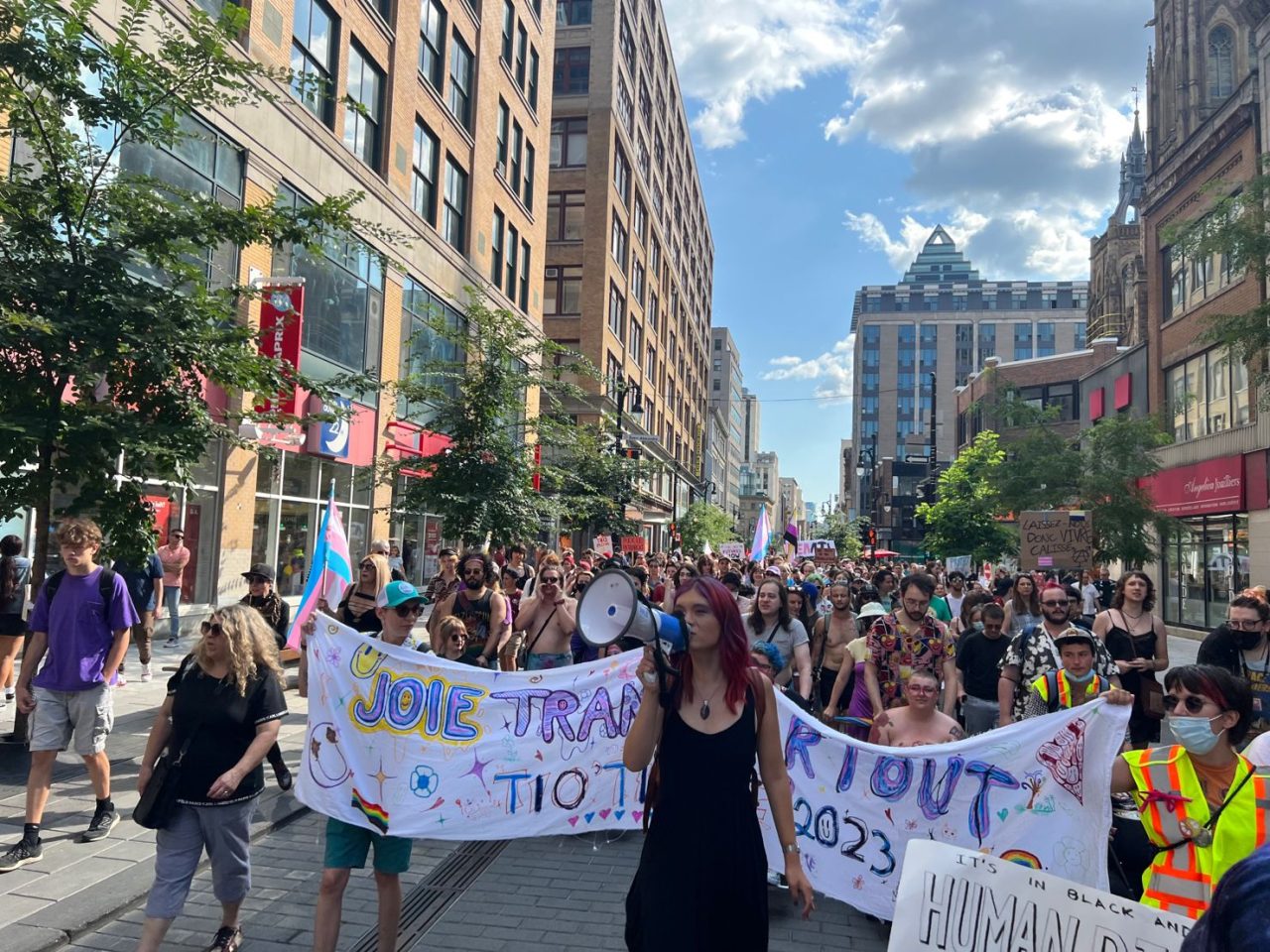
As one of the organizers against the bill, tell us a bit about what it was like organizing.
Trianon: Just to preface this, we don’t know yet why the anti-trans parts of the bill were introduced in the first place. My personal theory, which I believe is the one that makes the most sense, after I consulted with law professors who have been involved in the drafting of said bill, was that the government ended up consulting anti-trans groups fairly extensively. Notably, our local TERF group, Pour les droits des femmes de Québec. So that’s the context.
The mobilization itself was very rapid. It was quite intense, I’ll be honest. I was the person who actually took the first step, if I’m correct, and ended up getting everyone across the province to meet up quickly to start denouncing the policy. Within one week of the bill being introduced, there was already a National Assembly petition, many other campaigns being drafted at the grassroots level, protests being organized. Basically, every single organization in the city almost went with a stop, drop and roll thing and come-to-the-emergency-room-immediately type of stuff because of how urgent the situation was. We fought. We made it basically politically untenable for the government to actually introduce these anti-trans policies.
They listened. They withdrew all the anti-trans parts of the bill, and eventually it led us to a point where they listened to trans community members, redrafted the bill in a way that complies with human rights law, and even listened to some are additional demands, notably, with regards to reducing the financial barriers to even gender marker changes, which have been successful.
I’ll be honest, though, I’m not sure if this would be possible in 2024, because since last year, it has been so much more anti-trans hate everywhere to the point where the very idea of “trans rights are human rights” is no longer something that can be taken for granted.
Organizers mobilize against Alberta’s bill
Lo Innes: As an organizer, what do you know is happening in Alberta? Do you think a victory like this could happen in Alberta or Saskatchewan or New Brunswick or any other province where there are anti-trans laws?
Trianon: Yeah, I’d say definitely the mobilization in Alberta this time is way larger than what happened for New Brunswick, when it happened for Saskatchewan, etc.
There are local community groups, both in larger cities such as Calgary and Edmonton, like Queer Citizens United, Walls Down Collective, Trans Rights YEG, about Pride YYC, all these are groups that have taken amazing strides to make sure, at the grassroots level, that these policies be untenable. You’re seeing protests by the thousands for trans rights, which used to never happen in Alberta. This is pretty much a first. Where it’s going to have a meaningful impact will depend on whether it’s going to become politically untenable for Danielle Smith to proceed with these anti-trans policies.
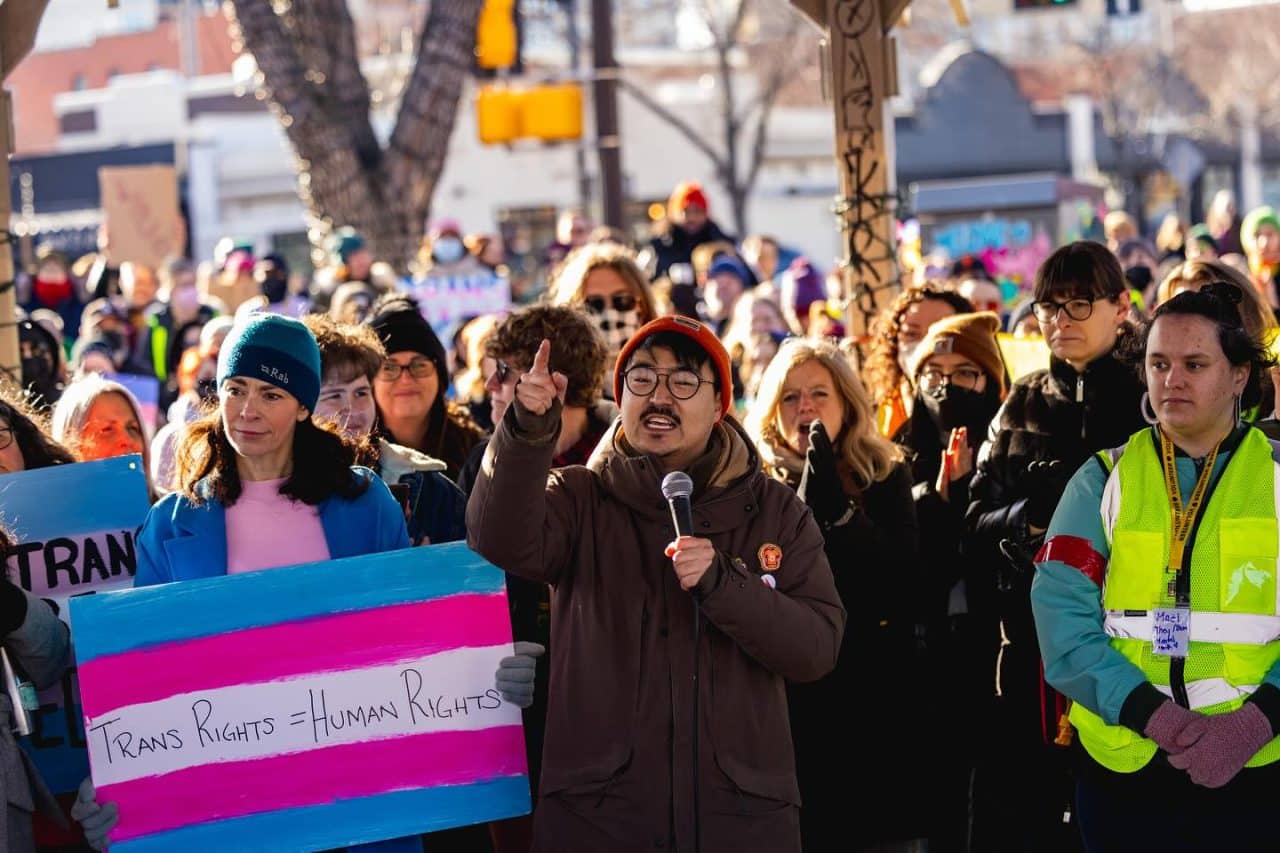
There used to be a time when introducing such policies would be political suicide because you’re attacking a marginalized group’s human rights. This would not be acceptable. That’s exactly what happened in North Carolina back in 2016 with their bathroom bill. It ended up having such economic repercussions on the state that it ended up being repealed.
Unfortunately, I don’t really see a way out, unless it’s for this very economic argument of Alberta losing so much to the point where they end up becoming a pariah province. I really hope it doesn’t get there and we can have Danielle Smith voluntarily withdraw these proposed legislative changes, but unfortunately, I think that might be the only way forward.
Lo Innes: Interesting that you said that North Carolina faced economic repercussions. Have you ever heard of something like BDS happening, like some sort of boycott, economic or otherwise?
Trianon: Yeah, and sadly these have not had enough impact, I’ll be honest.
For example, despite Florida being such an unsafe state for people to go to—there’s a trans bathroom ban there. Even using the bathroom at the airport or in any public building can land you in jail for a year. It is very much a place no trans person should go to and is rated as “do not travel” by major American organizations as well as trans activists.
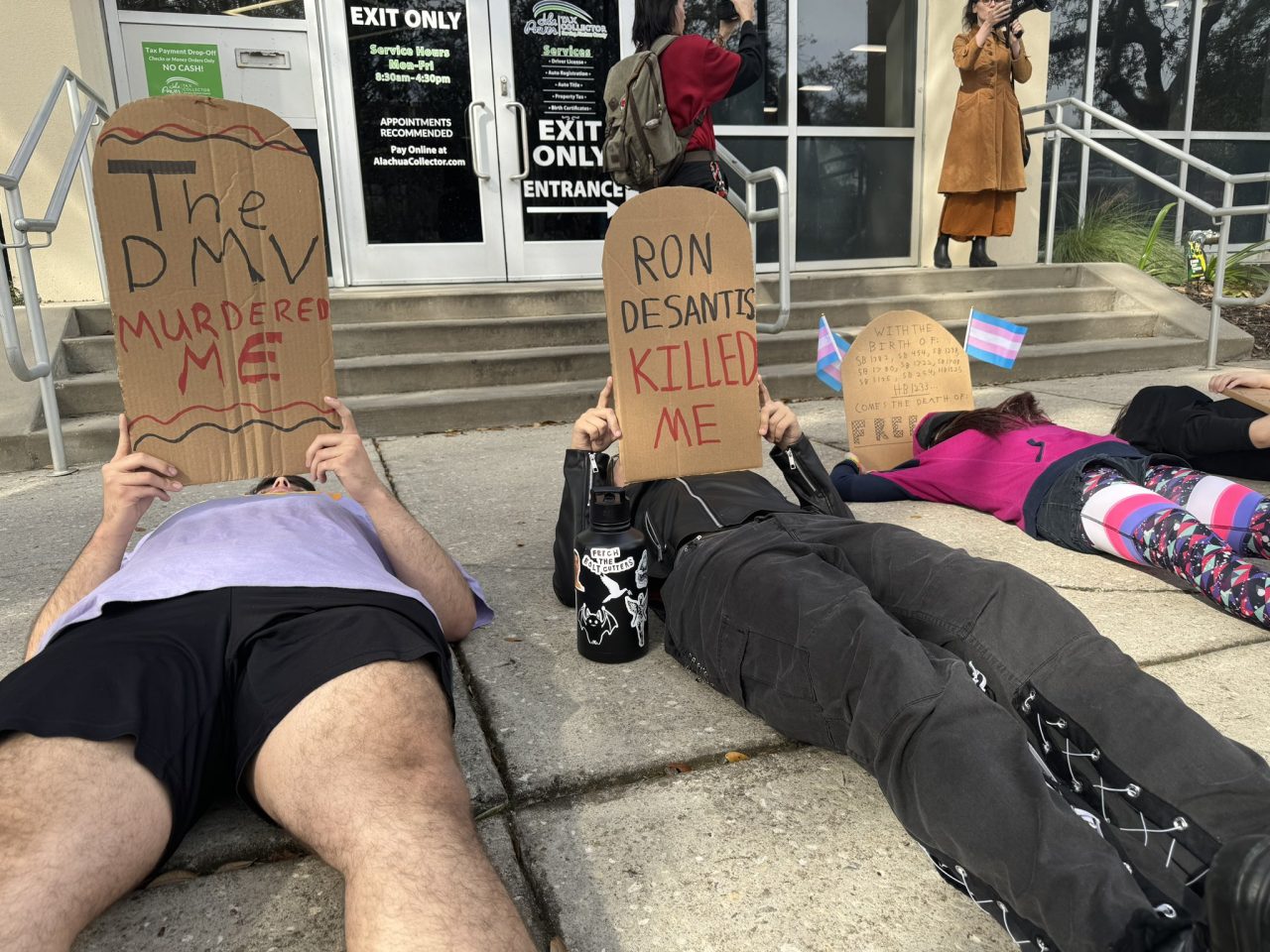
Yet, we’re still seeing so many parts of their tourism industry thrive as per usual. You still get advertised on Air Canada to go Florida. Disney World still does its advertisements everywhere. We are not seeing people standing up for trans rights when it comes to this. I very much believe that a boycott-centered approach towards making sure that anti-trans policies are economically unsustainable, these need to form part of a broader strategy down the line, even though I will admit the purchasing power, the economic power of the trans community itself is extremely limited because of how much we’re already marginalized. We’re going to need way more solidarity than this.
Lo Innes: Even if the economic purchasing power of the trans community is small, the trans community is a community that would benefit from the solidarity and the allyship of many other marginalized groups, many of the groups who have had their Charter rights attacked.
Trianon: Absolutely, like, say the unions, or the rest of the rainbow, you know?
Lo Innes: I guess looking forward—and we touched on this a bit—the fact that trans issues are becoming a focal point in Canadian politics.
Trans issues could become election issue
We’re actually quite far out from the next election for normal people. It’s [in] 2025, so a year, and so for people in politics, that’s actually very soon. Pierre Poilievre is the leader of the federal Conservatives, he’s defended Danielle Smith’s policies and he said that he opposes the use of puberty blockers.
It’s not crazy at all to predict that trans issues and gender identity are going to be hot-button issues in the next election. How do you see things shaping up?
Trianon: I’m seeing more and more fear within the trans community. I’m afraid that unfortunately, the 2025 elections are going to be pretty much determinative of whether we get to live with our full human dignity and human rights down the line.
It is looking to be pretty scary. Like, you have to wonder, how’s it gonna go for us? So I very much expect trans issues to become a pretty major talking point.
I expect federal parties, notably the Liberals and the NDP, I’d say especially, could benefit from the trans vote. But at the same time, I very much see this becoming a major campaigning point for both the aforementioned parties, while potentially anti-trans policies being more explicitly campaigned for by the Conservatives.
This is something that, unfortunately, is going to become very much such a politicized issue, just like how abortion was 40 years ago. I’m afraid that’s something that people are going to be willing to sell out our human rights for lower taxes or other perceived benefits.
That’s having an impact instantly for sure, but most likely between now and then we’ll see more provincial initiatives, and more provincial governments positioning themselves either explicitly for or explicitly against trans justice. All of this is going to shape us up for a pretty frightening election period, I’ll be honest.
Lo Innes: You mentioned that it might be a sticking point for non-conservatives—the NDP, the Liberals, the Green Party—are there any sorts of political mobilization or organizing by the trans community within any of the major political parties that you’re aware of right now?
Trianon: Many of the parties such as the Liberals, mostly through the government, and the NDP, have tried to connect more with trans voters and step up with them, meet them and help determine policies alongside them. There’s currently a petition going online launched by my friend Fae Johnstone, specifically demanding that the NDP’s White Paper on trans issues gets implemented in Canadian federal legislation.
A lot of these initiatives are beginning to take a much bigger role. I believe eventually, we’re gonna see more and more trans legislation be introduced in Parliament at the federal level, so of course there’s going to be that.
Lo Innes: Well, good to know that people like Fae are out there fighting the good fight.
Trianon: Exactly.
Lo Innes: Well, Celeste, that’s all the questions I have for you. Thank you for joining us.
Trianon: No problem, it’s a pleasure.
Lo Innes: If you like what you’ve heard on The Breach Show, please subscribe to our podcast or YouTube channel. If you want to support our work, please become a sustaining member to help us produce more ‘journalism for transformation.’ You can do that at breachmedia.ca/support. Thanks for listening.

I often hear that I’m lucky to have a full-time job in journalism.
Critical, bold journalism that isn’t beholden to media monopolies should be the norm—not the exception.
By supporting The Breach, you’re supporting a more robust, progressive media. Join us today.
– Katia Lo Innes, Associate Producer, The Breach