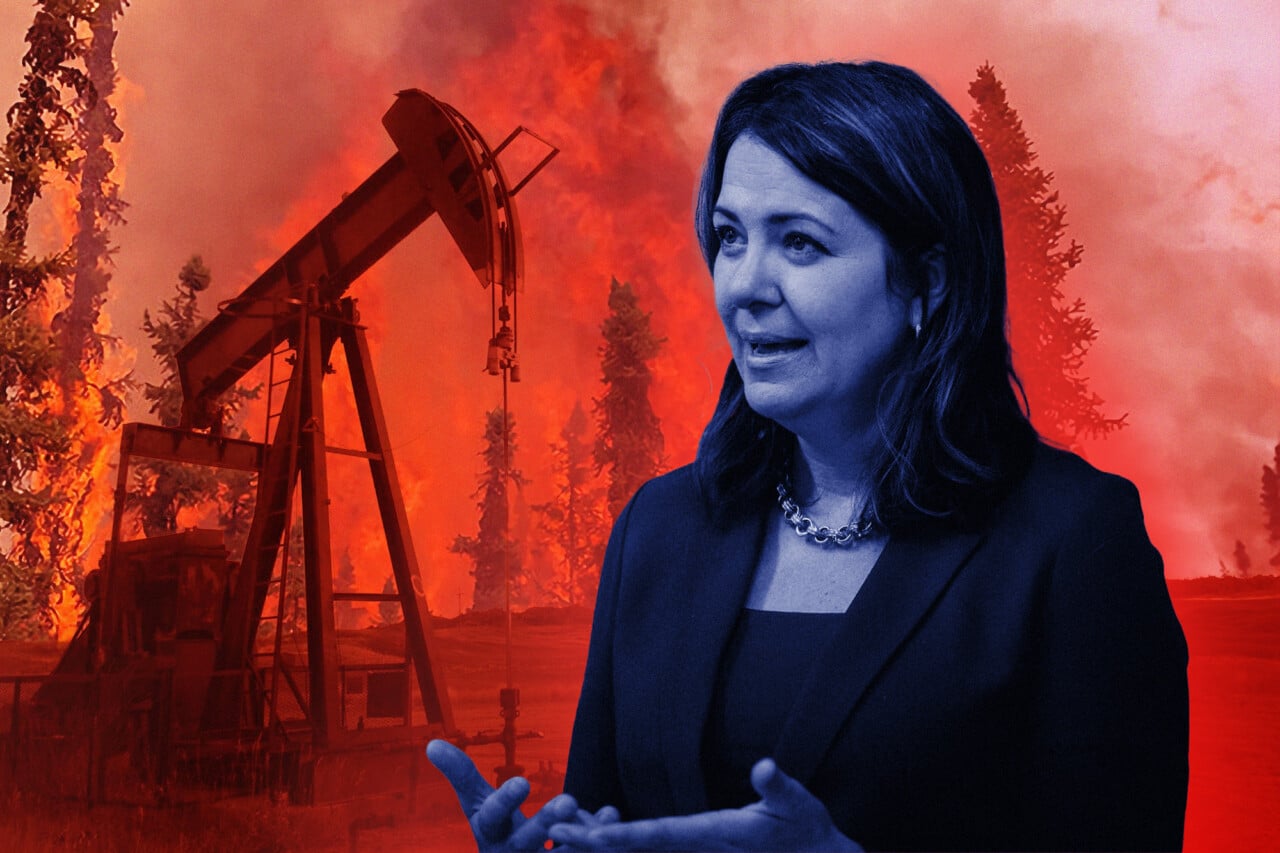
Alberta’s oil-lobbyist-in-chief will return to the premier’s office.
After the closest election in the province’s history, Danielle Smith’s United Conservative Party won a majority government Monday night.
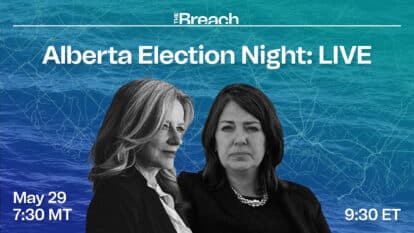
On The Breach’s live election night broadcast, the Parkland Institute’s executive director Ricardo Acuña described Smith as a “serial lobbyist” and right-wing libertarian willing to play footsie with the far right.
“She’s played footsie with those folks, while at the same time bringing out the biggest spending budget in Alberta history,” he said, listing her nods to the far right, like introducing the Alberta Sovereignty Act, toying with giving Alberta its own police force, and promising amnesty to a preacher who incited protesters at the Coutts border blockade, which stopped traffic at the province’s main border crossing with the United States for two weeks.
“So, she’s tried really hard to play both sides of that spectrum to keep both sides happy.”
Smith has made a career out of attacking public sector and unionized workers as a columnist and shock jock on talk radio. Most recently, she was also a lobbyist for the Alberta Enterprise Group, which represents energy, finance, and construction firms.
Acuña pointed out that many of the things Smith lobbied for in the past—privatizing health care, giving royalty breaks to oil companies—she is now promoting as premier.
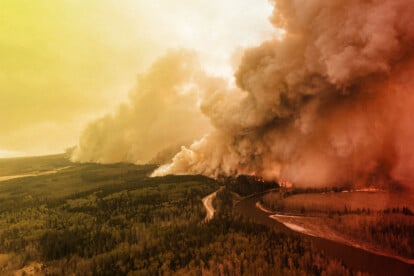
Her return to the premier’s office means “more apocalyptic experiences and more red skies,” according to Angele Alook, an assistant professor at York University, a member of Bigstone Cree Nation and one of the authors of The End of This World: Climate Justice in So-Called Canada.
Alook noted that two major oil industry groups, Pathways Alliance and the Canadian Association of Petroleum Producers, praised the climate plan Smith’s government rolled out in April.
“It looks like this plan will just mean business as usual,” she said.
Unpredictability could backfire on oil industry
Emma Jackson, an organizer with Climate Justice Edmonton said that Smith’s “very unhinged, very unpredictable” style might actually undermine the public-relations game the oil industry is playing right now.
“I think it’s creating a very hostile, volatile investment climate in the province,” Jackson said on The Breach’s broadcast. “I wouldn’t be surprised if a lot of fossil fuel executives right now watching this election unfold, are actually quite worried about that.”
But Smith’s style also poses a challenge for social movements on the left, Jackson said.
“What we’ve seen from Danielle Smith is really this shock and awe politics. There’s always something absurd and with that there’s a temptation to get pulled back and forth and to not have a clear vision of where we are going.”
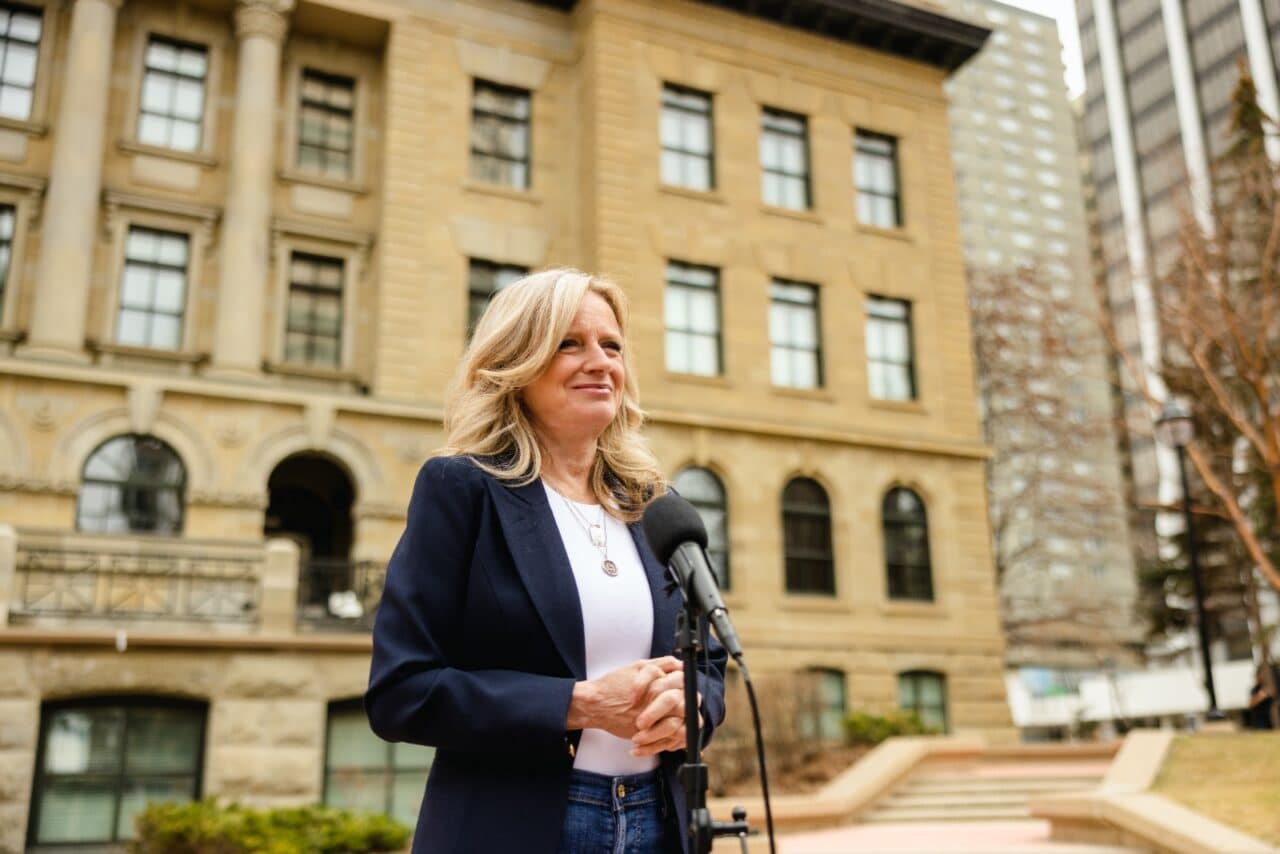
Rachel Notley’s ‘Hillary Clinton moment’
Despite the dangers posed by a UCP government, Jackson said many progressives weren’t motivated to campaign hard for the Alberta NDP.
“In a lot of ways, I think what Rachel Notley has done has been to have her Hillary Clinton moment of, ‘We’re just going to placate the middle as much as possible,’” she said.
Smith is a “dangerous” leader, Jackson said, but many could not bring themselves to volunteer for a party that bragged about getting a pipeline approved during the climate crisis, and boasted about having the lowest corporate tax rate in the country.
“In Edmonton, a lot of us really dragged ourselves to the polls,” Jackson said. “There’s a small ice cream shop that offered a free ice cream if you go and vote and I was like, ‘That might be the thing that does it for me.’”
Notley, the Alberta NDP’s leader, made no secret of her effort to court conservative supporters this election cycle.
“Every day, more and more conservatives are actually realizing that their basic Alberta values are not represented in Danielle Smith’s UCP and some of those folks as a result are telling us they’re going to lend us their vote,” Notley said in an ad posted about a week before the election. “To be honest, I don’t mind that at all.”
Hoping to pick up votes in Calgary, the party pushed this strategy by focusing on specific affordability issues like the Kids’ Activity Tax Credit, said Brad Lafortune, the executive director of Public Interest Alberta and former chief of staff to an NDP minister, on The Breach’s broadcast.
“The campaign really seemed to get away from big social democratic proposals on making health care public again, and making sure that education is fully public again,” he said. “We didn’t see any big policy offers that were hugely socially democratic, transformative and visionary.”
Disenfranchised channelled to the right
Romy Garrido, a longtime Calgary activist, said the Alberta NDP’s strategy was, “built for speed, but not built to last.”
She paraphrased Notley’s strategy as: “We’re better than the guys you usually vote for because they’re a bit of a shitshow right now.”
This message breaks down “as soon as the other guy gets his act together,” Garrido argued.
While the far-right group Take Back Alberta brought voters into the fold for the UCP, the NDP missed an opportunity to offer a compelling alternative.
“At the core, there was a mobilization of working class, disenfranchised people in Alberta. And I think that’s really key for the NDP to pay attention to in the long term,” Garrido said.
“The NDP vision should be catering a solution to that type of person. The NDP vision of equalizing the playing field, of making a just economy and increasing your quality of life through strong public services—that’s the answer for a lot of those folks, and unfortunately, they’re starting to find it with conservatives.”
Even if the Alberta NDP had won, Garrido said, the work of civil society—unions, community groups, school boards and parent groups—would be the same as it is with the UCP back in power.
“We can’t really wait for the NDP or for these parties to bring solutions for us because we’re running out of time,” she said. “We have a climate crisis right at our doorsteps. It’s seeping through our windows.
“We have to start winning hearts and minds. That’s just the reality of it.”

The Breach’s investigations don’t just inform our readers—they force the powerful to react.
An exposé on blood plasma privatization led to national headlines. Our revelations about the government’s cozy connections to Big Pharma sparked a parliamentary probe. A report on high-tech price-fixing by mega landlords resulted in a criminal investigation.
From activists to elected officials, people are using The Breach’s journalism to push for transformative change.
– Dru Oja Jay, Board President, The Breach