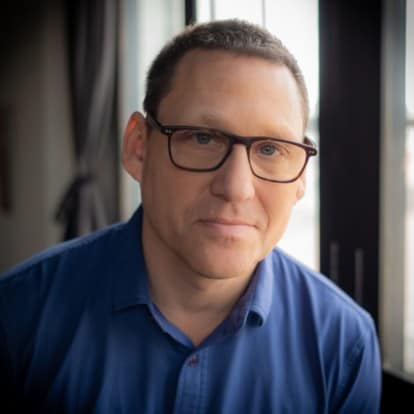
Avi Lewis: This is not just exceptionalism, the only word for it is supremacy.
I’ve been to Gaza. It was in 2009. It was six months after the devastating bombardment that they called Operation Cast Lead.
It was confusing that they let us in. Because I was traveling with my partner Naomi Klein, and also with us was our friend Cecilie Surasky.
The people we met, the extraordinary generosity, the level of discussion around the most magnificent dinner tables, with people who had massive challenges putting together those meals, I have no doubt. We met Gazans who had lost their entire family in a single explosion.
It was a brutal foreshadowing of the situation today, in which most of northern Gaza and vast swaths of the south, the built environment in the civil infrastructure of Gaza, have been just leveled.
So between Israel and Gaza, there was a wide scrubby no man’s land, with a chain link fenced-in corridor.
At one end was Israel, the Erez checkpoint, which is like a mammoth concrete structure that was built to process at least 10,000 Palestinian workers a day, except that Gaza was put under siege, and the cheap labor was mostly locked on the other side of the wall.
At the other end was the Gaza side, where the border was a shipping container, empty except for a battered desk, with two guys behind it, and a metal chair, where I sat for about 45 minutes as they questioned me.
It was tense, and it was scary.
Mostly they were stuck on the fact that I had a Canadian passport but an Israeli name.
And they were utterly uninterested in the two women that I was traveling with.
Eventually, they kind of let us through.
My experience with the Israeli border was as asymmetric as the two structures themselves.
I won’t tell you the long version, but after many, many hours of waiting in a concrete maze, outside an elevator with no call button, you’re led in to be processed.
It was like being the only travelers in a giant, empty airport.
And once again, the officials showed almost no interest in Naomi and Cecilie—the casual misogyny was the thread that connected the two very different experiences.
I was taken to the very top floor of the facility, down corridor after corridor to a corner office, where I was introduced to the commander of the entire checkpoint, a brigadier general, if I recall correctly, who took me to the window and pointed out at a squadron of tanks that was moving around in formation.
And he said, “we know you don’t like us, you’re against what we do.
But do you have any idea how much danger you were in going in there?
We were mobilizing a whole army division to go into Gaza and rescue you.
Yeah, even though you hate us, we would still save your life, because you are a Jew.”
Because you are a Jew.
And I’ve been processing those four words for about 14 years. And it didn’t help when he added “And keep your woman under control. She’s gonna get herself in trouble one of these days.”
A whole worldview was transmitted in that short exchange. Patriarchy; check. The victim become victimizer; check. The power of those with the biggest guns to rank human life—who matters and who doesn’t; check.
The message to me has become clearer and clearer over the years. He was telling me that my life had intrinsic value, that I was special, that I was worth a huge amount, that I would be protected, resources would be mobilized, lives would be risked.
Because my life, my Jewish life, was so precious, even as a dissident who denied my birthright, I was among the chosen.
And that’s the same message that Israel has been sending in response to those gruesome attacks and murders of civilians on October 7, the apocalyptic fury of retribution and collective punishment.
On one level, it’s just to send that message, that Israel will take 10 Palestinian lives for every Israeli life taken. That’s the exchange rate.
This is not just exceptionalism. The only word for it is supremacy.
A worldview that sees some human beings as inherently valuable, while others are less than human.
“Human animals,” as Israel’s defense minister said.
“Children of Light versus children of darkness,” as its prime minister said.
It’s the violent logic of colonialism, it’s the logic that leads to genocide.
We’re in a fight for life, for the right of all beings to live a life of decency.
Those are the existential stakes of our struggle, and the current violence and its ripples around the world have to reground us in that basic truth.

“It’s about getting to the bottom of things. It’s about unveiling who has the power and what they’re doing with that power.”
Linda McQuaig, journalist and author
As a non-profit, free from powerful corporate interests, we invest in investigations and uncover the cover-ups. Sustain our journalism for transformation.