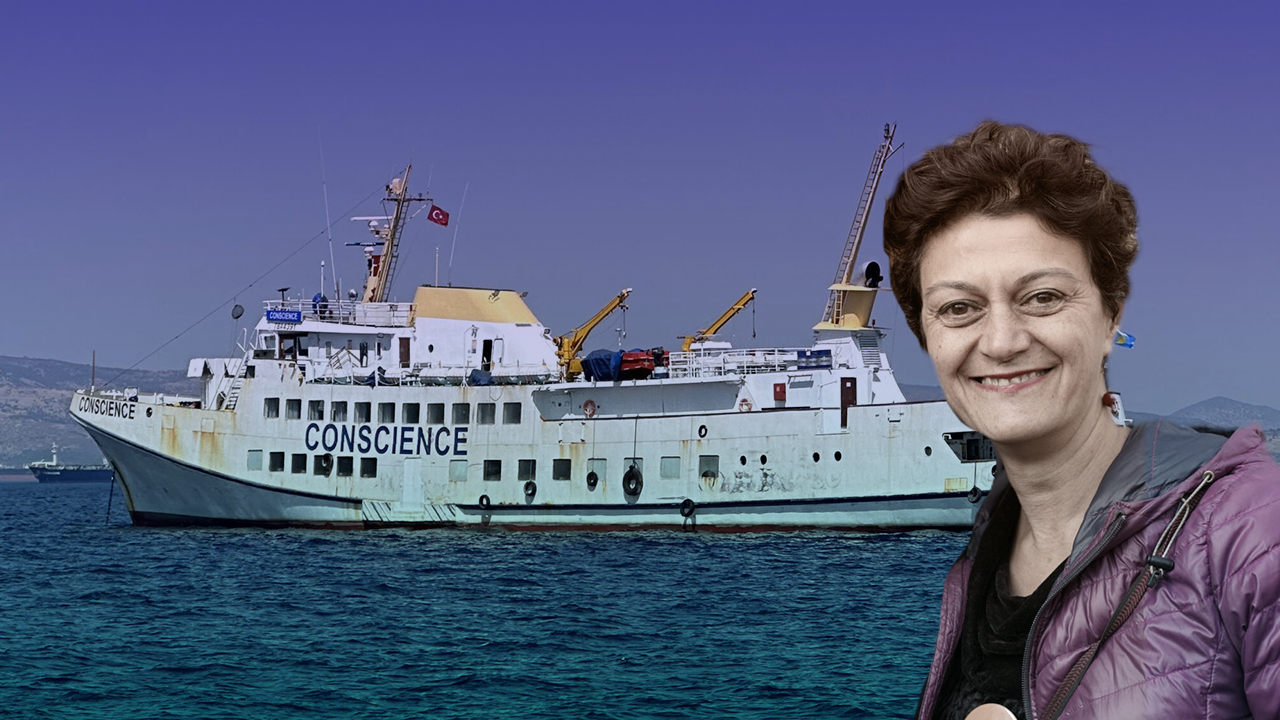
Israel intercepted and seized a civilian flotilla that included six Canadians this morning in international waters, about 120 nautical miles from Gaza, as it attempted to deliver desperately-needed humanitarian aid to Palestinians.
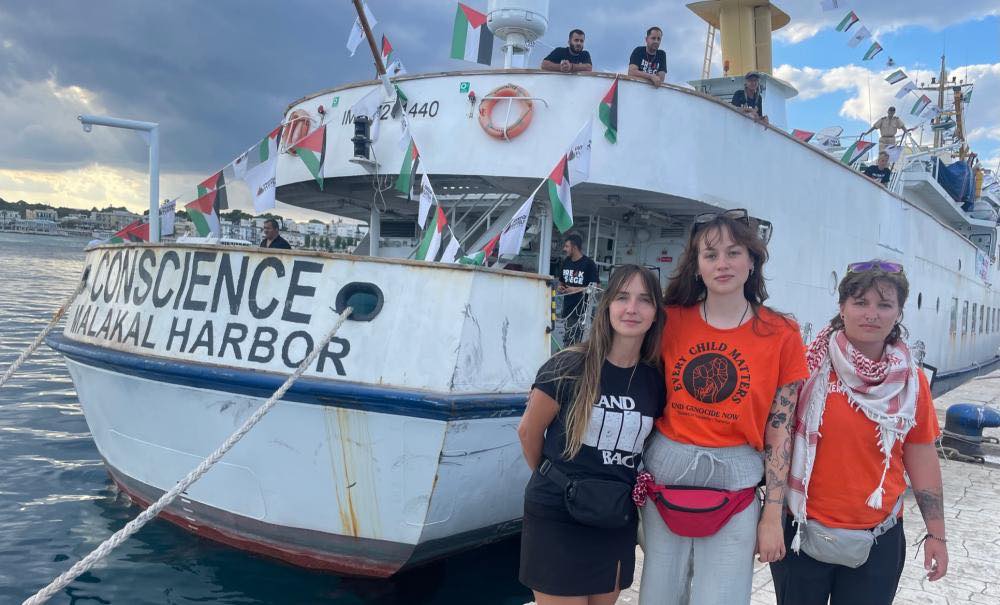
Among the 93 passengers of the seized vessel—the Conscience— were doctors, journalists, and human rights defenders from more than 30 countries, among them Quebec epidemiologist Nimâ Machouf and Mskwaasin Agnew, an Indigenous humanitarian and advocate from Toronto.
Before losing all communication early this morning, participants aboard the vessel reported being attacked by an Israeli military helicopter while Israeli naval forces simultaneously intercepted and boarded other ships in the flotilla.
The Freedom Flotilla Coalition says all passengers are now being detained “in unknown conditions” after their ships were towed to an Israeli port.
Organizers have called the operation a “kidnapping” and “an act of piracy,” urging the Canadian government to intervene immediately to secure the release of its citizens and to condemn this grave violation of international law. Israel’s Ministry of Foreign Affairs has defended the seizure as a “futile attempt to breach the legal naval blockade.”
Israel has maintained an illegal naval blockade of Gaza for 18 years, restricting the movement of people and goods and preventing life-saving aid from reaching the besieged population.
“A state that must attack doctors and journalists delivering aid—and that sustains itself only through violence, repression, and fear—so clearly and repeatedly exposes its illegitimacy,” said Gur Tsabar of the Jews Say No to Genocide Coalition, which is supporting the activists on board the vessel. “The courage of those aboard the Conscience will outlast the fear that drives Israel’s violence; and their actions remind us that humanity will always break the siege.”
It was the second such interception in less than a week. Israel’s military recently stopped a 40-boat convoy—the Global Sumud Flotilla—detaining more than 450 activists, including Swedish climate campaigner Greta Thunberg.
The Breach is republishing this interview with Nimâ Machouf, originally conducted in French by Pivot last Thursday while she was on the boat heading to Gaza.
Pivot: Nimâ Machouf, you are aboard the Conscience, a vessel carrying approximately 90 people, including health personnel, humanitarian workers, and journalists. This is the day after the illegal interception of several boats from the Global Sumud Flotilla by the Israeli navy. What is the current atmosphere aboard the Conscience as you head exactly where your colleagues from the Sumud were?
Nimâ Machouf: Apart from the sea, which is causing a lot of disturbance and discomfort for some people, morale is excellent. People are more determined than ever; we have set our sights on Gaza and are continuing to sail.
In the past, people have been killed by the Israeli army at sea. Right now, your colleagues from Sumud are presumably being held by the Israeli army. There are enormous risks involved in what you do: why is it important to take these risks despite everything?
It is absolutely necessary because the work we are currently doing is something that governments should be doing, and since governments are not doing it, we, humanitarians, health personnel, and journalists, are obliged to do it and venture out to sea to possibly break the siege of Gaza and bring the equipment we are transporting, the medical equipment we are transporting for the people of Gaza.
The humanitarian material that is transported is extremely important, but what you are doing now also has symbolic value.
Yes, the equipment we bring is absolutely insignificant compared to the needs of the people of Gaza, but the importance of our mission is to break the siege of Gaza. Once the siege of Gaza is broken, a humanitarian aid transport corridor will be opened, and at that point, people will no longer need us.
The people of Gaza, you know, have been under siege for 18 years. It’s not since October 7, it’s been 18 years that Gaza has been under siege, that everything that enters and leaves Gaza is controlled by the Israeli army. So what the people of Gaza are asking for is to have a safe corridor where they can receive the equipment they need, and in that case, we would no longer need to create a flotilla to deliver this aid to them, because what we bring is absolutely derisory. It takes much, much more than what we have on board.
The current mobilization is the largest we’ve ever seen. There has been a lot of protection from different countries for some time: Spain, Italy, Greece, and Turkey have deployed ships to protect the flotilla. What makes this moment critical and why is it important to send ships to Gaza?
As you mentioned, this mobilization is the largest civil mobilization against Israeli aggression in Palestine and I think that, over the last two years that Israel has intensified its aggression on the Gaza Strip, this has greatly awakened populations throughout the world and more and more people are mobilizing and asking their governments to put pressure on Israel to stop the genocide.
So, citizen mobilization has certainly been extremely important in getting countries to take a position, even if it is only the recognition of Palestine. Even so, this recognition remains extremely timid, and we must go further than what Canada or the European states that have recognized Palestine have done.
And now Israel, with its aggression towards the population of Gaza. You know, there are almost no hospitals left. We have medical colleagues with us aboard the Conscience who have been on missions to Gaza several times. The hospital system in Gaza was already almost non-existent. Everything is failing: there is a lack of equipment, the hospitals have been bombed, and doctors have been targeted—not accidentally killed, but deliberately targeted. These are truly war crimes, and people have witnessed them.
People now realize how Israel’s aggression is destroying Palestine, and there is almost nothing left of Gaza. So, before Gaza is completely razed and Netanyahu manages to carry out his plan to start building settlements in Gaza—they’ve even started selling the land, can you imagine?—it’s important to break the siege now and, above all, to force our governments to force Israel to stop its policy of aggression and colonization. And the occupation must end.
The fact that Netanyahu, when he appears before the UN General Assembly, speaks in front of an empty room, and the fact that [Colombian President] Gustavo Petro talks about the failure of diplomacy at the international level, says we must now take a step forward, and proposes an international force to confront Netanyahu’s aggression—all of this shows that the world is beginning to be much more ready to end the occupation of Palestine and force Israel to leave the territories it has occupied. It is somewhat like the moment in South Africa when we managed to break apartheid.
Israel is increasingly isolated internationally, and you are calling on the Canadian government to be tougher on Israel. For example, we know that a Canadian ship is currently deployed near the Mediterranean. Are you calling on Canadian authorities to deploy this ship to protect you, for example, on your journey to Gaza?
I didn’t even know there was a Canadian ship in the Mediterranean. Thank you for letting me know! If they are there, we are asking them to come and support the flotilla because, firstly, the Canadian population wants it, and, secondly, the Canadian Parliament voted for Canada to stop selling arms to Israel, which Canada is not even doing. And also, Canada has already said that, if Palestine needs humanitarian aid, a safe humanitarian aid corridor must be created. So, if we are absolutely on the same path as what [Minister of Foreign Affairs Anita] Anand is saying, then [this Canadian ship] should come and support us!
When we bring humanitarian aid, we don’t bother anyone. We are peaceful, unarmed, and there is no reason for Israel to attack us. Yet when all the countries allow Israel to attack the Palestinians—the neighboring countries, the flotillas, everyone—they, too, permit it to happen.
Nimâ, if you were to be illegally intercepted by the Israeli army in the coming days, which, if we rely on what happened to your colleagues from Sumud, even Madleen and Handala before you, is very likely, do you have a message to send to the rest of the world, to the Canadian authorities? What would you like people to do?
Our goal is to reach Gaza. The humanitarian organizations there are waiting for us, and we would like to be able to break the siege and bring them supplies.
But, as you mentioned, there is also this possibility, which is still very high, that Israel intercepts us, arrests us, and attacks us. So, if they ever arrest us, what I would ask the Canadian population is, firstly, to pick up the phone, to get to your keyboards and write to your federal MPs so that they ask [Prime Minister Mark] Carney to intervene so that they release us as quickly as possible. And secondly, that he condemns this attack and this arrest.
We are humanitarians, health workers, and journalists on board, with medical equipment and medicines. We are unarmed, we are nonviolent, and we are within our rights. Therefore, it is up to Israel to cease its aggression. Israel has violated all international laws that protect populations, including populations in war zones.
Canada should protect us. Canada is a signatory to the Genocide Convention, and that means that when someone sounds the alarm, Canada has an obligation to prevent genocide. So, even if Mr. Carney is unable to say that word and accept that what is happening in Gaza is genocide—whatever he wants to call it—the important thing is that he must prevent genocide. And for that, he must stop selling weapons to Israel, and force Israel to withdraw, to end the occupation, to stop killing people, and also to open the border so that people can receive the aid they need.
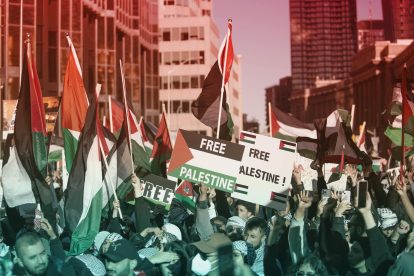
Don’t wait for people to attack us, because the situation is serious. The situation is heated. We are four days away from Gaza. Call now, get to your keyboards now to put pressure on the Canadian government. Already, last night [Wednesday, October 1], when the Sumud boats were attacked, in many cities around the world, people took to the streets. There were many huge demonstrations—in Montreal too, I know there was a demonstration.
Keep putting pressure on them to intervene before the Conscience is attacked.
The Breach’s investigations don’t just inform our readers—they force the powerful to react.
An exposé on blood plasma privatization led to national headlines. Our revelations about the government’s cozy connections to Big Pharma sparked a parliamentary probe. A report on high-tech price-fixing by mega landlords resulted in a criminal investigation.
From activists to elected officials, people are using The Breach’s journalism to push for transformative change.
– Dru Oja Jay, Board President, The Breach