When Sydney first started as a flight attendant with WestJet, she says she drank the Kool-Aid—literally.
“In my flight attendant initial class we had a blue cup with blue Kool-Aid, and we all cheersed to being a part of the WestJet group and family,” Sydney said.
“When I first started it was, ‘We’re all in this together.’”
Sydney, who is being identified by a pseudonym to avoid repercussions from her employer, has worked at WestJet for more than five years. At the time she started, Sydney said WestJet’s corporate culture allowed employees to be listened to. And while pay for crews was never fantastic, the company had a lucrative profit-sharing scheme.
Speak to any WestJet employee today and they’ll whisper about the old days when they took home enough in quarterly profit-sharing cheques to buy “T and Ts”—new trucks and…breast enhancements.
Now, employees say the workplace is far less rewarding. An investigation by the Breach has found that WestJet flight attendants make as little as $3 per hour — because of what their union calls “very creative” payment practices and unfair labour practices. And their concerns are echoed by other workers across the sector, who say low wages and unfair labour practices are pushing them to take action.
“I do have a base salary, but based on how much I actually work, it works out to being less than minimum wage,” Sydney said.
On the surface, flight attendants appear to earn between $25 and $55 per hour. Those are the hourly rates on their collective agreements. Flight attendants who’ve worked at WestJet Encore for four years, for example, should earn $32.12 an hour.
That should add up to a full-time annual salary of around $64,000. The reality is that some flight attendants who provided their T4s to The Breach make less than $30,000.
That’s because flight attendants are only paid their hourly rate when the brakes come off the plane’s wheels. The rest of the time, they’re only paid a per diem rate. For domestic flights at WestJet that’s between $3 and $4 per hour—far below the federal minimum wage of $16.65 an hour.

‘Pay me for boarding’ campaign inspired by colleagues
After seeing the success of an online campaign by American flight attendants, Sydney launched the Instagram account Pay Me For Boarding Canada. She hands out pins that say “Pay me for boarding” to other members of the crew and she wears them on her uniform and luggage.
But her employer isn’t happy about that and she’s been warned about her behaviour.
“It does come with risk. I’ve had meetings with my direct manager about wearing my pin because it’s not a part of the uniform. I say that to everybody too: this isn’t approved in our uniform standards so if you’re gonna wear it, be smart.”
Alia Hussain, president of the WestJet flight attendants’ union CUPE 4070, said the union is considering taking action against the company, which she said is “very creative” with its payment practices.
“They’ve baked it into collective agreement language in a way that is very confusing and arguable.”
A spokesperson for WestJet said that the per diem rates were reached through good faith bargaining.
“These rates were bargained to take into account a Credit Hour system that provides wages on a basis other than duty time worked, including pre and post flight duties. WestJet remains committed to addressing concerns raised by our valued cabin crew members through the bargaining process,” public relations manager Denise Kenny told The Breach by email.

‘I dissociate for four days and then I go home’
Frankie, another flight attendant whom The Breach is identifying with a pseudonym, is looking for a way out.
“This industry does not pay livable wages,” she told The Breach. “I disassociate for four days and then I go home…It’s forced me to look into getting another career.”
Those airport delays that are so frustrating for passengers are even worse for flight crew, Frankie said.
“You’ll completely board an aircraft. It’ll take you 40 minutes to fill the aircraft…and they’ll tell you, ‘Oh, we can’t let you leave for another two hours.’
“I’m not being paid for that.”
Even without delays, schedules often add up to less than half the crew’s time being paid fairly. Both Sydney and Frankie provided The Breach with work schedules that showed multiple instances of 14-hour shifts with only four to seven hours of paid time.
Sydney says employees aren’t sitting around doing nothing when the plane’s brakes are on. They’re doing vital work such as helping out passengers with special needs.
“I’m actually doing work. I have to pre-flight the aircraft, so I have to check all the safety features. I’m setting up for service, doing last minute grooming. I’m doing briefings with the pilots.”
In the United States, Delta recently started paying flight attendants 50 per cent of their hourly rate during boarding—the country’s first airline to do so. Delta’s rates are already significantly higher than their Canadian equivalents, even though code-sharing means that they can be flying on the same planes with the same passengers.
Now the Canadian Union of Public Employees (CUPE), the union that represents flight attendants at airlines such as Air Canada, WestJet and Air Transat, has launched Unpaid Work Won’t Fly. The union is inviting Canadians to write to the federal government and big airlines denouncing unpaid work, which CUPE says amounts to an average of 35 hours per month.
The union is also holding rallies in Vancouver, Calgary, Toronto and Montreal for a national day of action on April 25.
Pilots could go on strike
It isn’t just flight attendants that are unhappy with their jobs in the industry. Air Line Pilots Association (ALPA), the pilots’ union, just voted 93 per cent in favour of strike action, on a 95 per cent turnout.
Bernard Lewall, chair of the WestJet master executive council at ALPA, says that WestJet pilots are paid around 50 per cent less than their American counterparts and that WestJet is losing around 30 pilots per month.
“We’ve had to cancel a few ground schools because we can’t actually fill them with new hire pilots.”
Pilots already spend 20 to 22 days a month away from home, Lewall said, and now they’re being asked to work extra to cover the gaps.
Kenny, the WestJet spokesperson, said that the company “remains unwaveringly committed to achieving an agreement with ALPA that is competitive within Canada’s airline industry and ensures we have a long-term sustainable future so that we can continue to operate critical air service for millions of Canadians, while providing jobs for thousands at the WestJet Group.”

Airline CEOs continue to rake in millions
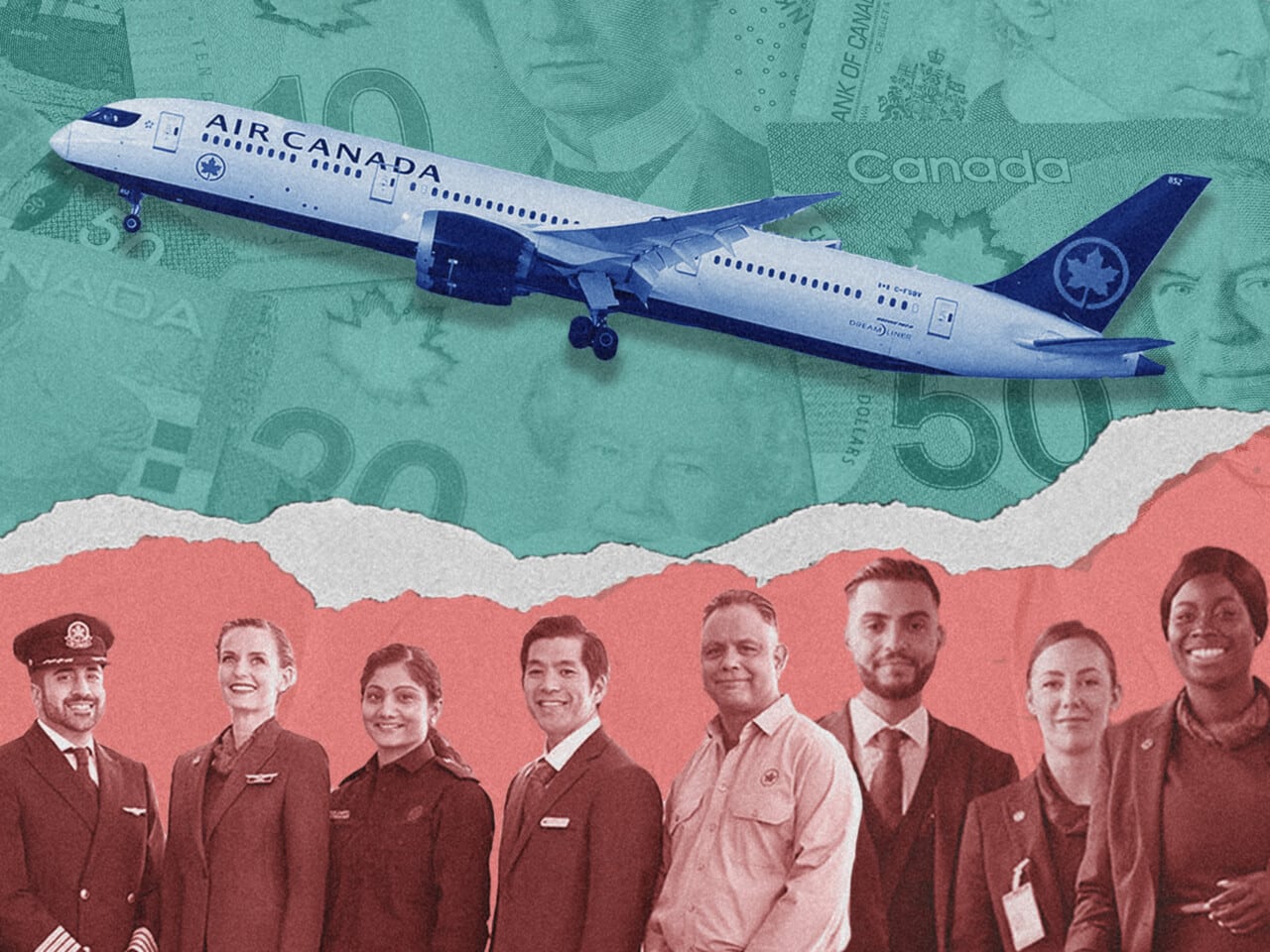
The airlines would love to paint this as difficult economic conditions taking their toll, but Air Canada’s CEO’s pay tripled in 2022. Michael Rousseau received a total of $12.4 million last year.
And after being bought by Onex in 2019, Sydney’s employer WestJet is no longer publicly traded. So while CEO Alexis von Hoensbroech’s compensation isn’t available publicly, staff are not impressed with him.
Von Hoensbroech came to Canada from Austrian Airlines, where the management board were forced to pay back €2.9 million in bonuses after a government bailout.
Both Sydney and Frankie say that WestJet used to feel a lot more collegiate, with crews staying together for the duration of a pairing. A pairing is time away from base, for example four days flying between different cities with overnight layovers.
Sydney says that culture was already being eroded, but Onex buying WestJet and hiring von Hoensbroech was the nail in the coffin. Now the airline treats flight attendants and pilots like an unfortunate expense rather than an important resource.
Sydney said WestJet has told staff they’re trying to bring back profit sharing but the airline needs to be profitable before they can do that.
“Since we first unionized the communication dropped,” she said. “It went from ‘Scratch my back and I’ll scratch yours,’ to ‘If it’s not in the contract, well that sucks to be you.’”
Hussain, who as well as being president of CUPE 4070 has been a flight attendant for 17 years, says, “This is the first time in my career I’ve felt like a number.
“This is an organization that, culturally speaking, doesn’t want to recognize unions.”
WestJet exec points the finger at union
Von Hoensbroech’s combative attitude towards the unions is well documented in his own words. In an internal company video obtained by The Breach, the CEO recently told staff he “would rather fly fewer planes than agreeing to a contract that puts us in a non-competitive place.”
During the same webinar, von Hoensbroech accused the pilots’ union of deliberately drying up the pilot supply to advance their bargaining position.
One theory that flight crew often suggest is that von Hoensbroech is attempting a similar strategy to his goals at Austrian Airlines: turning WestJet into an ultra low-cost carrier like the European Ryanair. That model requires simplifying staffing structures and reducing the number of bases. WestJet Encore has recently drastically reduced service out of Toronto, for example, making Calgary WestJet’s major hub.
“He’s treating the second-largest country [in the world] like a tiny country in Europe,” Sydney said.
None of the airlines’ wage suppression and fighting with unions has kept prices down. Air travel in Canada remains exorbitantly expensive and passengers have noted Air Canada has started charging up to $150 just to check a bag.
Sydney said at Air Canada, too, that money isn’t making its way to the workers.
“I have friends that have gone there that have said, ‘Same shit, different pile.’ The grass is greener because it’s fake.”

I often hear that I’m lucky to have a full-time job in journalism.
Critical, bold journalism that isn’t beholden to media monopolies should be the norm—not the exception.
By supporting The Breach, you’re supporting a more robust, progressive media. Join us today.
– Katia Lo Innes, Associate Producer, The Breach