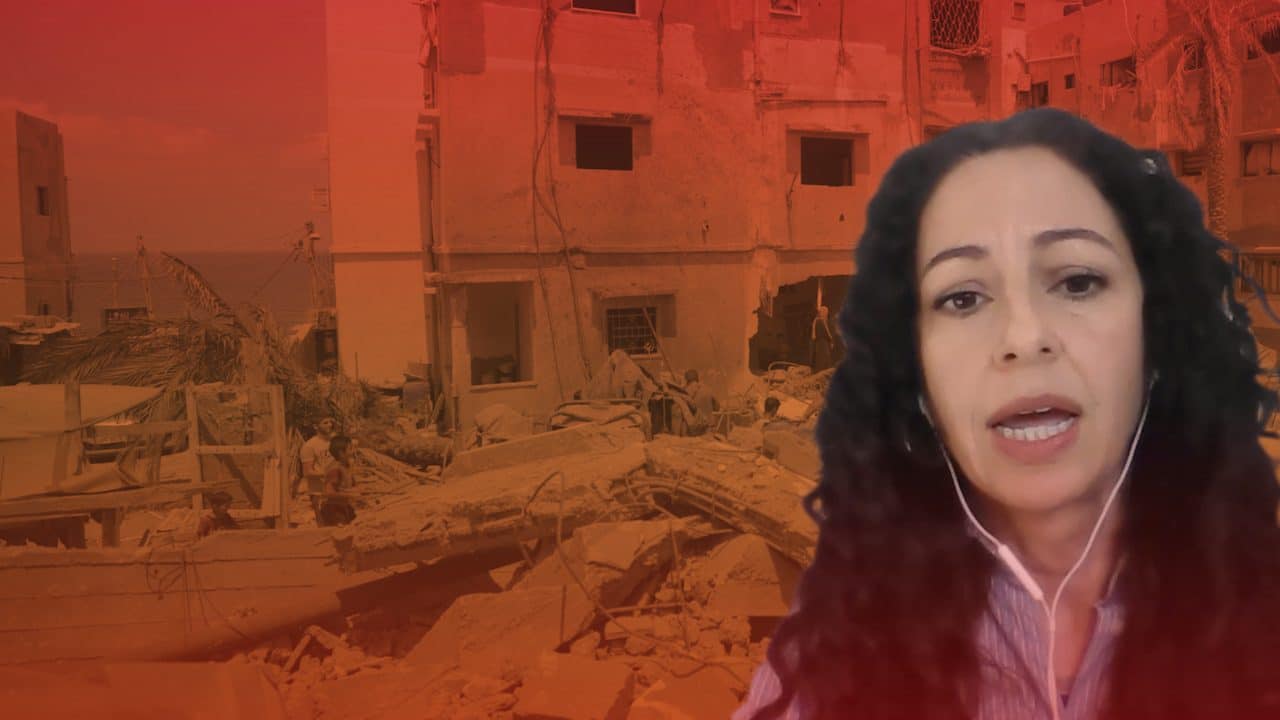
Dania Majid, president of the Arab Canadian Lawyers Association, joins The Breach Show to talk about the legal dimensions of Israel’s escalating assault on Gaza.
As UN experts warn of a “risk of genocide,” is Canada meeting its obligations? And as an occupying state, does Israel actually have a “right to defend itself?” Majid also breaks down the effect of anti-Palestinian racism and the surge in mobilizing for solidarity with Palestine.
Martin Lukacs, managing editor: Welcome to The Breach Show, featuring sharp analysis on politics and social movements in Canada. I’m your host, Martin Lukacs, and our guest today is Dania Majid, joining us to talk about the escalating Israeli assault on Gaza.
Dania is a lawyer, the president of the Arab Canadian Lawyers Association, the artistic director of the Palestinian Toronto Film Festival, and her day job is as a lawyer with a legal clinic in Ontario. Dania, thanks for joining us.
Dania Majid: Thanks for having me.
Lukacs: In Gaza, Israel’s ground invasion is intensifying. As of [Nov. 3], Israeli strikes have killed at least 9,227 Palestinians, including more than 3,800 children since Oct. 7. There are growing global calls for ceasefire. One hundred and twenty countries at the UN General Assembly last week supported a resolution calling for a ceasefire. Canada, however, abstained from that resolution.
Dania, why won’t the Canadian government call for a ceasefire?
Majid: That’s a great question that many of us doing this work have. Canada is definitely well aware of the laws that are governing the occupation of Palestine, and its official positions. Global Affairs Canada does set that position around occupation and settlements in line with international law. But in practice, we do not see Canada following its own policies.
Since the Harper years, Canada has declared itself to be a very close friend and ally of Israel. And since then, Canada has shielded and protected Israel from any criticism of its actions, both domestically and internationally. It is both [for] economic and political reasons [that] Canada won’t call for a ceasefire.
We buy and sell weapons with Israel. We coordinate both security and trade agreements with them.
There are cultural exchanges. We’ve seen many politicians have taken free trips to Israel in building its support for Israel and establishing itself as a true friend.
They have simultaneously sidelined the Palestinian community, which has come under attack by the government for advocating for Palestinian rights. Many organizations have lost funding, or they do not have access or the resources to meet with senior officials to try to influence positions. When members of the community and organizations have tried to hold Israel to account, the government itself has blocked or smeared their attempts.
In general, Canada is also a junior player on the world stage. We tend to fall in line with our key allies like the United Stated and the United Kingdom, who have thrown their full support for Israel and its actions.
Lukacs: I want to play you a clip of Justin Trudeau speaking just two days earlier in which, I think, we see some of the moral and political gymnastics that the government is undergoing to avoid saying anything critical about Israel.
Prime Minister Justin Trudeau: We, of course, continue to unequivocally condemn Hamas’ abhorrent terrorism and Israel has the right to defend itself but the price of justice cannot be the continued suffering of all Palestinian civilians.
Lukacs: Dania, what do you make of this?
Majid: This is not where the government started in talking about what’s been happening in Gaza. What we saw, initially, was essentially Canada following the U.S. and U.K. and giving Israel the green light to go ahead and attack Gaza.
Now, we are seeing the horrors of that decision unfolding in a genocide. There are grave concerns around what’s happening in the West Bank as well with Israeli and settler attacks there.
What we have seen has been a mass and rapid mobilization of all sectors of the Canadian civil society condemning Israel’s bombardments and calling for an immediate ceasefire. Those calls have grown with the rising death toll that you have highlighted, including that among children.
In addition to the fact that we’re also seeing the entire population being starved, deprived of fuel and the entire collapse of civil society, including hospitals. Everyone in the international body is sounding the genocide alarm bells. We have UN officials and human rights organizations deeply concerned.
Yet, despite this particular statement that Justin Trudeau has made and everything we have seen unfolding thus far, the government has still not called for that immediate ceasefire.
The NDP, so far, is the first party that has come out in support of a call for a ceasefire, but other parties in the government have not yet.
Lukacs: One thing Trudeau mentions is the right to defend itself for Israel. In Western discourse, we’ve heard endless repetitions of this point. It’s practically an article of faith among the governing class. As a lawyer, what is the actual meaning of the right to defend itself as a state?
Majid: Hearing this term used to justify an assault in Gaza has been really disturbing for myself and other lawyers, especially those who are experts in international law. This right to self-defence has been used instead as a cover to allow Israel to bombard Gaza, to blockade Gaza, and has been used as a cover or justification for not calling for an immediate ceasefire.
The law is clear. Article 51 of the UN Charter does speak to the right of self-defence, and it has outlined that an attack that would trigger self-defence must be committed by another member state and cannot have originated from a territory that is under belligerent occupation by the state that is claiming self-defence.
In other words, Palestinians and their territory are under illegal occupation, and therefore any attacks that emanate from Gaza—which is under Israel’s control as an occupier—does not allow for Israel to use force against Gaza as self-defence as outlined in Article 51 of the Charter.
Putting that aside, even if we were to say they were to have this right, what we’re not talking about and hasn’t been discussed is the other critical international humanitarian laws that are in play now because the attack has happened.
Under those laws, Israel must ensure that it conforms with the principles of proportionality, distinction, precaution, and humanity. Again, from the stats you read earlier, it is abundantly clear that Israel has disregarded all these principles.
When you look at the sheer number of people killed and injured, and the disproportionate number of them being civilians, and the destruction of civilian property and infrastructure, the collective punishment by this policy of starvation and deprivation of fuel. All these measures are considered war crimes under international law and far exceed anything that’s permissible under international law.
We can’t just look at the right to self-defence in a vacuum. It is part and parcel of a greater body of law and those laws all come into play at this time.
Lukacs: Just yesterday, a group of UN experts issued a statement saying, Gaza is “running out of time,” and that “we remain convinced that the Palestinian people are at grave risk of genocide.”
Lots of other legal scholars are using that term as well. I want to play you a clip from Mehdi Hasan‘s show where he is quoting top Israeli politicians and generals statements in the last few weeks.
Mehdi Hasan, broadcaster: When it comes to “intent,” in the context of the genocide convention, listen to what Israeli politicians and generals themselves have said.
Cabinet ministers like Yoav Gallant, the defence minister who said Israel was fighting “human animals” and ordered a complete siege on the Gaza Strip. No electricity, no food, no fuel.
Or, Energy Minister Israel Katz, who said “no electrical switch will be turned on [in Gaza], no water pump will be opened and no fuel truck will enter until the Israeli abductees are returned home.”
Or, heritage minister, Amichai Eliyahu, who said “blow up and flatten everything,” in the north of Gaza, and “give that land to Israeli settlers.”
Or, Israeli President Isaac Herzog, who said that the innocent civilian population of Gaza—2.3 million people, half of them children—weren’t so innocent because they could’ve risen up against Hamas.
Members of Benjamin Netanyahu’s governing party in the Israeli Knesset like Revital Gotliv, who called for the use of a “doomsday” weapon to flatten Gaza without mercy.
Lukacs: Dania, what are your thoughts?
Majid: These are things that we have heard playing out—or similar statements being made not just recently but for months and even years—this type of language being used against the Palestinian population.
In international law, genocide is the worst of the worst of crimes. Its use, or anything being referred to as genocide, is not done lightly. If anything, experts, government officials, UN officials tend to be very cautious when they use this term because of its weight and its significance. It requires a great deal of evidence to be gathered to be able to make that claim.
We already started seeing the term genocide being used, first by international law scholars and experts, and then we started hearing the UN officials saying and using this term warning of the grave risk of genocide or an unfolding genocide.
I think this really underscores—especially for those of us in the legal community—how serious and how bad the situation is. We do have an international genocide convention, which both Israel and Canada are a party to. It outlines what acts would be deemed to be considered genocide, including the intent.
It underscores the importance that there needs to be an intent to destroy—whether it be in whole or in part—an ethnic, national, racial or religious group. Those acts include killing members of that group, causing serious bodily or mental harm to members of that group, deliberately inflicting on the group conditions of life calculated to bring about its physical destruction in whole and in part.
In under three weeks, when we look at what’s happening in Gaza, it’s very clear that we have crossed all these acts. Where the hesitation for many international scholars or international bodies comes is the intent piece because we see mass destruction happening in other conflicts.
But the intent to genocide is sort of the piece that prevents these officials from saying it is a genocide. However, here, which is even more alarming, is that intent has been formed so very quickly and probably very easily compared to other conflicts. That’s because as you played on those clips, Israeli officials have been very open about what their plans are for Gaza.
Canada and other Western countries have an absolute obligation to prevent a genocide and stop a genocide. This is why it is very problematic that the West still has not called for a ceasefire, an immediate and unconditional ceasefire.
Lukacs: Let’s shift back to home in Canada. We have been seeing a crackdown on Palestinian solidarity everywhere, in Europe in particular, in France, Germany, Hungary and Austria have all banned protests in solidarity with Palestine.
What are you seeing happen in Canada?
Majid: This is probably the worst we’ve seen since 9/11 in terms of the rampant anti-Arab, anti-Muslim and anti-Palestinian racism. It really started immediately with politicians coming out and using very racist and dehumanizing language towards Palestinians.
Then, a lot of that was also echoed in media articles that called for the clamping down of protests, referring to the protests as “Hamas rallies” or “celebrations of death” and other very disparaging and dehumanizing rhetoric.
Very soon thereafter, we started seeing statements coming out from public institutions that, again, used dehumanizing language or erasure of Palestinians from the narrative of what they were putting out statements on.
Right after that we started seeing and getting reports of people getting punished at work, whether they be suspended, fired.
We’ve seen reprisals happening at school, whether it be universities or high schools, students, [teaching assistants] being suspended for supporting statements, blacklisted by future employers and losing jobs.
Again, we’ve seen that play out on the political side of things. We’re seeing people in all areas of, in all sectors being doxed online, receiving death threats. We’re seeing a lot of trolling on social media.
What is interesting is the trolling is not even being done by anonymous profile picture-less types, but we’re seeing trolling done by professionals in journalism, politicians, doctors, lawyers who are bound to abide by strict professional codes, but have taken to harassing people for their views on Palestine or support of Palestine. This has created fear amongst our community. It has created a chilling effect.
I’ve even heard of renters being illegally locked out of their apartments by their landlords or being kicked out of business offices because of their position or showing any sort of public support for Palestine.
We’re seeing the attacks happening to those who support Palestinians, especially those who are black, indigenous, racialized, queer and female allies.
Lukacs: Let me ask you about that because last year you published a report with the Arab Canadian Lawyers Association where you detail anti-Palestinian racism.
You define it as, if I can quote, “a form of anti-Arab racism that silences, excludes, erases, stereotypes, defames, or dehumanizes Palestinians or their narratives.”
How does this analysis apply to the present moment?
Majid: What we described in that report is absolutely playing out in real time now, but obviously in a much more intense, extreme, and overt way.
In many instances, anti-Palestinian racism can be played out in whisper campaigns. That’s what happened at the University of Toronto Law School, which was one of the sparks that prompted us to produce this report.
It’s emails that go around telling people to try to exclude people or push them out of spaces or get them fired or prevent them from getting hired.
At [University of Toronto]—which [we] covered from 2020 to 2021—it was a really big scandal that happened when the International Human Rights program tried to hire a director. There was a whisper campaign that came out to have her de-hired because of her positions on Palestine. That campaign was successful and the job offer was retracted.
This was the cherry on top for us to be prompted to say, “We have to work and put a report out that talks about anti-Palestinian racism,” because it wasn’t being talked about.
We took it upon ourselves to put this report that laid out very clearly what anti-Palestinian racism is, and we have a description of that there. We break down those terms of the description, and we explain how it manifests, how it plays out in different sectors, including academia, media, politics and the arts.
When we look at the report—and our findings of that report—and apply it to present times, we are still seeing those same essential characteristics playing out. We’re seeing the same types of dehumanizing, erasing, denying, defaming, discrediting of Palestinians or their allies.
It’s all being done ultimately to silence those who are advocating for Palestinian human rights. I can’t think of anything that’s more silencing than firing employees or labeling them or labeling movements as being antisemitic or inherently violent in the press.
It’s being used as anti-Palestinian racism, it is actually being used to justify genocide and justify the reasons for not calling for an immediate ceasefire.
Lukacs: In past years, the federal government’s been criticized for playing a part in obstructing efforts to seek remedies for injustice against Palestinians at the International Criminal Court and the International Court of Justice.
Can you talk a bit about these two courts, what the stakes are, and what has Canada’s approach been to them?
Majid: It’s been pretty abysmal. Canada has done all it can to block Palestinians from holding their occupiers accountable in these legal forums, and even contravening its own foreign policy positions to do so.
What they are claiming is that these bodies do not have the jurisdiction to hear these matters.
It’s not even on the merits, it’s just that Palestinians don’t even belong in these spaces.
With the International Criminal Court, one of the reasons that’s the basis for Canada’s argument that the ICC does not have the jurisdiction to hear these matters, is because Canada refuses to recognize Palestine as a state. Therefore, it says as a non-state, [Palestine] cannot go to the International Criminal Court.
When they made these arguments, they didn’t even do this in a “friend of the court brief,” which other countries did. They simply put it in a letter to the court sent on behalf of Israel.
At each level, wherever Palestinians have tried to hold Israelis to account, whether it be through [boycott, divestment, sanctions campaigns], whether it be through United Nations resolutions, whether it’s at the international courts, Canada has been there to block them.
It is in contravention of Canada’s own obligations under these conventions to hold those responsible for war crimes accountable. At the end of the day, by continuously blocking Palestinians from all these options, it’s really left Palestinians with next to no options to hold Israel to account.
Lukacs: Dania, let me end by asking you about Palestinian solidarity efforts. Where is pressure in Canada most needed right now?
Majid: Everywhere. Based on all the hats that I wear and seeing what things are happening on the ground on different fronts, we need solidarity everywhere.
Despite how unsupportive the Canadian government has been, it’s been really inspiring to see how fast and how rapidly Palestinian solidarity efforts have grown here in Canada and around the world.
We have been seeing mobilizing happening on all different fronts, whether it be protests, days of actions. We will be seeing one happening on Nov. 4 and probably each weekend thereafter.
We are seeing people on the streets, we’re seeing unions, the labour movement organizing. We’re seeing artists mobilizing, high school students mobilizing, university students mobilizing, environmental groups mobilizing. On all fronts, people have been mobilizing in support of Palestine.
If I can highlight one particular action just to show how much support and solidarity has grown, there is an open letter called the Ceasefire Now letter calling for an immediate ceasefire and the end of the occupation.
It already has over 200 groups signing from all these different sectors, including the biggest labour unions in Canada. Collectively, we might be talking about more than 1 million Canadians that are represented by these groups, and maybe even more.
Not too long ago, we were in this position again, after 9/11 and the impending war on Iraq. Canadians then came down in the hundreds of thousands. People came down to the streets in cities across Canada and demonstrated to tell the Canadian government not to join the U.S. and enter into an occupation of Iraq, and a war on Iraq.
We know how disastrous that was. We know how many Iraqis were killed— millions, maybe more. The country was destroyed, dismantled, privatized. It was an absolute disaster.
We need to do this now. We need to grow from the thousands, from the tens of thousands to hundreds of thousands to call for an immediate ceasefire before this genocide gets even worse.
Lukacs: Dania, thanks so much for joining us.
If people want to see the signatories to that ceasefire call, you can check it out at ceasefirenow.ca. Thanks again for taking time, Dania.
Majid: Thank you for having me.
Lukacs: If you like what you’ve heard on The Breach Show, please subscribe to the podcast or our YouTube channel.
If you want to support our work, please become a sustaining member to help us produce more journalism for transformation. You can do that at breachmedia.ca/support.
The Breach’s investigations don’t just inform our readers—they force the powerful to react.
An exposé on blood plasma privatization led to national headlines. Our revelations about the government’s cozy connections to Big Pharma sparked a parliamentary probe. A report on high-tech price-fixing by mega landlords resulted in a criminal investigation.
From activists to elected officials, people are using The Breach’s journalism to push for transformative change.
– Dru Oja Jay, Board President, The Breach