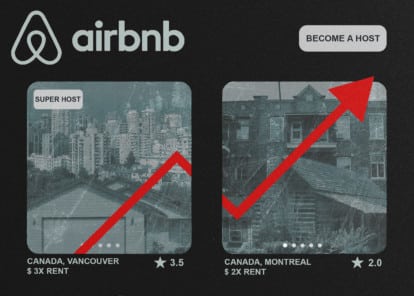
Martin Lukacs: If you watch Canadian media, you might think that landlords—those who own and rent housing—have a terribly hard life.
Newscaster: We begin with a story that really is a landlord’s worst nightmare.
Newscaster: Shafiq’s among a growing number of small Ontario landlords protesting against the system they say unfairly favors tenants.
Newscaster: Would you ever tell anyone you know or love to be a landlord
Landlord: Never. Never.
Landlord: I literally collapsed out here on the front step, in front of the unit, and all I could do was just cry.
I literally just sobbed and sobbed and sobbed.
Lukacs: This isn’t real reporting. It’s an exercise in gaslighting.
Amplified by the establishment media, these sob stories serve to disguise the exploitation of the housing market and to undermine the fight for stronger tenants rights.
Their goal?
To make you pity the landlord class, rather than be pissed at them.
Title: How the media teaches us to pity the landlord
Intro [music]: So pity the downtrodden landlord, and his back that is burdened and bent.
Respect his gray hairs, don’t ask for repairs.
And don’t be behind with the rent.
Lukacs: Pity the landlord stories follow a similar formula. They usually start like this:
1. The downtrodden landlord
CBC newscaster: On a teacher’s salary, Norma DeSilva scrimped and saved to invest in two properties.
Lukacs: Landlords are depicted as modest, hardworking, barely-scraping-by individuals.
Their tenants, by contrast, are depicted as delinquent villains.
2. Tenants from Hell
Kingston landlord: They definitely had quails in the house. Definitely rabbits. There were chickens. There was definitely a goat.
Lukacs: But studies by landlord groups themselves have found that nearly 100% of rent is collected when it’s due, making it an extremely stable industry.
And yet when a landlord’s property doesn’t immediately go cha-ching, the media report on it like it’s the saddest day in history.
3. Painting investment risk as a tragedy
Newscaster: Natalie Clancy has this exclusive story. Gouws is owed more than $5,000.
Gouws: It’s shocking and it shouldn’t happen.
Lukacs: When you own rental property, you’re not a worker earning an income, you’re an investor aiming to make a huge profit—and that always has some risk.
Lately, to make the landlord class appear even more sympathetic, the media have introduced a new element to their formula: disproportionately featuring racialized landlords.
4. Weaponizing racial justice
But landlords more often look like me, not like this:
This is a cynical strategy encouraged by real estate lobby groups: weaponizing racial justice to promote policies that will further enrich the landlords.
Oppose giving landlords more power to evict tenants? Clearly, you must be racist.
And finally, the media frequently disappear the most important perspective on rental housing: tenants and their advocates.
5. Vanishing tenant voices
Organizer: When I say rent, you say strike! Rent strike!
Tenants: Rent… Strike…
Lukacs: This lets them present landlords as the real victims—and their “looming financial ruin” as a result of supposedly-radical tenant protection laws.
“Pity the landlord” stories flip reality on its head.
Landlords and tenants aren’t equivalent. They’re on opposing sides of a conflict in which landlords siphon income from working-class families into the pockets of a property-owning class.
In truth, landlords in Canada mainly aren’t even individuals.
Apart from the small amount of housing that is public and non-market, landlords are wealthy families owning more than one home, small businesses operating dozens of units, corporations holding hundreds of buildings and tens of thousands of apartments, and powerful financial investors buying up hundreds of thousands of units.
This class is making eye-watering profits by raising rents to record highs.
They’re writing legislation for friendly provincial governments to implement.
And they’re using their power to push out tenants so they can jack-up prices to accumulate even more wealth.
Tenant advocacy organizations estimate that upwards of 40,000 people are fraudulently evicted every year in Ontario alone.
In other words, for every goat loving tenant, there are infinitely more predatory landlords.
But good luck getting the Canadian media to report on that.

I often hear that I’m lucky to have a full-time job in journalism.
Critical, bold journalism that isn’t beholden to media monopolies should be the norm—not the exception.
By supporting The Breach, you’re supporting a more robust, progressive media. Join us today.
– Katia Lo Innes, Associate Producer, The Breach