Jobanpreet Kaur Malhi realized life in Canada was not all it had been chalked up to be when she saw the numbers on her first pay stub: $6.25 an hour.
Malhi had gotten the job at a bakery called French Sweets in Brampton, Ont., soon after arriving from Punjab on a study permit in 2018.
A year later, she got a new job at a grocery store. That paid $7 an hour.
“In addition to working for six or seven dollars an hour, all of my workplaces were very unsafe and abusive,” she told The Breach, in an interview translated from Punjabi. “I was depressed and contemplated returning to India almost every day.”
Not only did the companies pay her extremely low wages—they at times didn’t pay her at all.
To this day, the two businesses still owe her over $3000 in unpaid wages.
Malhi is hardly alone—in Ontario today there are tens of thousands of students and young workers from India, many of them facing an epidemic of wage theft and sexual harassment on the job.
Employers in the trucking, food service, and grocery sectors are taking advantage of their precarity and perceived lack of power to pay illegally low wages as well as hold back millions of dollars that are owed.
When Malhi first arrived in Canada, she had no recourse. Going to court, she thought, was futile, since she was only on a study permit—and therefore legally not allowed to work more than twenty hours per week. Her mental health continued to deteriorate while she struggled to make ends meet.
But she soon discovered an organization that, over the past few years, has been leading a pushback against this trend of exploitation and wage theft—with dramatic results.
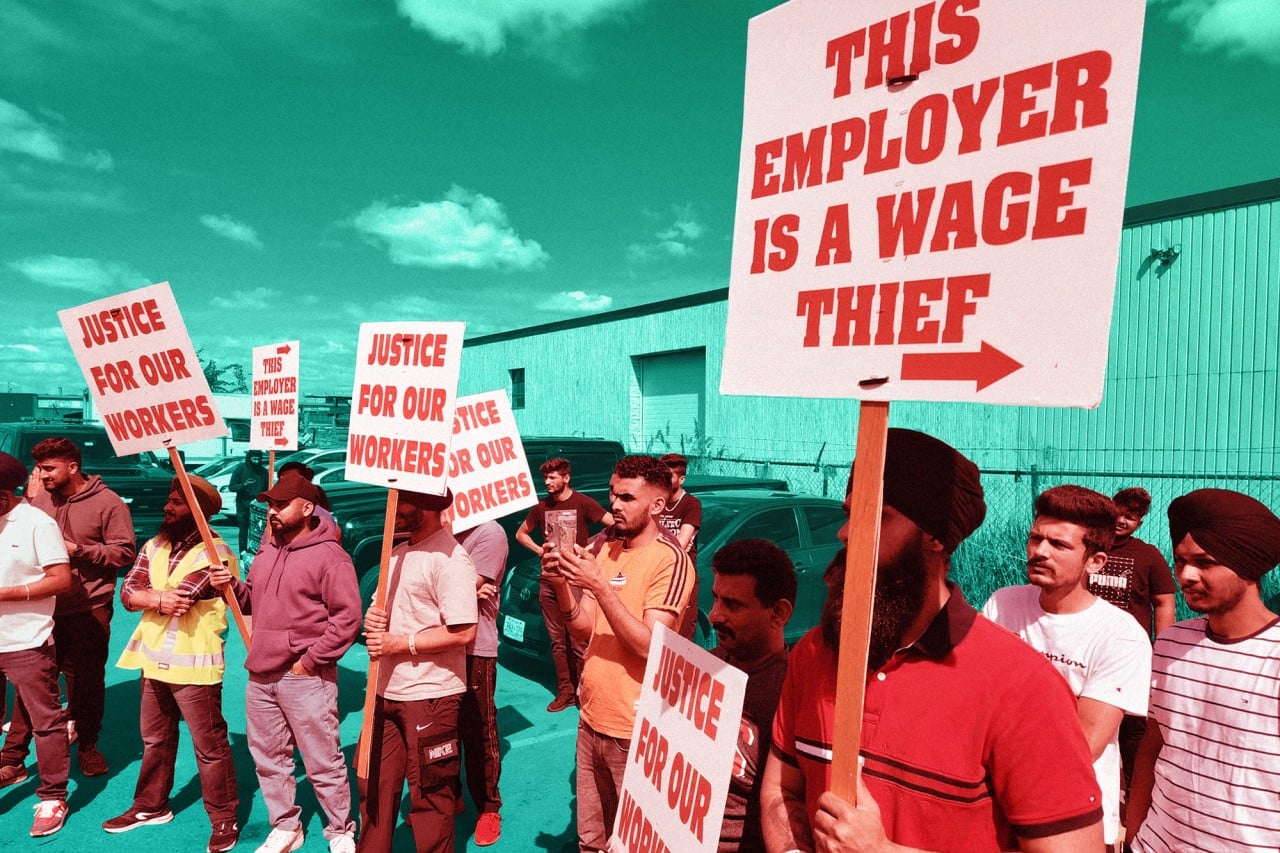
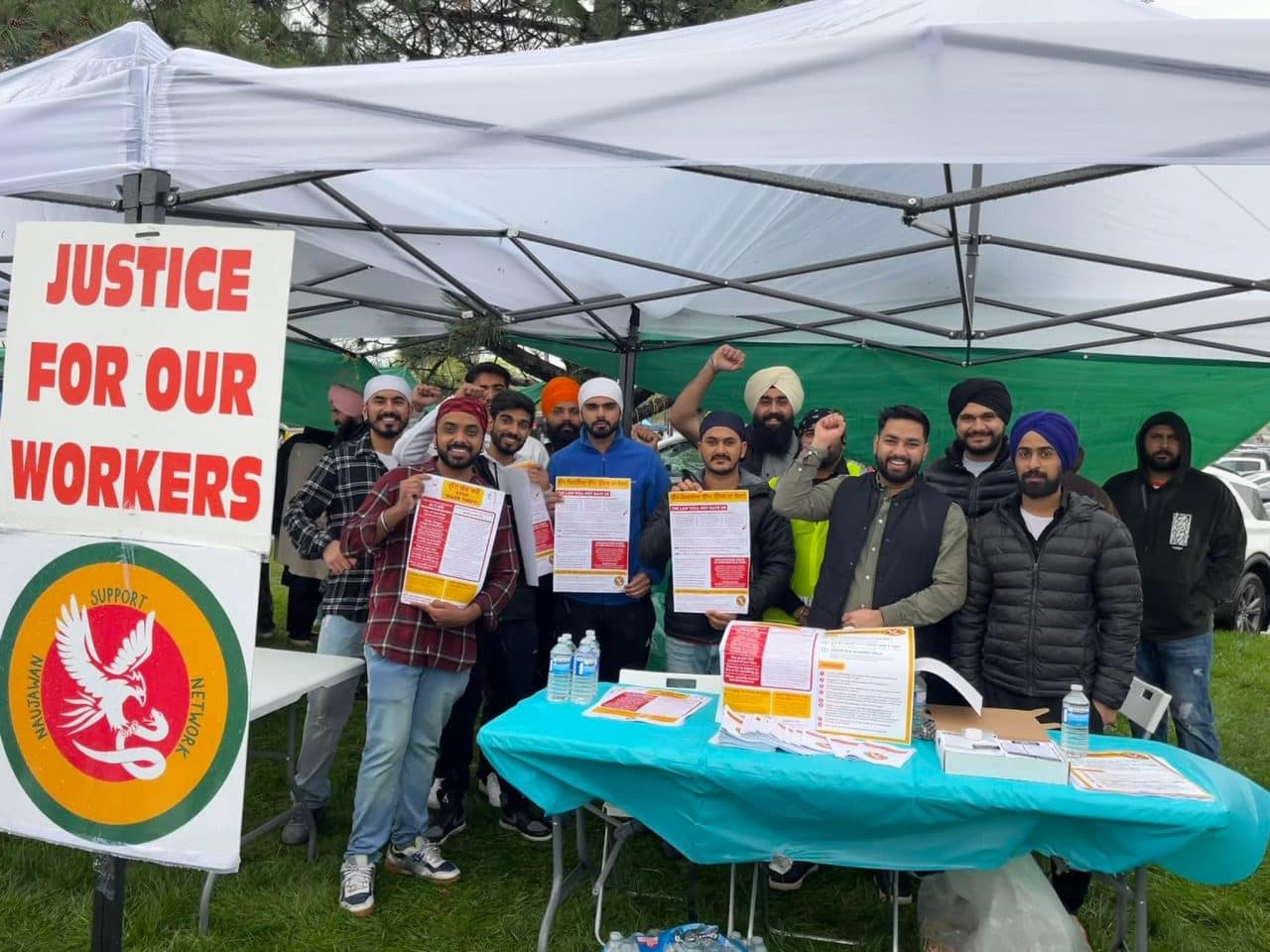
Formed in 2021, the Naujawan Support Network (NSN) is a collective of international students and immigrant workers based in the Greater Toronto Area (GTA). Through direct action and organizing large-scale protests in front of businesses and residences, they have challenged employers, landlords, immigration consultants and the Canadian government, with increasing success.
Since their launch, they’ve recovered more than $650,000 in unpaid wages for exploited workers, halted the deportation of dozens of students—and they’re now working to take their fight beyond the GTA to support workers across the country.
“It was helping others like me in need that made me join NSN,” Malhi said. “For the forces exploiting us are deeply entrenched, and too powerful to challenge alone or through established legal or political channels.”
A movement organized in funeral homes
The spark for the creation of NSN was lit many thousands of kilometers from Brampton: in the farmers’ movement in India in 2020, when hundreds of thousands of farmers sat in protests on the borders of Delhi for over a year to fight the deregulation and privatization of the country’s agricultural sector .
Solidarity protests were organized in the GTA in early 2021, under the banner of Kisan-Mazdoor Ekta Zindabad (“Long live farmer-worker unity”). They quickly became an opportunity for the Panjabi community to congregate, especially recent immigrants and international students.
During these protests, many workers and students discovered a shared experience: wage theft.
“Till this point, we did not realize wage theft was such a burning issue that an entire organization could emerge around it, especially in the unorganized sector and the trucking industry,” said Bikram Singh Kullewal, one of the co-founders of NSN, who first came to the GTA from Cornwall to participate in these protests.
Over the subsequent months, a disturbing reality would underline the stakes of the struggle of international students facing wage theft, sexual harassment, inadequate job training, and threats of deportation from their employers.
Funeral homes in the GTA began to raise the alarm about the increasing number of international students and immigrant workers taking their lives.
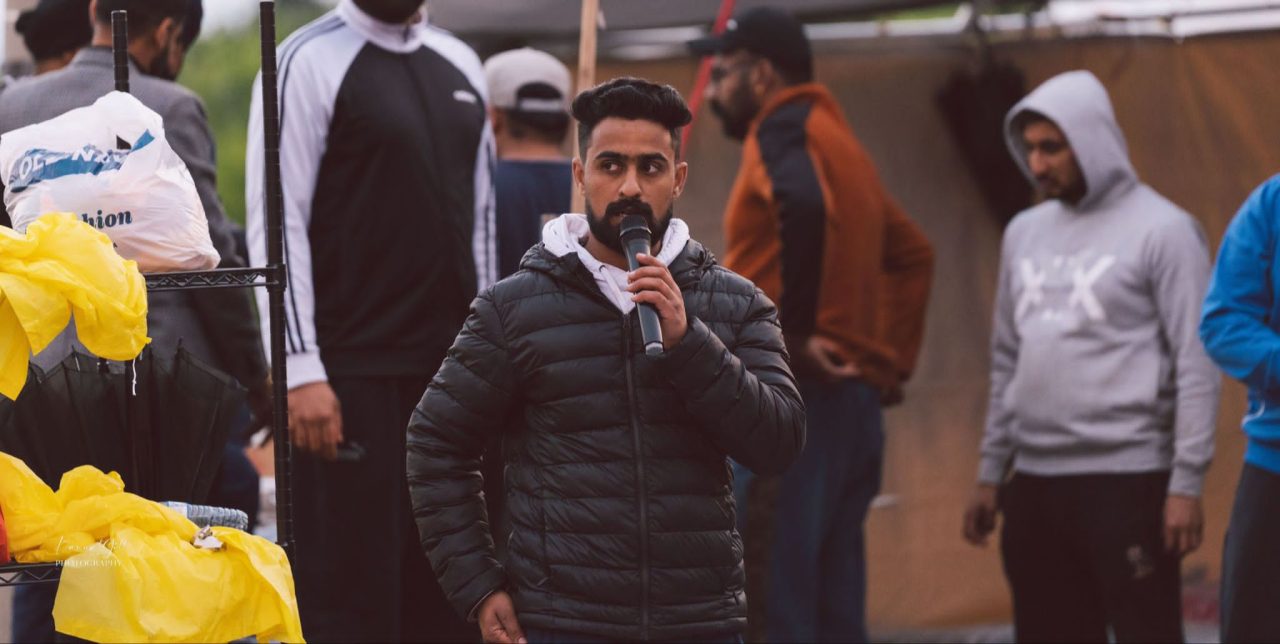
“Every week, we were raising funds to cover the cost of sending the body of a young worker back home,” Kullewal recalled in an interview with The Breach. “One of these, a student who took his own life because of wage theft, went viral on social media. Some of us met at his bhog (funeral) and immediately decided to hold a public meeting.”
In June, 2021, NSN was officially founded.
Today, they have a core organizing committee of around 20 members, and a larger network of over 200 activists and supporters. They say they field 40-50 new cases every month, and have provided legal information and guidance to thousands seeking to fight back against their exploitation.
Facing bullying and retaliation
Simranjeet Kaur reached her breaking point at her job as a dispatcher with a trucking company in the fall of 2021.
She was with her sister, who had been hospitalized, when she received a text from her employer. The message demanded that she return to work immediately.
Kaur had started work at a company called North Edge Logistics a few months earlier.
It was four years since she had arrived in Canada to pursue a two-year diploma in hospitality management at a college in Windsor. Her pay was fixed at $2500 per month, and she worked for 45 hours a week without overtime or vacation pay.
Effectively, Kaur was making less than $14 an hour, below the provincial minimum wage at the time of $15.50. On top of that, employees often reported being at the receiving end of the employers’ outbursts.
North Edge Logistics has denied these allegations, writing in an email to The Breach, “[these] allegations are false and this matter is in litigation.”
Kaur resigned after the message she received while at her sister’s side. Soon after, she asked for the $8000 in pay that she was still owed, but her employer refused, and also threatened legal action.
Not long after, she reached out to the NSN.
The ‘most exploitative industry’ in Ontario
At NSN, Kaur found she was not alone in her experience with the trucking industry, which is notorious for exploiting international students and immigrant workers with low-wage, under-the-table jobs.
“It’s the most exploitative industry for immigrant workers and students in Ontario,” said Navpreet Singh Dhillon, who arrived in Canada in 2019 under a spousal work permit.
To evade insurance costs, companies prefer older drivers over 25 years of age. For those under 25, companies often ask employees to pay an upfront cost. In 2020, Dhillon paid a thousand dollars to begin work at a company called One Time Transfer.
Eventually, he would take this company to labour court for $2500 in dues unpaid.
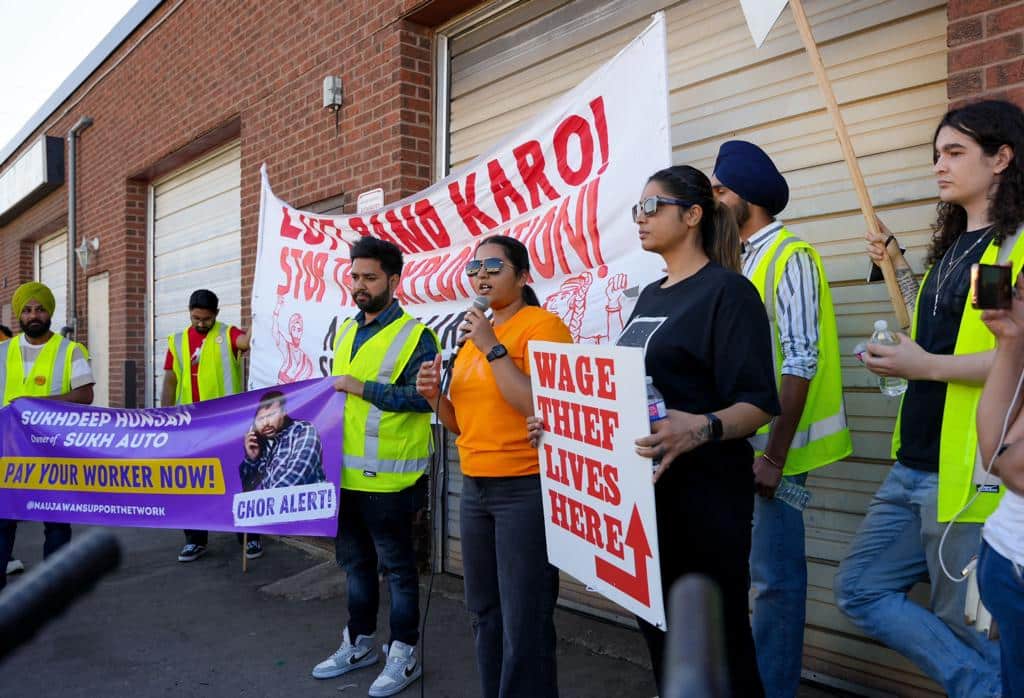
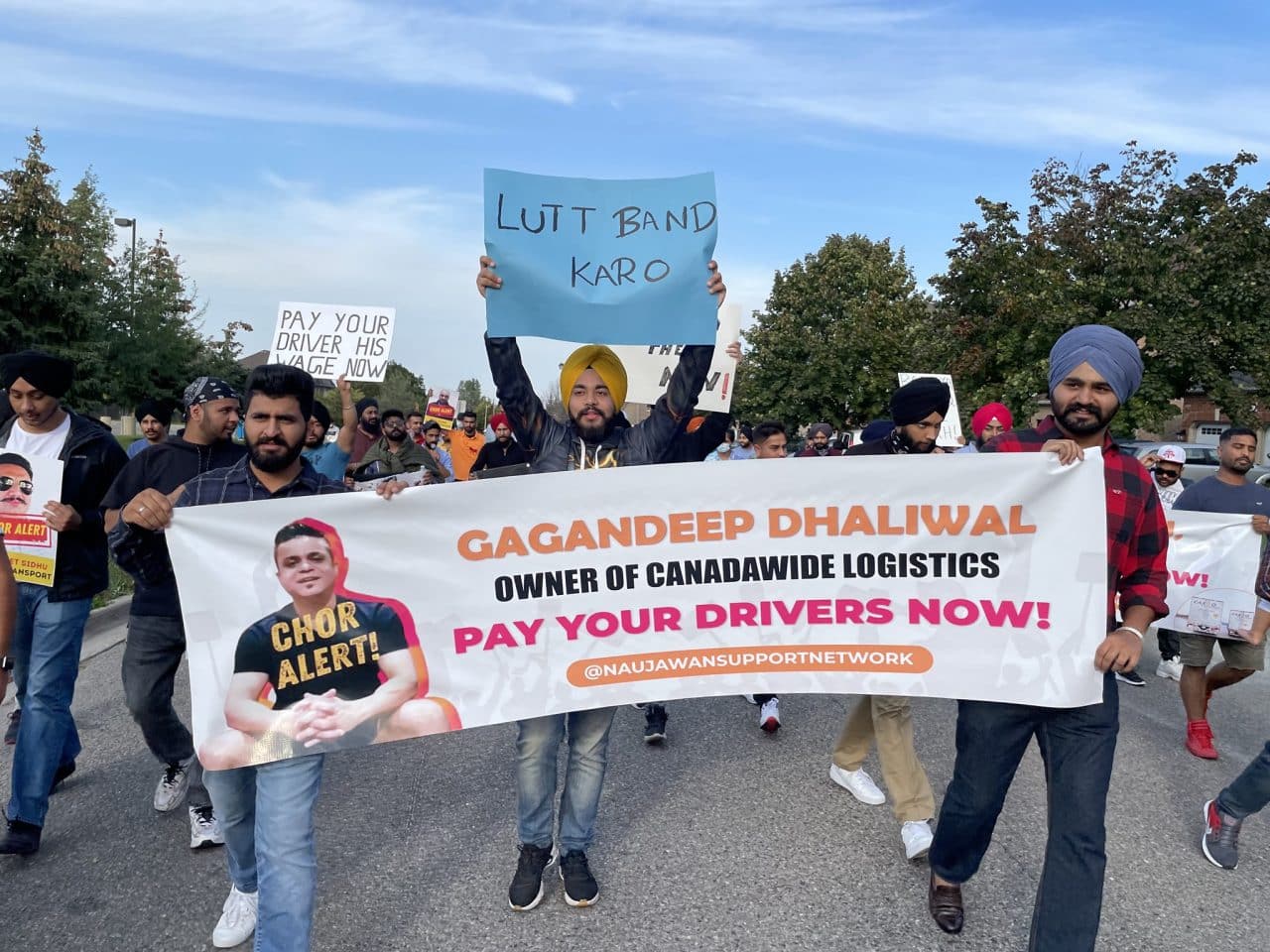
Later, working at another company called Canadawide Logistics, Dhillon had $8000 in wages withheld by the owner Gagandeep Dhaliwal. Dhaliwal, he said, also verbally abused him and insulted his religion on multiple occasions.
Neither Canadwide Logistics nor Dhaliwal could be reached for comment.
In March 2021, NSN helped Dhillon file a case with the labour court, drafting emails and organizing documents. Later that year, they organized two protests outside Dhaliwal’s house in Brampton.
In April, 2022, the court sided with Dhillon, seized the $8000 he was owed from Dhaliwal’s bank account.
Kaur, on the other hand, is still owed by the trucking company she worked at. Since trucking is regulated by the federal government, NSN directed her to file a federal case against the company. The case is still pending.
Her experience with NSN, however, has given her faith, and she remains an active member to this day.
“The fight is much bigger,” Kaur said. “It’s not just about one company, but the general condition of exploitation of international students and immigrant workers. Employers think they have bought us, that they can make us do anything.”
A ‘broken policy’ that makes students vulnerable
Many members of NSN are international students, who are limited by their visas to working 20 hours per week. Those on work visas require a letter of employment to apply for Permanent Residency.
Dhillon describes these as key opportunities for “exploitation.”
Dale McCartney, a professor at the University of the Fraser Valley, calls the 20-hour work limit on student visas a “broken policy” and its removal during the pandemic to fill gaps in the workforce “the biggest red flag.”
“Even though theoretically the 20-hour work limit is seen as a policy designed for student benefit, in practice it makes them extremely vulnerable,” McCartney said.
As of 2022, there are over 800,000 international students in Canada. Of these, 40 per cent are from India alone. Half of all international students in the country study in Ontario, with many concentrated around the GTA.
Working minimum wage for 20 hours a week, these students can expect to earn only $1000 a month. Meanwhile, the current cost of living in Toronto for “renters who commute” is nearly four times that amount.
“Theoretically, the 20-hr limit seeks to prevent students from becoming workers and disrupting the labour market. But, in practice, students have to work,” said McCartney. “With rising living costs and fees, it effectively makes them low-wage workers who are driven to the bottom of the labour market.”
Students often find themselves working “under the table” or “cash” jobs to make ends meet. These undocumented jobs evade the work limit, and often require little paperwork to get.
In these off-the-book jobs, the precarity is multifold: there is no minimum wage, limit on hours, workplace regulation, vacation pay, overtime, and additional costs associated with payroll, social security, or worker’s compensation.
“The government has been intentionally creating a segmented labour market with a group of lower-wage workers for over a decade,” said McCartney.
“The Canadian immigration system is violent and pro-corporate and entirely organized around people’s economic contributions. It becomes difficult to refuse unsafe work in a regime that says ‘you can only stay in Canada if you have a job and are in good economic standing.’”
Fighting for justice ‘with our own hands’
This past week, NSN recorded their latest victory.
After protesting outside of Live Freely Foods for over 30 days, NSN recovered $185,000 in unpaid wages for 37 former employees at the now-bankrupt Mississauga factory.
That came on the heels of another victory in June, when they captured national headlines and successfully fought to freeze the deportations of dozens of international students.
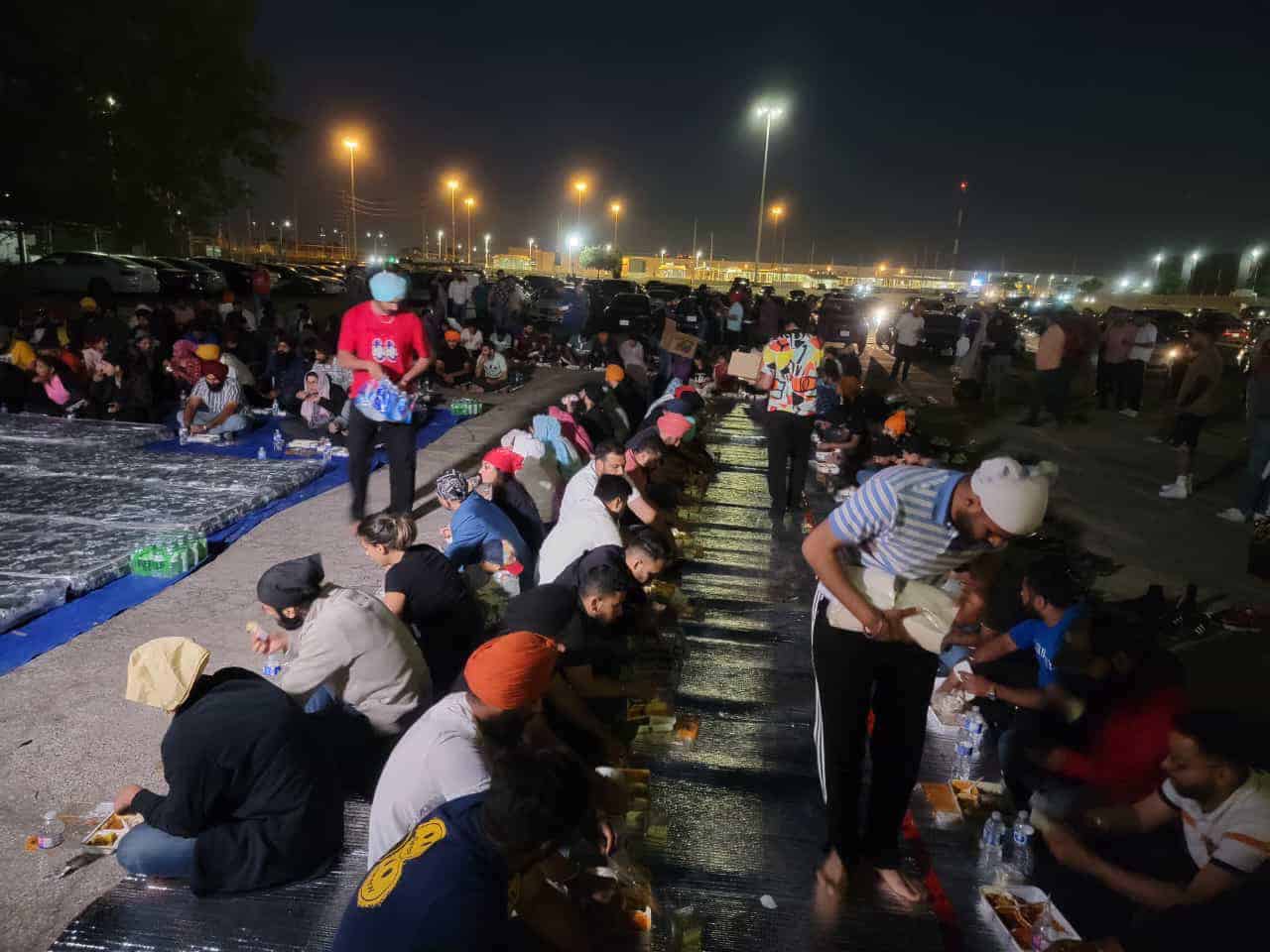
In the most recent victory’s aftermath, the organizers conducted a victory march, fateh morcha, which began with a recitation of the Guru Granth Sahib, and was followed by speeches and langar, food prepared and served freely by the Sikh community.
The Guru Granth Sahib is the sacred text of the Sikh religion, from which the NSN draws the belief that “ਆਪਣ ਹਥੀ ਆਪਣਾ ਆਪੇ ਹੀ ਕਾਜੁ ਸਵਾਰੀਐ,” meaning “with our own hands, let us resolve our own affairs.”
After their string of recent successes, NSN hopes to make their movement national, broadening their efforts to workers outside the Sikh community.
“NSN has two broad aims for the future,” said Parmbir Gill, a co-founder of NSN and a criminal defence lawyer in Toronto. “To support workers who are struggling against low pay, unsafe conditions, sexual harassment, inhumane productivity targets and disrespect, and to build relationships with workers’ organizations outside the Panjabi community who are fighting exploitation, in order to share knowledge and resources, and foster solidarity,”
NSN is the latest iteration of a long history of Sikh activism in Canada. Canada’s Sikh community has a long-held tradition of fighting against imperialism, racism, and capitalism, from the historic Ghadar movement to the Komagata Maru, to being active founders of the more recent Canadian Farmworkers’ Union and the Canadian Communist Party. NSN not only takes inspiration from this rich history, but advances it by building an alternative institution of power.
Seva is another crucial principle in Sikhism. It is the idea of selfless service, partaken for the larger good of the community and as a means of connecting with God. This principle informs much of NSN’s efforts to organize against exploitation and injustice.
“It is the spirit of seva that drew me to NSN,” said Jobanpreet Kaur Malhi.
Malhi, who joined NSN in 2022, never recovered the $3000 she has been owed since 2018 by French Sweets, who could not be reached for comment by The Breach.
At the time, she had no family in the country, and there was no movement to fight the exploitation she experienced.
NSN, she says, has given her both.
“We are international student-workers here, without families,” she said. “NSN is our family—a family that fights exploitation together, a family that helps us feel safe and get justice in a system that’s rigged against us.”

“It’s about getting to the bottom of things. It’s about unveiling who has the power and what they’re doing with that power.”
Linda McQuaig, journalist and author
As a non-profit, free from powerful corporate interests, we invest in investigations and uncover the cover-ups. Sustain our journalism for transformation.