
For those outside the Maritime provinces, New Brunswick might conjure images of small towns and the immense tides of the Bay of Fundy, along with a vague sense of an economy dominated by the Irving family.
Now, it is increasingly being seen as a land of opportunity by corporations from south of the border.
American mining and military interests, backed by funding from the U.S. Department of War and welcomed by a federal government under Prime Minister Mark Carney, are zeroing in on the province as a strategic frontier for extractive “nation-building.”
These forces claim that a trio of projects—a tungsten mine, a gas-fired power plant, and a sprawling data centre—promises revival.
But local organizations say they are designed instead to serve American supply chains, weapons production, and corporate balance sheets, while asking New Brunswickers and Indigenous nations to absorb the environmental and social costs.
Locals are now mobilizing, in the wake of months of patriotic rhetoric from Ottawa in the face of U.S. pressure that seems to have amounted to little.
“The fact that these projects are all associated with American investment or ownership is a pretty damning conclusion,” said Jim Emberger, a spokesperson for the New Brunswick Anti-Shale Gas Alliance that has been helping mount a resistance to the projects. “They’re not interested in finding new markets.”
And in the case of the gas plants, Emberger points out they will tie the region to the United States not merely for a short while, but for 30 to 35 years.
“What happened to ‘elbows up’?”
Mining for war
Northwest of Fredericton, the U.S. Department of War is eyeing one of the world’s largest deposits of tungsten and molybdenum. But accessing the metals requires building a new open-pit mine.
Tungsten is a “critical” resource used in defence and aerospace, including munitions, which explains the military interest. In November, Carney chose the Sisson Mine as one of his major nation-building projects, putting it in the running to get fast-tracked past certain laws.
Investors have been trying to launch the mine since 2007. “Because it’s an existing project, it looks like the federal government is doing something, and it catches this new wave of enthusiasm for rare metals,” said Emberger.
The mine would be developed by Vancouver-based Northcliff Resources, with minority ownership by New Zealand’s Todd Minerals Ltd. Though it received environmental approvals in 2015 and 2017, it never moved into construction. Now, new funding has reignited interest. The U.S. Department of War invested roughly US$21 million, and Natural Resources Canada committed C$8.2 million to support feasibility and engineering work.
Emberger noted the mine will bring limited economic benefits and create huge environmental problems. It will create just 500 jobs during construction and 300 during operation. China is the world’s largest producer of tungsten, and has the ability to tank global prices if it decides there are too many competitors—meaning the mine could suddenly turn into a money sink.
Because the site contains low-grade tungsten ore, mining it would create mountains of waste to be stored in enormous tailings ponds at the mouth of the Nashwaak River, which is crucial to Indigenous peoples, particularly the Wolastoqiyik (Maliseet), as part of their traditional territory.
During the mine approval process, Northcliff was required to present an assessment of what would happen if the tailings pond failed, and how the company would respond. This assessment has never been made available to the public.
American corporations move in
Advocates are also sounding the alarm on two other projects: a gas- and diesel-fired power plant near Sackville, and a massive data centre proposed outside Saint John.
Both projects would involve significant U.S. ownership and control—and both are being fast-tracked with the backing of provincial and federal authorities.
Missouri-based ProEnergy, in partnership with N.B. Power, a provincial Crown corporation, proposed a 500-megawatt gas-fired generating station in the rural municipality of Tantramar. N.B. Power executives have described the plant as a “Swiss Army knife” for the grid, meant to backstop renewable energy, replace coal, and meet peak demand.
But local officials and residents say the site was chosen less for public interest than for speed: N.B. Power has acknowledged the location faces the fewest hurdles for infrastructure and regulatory approval.
The gas plant has raised eyebrows as well as elbows. ProEnergy’s parent company donated nearly a million dollars to Republican politicians and candidates in 2024, and the company has openly pressured the province to rush approvals. N.B. Power has warned that unless regulatory sign-off is completed by April 2, 2026, ProEnergy will take the project elsewhere. In response, the province has compressed the hearing schedule, shaving weeks off the public review process.
“The government caved,” said Emberger. “Now they’re cutting a month off the hearing schedule, which makes it really hard on citizen groups that are trying to oppose this.”
Community organizations are now scrambling to line up expert witnesses and technical reports, while Tantramar council has formally opposed the project and called for its suspension.
Risks around water use and pollution have further eroded trust among residents. N.B. Power officials have acknowledged the plant is likely to affect local groundwater, and that the facility would burn diesel fuel for up to two weeks a year when natural gas supply is unavailable.
Meanwhile, a Texas- and Calgary-backed consortium—VoltaGrid and Beacon AI Centers—has proposed a sprawling data centre outside Saint John.
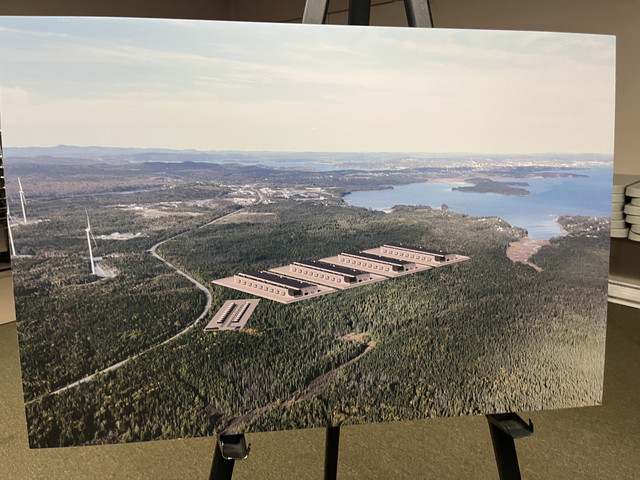
If built, the data centre would draw half its power from the provincial grid—amounting to nearly half the output of the proposed Tantramar gas plant—with the rest of its energy coming from on-site gas-fired generation. N.B. Power has denied any formal link between the two projects, but critics argue the scale of the data centre helps explain the urgency behind new fossil fuel infrastructure.
Local residents are alarmed by the environmental footprint. The site sits atop mature and old-growth forest, wetlands, and peat bogs that would be cleared to make way for the facility, with homes located a three-minute walk away.
A local group, Save Lorneville, has launched a judicial review challenging the city’s rezoning decision, raising concerns about noise, water use for cooling, and well water contamination.
For Wolastoqewi Grand Chief Ron Tremblay, it comes as no surprise that Canada would allow foreign companies to exploit his people’s homeland. Still, he said the federal and provincial governments’ support of this slate of U.S.-backed projects is the equivalent of them “cheating on Canadians.”
Tremblay has defended Wolostokuk land against the Sisson Mine for nearly a decade. He recently travelled to New Zealand, where he met with the Todd family behind Todd Minerals Ltd, which has a stake in Northcliff and the Sisson mine. He informed them there would be “major resistance” to the project.
“The settler population can move and leave and go wherever they want, but for us, this is our homeland,” he said. “We can’t call another place home. So I said we will defend the land. We can’t control our people when they want to go out on the land to defend it. They will.”
Fighting against the rush
A movement is growing across the province to resist the recent development announcements. The Protect the Chignecto Isthmus Coalition, an alliance of 15 organizations including environmental, health, and community groups, is standing up against the Tantramar gas plant.
“It’s one of the largest coalitions in New Brunswick history,” said Emberger, and is similar to the grassroots movement that sprung up against Hydro Quebec’s attempted acquisition of N.B. Power in 2010 or the anti-shale gas movement of 2013.
Organizing in New Brunswick can be complicated, according to Emberger. It’s a rural province, and large gatherings are tricky to organize as they require people to commute for hours. However, this movement has birthed multiple grassroots tactic—digital campaigns, flyers, town halls, and social media groups such as Stop the Tantramar Gas Plant and Save Lorneville.
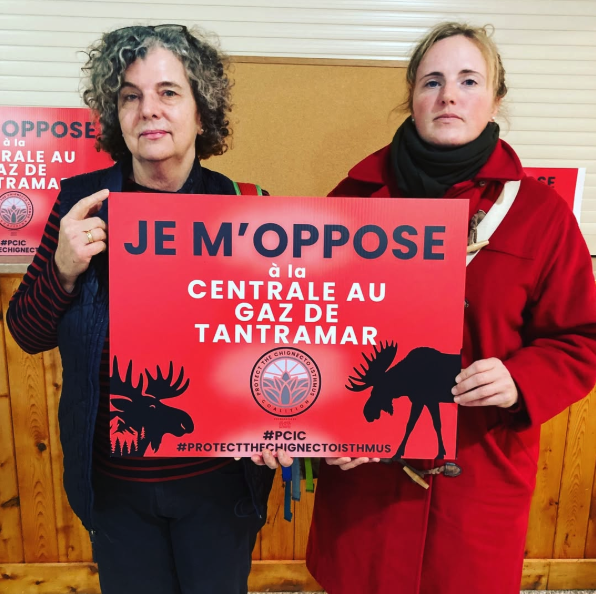
One of the coalition’s focuses has been helping New Brunswickers understand the power they have.
“Over and over we hear folks that we interact with that aren’t even aware that they have that right to speak to their member of Parliament or their member of the Legislative Assembly,” said Melanie Langille, president and CEO of New Brunswick Lung, one of the province’s oldest charities dedicated to improving air quality.
New Brunswick Lung is primarily concerned about the health impacts the gas plant would have. “Air pollution is one of the biggest drivers of lung disease and also exacerbation of existing lung conditions,” she said.
According to the group, one in five New Brunswickers already lives with lung disease. This gas plant would bring with it health problems associated with the combustion of fossil fuels.
“There seems to be a troubling trend towards eroding the environmental protections that our neighbours have enjoyed in the past,” Langille said of the recent projects.
New Brunswickers want the government to commit to investing in the well-being of the land and the people that live there.
For Ron Tremblay, this would involve returning land and land names to the Wolastoqewi. For starters, he said, the names of the river running through their territory could be returned. Beyond that, he wants his people to regain management of their own lands.
“Let’s start talking about Crown land that really belongs to our people,” he said.
For coalition members, this means investments in green energy and transportation. They’re calling for publicly-owned clean power to respond to the province’s projected energy shortage. They’d like to see a nation-wide power grid built.
“Alternatives exist,” said Langille. “We are very quick to rely on what we’re comfortable with, what we have used in the past, which is combustion of fuel for energy, but that leads to health impacts. We can do better.”

When I went to journalism school 10 years ago, my parents thought that they would eventually read my articles in The Montreal Gazette. Today, that newspaper is a husk of its former self. But I get to explain that I’m working towards critical, independent, and sustainable journalism.
Want to be a part of the future of journalism? Support our work with a monthly contribution. Sign up here.
– Amanda Siino, Development Director, The Breach