Joshua Richards was never that interested in politics—until 2020. Watching news about George Floyd’s murder and the subsequent Black Lives Matter protests, the 36-year-old was inspired to read about police forces in Canada. He started to feel that Toronto’s police force was “severely overfunded” at the cost of other services.
When Richards learned that former police chief Mark Saunders was running for mayor in Monday’s byelection, he said he was “genuinely upset,” but didn’t know what to do about it.
A few weeks later, he came across tweets going after Brad Bradford, another candidate in the mayoral election. A Twitter account called BradfordFactsTO was posting satirical content, like a dubbed video—which has been viewed 245,000 times—where Bradford appears to say, “I’m running for mayor because I’m ambitious. I’ve been in council for five years, voting against rent control and to violently clear people from encampments.”
“At first, it just made me laugh,” Richards said of the posts. “And then I was like, ‘You know what? I have time. I’m passionate. I want things to change around here. How can I get involved?’”
The tech professional shot off a direct message offering his expertise in search-engine optimization.
Now Richards is the “randomest” member of the Toronto Citizens Collective (TCC), according to Britt Caron, one of the group’s original members.
Richards helps juice the Google rankings for the collective’s websites so that they show up when voters search the candidates’ names. And he’s the “flyer guy,” going to the print shop to pick up their materials.
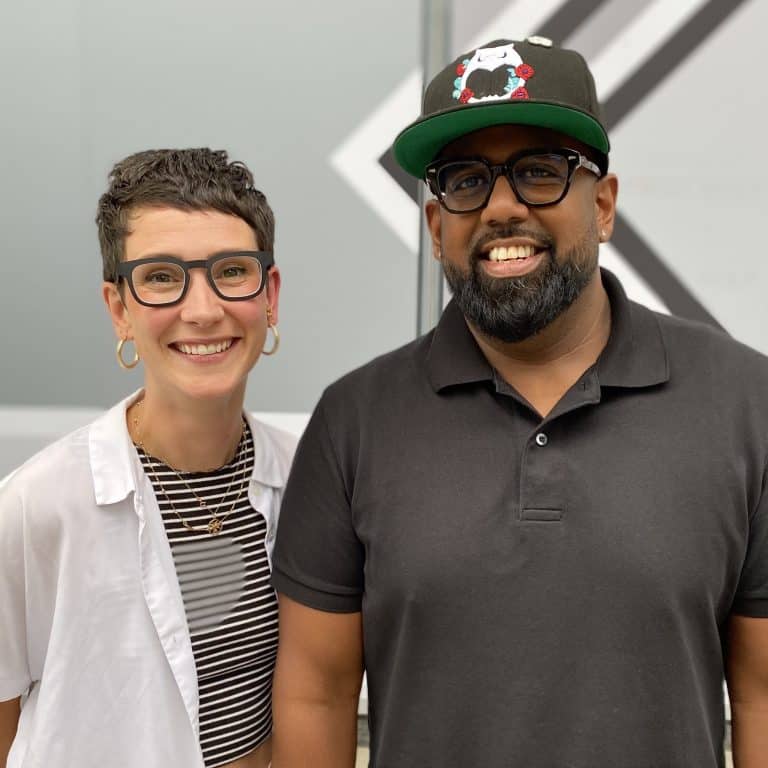
The collective started out as a Twitter chat for Caron, 34, and her neighbours. They all lived in Bradford’s ward of Beaches-East York and wanted a place to air complaints about his voting record and politics, which they disagreed with.
When former mayor John Tory resigned and Bradford started putting out campaign materials, the neighbours decided to mount a campaign against him. They made posters highlighting his voting record and a song and hashtag, #FreePaul, making fun of Bradford’s anecdote about renting his basement to his best friend, who can’t afford to live anywhere else.
As other candidates joined the race, the group expanded.
“We just decided that we were going to mount an accountability based campaign to say, ‘Here are some people who actually have had a role in shaping the city that we have right now,’” Caron said. “And if we’re unhappy with it, then we can’t elect them to the mayor’s office.’”
They’ve since registered as an official third-party advertiser so that they can fundraise and spend money during the election period. They’re now running three campaigns against the candidacies of Bradford, Saunders and Ana Bailāo.
And they do it all online, with no in-person meetings, making decisions in a Discord chat.
Collective swelled in size during mayoral campaign
Over the course of the 2023 mayoral election, the collective has doubled its members to about 15 to 20 people. Most of them had never met before, Caron said.
Their materials hone in on certain aspects of each candidate’s record.
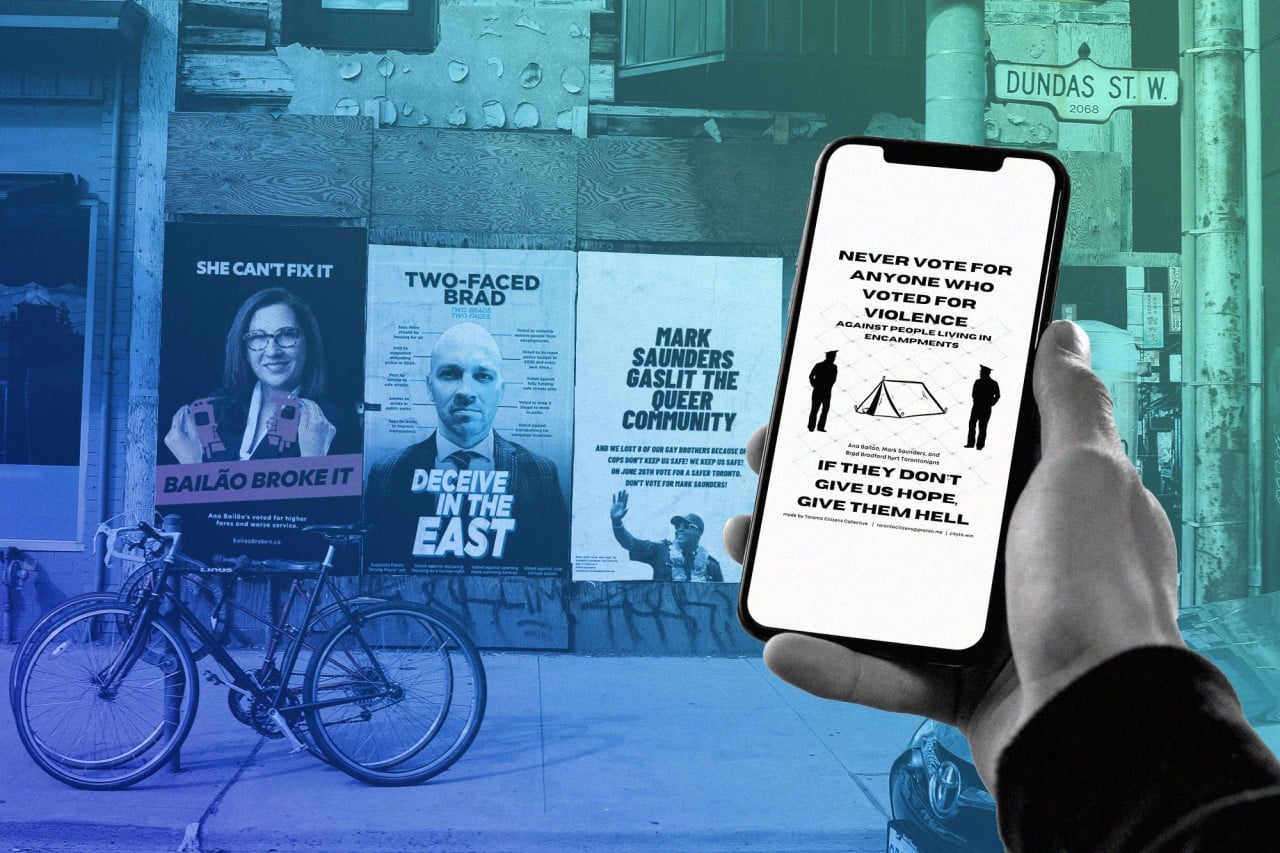
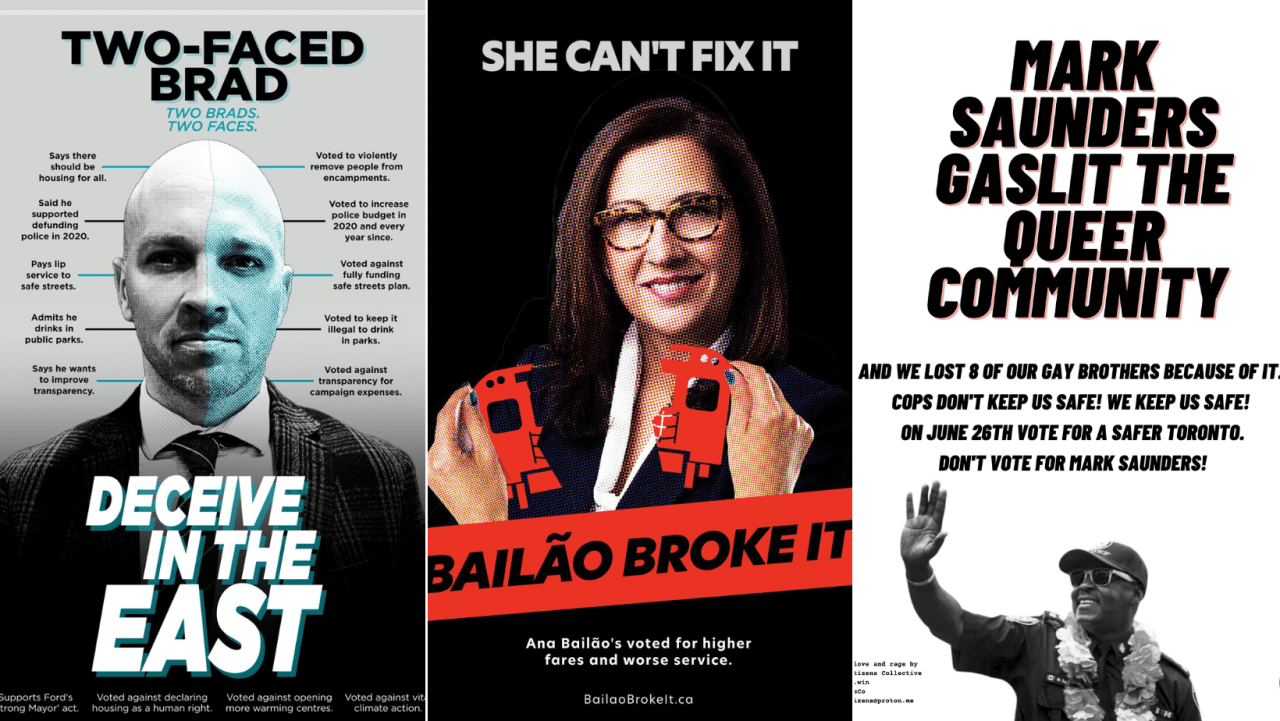
The “Bailāo Broke It” website and Twitter account highlight former councillor Bailāo’s votes against adding 1,000 new shelter beds, against defunding the police by 10 per cent and for higher rent increases on certain units.
The Bradford site highlights his votes for fare increases on public transit, against stricter rent control and for encampments of unhoused people to be cleared from parks.
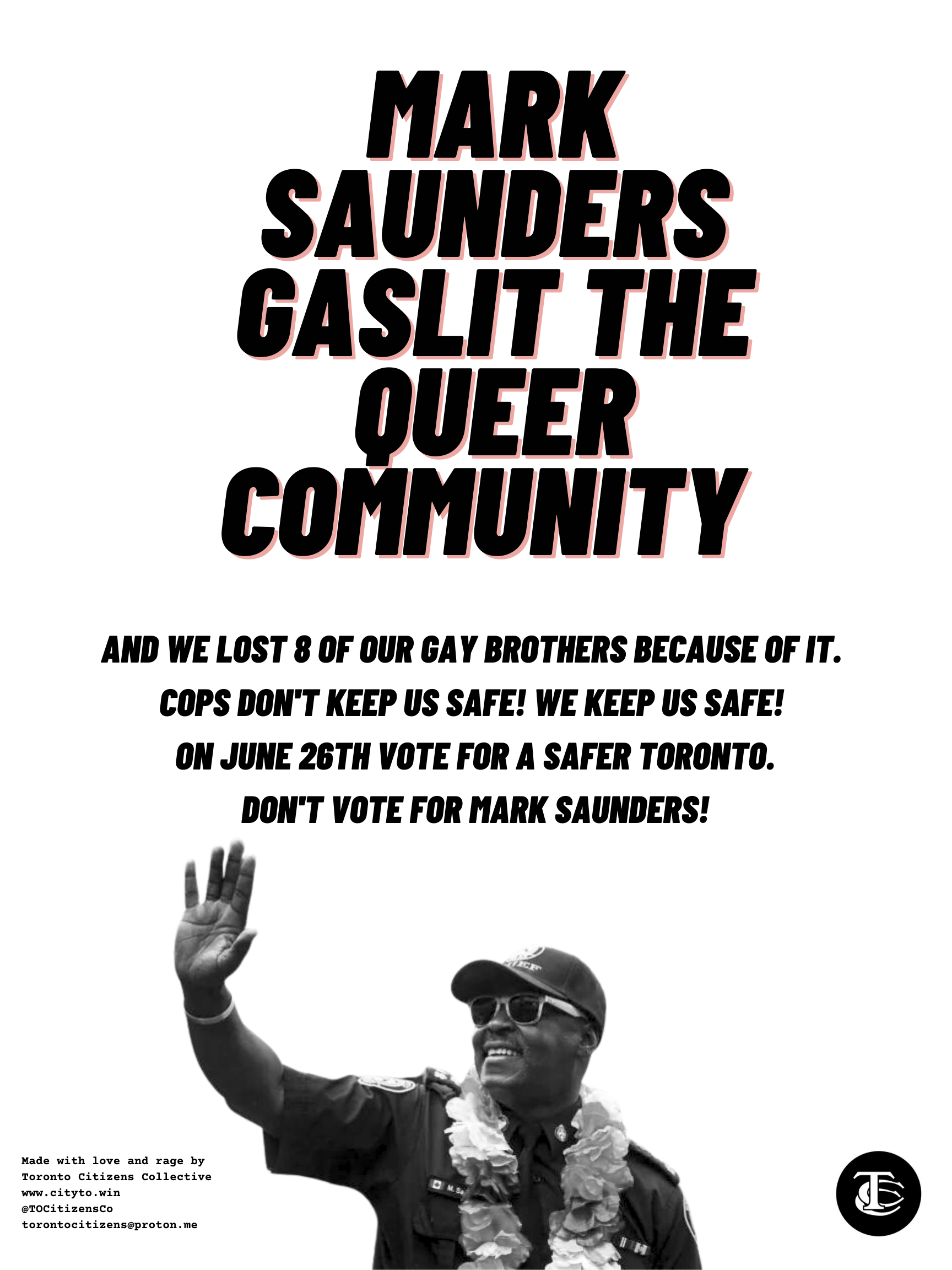
And a striking poster featuring a photo of Saunders wearing a lei around his neck at Pride declares, “Mark Saunders gaslit the queer community.”
Saunders was deputy chief in charge of special operations when serial killer Bruce McArthur was interviewed by police and let go in 2014. Saunders then blamed the police’s failure to catch McArthur on civilians, even though the LGBTQ community in Toronto had long suspected a serial killer was targeting gay men and organized their own safety programs.
The collective’s goal has been to raise money from people who like their online content and spend that money on old-school supplies, like posters and flyers, in order to have an offline impact. And they believe it’s working.
A few thousand dollars have been spent on 4,000 flyers and about 500 posters. Caron has fielded calls from strangers who see her online or on TV, and ask for deliveries of posters to put up in their buildings and neighbourhoods.
Creating an ‘easy way’ into municipal politics
Richards said they’re creating an “easy way” into politics. So far, he said it’s working on his group of friends, who don’t normally pay attention to local elections.
When he shows them their content, Richards said, his friends say, “‘That was jokes. Now, I want to know what it’s really about.’”
The group has been flexible, adapting its strategy as new polling and new information comes out. They discussed endorsing a specific candidate, but decided against it—in part because the group isn’t actually unified on which candidate would make the best mayor.
But they believe their materials have had an impact.
Last weekend, Richards said he ran into an acquaintance at Dundas West Fest and the person told him they were torn between Bailāo and Olivia Chow.
Richards pulled up the Bailāo Broke It website on his phone.
“They were shocked,” he said. “By the end of the conversation, they were like, ‘I think my decision is made.’”

“It’s about getting to the bottom of things. It’s about unveiling who has the power and what they’re doing with that power.”
Linda McQuaig, journalist and author
As a non-profit, free from powerful corporate interests, we invest in investigations and uncover the cover-ups. Sustain our journalism for transformation.