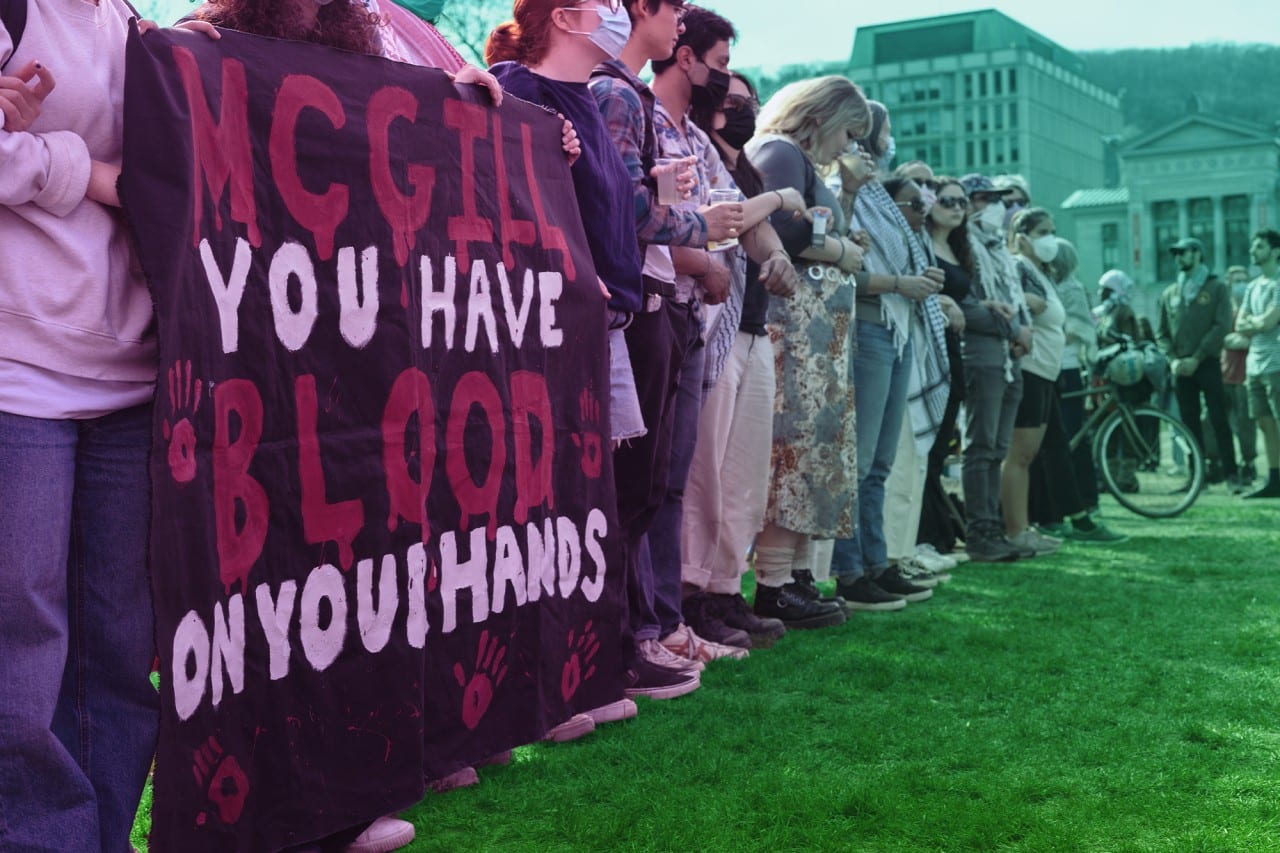
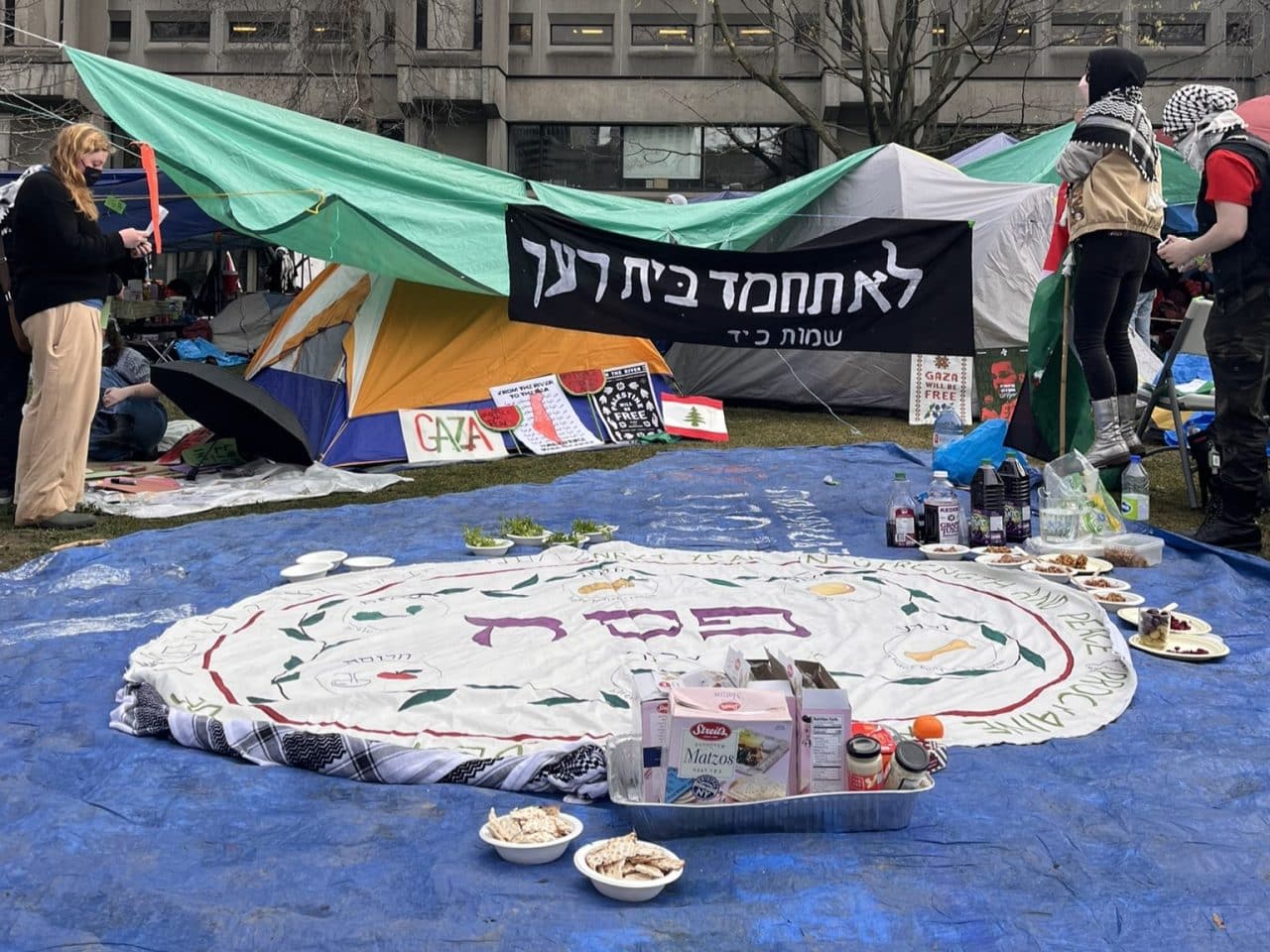
For a supposed hotbed of antisemitism, the scene at McGill’s Gaza protest encampment was distinctly Jewish: giant bottles of kosher grape juice and matzah bread piled on the ground, the fixings for a Passover dinner.
On Sunday, when I visited the university’s campus, now the source of daily national headlines, a large group of students were settling in for this religious ritual.
Passover tells the story of Jewish struggle against enslavement in Egypt—including the Pharaoh’s commandment to kill every newborn boy. It’s also the most justice-oriented of our holidays, demanding we apply the imperative of liberation to the present.
“In the midst of Israel’s genocidal assault on the people of Gaza,” one Jewish student read out to the circle, “these verses now resonate with unbearable urgency.”
As students passed around the flat matzah—symbolizing the meager “bread of affliction” baked quickly while fleeing Egypt—they wove in the current reality of Palestinians in Gaza, enduring a catastrophic famine imposed by the Israeli blockade.
In the middle of the circle, a large painted tapestry depicted Passover’s other symbolic foods. In the background, a large Hebrew banner hung on a fence: “thou shall not covet thy neighbour’s home.”
Many were first-time participants in such a meal. People drummed and sang Hebrew songs.
This environment—of respect, curiosity, and support for freedom, apparent at Passover and through the rest of the camp—is what B’nai Brith claimed this week represents a “horrifying normalization of antisemitism on university campuses.”
It’s what the Centre for Israel and Jewish Affairs claimed was a “toxic” situation full of “calls for violence and antisemitic slogans.”
I witnessed no such thing.
“The passover seder was part of the official programming of the encampment, and it was a testament to the diversity of voices involved in the organizing,” Ezra Rosen, a 24 year old student with the group Independent Jewish Voices at nearby Concordia university told me later.
It was also a rebuke to all those calling for police to dismantle the peaceful camp: McGill’s administration, Israel lobby groups, and pundits and politicians that now include Quebec’s premier François Legault.
The smears are a desperate attempt to deflect attention from the student’s anti-racist principles and carefully-researched demands: that McGill divest from weapons companies implicated in Israel’s assault on Gaza, and cut ties with Israeli universities that have enabled Israel’s rule over Palestinians.
The smears are also an attempt to invisibilize the many young Jewish students involved in the encampment, and the growing numbers who think similarly.
An injunction filed earlier this week on behalf of two McGill students claimed the encampment had “created an environment of aggression, hatred, and violence.” It named the Palestinian groups involved, but strategically avoided mentioning the two Jewish student groups that have been central to the organizing. When lawyers on behalf of Jewish groups successfully intervened in court, the plaintiff’s lawyer was visibly annoyed.
To support their case, the best the plaintiff’s lawyers could muster was claiming the chants of “intifada” were a “call for armed violence”—when it in fact means “uprising” or “shaking off.”
McGill’s admin has been putting their own statements that they “saw evidence of appalling antisemitic rhetoric and behaviours.” That netted them headlines in The Globe and Mail like “McGill calls pro-Palestinian camp illegal, levels accusations of antisemitism at protesters.”
When they finally provided the evidence, it was a video that had already circulated on social media—and encampment organizers told me it wasn’t from people within their ranks, but those who had showed up for the frequent rallies that stop by the campus.
In the video, a small group heckles an Israeli student to “go back to Europe.” Such anti-colonial maximalism is offensive and stupid (where in Europe would Israeli Jews go back to—the towns and homes they were dispossessed from?). But tarring the entire encampment on this account is wildly inappropriate.
For one thing, I got a glimpse of the de-escalation training being conducted regularly under large tents. If individuals show up with bullhorns or antagonistic remarks, the students typically link arms and refuse to engage—which makes it even less plausible that those caught on camera were the students.
For another thing, the organizers are trying to create a camp culture with a heightened awareness of racism.
They’ve developed community guidelines that forbid such behaviour. When some tasteless posters were put up on the camp’s fence, they were taken down. A workshop on antisemitism happened on Thursday; a Shabbat dinner is being planned for Friday.
Ezra Rosen from Independent Jewish Voices told me “he’s never felt so safe in a community. Everyone is always checking up on one another.”
Like any Jewish person, he’s always on the “lookout” for antisemitism. “I’m confident that I know what it looks like. I’m confident that there’s none of it here.”
These facts are awkward for apologists for Israel’s policies toward Palestinians, who’ve long relied on undermining support for Palestinian self-determination with false charges of antisemitism. As Israel’s murderous bombardment of Gaza has reached horrendous proportions, those accusations have only grown more brazen and unfounded.
Liberal MP Anthony Housefather, the first politician to call for the camp to be dismantled by police, appears confident he’ll be granted a parliamentary committee to study the antisemitism supposedly exploding on campuses.
Two decades ago, when I was a Jewish student at McGill, such notions carried more weight. We Jews expressing solidarity with Palestinian rights were few in numbers. But as an upswell of Jewish people have joined these protests over the past months, the smears are losing their power.
While the establishment media initially ran with “antisemitism” headlines, for instance, they’ve since given ample opportunities to Jewish students and professors to counter it. And as the encampment has continued, the media has started to press McGill’s administration on its investments, even pointing out that their claim that it’s too complicated to divest is “silly.”
It’s not a technical question. It’s always been a question of power. Decades ago, similarly unruly actions by students finally forced the McGill administration to become the first university to divest from South African apartheid (a fact the university now boasts about on their website).
Such is the ability of protest to upset the status quo.
When I visited the camp again briefly on Wednesday, I spoke to Miriam Liben, another student with Independent Jewish Voices.
“Camping out is not exactly pleasant,” she said. “It was pouring rain all day yesterday. But we’re here because we don’t see any other choice.”
The camps, while inspired by those in the U.S., have come after many years of organizing. McGill students have passed motions in cross-campus assemblies to call on the university to divest. The administration responded by threatening to cut funding to their campus union. Since October, rallies, mass petitions, meetings behind closed doors have resulted in nothing. Last month, a student conducting a multi-week hunger strike was hospitalized.
Now they’re doing what many of us have for a long time hoped for: building brave new alliances for justice.
As the sky over the McGill university’s campus turned into dusk on Sunday, the Passover seder ended with Rosen reading out some final quotations.
They included a passage from Dutch Jewish author Etty Hillesum, murdered by the Nazis in Auschwitz.
It might as well have been another poster pinned along the encampment’s fence, an expression of their commitment to fight a genocide in Gaza, while fighting the hatred that they’ve been falsely accused of.
“Each of us must turn inward and destroy in himself all that he thinks he ought to destroy in others,” he read. “It has been brought home forcibly to me here how every atom of hatred added to the world makes it an even more inhospitable place.”

“It’s about getting to the bottom of things. It’s about unveiling who has the power and what they’re doing with that power.”
Linda McQuaig, journalist and author
As a non-profit, free from powerful corporate interests, we invest in investigations and uncover the cover-ups. Sustain our journalism for transformation.
Campus Activism | Historic student movement for Gaza reaches Canada

Palestine Solidarity | Why thousands of Canadians are joining the ‘Free Palestine’ movement
Heather Reisman | In stunning pre-dawn raids, Toronto police ‘terrorize’ Palestine activists

4 comments
Comments are closed.

It looks like the students are following the wise advice of the late Les Barker: “Never argue with a fool, for he is doing the same.”
You write that “go back to Europe” statements are “anti-colonial maximalism” that are
“offensive and stupid”. To live in Canada as a non-Native, and make claims that non-Indigenous Jews should “go back” is, indeed, hypocritical. I don’t know who the people who made the comment are, but as to it being offensive, I wonder if you would have the same standards if you heard Indigenous peoples of Canada saying the same thing to Canadian White Europeans? Or, would you understand the tragic context of those that say this and the deep frustration they feel? I am an Iranian with well established and deep Jewish heritage, but I do not have a right to land in Palestine. Full stop. It’s really not that complicated. I think most simply want the illusion of Indigeneity of European Zionists and/or Israeli residents to stop, and for the admission of truth and reconciliation to start. It won’t happen with the unhinged belief of God being a real estate agent, a holy book as historical evidence and/or an imagined account of lineage. If you are the inheritor of a colonial project, live on the land in equity and peace, but recognize where you came from. The current settlers from places like the USA who are actively displacing/killing Palestinians are, however, another story.
It’s time that both parties get together and resolve the situation… They are not ignorant today they are lucky they got the EDUCATION to resolve the issues between them by dialogue and not war… They been fighting for so many years and none of them won… This new educated generation should use another way to end this.. They should get together and try another tactic
Thankyou peaceful dedicated to weapons divestment students. You’ve opened Canada’s Pandora box of profiting from misery and death by way of weapon sales, investments in both sides of conflicts, through university, and the $2 trillion of Canadian retirement funds. Keep the peace dear students while we readers reveal the hidden horrors of unethical Canadian investments to our friends and families, to join you in demanding divestment from weaponry profit. Bravo 👏❤️