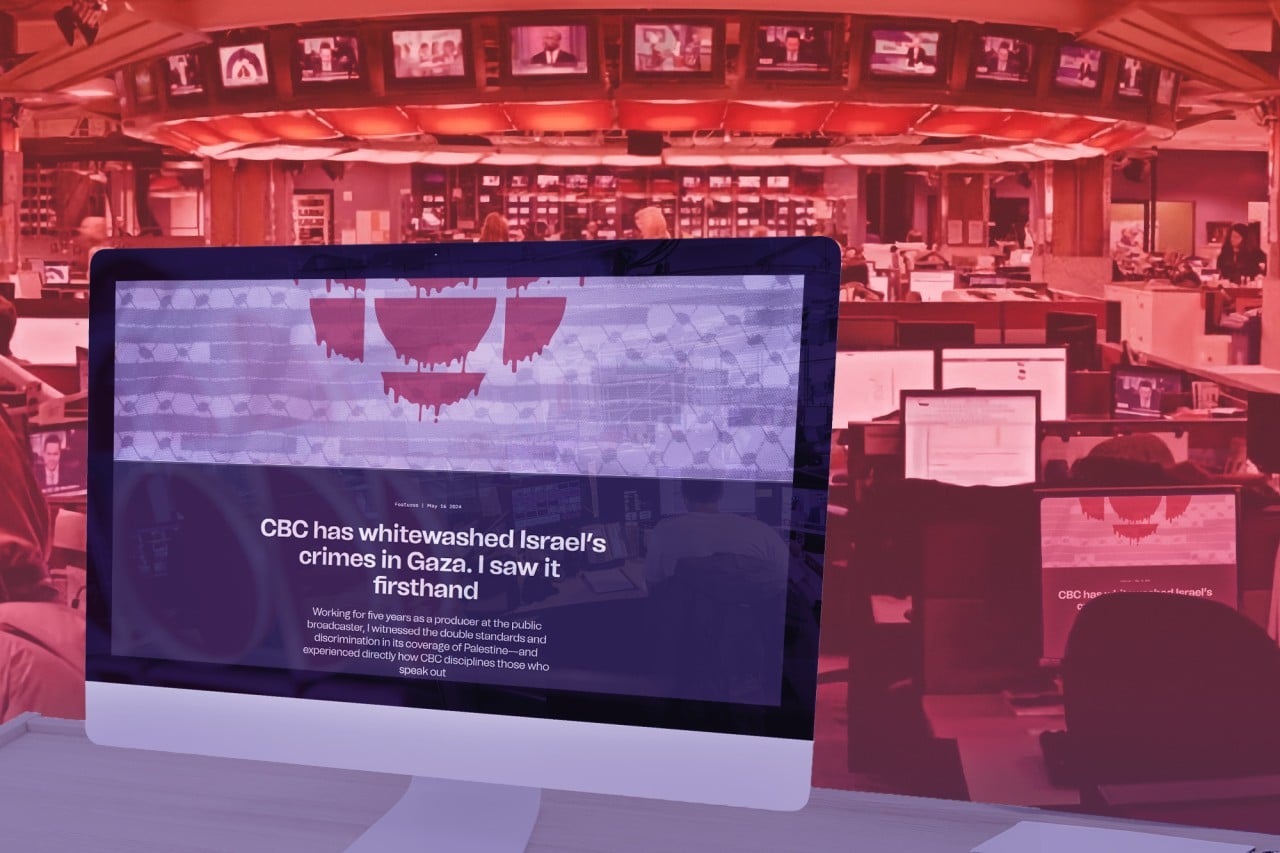
At CBC’s Toronto headquarters last Thursday, an employee walking through the newsroom noticed several people’s monitors displaying the same page: an essay in The Breach, written by one of their former colleagues, revealing behind-the-scenes details about the broadcaster’s reporting on Israel-Palestine.
Meanwhile, CBC’s top managers were scrambling to meetings to discuss how to handle any fallout from the exposé, which was widely shared on social media, prompting calls for the reevaluation of its approach.
The essay—in which a producer of Jewish background shared her experiences witnessing biased decision making and unprecedented scrutiny of Palestinian guests, before being labelled antisemitic for raising concerns about the coverage—spread like wildfire among staff at the public broadcaster, according to conversations The Breach conducted with several CBC employees.
It elicited a quick public response, less than 24 hours after publication, from CBC editor in chief Brodie Fenlon, who wrote that the essay’s “broad conclusions are not true,” without addressing the specific assertions in the article.
But in its latest response to The Breach, CBC has shifted its tune, suggesting that its coverage over the past months has “improved” because it took seriously the “feedback” of the author of the Breach essay.
In interviews, five employees who work in radio and broadcasting said the article resonated with them, shared similar experiences of navigating anti-Palestinian bias, and expressed fears of being falsely labelled as antisemitic. One veteran producer said the editor in chief’s denial’s were “ludicrous.”
All said the essay elicited mixed reactions among their colleagues, with more precarious, younger workers tending to identify more with author Molly Schumann, and more established employees tending to defend CBC’s top managers.
All five, who requested to remain anonymous for fear of retaliation, said they were either baffled or insulted by Fenlon’s note—first sent in an email to staff and later published online—in response to the essay. For the sake of clarity, The Breach has added gender-neutral pseudonyms to some sources in this article to protect their anonymity.
Biases in CBC coverage of Israel-Palestine have been documented in previous years by various sources, including the Toronto Metropolitan University’s Review of Journalism and senior CBC employee Pacinthe Mattar in the Walrus.
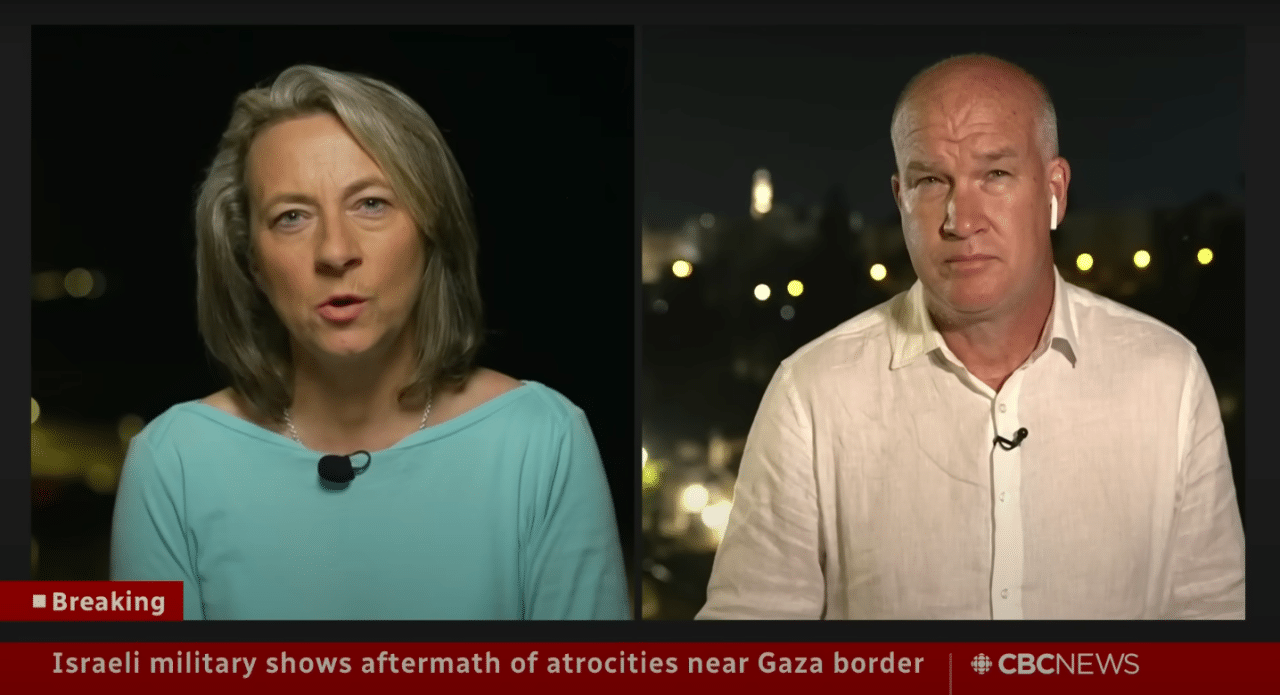
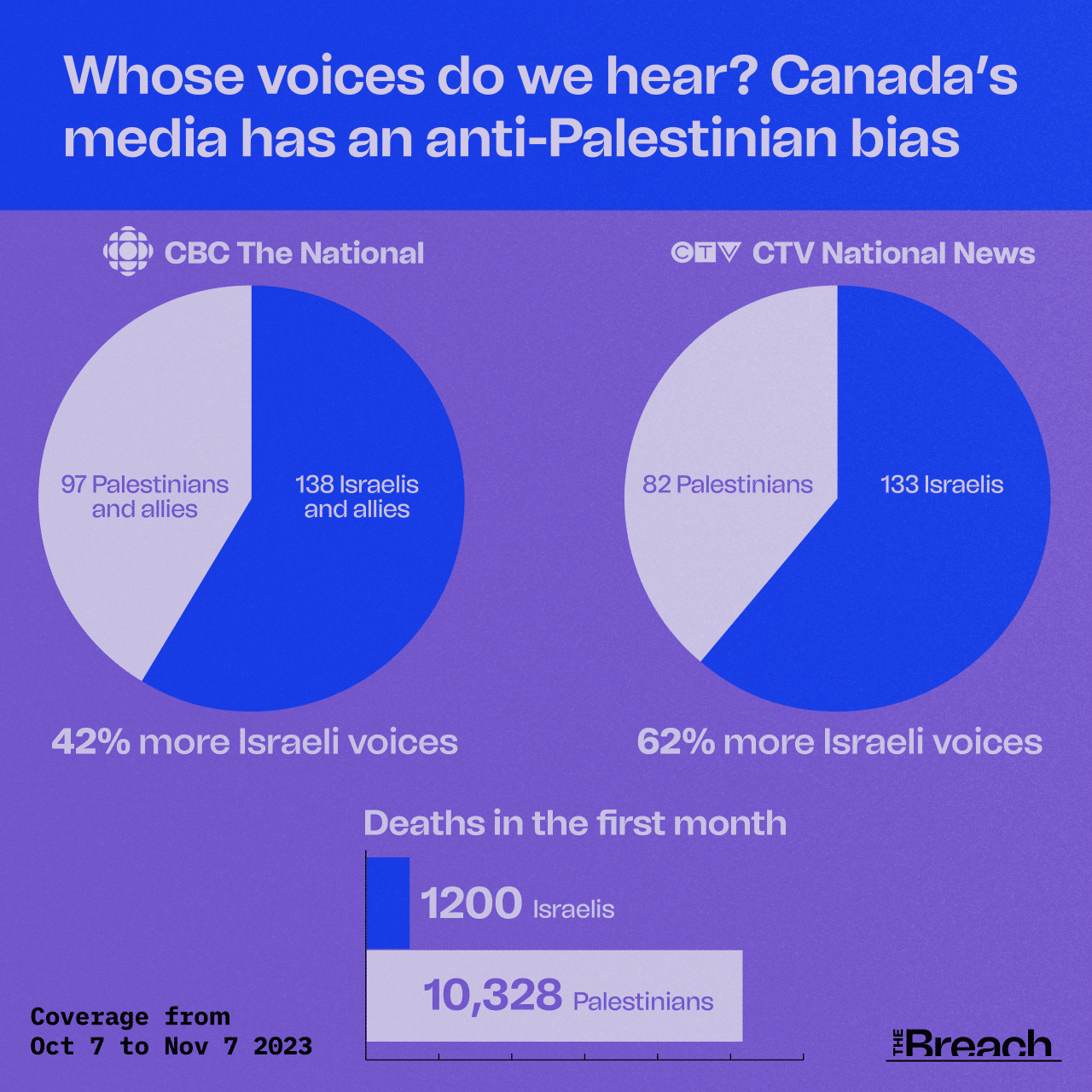
Reports in The Breach since Oct. 7 have revealed its flagship shows aired far fewer Palestinian voices than Israelis, and that senior managers of journalistic practices at CBC believe it is justified to use less emotive language to describe the killing of Palestinians compared to Israelis.
This existing context was raised by several of the employees interviewed by The Breach.
The Breach sent multiple specific questions to CBC about employees’ responses to the Breach essay, which it answered with a statement.
“We have taken a number of measures to support staff through [the story], always working toward a more inclusive newsroom environment. Those measures include training, coaching for editorial leaders, and our peer-to-peer support network,” wrote Chuck Thompson, head of public affairs at CBC.
“Our coverage is strong and has improved, in part thanks to internal feedback by many employees from a wide range of backgrounds and seniority levels, including months ago from the author of The Breach essay. Critical voices are not silenced, they are encouraged.”
Palestine, a workplace security issue
Cam, a radio producer who has worked at CBC for decades, said they were most troubled by the accusation of antisemitism levied by co-workers against the author of The Breach essay, the pseudonymous Molly Schumann.
In a team meeting Schumann described in The Breach, she said that a factor shaping their coverage was the fear of getting flooded by email complaints from pro-Israel lobby groups like Honest Reporting Canada.
A week later, a manager informed Schumann that someone had accused her of antisemitism for referring to the “Jewish lobby.”
But recordings of the meeting reviewed by The Breach prove that Schumann—whose father is a Holocaust survivor—did not say those words.
In response to The Breach’s questions about the antisemitism allegation, CBC spokesperson Chuck Thompson said the corporation is “limited in what we can say” about “confidential employee matters.”
“A number of employees expressed concerns that some of her comments and behaviour in a team meeting were hurtful, disrespectful and discriminatory,” he added.
The false allegation of antisemitism levied against Schumann is, for Cam and some of their colleagues, a workplace safety issue.
“If she hadn’t taped that conversation, the accusation of what she was alleged to have said by whatever colleague may have stood,” Cam said. “Are we supposed to walk around thinking that false allegations are going to be made about us in terms of what we say about the story, and we should all be recording our conversations?”
The fact that Fenlon and management’s response did not address this, “I found really negligent, as did other people,” Cam said.
Job security is a major factor, a number of employees said, in their ability to speak up. Over a quarter of CBC’s workforce are temporary.
When a producer on Cam’s team objected to a Palestinian historian being put on air, Cam could ignore them. “I have the comfort of being able to do that because I have 30 years of experience and I’ll retire in three years,” they said. “But I know the younger ones don’t.”
In another newsroom, for a different CBC show, a younger producer said they have been having a difficult time getting Palestinian voices on air for the same reasons Schumann highlighted in her essay.
“I’m just concerned that if I keep raising these issues, I’m going to get labelled as an antisemite,” they said.
Another temporary employee, a reporter on a multimedia unit, said that despite some shifts, it’s a problem that the word “Palestine” will still get edited out of drafts.
“Even just being comfortable enough to have these sorts of conversations and to be more critical,” they said. “It depends on how stable you are at your job and I think all of that factors into whose opinions get heard.”
Acts of editorial resistance
In their team, Cam says they regularly pitch coverage of Gaza and the war’s connections to Canada, which gives younger members of their team space to do the same.
But across the nearly 50 cities in Canada that the CBC operates in, many teams don’t have senior members like Cam.
Del, a pseudonym for a producer on the opposite side of the country from Cam, said some of the conversations Schumann wrote about in the essay “played out almost word for word in my station too.”
“It was kind of validating to be like I’m not alone,” they said. “Our newsroom isn’t the only one that’s facing these issues. It goes all the way to the top.”
Some older colleagues on Del’s team and other teams celebrated Fenlon’s response and criticized the author of The Breach essay for writing under a pseudonym. In some units, colleagues spent time trying to figure out the real identity of Molly Schumann.
“I find this happens any time the CBC gets scrutinized in a public way,” Del said. “Some of the younger staff will be like ‘100 per cent this criticism is valid, we can see this happening.’ And among the old guard, their instinct will automatically be to get defensive and dismissive, instead of maybe contemplating or digging into why this criticism is arising.”
At Del’s station, they said reporters’ scripts “would get edited to the point of meaninglessness” when they tried to interview anti-war protesters who had been gathering in their city weekly since mid-October. Guests, including an acclaimed former CBC reporter, were told their interview would be pre-taped instead of being live because of what language they may use to describe the Israeli assault on Gaza.
Still, Del and another producer on their team said reporters pushed back on their local managers’ attempts to muzzle Palestinians or guests speaking in support of Palestinian rights.
“There were times when we changed scripts back to their original, accurate wording after they were sanitized or de-fanged by higher-ups,” Del said, adding that some producers who “got it” would keep guests’ words intact and used active language in their scripts like “an Israeli bombing killed Palestinians” instead of “Palestinians were reported dead.”
Change at a glacial pace
None of the people interviewed said they are hopeful that the essay will cause CBC managers to properly address clear anti-Palestinian biases in coverage.
For Cam, 30 years at the public broadcaster has taught them that it’s “ludicrous” to say there is no anti-Palestinian bias at CBC, as Fenlon’s note suggested. They believe that lasting change at the corporation happens at a glacial pace.
“That reluctance to put on Palestinian voices has always been there,” Cam said. “But honestly at one point, there were none. At least now, there is a comfort level in some quarters that it’s okay to talk to Palestinians, or Middle Eastern people for that matter, about this story. Much more than there was five years ago, where they would have always been seen to have a bias and not to be trusted sources.”
On the other hand, several employees noted that since Oct. 7, Israeli officials and pro-Israel commentators were often allowed to go unchecked on live radio and broadcast segments.
“I have seen egregious things happen,” Cam said, “like them putting on an Israeli official in the middle of December and letting him go off about beheaded babies and how Hamas is coming for us in Toronto and Vancouver and not challenging him.”
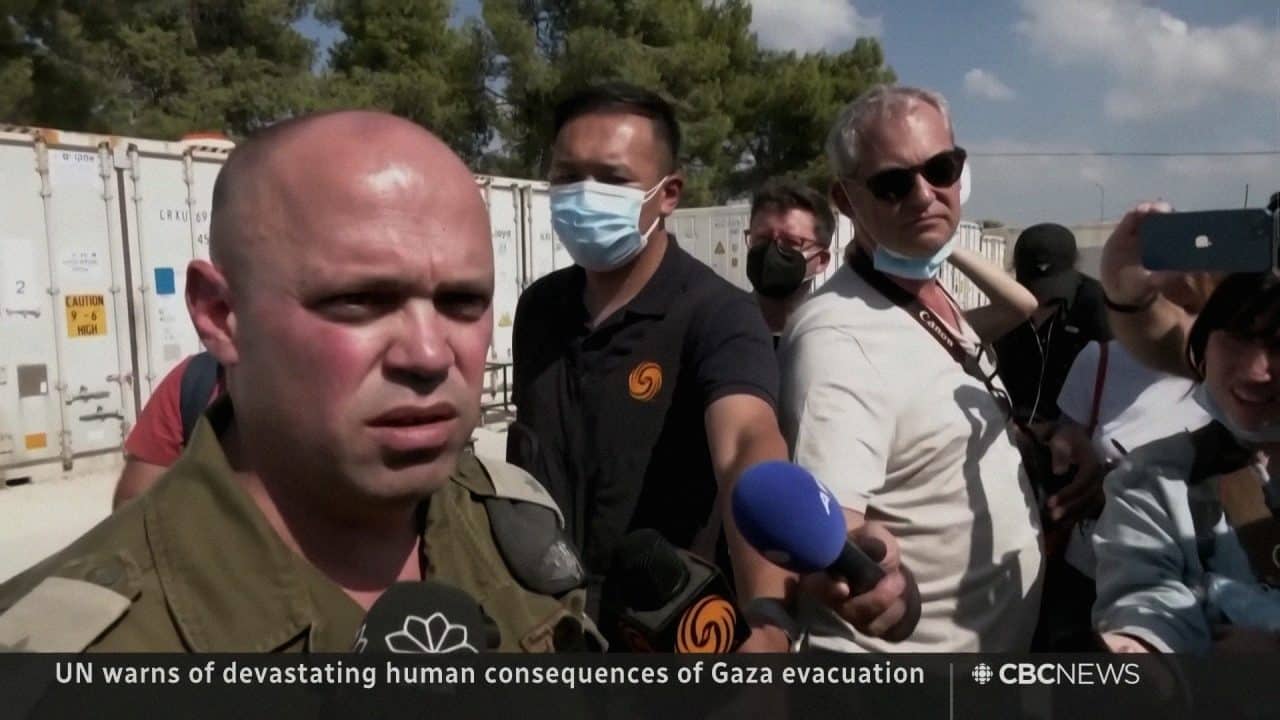
After months of navigating these practices, slow changes at CBC are too little, too late for some employees.
Alex, a pseudonym for a radio and broadcast producer, left CBC a few weeks ago after three years of working at the public broadcaster. He told The Breach it was because of the “moral baggage of being associated with a organization that I do believe has and continues to successfully manufacture consent for a genocide.”
According to Alex, their manager repeatedly removed their guests’ claims of genocide being committed by Israel in Gaza, from their tapes. The more Alex pitched segments about growing Palestinian solidarity protests in their city, the more uncomfortable they said their supervisor would get, at times even removing him from covering the story he’d pitched.
“The foot soldiers, the people who are making the operation work, are on the same page, but then there’s this disconnect with management.”

“It’s about getting to the bottom of things. It’s about unveiling who has the power and what they’re doing with that power.”
Linda McQuaig, journalist and author
As a non-profit, free from powerful corporate interests, we invest in investigations and uncover the cover-ups. Sustain our journalism for transformation.
Palestine | CBC has whitewashed Israel’s crimes in Gaza. I saw it firsthand
Palestine | CBC says killing of Palestinians doesn’t merit terms ‘murderous,’ ‘brutal’
Corporate Media | CTV forbids use of ‘Palestine,’ suppresses critical stories about Israel
13 comments
Comments are closed.

Like the NYT, CBC reflects the government’s foreign policy. If they hadn’t, Human Rights Watch documentation of the monthly killings of Palestinian children by the IDF would have been exposed by now.
This is not an isolated case of lethal bias in CBC’s journalism.
For decades, CBC has disappeared the horrific abuse, in health care and other venues, of Canadians whose psycho-social problems result from the psychiatric sequelae of environmental sensitivities, despite ample evidence.
My career as a CBC journalist ended when I blew the whistle on abusive journalism based on misconceptions and stereotypes.
Brodie Fenlon was, again in this instance, a source of illogical, abusive bigotry.
Thank you for continuing to work at honest reporting of the plausible genocide being perpetrated by Israel on Gaza inhabitants (ICJ, ICC) and, for calling out of our ‘national broadcaster’, CBC. I can’t imagine the courage it takes to maintain your integrity!
Just sayin’, CBC headquarters are in Ottawa, not Toronto.
Thank you, The Breach, for staying with this critical issue at Canada’s public broadcaster. What is happening at CTV bothers me, but bias at CBC bothers me a lot more. It is supported by the public and has a greater obligation to ensure fair presentation of critical issues. The situation has been made worse by the reduction in CBC’s global presence, depending instead on wire services and material of dubious provenance. I stopped watching and listening to its world coverage a long time ago.
Breach is the best news site I have seen in over 60 years of reading news. Congratulations. I sincerely hope you will continue your unbiased reporting. Kudos to Molly Schumann for starting a revolution in journalism!
I believe that this very interesting article forces us to rethink how media operate. Journalism is, first and foremost, the work of people who convey facts in a neutral and objective way, thus allowing the reader / viewer / listener to make up his/her own mind on the meaning of the event(s) depicted. I believe that the arrival of continous, 24 / 7 cable news networks has warped the perception of the work behind journalism. With people constantly on the air, journalists have become analysts of the events on which they report, trying to give sense and meaning, doing the “work” of critical thought that should be left to the news consumer.
In today’s media environnment, there is more analysis and commenting than there is reporting of the facts on the ground. Even in newspapers, the pages are filled with chronicles rather than articles. In media, opinion should be the domain of editorial, not that what appears on the front page.
At the end of the day, I want the facts. I can analyse them and give them the meaning I believe they have. I don’t need someone doing that for me.
Hi,
With Trump in the US… Republicans call the media biased when it doesn’t just report what he’s up to and leave it to the viewer to decide whether the guy’s an off-the-chart threat to liberal democracy or not. Of course he is, but to realize that, you need many, many more facts than you’ll find in any news article or broadcast. And so we need responsible interpreters of the facts to help us make sense of the situation. — There are at least two government media outlets in Germany doing exactly that: ARD and ZDF. Recently, ARD released four years worth of internal texting inside the AfD. The two journalists that are the face of the project don’t mind telling us: this is the face of fascism we’re looking at here folks. I take it you think they should not point that out. Me, I think it would be highly irresponsible not to. I think the Canadian media, including the CBC, is doing a reaosnably good job of alerting Canadians to the threat to lib dem that is Poilievre. — Also, your just-the-facts-please attitude misses the fact that facts come in lists. As soon as someone has created a text, we’re into narrative. Once you’re into narrative you’re into making meaning from the facts. Point of view, interpretation, meaning making, all of it… has swung into action. — I admit I feel a little discouraged when I read, on the left, someone calling for “just the facts”. We’re supposed to be the adults in the room. — My take.
Love and appreciate your coverage. Would like to support but lost my job due to covid bs. I know it’s old news but how about something on the Covid Brainwashing Corporation’s complicity.
Thank you for addressing the bias of CBC, which is supposed to provide Canadians with clear and unbiased international news. Unfortunately, they seem to have their own agenda. I was personally harmed by their false reporting about my company, where I was assisting Syrian refugees. Their inaccurate report damaged my company and negatively affected the refugees’ immigration applications. At the time, I couldn’t afford to hire a lawyer to sue them, which was unfair. Their defamation led to a disaster for my family, the collapse of my company, and harm to my refugee clients.
I have been frustrated by the bias from mainstream media and government officials re the “war” in Gaza and by the misuse of of the words anti-Semitism and pro-Palestinian. The lack of condemnation of Israel’s slaughter of civilians is appalling. You don’t have to be “pro-Palestinian” to be against the in discriminant killing of Palestinians. Nor are you anti-Semitic if you are against the war mongers who lead the Israeli government.
2 days after this news report, there has been stunning silence in North America’s mainstream media on the threat made to the ICC’S former chief prosecutor on her and her family’s security for considering war crime charged against top Israeli officials. The threats were made by a former Mossad chief and close associate of Netanyahu, as reported in the Guardian in concert with an Israeli-Arab and a Hebrew news outlets. Shortly after Brazil withdrew its ambassador from Israel. This is a huge story all over the world but not a peep from the CBC.
I thought there is freedom of expression and unbiased media reporting in Canada and the other “Western” countries, but I am shocked and dismayed at the partiality shown by almost all except for “Breach”. Disgraceful media!