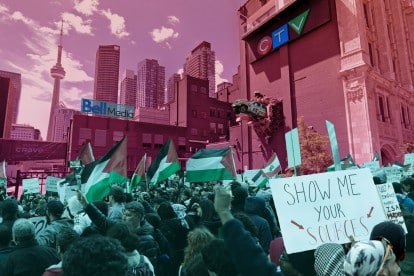
The executive producer peered at me with concern. It was November 16, 2023 and I had been called into a virtual meeting at CBC. I was approaching my sixth year with the public broadcaster, where I worked as a producer in television and radio.
He said he could tell I was “passionate” about what was happening in Gaza. His job, he told me, was to ensure my passion wasn’t making me biased. He said I hadn’t “crossed the line” yet, but that I had to be careful. The conversation ended with him suggesting that I might want to go on mental health leave.
I declined. My mind was fine. I could see clearly what was happening.
Earlier that day, I had spoken out in a meeting with my team at CBC News Network—the broadcaster’s 24 hour television news channel. It was six weeks into Israel’s siege and bombardment of the Gaza Strip, which had, at the time, killed over 11,000 Palestinians, the majority of them women and children. Legal experts were already suggesting that what was taking place could be a “potential genocide,” with an Israeli Holocaust scholar calling it “a textbook case.”
I expressed concern to my team about the frequency of Palestinian guests getting cancelled, the scrutiny brought to bear on their statements, and the pattern of double standards in our coverage. After this, I pitched a reasonable and balanced interview: two genocide scholars with opposing views discussing whether Israel’s actions and rhetoric fit the legal definition of the crime.
Senior colleagues sounded panicked. My executive producer replied that we had to be ”careful not to put hosts in a difficult position.” They wanted time to consult with higher-ups before making a decision. A few hours later, I was sitting across from the same executive, being warned about “crossing the line.”
The following afternoon, I showed up for what was supposed to be a typical meeting to go over the interviews we had lined up for the coming days—but some unusual guests were present. In addition to my co-workers, the faces of my executive producer and his higher-ups appeared on Google Meet.
The managers were there to talk about my pitch. They said they weren’t vetoing it—they weren’t meant to even make editorial decisions—but suggested our show wasn’t the best venue. I pointed out that the network was deemed a suitable place for interviews with guests who characterized Russia’s war on Ukraine and China’s oppression of the Uighurs as instances of genocide. The managers looked uncomfortable. I was reassigned to work on a panel with two guests calling on the West to support regime change in Moscow and Tehran. (Ever since these unusual meetings had started, I was recording them for my protection.)
If journalists in Gaza were sacrificing their lives to tell the truth, I should at least be prepared to take some risks.
But that wasn’t the end of the blowback. The next week, late on a Friday afternoon, I received an email from the same two managers who had poured cold water on my pitch. They needed to speak to me urgently. Over the phone, I was asked to keep the conversation secret.
They told me I had hurt the feelings of some of my co-workers. But it was more than just hurt feelings: someone was accusing me of antisemitism.
I had, it appeared, “crossed the line.”
Trying to work your way up to a permanent position at Canada’s public broadcaster requires knowing the sort of stories, angles and guests that are acceptable—and which are out of bounds. As a precarious “casual” employee—a class of worker that makes up over a quarter of CBC’s workforce—it hadn’t taken me long to realize that the subject of Israel-Palestine was to be avoided wherever possible. When it was covered, it was tacitly expected to be framed in such a way as to obscure history and sanitize contemporary reality.
After October 7, it was no longer possible for the corporation to continue avoiding it. But because CBC had never properly contextualized the world’s longest active military occupation in the lead-up to that atrocity, it was ill-equipped to report on what happened next.
The CBC would spend the following months whitewashing the horrors that Israel would visit on Palestinians in Gaza. In the days after Israel began its bombing campaign, this was already evident: while virtually no scrutiny was applied to Israeli officials and experts, an unprecedented level of suspicion was being brought to bear on the family members of those trapped in Gaza.
My job required me to vet the work of associate producers and to oversee interviews, so I was well-positioned to see the double standards up close.
At first, out of concern that it would jeopardize my chances of landing a staff job that I had recently applied for, I only voiced mild pushback. But as the death toll mounted, my career started to seem less important. If journalists in Gaza were sacrificing their lives to tell the truth, I should at least be prepared to take some risks.
Besides, I naively told myself, it would be easier for me to dissent than most of my colleagues. I am of mixed Jewish heritage, having been raised by a father who fled the Holocaust as a young child and dealt with the life-long trauma and guilt of surviving while his family members were murdered by the Nazis. It would be more challenging, I believed, for cynical actors to wield false accusations of antisemitism against me.
I turned out to be wrong.
The Palestine exception at CBC
In the run-up to Oct. 7, a senior colleague said that if we were lucky, “the news gods would shine on us” and put an end to a stretch of “slow news” days. Waking up on that fateful Saturday to multiple alerts on my phone, I knew that both the world and my professional life were about to dramatically change.
Even before Oct. 2023, trying to persuade senior CBC colleagues to report accurately on Palestinians was a struggle. Here are some of the TV interview ideas that a colleague and I pitched but had turned down: Human Rights Watch’s 2021 report designating Israel an apartheid state; the Sheikh Jarrah evictions in the same year; Israel assassinating Palestinian-American journalist Shireen Abu Akleh in 2022; and the Israeli bombing of the Jenin refugee camp in July 2023.
The last of these ideas was initially greenlit but was later cancelled because a senior producer was concerned that the host would have too much on her plate. Around this time, I also pitched someone from the Israeli human rights organization B’Tselem to talk about the potential impact of widely-protested judicial reforms on Palestinians—but this was nixed for fear of complaints. These would become familiar excuses.
After October 7, I dreaded going into work: every shift, the impact of the biases went into overdrive. Even at this early stage, Israeli officials were making genocidal statements that were ignored in our coverage. On October 9, Defence Minister Yoav Gallant said, “I have ordered a complete siege on the Gaza Strip. There will be no electricity, no food, no fuel; everything is closed. We are fighting human animals and we act accordingly.” Even after this comment, my executive producer was still quibbling over uses in our scripts of the word “besieged” or references to the “plight of Palestinians.”
On October 20, I suggested having Hammam Farah, a Palestinian-Canadian psychotherapist, back on the network. In an earlier interview he had told us that his family were sheltering in Saint Porphyrius Greek Orthodox church in Gaza City. The following week, I learned from social media that his step-cousin had been killed in an Israeli airstrike on the 12th-century building. My executive producer responded to my pitch via instant message: “Yeah, if he’s willing. We also may have to potentially say we can’t verify these things though—unless we can.”
I was stunned. Never in my nearly 6 years at CBC had I ever been expected to verify the death of someone close to a guest, or to put a disclaimer in an interview that we couldn’t fact-check such claims. That’s not a standard that producers had been expected to uphold—except, apparently, for Palestinians.
Besides, even at that early stage, civil society had completely broken down in Gaza. I couldn’t just call up the health authority or courthouse to ask that they email over a death certificate. I already had Farah’s relative’s full name and had found a Facebook profile matching a commemorative photo he had posted on Instagram. This was already more verification than I had done for Israeli interviewees who had loved ones killed on October 7. A few days later, a different program on the network aired an interview with the guest using passive language in the headline: “Toronto man says relative was killed in airstrike that hit Gaza.”
I was being forced to walk a tightrope, trying to retain some journalistic integrity while keeping my career intact.
In early November, I was asked to oversee production of an interview with a former US official now working for the Washington Institute for Near East Policy, a pro-Israel think tank.
During the interview, he was allowed to repeat a number of verifiably false claims live on air—including that Hamas fighters had decapitated babies on October 7 and that Gazan civilians could avoid being bombed if only they listened to the Israeli military and headed south. This was after civilian convoys fleeing southward via “safe routes” had been bombed by the Israeli military before the eyes of the world.
As soon as I heard this second falsehood, I messaged my team suggesting that the host push back—but received no response. Afterwards, the host said she had let the comment slide because time was limited, even though she could have taken the time from a less consequential story later on in the program.
The majority of Palestinian guests I spoke to during the first six weeks of Israel’s assault on Gaza all said the same thing: they wanted to do live interviews to avoid the risk of their words being edited or their interview not being aired. These were well-founded concerns.
Never before in my career had so many interviews been cancelled due to fear of what guests might say. Nor had there ever been direction from senior colleagues to push a certain group of people to do pre-taped interviews. (CBC told The Breach it “categorically rejects” the claim that interviews were “routinely cancelled”.)
On another occasion in November, a Palestinian-Canadian woman in London, Ontario named Reem Sultan, who had family trapped in the Strip, was scheduled for one such pre-taped interview. Because of her frustration over previous interviews that she had given and coverage of her family’s situation being “diluted,” she asked if she could go live instead.
When I asked the senior producer, he looked uneasy and said the interview should be cancelled, citing that the guest had already been on the network that week. I agreed that it would be preferable to interview a new Palestinian voice and said I had contact information for a number of alternative guests. However, after cancelling the interview with Sultan, the senior producer informed me that he didn’t want another guest after all.
Editing out ‘genocide’
Most shows on the network seemed to avoid airing any mention of “genocide” in the context of Gaza.
On November 10, my senior producer pushed to cancel an interview I had set up with a Palestinian-Canadian entrepreneur, Khaled Al Sabawi. According to his “pre-interview”—a conversation that typically happens before the broadcastable interview—50 of his relatives had been killed by Israeli soldiers.
The part of the transcript that concerned the senior producer was Al Sabawi’s claim that Netanyahu’s government had “publicly disclosed its intent to commit genocide.” He also took issue with the guest’s references to a “documented history of racism” and “apartheid” under Israeli occupation, as well as his suggestion that the Canadian government was complicit in the murder of Gazan civilians.
The senior producer raised his concerns via email to the executive producer, who then cc’ed one of the higher-up managers. The executive producer replied that it “sound[ed] like [his statement was] beyond opinion and factually incorrect.” The executive manager’s higher up chimed in, saying she thought the interview would be “too risky as a pre-tape or live [interview].”
Despite the guest’s position aligning with many UN experts and Western human rights organizations, the interview was cancelled. (CBC told The Breach “the guest turned down our offer of a pre-taped interview,” but Al Sabawi had said to the producers from the start that he would only do a live interview.)
Never in my nearly 6 years at CBC had I ever been expected to verify the death of someone close to a guest. That’s not a standard that producers had been expected to uphold—except, apparently, for Palestinians.
In another instance, a Palestinian-Canadian guest named Samah Al Sabbagh, whose elderly father was then trapped in Gaza, had part of her pre-taped interview edited out before it went to air. She had used the word “genocide” and talked about the deliberate starvation of Palestinians in Gaza. The senior producer told me the edit was because of time constraints. But that producer and the host were overheard agreeing that the guest’s unedited words were too controversial. (CBC told The Breach it “has not ‘cancelled’ interviews with Palestinians because they reference genocide and apartheid.”)
By November 2023, it was getting harder to ignore the brazen rhetoric coming from senior Israeli officials and the rate of civilian death, which had few precedents in the 21st century. But you wouldn’t have heard about these things on our shows, despite a number of producers’ best efforts. (By early 2024, the International Court of Justice’s hearings—and later its ruling that Israel refrain from actions that could “plausibly constitute” genocide—forcibly changed the discussion, and the word “genocide” finally made some appearances on CBC.)
But back in late October, I booked an interview with Adel Iskandar, Associate Professor of Global Communication at Simon Fraser University, to talk about language and propaganda from Israeli and Hamas officials. The host filling in that day was afraid of complaints, was concerned about the guest wanting to be interviewed live, and judged him to be biased. Yet again an interview was cancelled.
A secret blacklist?
One Saturday in mid-October, I arrived at work shortly after the airing of an interview with the prominent Palestinian-Canadian lawyer and former spokesperson for the Palestine Liberation Organization, Diana Buttu.
There had been a commotion, I was told. A producer from The National—the CBC’s flagship nightly news and current affairs program—had apparently stormed into the newsroom during the interview saying that Buttu was on a list of banned Palestinian guests and that we weren’t supposed to book her.
I heard from multiple colleagues that the alleged list of banned Palestinian guests wasn’t official. Rather, a number of pro-Israel producers were rumoured to have drawn up their own list of guests to avoid.
Later, I was told by the producer of the interview that, after the broadcast, Buttu’s details had mysteriously vanished from a shared CBC database. By then, I had also discovered that the name and contact details for the Palestinian Ambassador Mona Abuamara, who had previously been interviewed, had likewise been removed. It didn’t seem coincidental that both guests were articulate defenders of Palestinian rights.
While producers distressed by the CBC’s coverage of Gaza were speaking in whispers, pro-Israeli colleagues felt comfortable making dehumanizing comments about Palestinians in the newsroom.
In one case, I heard an associate producer speak disparagingly about a guest’s decision to wear a keffiyeh for an interview before commenting that “[the host] knows how to handle these people.” This guest had dozens of family members killed by the Israeli military in Gaza.
It seemed the only Palestinian guest CBC was interested in interviewing was the sad, docile Palestinian who talked about their suffering without offering any analysis or solutions to end it. What they did not want was an angry Palestinian full of righteous indignation towards governments complicit in their family’s displacement and murder.
At this stage, I was starting to feel nauseous at work. And then one Saturday night, that sickness turned into anger.
I had been asked to finish production on a pre-taped interview with a “constructive dialogue” researcher on incidents of campus hostilities over the war and how to bring people together—the sort of interview CBC loves, as it’s a way to be seen covering the story without actually talking about what’s happening in Gaza.
I carried out the task in good faith, writing an introduction leading with an example of antisemitism and then another of anti-Palestinian hate, taking care to be “balanced” in my approach. But my senior producer proceeded to remove the example of anti-Palestinian hate, replacing it with a wishy-washing “both sides” example, while leaving the specific serious incident of antisemitism intact. He also edited my wording to suggest that pro-Palestinian protesters on Canadian campuses were on the “side” of Hamas.
I overheard the host thank the senior producer for the edits, on the basis that incidents of antisemitism were supposedly worse. While the introduction of these biases into my script was relatively minor compared to some other double standards I witnessed, it was a tipping point.
I challenged the senior on why he had made my script journalistically worse. He made up a bad excuse. I told him I couldn’t do this anymore and walked out of the newsroom, crying.
Truth-telling about CBC
That evening at home, the nausea and the anger dissolved, and for the first time in six weeks I felt a sense of peace. I knew it was untenable to stay at CBC.
At a team meeting the following week, in mid-November, I said the things I had wanted to say since the start of Israel’s assault on Gaza.
I prefaced the conversation by saying how much I loved my team and considered some coworkers friends. I said the problems weren’t unique to our team but across the CBC.
But the frequency of Palestinian guests getting cancelled, the pressure to pre-tape this one particular group, in addition to the unprecedented level of scrutiny being placed on them, demonstrated a pattern of double standards. I said there seemed to be an unspoken rule around words like “genocide.”
I pointed out that Arab and Muslim coworkers, especially those who were precariously employed, were scared of raising concerns, and that I and others had heard dehumanizing comments about Palestinians in the newsroom. (The CBC told The Breach that there “have been no specific reports of anti-Palestinian and Islamophobic comments in the newsroom for managers to respond to or follow up”.)
I said that two decades since the US-led invasion of Iraq, it was widely-acknowledged that the media had failed to do their jobs to interrogate the lies used to justify a war and occupation that killed one million Iraqis—and that as journalists we had a special responsibility to tell the truth, even if it was uncomfortable.
A couple of coworkers raised similar concerns. Others rolled their eyes. (CBC told The Breach that it doesn’t recall there was anyone else who raised concerns in the meeting, but audio recordings show otherwise.)
The question of why there was nervousness around this issue came up. I said one reason why we were adverse to allowing Palestinian guests to use the “G-word” was because of the complaint campaigns of right-wing lobby groups like HonestReporting Canada.
Indeed, in just 6 weeks, there were already 19 separate instances of HonestReporting going after CBC journalists, including a host on our team. HonestReporting had also claimed responsibility for the firing at two other outlets of two Palestinian journalists, one of whom was on maternity leave at the time.
All this had a chilling effect. Hosts and senior colleagues would frequently cite the threat of complaints as a reason not to cover Israel-Palestine. During my time there, a senior writer was even called into management meetings to discuss her supposed biases after a HonestReporting campaign targeted her. Her contract was cut short.
This policing of media workers’ output reinforced existing institutional tendencies that ensured CBC rarely deviated from the narrow spectrum of “legitimate” opinions represented by Canada’s existing political class.
Certain CBC shows seemed to be more biased than others. The National was particularly bad: the network’s primetime show featured 42 per cent more Israeli voices than Palestinian in its first month of coverage after the Oct. 7 Hamas attack, according to a survey by The Breach.
Although some podcasts and radio programs seemed to cover the war on Gaza in a more nuanced way, the problem of anti-Palestinian bias in language was pervasive across all platforms.
According to an investigation in The Breach, CBC even admitted to this disparity, arguing that only the killing of Israelis merited the term “murderous” or “brutal” since the killing of Palestinians happens “remotely.” Images of children being flattened to death in between floors of an apartment building and reports of premature babies left to starve in incubators suggested otherwise.
It seemed the only Palestinian guest CBC was interested in interviewing was the sad, docile Palestinian who talked about their suffering without offering any analysis or solutions to end it.
I spoke to many like-minded colleagues to see if there was any action we could all take to push back on the tenor of our coverage, but understandably others were reluctant to act—even collectively—out of fear doing so would endanger their jobs. Some of those colleagues would have loved to have walked out, but financial responsibilities stopped them.
There had been previous attempts at CBC to improve the public broadcaster’s coverage of Israel-Palestine. In 2021, hundreds of Canadian journalists signed an open letter calling out biases in the mainstream media’s treatment of the subject.
A number of CBC workers who signed the letter were hauled into meetings and told they either weren’t allowed to cover the subject or would have any future work on the issue vetted. A work friend later regretted signing the letter because she got the sense that she had been branded as biased, leading to her pitches on Palestine being more readily dismissed.
Smeared as antisemitic
In mid-November, after laying out my concerns to my colleagues, the regular weekly pitch meeting took place. It was then that I pitched the two genocide scholars, before having to attend that virtual meeting with my executive producer—where he suggested I go on mental health leave—and yet another meeting with two managers who raised concerns over my pitch the next day. But the most unpleasant meeting with management was about to come.
A week later, I was accused of antisemitism on the basis of something I didn’t even say. According to a manager, someone had accused me of claiming that “the elephant in the room [was] the rich Jewish lobby.” (CBC told The Breach that “employees expressed concerns” that what she said was “discriminatory”.)
The accusation was deeply painful because of my Jewish heritage and how my dad’s life—and, as a consequence, my own—was profoundly damaged by antisemitism. But I also knew I could prove that it was baseless: I had recorded what I said, anxious that someone might twist my words to use them against me.
What I had actually said, verbatim, was this:
“I just want to address the elephant in the room. The reason why we’re scared to allow Palestinian guests on to use the word ‘genocide’ is because there’s a very, very well funded [sic], there’s lots of Israel lobbies, and every time we do this sort of interview, they will complain, and it’s a headache. That’s why we’re not doing it. But that’s not a good reason not to have these conversations.”
I stand by my statement. HonestReporting Canada is billionaire-funded. In December 2023, HonestReporting bragged about having “mobilized Canadians to send 50,000 letters to news outlets.” The group has also published a litany of attacks on journalists at CBC and other publications who’ve done accurate reporting on Palestine, and created email templates to make it easier for their followers to complain to publications about specific reporters.
Other, similar pro-Israel groups like the Committee for Accuracy in Middle East Reporting in America (CAMERA) and the Canary Mission employ similar tactics to try to silence journalists, academics, and activists who tell the truth about Israel-Palestine.
I told the manager it was telling that instead of following up on the racist comment I had heard from colleagues about Palestinians, I was the one being accused of antisemitism and discrimination—on the basis of words I hadn’t even uttered.
The banality of whitewashing war crimes
When I handed in my resignation notice on November 30, I felt relieved that I was no longer complicit in the manufacturing of consent for a genocidal war of revenge.
Despite my experience, I still believe in the importance of the national broadcaster to act in the public interest by reporting independently of both government and corporate interests, presenting the truth and offering a diverse range of perspectives.
However, I believe that CBC has not been fulfilling these duties when it comes to its coverage of Israel-Palestine. I believe that in the future, historians will examine the many ways that CBC, and the rest of mainstream media, have all failed to report truthfully on this unfolding genocide—and in doing so likely accelerated their delegitimization as trusted news sources.
Before resigning, I raised the issue of double standards with various levels of the CBC hierarchy. While some members of management pledged to take my concerns seriously, the overall response left me disappointed with the state of the public broadcaster.
After my appeal to my coworkers in mid-November, I had a phone conversation with a sympathetic senior producer. He said he didn’t think my words at the meeting would interfere with my chances of getting the permanent staff job I had long dreamed of. Despite this assurance, I was certain that I wouldn’t get it now: I knew I’d crossed the line for saying out loud what many at CBC were thinking but couldn’t say openly. Indeed, I wouldn’t have spoken out if I hadn’t already decided to resign.
As a kid, I had fantasies of shooting Hitler dead to stop the Holocaust. I couldn’t fathom how most Germans went along with it. Then, in my 20s, I was gifted a copy of Hannah Arendt’s Eichmann In Jerusalem: A Report On The Banality Of Evil by anti-Zionist Israeli friends. I’ve been thinking a lot about that piece of reportage when trying to make sense of the liberal media’s complicity in obfuscating the reality of what’s happening in the Holy Land. As Arendt theorized, those who go along with genocides aren’t innately evil; they’re often just boring careerists.
To be sure, while there are a number of senior CBC journalists who are clearly committed to defending Israel no matter its actions, many journalists just follow the path of least resistance. The fact that permanent, full-time CBC jobs are in such short supply, combined with threats of looming cuts, only reinforces this problem.
I still hear from former colleagues that pitch meetings are uphill battles. Some shows are barely covering Gaza anymore.
Being a journalist is a huge privilege and responsibility, especially in a time of war. You’re curating the news for the audience; deciding which facts to include and which to omit; choosing whose perspectives to present and whose to ignore. I believe that a good journalist should be able to turn their critical eye, not just on the news, but on their own reporting of the news. If you’re unable to do this, you shouldn’t be in the profession.
I purposefully haven’t given away identifiable information about my former colleagues. Ultimately, this isn’t about them or me: it’s part of a much wider issue in newsrooms across the country and the Western world—and I believe it’s a moral duty to shed a light on it. If I didn’t, I’d never forgive myself.
Just as I’m not naming my colleagues, I’m writing this using a pseudonym. Although the spectrum of acceptable discourse continues to shift, the career consequences for whistleblowers on this issue remains formidable.
I encourage fellow journalists who refuse to participate in the whitewashing of war crimes, especially those with the security of staff jobs, to speak to like-minded coworkers about taking collective action; to approach your union steward and representative; and to document instances of double standards in your newsrooms and share them with other media workers.
It was scary, but I have no regrets about speaking out. My only regret is that I didn’t write this sooner.
The Breach’s investigations don’t just inform our readers—they force the powerful to react.
An exposé on blood plasma privatization led to national headlines. Our revelations about the government’s cozy connections to Big Pharma sparked a parliamentary probe. A report on high-tech price-fixing by mega landlords resulted in a criminal investigation.
From activists to elected officials, people are using The Breach’s journalism to push for transformative change.
– Dru Oja Jay, Board President, The Breach
Palestine | CBC says killing of Palestinians doesn’t merit terms ‘murderous,’ ‘brutal’
Palestine Solidarity | Ontario government screened law students who signed pro-Palestine letter
Corporate Media | CTV forbids use of ‘Palestine,’ suppresses critical stories about Israel
54 comments
Comments are closed.

Excellent piece. I’ve stopped listening to mainstream media like the CBC.
Thank you for writing this! I have been so frustrated by CBCs whitewashing and down right racism for a long time. I have written to them several times about print news pieces. A publicly funded news outlet should not be cowards to rich lobbies. They owe truth to the public.
The CBC is also grotesquely biased on Russia and China. But that’s another story.
Thank you so much for giving us insight into what we’ve been feeling watching any kind of mainstream coverage.
I am curious to know whether the CBC former correspondent Neil MacDonald suffered the same sort of pushback from the top as well. He always struck me as a fair-minded reporter who told it ” like it was” when he was Middle East reporter years ago. My guess is yes.
Thank you so much for writing this. It’s heartbreaking what you went through and at the same time so endearing to see what you did and what the state of our media is. I applaud you for your courage and pray that you find a better opportunity.
Wow! This is what I have always sensed, the bias in reporting by CBC on this and other issues. But here is an insider’s story for confirmation.
Whistleblowers are our first line of defense. CBC, like NYT’s. like CNN, like MSNBC, like BBC, like…. Thank you for such honest reporting.
I worked with ‘Molly’. This bears no resemblance to what actually happened
I have complained to the cbc about this by voice and email and never received a reply, It is a sad state what the cbc has fallen to. At one point they were respected. It is also sad that the writer feels they must use a name other than their own.
Very sad and disappointing to read the blatant fear of the head executives of CBC who have now become the Israeli BC.I have said this many years before of this cancer in our media rooms.Never before has the world risen to such anger to this small group of criminals who are capable of causing a world war with the American govt and media support.
Our best admiration to the writer of this long analysis.
Excellent. I fully support unbiased reporting and exposing media bias. Journalists are supposed to report the truth as it is leaving the readers/listeners to make judgements. CBC is disgrace to journalism and Canada is a disgrace to media freedom. I think there should be a crowd fund created to support people who have been penalised for telling the truth or resisting suppression of freedom of speech.
Thanks kindly for stepping up. Freedom is coming
In this piece, where she is trying to elicit sympathy for herself, she comes across as a strong advocate for “Palestinians are angels and Zionists are devils” , not as a journalist dedicated to presenting a fair and balanced story, and certainly not as someone with an awareness of the rights and wrongs on both sides. Perhaps there is another side to this story of how she alleges she was treated at CBC.
That’s not how this reads in the least. Did you actually read it? Or make up your mind based on the title?
My impression was similar to David’s.
First: I am a supporter of Palestine and a supporter of Judaism. I am opposed to Zionism and other manifestations of apartheid and racism. It is clear to me that the Palestinian genocide began with The Nakba….and that, right now, we are witnessing a horrific attempt to bring it to a close.
Having said that: I found this reportage more subjective than objective. I have no doubt that the events occurred as described. Perhaps it’s the first person narrative that harms the report. Emotion is a powerful tool but it may foster doubt in the mind of a reader.
Withholding the author’s identity presents an opportunity to question veracity. An explanation of the choice would be a good decision. In my mind, the identity becomes irrelevant if the person has removed themself from the situation. I’m sure there is a good reason to support the author’s anonymity. However, revealing some small fact about the reasoning will go a long way to preserving integrity.
This journalist’s experience is very insightful. I have been wondering why the CBC’s coverage of the genocide in Gaza has been so limited while my social media feeds from Palestinian journalists and reputable charitable organizations (i.e. MSF, Oxfam and UNICEF) are filled with pictures and videos of the atrocities in Gaza. It’s all making sense now as I read this article! As much as I count on CBC as my primary news source, this article has made me extremely disappointed in our public broadcaster. Shame on CBC!
Thank you
WOW. A real news story, with information I trust! I had stopped believing I would find such news within Canada.
Any thinking and observant individual can see clearly the causes of the first Nabka and those historical antecedents of the present day nabka. Only peace and coexistence direct our will for the future.
Thank you for writing this article. As a life long CBC listener, I am truly disappointed and I will let them know… for what it’s worth.
I’m also horrified to see Jewish people, who make North America their home, raising the Israeli flag. Have they learned nothing from the horrors inflicted on their own population? It boggles my mind.
Again, thanks for speaking out.
This is very interesting and revealing. That they tell her to get mental health treatment for applying reasonable journalistic standards shows the emperor has no clothes.
But she makes no assessment of why CBC management is enforcing the propaganda or broader interests. Hasn’t she been following the vicious persecution of Assange and the CBC’s biased coverage of that?
She mentions the union but has been the role of the Canadian journalists’ union?
Heroic individuals cannot win. A political response is required in this war.
Thank you so much for this article! I commend you for standing up as I am sure it wouldn’t have been easy. I hope this inspires other like minded journalists to collectively stand against this.
Good for you. Great article. My 34 year old son posted this on our Gazebo group. Everything you described regarding the mainstream media I already knew. NOT BECAUSE I am smart, but I’m critical of everything. Science says this is a natural human instinct for survival. Anyhow, it’s great that my son posted this. It shows that people are waking up to the real enemy., who has always been trying to divide the people and keep them busy with senseless issues. I will repost and repost. In the end, when we stand in front of God for judgment, at least we can say we did our part. This is worth more than all that is before us in this world an infinite times over. GOOD FOR YOU!!!
I am a 73 yr. old Canadian senior. The only thing I know related to the profession of journalism is that the Public wants and deserves the Truth! The real author of this piece is in Truth, an Honourable person! The God of Israel and all mankind is the God of Truth! To no
Not lallow the Truth to Rule is to work against Him! Only the evil and cowards…forbid the Truth!
Thank you for speaking out about something that must be going on in newsrooms across the west.
I value hearing from Israelis/Israel supporters as much as Palestinians because I strive to have an understanding of the issues I take my positions on. For this reason, I go out of my way to not click or find in to mainstream media, on this issue or any other. I don’t appreciate being manipulated and used as a tool for genocide, even for the few cents my clicks may generate to sustain the machine.
I hope you are able to achieve a position in one of the thriving independent media operations that are coming to the fore. We need more clearheaded reporting.
Fantastic! Absolutely spot on I am a Pro Palestinian supporter since forever. I have always known Israel was treating Palestinian like apartheid Africa. Article SPOT ON!👏👏👏👏👏✊
Bravo, bravo, BRAVO Molly for saying what it had to be said!
Voices like yours are rare, and therefore more valuable.
Sorry for losing the (somehow comfortable) position within the CBC but, as they say, “every kick is a boost”…
Take care,
Bert Schumann
we need more people like you working in journalism
Trying to achieve balanced coverage of complex situations can be challenging for any news agency, particularly as every human has their own biases, and these biases may tilt the scales in one direction or another with every single news segment or article that is presented. A good news agency like the CBC attempts to balance coverage using a variety of methods, including reporting hard facts, using neutral language, avoiding politicized rhetoric, fact-checking, having multiple producers/editors review and provide input on potentially controversial news items, allowing for two or more opposing views to be presented, and having an ombudsperson review bias complaints after a story is released. It is far from a perfect process, but it ensures that, at least in the case of the CBC, there is, overall, a far more balanced body of news than that which is available from most other news sources in Canada.
.
So it is very interesting to me that this article, as written, tries to present a case that the CBC has a clear bias in favor of Israel and against Palestine. On the one hand, the writer uses language and reports on workplace incidents that, upon its surface, suggests she was advocating for balanced coverage in the face of the scales tilting in one direction. On the other hand, she has her article, nominally about media bias, published in a publication that has an unequivocally clear bias for one side: for example, the article is tagged for inclusion in the “Israeli Apartheid” section. A quick scan of the website suggests that all of the articles on this site dealing with the issue of Israel-Palestine present only anti-Israeli or pro-Palestinian viewpoints. “Israeli Apartheid” is not a factual term, it is biased, highly-politicized rhetoric making an analogy with a system that actually had that name, and it is used exclusively by opponents of Israel as a loaded black and white term intended to demonize Israel.
.
In addition to choosing to publish her account on a clearly biased site, the writer further undermines her own claims of attempting to “fight the good fight” for balanced coverage by betraying her own biases within the body of the article. For example, she slips from neutral language when she characterizes HonestReporting Canada as a “right-wing lobby group,” which is used as a subtle epithet (“right wing bad”) that signals a probable left-wing bias on her own part, particularly in the case that the choice of publishing at this site is essentially a case of “preaching to the converted.” This is used to set the stage for her complaint that Palestinian journalists have been fired by news outlets in Canada, ironically (re: the article title) “whitewashing” the fact that one of the fired journalists who worked for CTV organized an anti-Israel rally and was quoted publicly in a news article saying that she believed Israel has no right to exist. She was clearly fired because such biased statements undermined her own journalistic credibilty and the integrity of a news agency that theoretically strives for balanced or neutral coverage. In the writer’s own case of getting into hot water in the workplace, the terminology she used about “well-funded… Israel lobbies” may have a factual basis, as she documents, but it also hits close enough to the most common of anti-Semitic tropes that one thinks that a professional journalist should know better.
.
In the end, the attempt by the writer to present herself as striving for journalistic balance reads as disingenuous, at best. The fact that this was penned under a nom de plume makes it impossible to verify her claims and can potentially be dismissed as an elaborate work of fiction in the service of anti-Israeli activism. I don’t believe it to be the case that this is a work of fiction, but I do believe that it is clear that she far underplayed her own biases in this article, yet has clearly exposed them by choosing to publish on a site that is unabashedly biased. As such, this ultimately reads as a case of inappropriate activism in the workplace – likely with accompanying cherry-picking, erasure and misrepresentation of workplace incidents and colleague interactions used to bolster her claims – rather than a sincere quest for journalistic integrity and balanced coverage.
As I read this post, I felt anger, hopelessness and disbelief as the length that a network like CBC will go to cover the truths. Knowing that that biased coverage results in more death and suffering. This is not a private network. One billion of our money goes there. Basically those in charge who do the coverup and intimidations are criminals.
I’m Jewish and lived in Israel for 20 years. Most of my family reside there. I’ve been following Palestine/Israel for over 50 years.
I loved your brave and honest reporting. I wish you the very best. Many of us are doing everything we can to support the end of this genocide. We need a way to support honest and brave journalists like you.
Your claims against the CBC seem hard to understand given the vast majority of articles CBC has published appear biased towards the pro-Palestinian movement and against Israel. This bias is so evident that I have stopped reading CBC. Their lack of neutrality sickens me. So, while we agree on one thing – a biased CBC – we disagree on which way the CBC is biased. My guess is that the CBC filters out the most outrageous rhetoric against Israel that journalists like yourself may have tried to peddle, but nevertheless is pushing a policy of more moderate bias against Israel and in favor of pro-Palestinian protesters here at home. I would like to see the CBC defunded and a politically neutral, unbiased tax funded news organization take its place.
This is beyond delusional. How more milquetoast and biased in favor of Israel could the CBC get? It’s hard to act as apologists for the mass murder of babies while pretending to care about human rights.
I hope very many people will read your article, so they get to know how western media misinform the public on this issue in particular. Bon courage!
CBC bias since 911 has been a stark contrast to what it once was. I have been declared persona non grata for a couple of years now, but that has not been a bad thing. The truth is out there.
I’ve relied on the BBC World Service to follow the hellish news from Gaza, Palestine and Israel. Personally, in a non-empirical way, I’ve found it quite balanced, with many quite a lot of reportage from reporters inside Gaza. From time to time I listen to CBC’s coverage of international news and I am often struck by how often the reporters seem to be reporting from locations far from where the news is happening. I presume that this is due to CBC management devoting resources away from foreign coverage towards more local concerns.
Thanks for the truth
This is beyond delusional. How more milquetoast and biased in favor of Israel could the CBC get? It’s hard to act as apologists for the mass murder of babies while pretending to care about human rights.
Thankyou. Same. You have much courage. When you look behind you, I’ll be there. Holy Land means no violence. No bombs. Peace now.
It’s scary when we are afraid to tell the truth. There’s no accountability when nobody speaks truth to power.
Thank you ‘CBC-Producer’ for this excellent report on CBC as part of MSM & even most of Social-Media’s coordinated MONOLOGUE silencing of Palestinian & Gazan voices. OH CANADA, YOU STILL VIOLENT GENOCIDAL NATION! Somehow CBC Staffers, Managers & Oligarch owners didn’t read their job-descriptions as employees of the Canadian people. Not discussed in our colonial ‘exogenous’ (Latin ‘other-generated’) ‘Media’ (Latin ‘medium’ = ‘middle’ aka ‘reporting from both sides’) is the very definition of media’s role. All humanity’s worldwide ancient ‘indigenous’ (L. ‘self-generating’) & Canada’s 1st Nations employed COUNCIL-PROCESS, before colonial invasion, genocide & ongoing occupation by illegal Oligarch-led colonial forces. People in all relationships were all expected to formally DIALOGUE. In C.-P. wherever an issue, either positive for desired collaboration or negative for Conflict Resolution, people were expected to formally sit down together in ‘Both-sided, Equal-time, Recorded & Published Dialogue. BOTH-SIDES-NOW, Equal-time, Recorded & Published Dialogue, is an easy to use format employing the Cell-Phones, note-pads, stop-watches, which are ubiquitous to most people. We can rejoin all humanity’s worldwide COUNCIL PROCESS, once a dialectic-right to raise issues positive for understanding, working-agreement or for Conflict Resolution. https://sites.google.com/site/indigenecommunity/d-participatory-structure/1-both-sides-now-equal-time-recorded-dialogues Social-media will do well to implement ‘debate’ (French ‘de’ = ‘undo’ + ‘bate’ = ‘the-fight’) options within Comment Sections. Such ‘debate’ can be carried out in equal-text or equal-time through such as ZOOM & Skype. https://sites.google.com/site/indigenecommunity/d-participatory-structure/1-communication-converting-social-media-from-mono-to-dialogue-libya Human mind works from 2-sides to contrast & compare information from each our senses. Each eye for example records in 2-D images which are integrated because of their discordant factors into 3-D images within the Neural Cortex, then joined with dialectic information from ears, nostrils & our kinetic motion 2 arms, 2 legs etc.
You write that Molly’s article has prompted a response from CBC management but don’t tell us what that response was with backup quotes
Thank you, ‘Molly’, for so bravely speaking out. Your analysis is sharp, detailed, well supported, and searing in its emotional honesty.
If the actual true name of this journalist is not revealed this article, although quite believable loses credibility
She is talking about the CBC -a public broadcaster, paid for with our tax dollars. This is not a private corporation. The CBC is now a publicly funded arm of the Zionists. Let that sink in!
Thank for sharing this. While it verifies the many posts on Twitter and other media about the biases in CBC reporting, and could justify cancelling the public broadcaster altogether, that would defeat its role of honest investigative journalism. I am sharing with my MP and others.
I have seen this story in two independent news outlets and am appalled with CBC, our national news outlet.
To CBC: Do Better
I’m disgusted by CBC’S biased journalism. Thank you to this brave journalist for opening our eyes to such journalistic hypocrisy.
Thank you for the fine report on CBC anti-Palestine bias. I thought it might interest you folks to hear my CBC bias stories.
In 2010 I was on board the Gaza aid ship the Mavi Marmara and witnessed the Israelis murdering and wounding aid workers, and then I spent several days in an Israeli prison with hundreds of other Freedom Flotilla aid workers, suffering abuse and torment from the Israelis. Immediately after my release the CBC National News contacted me in Istanbul, and I spent about 30 minutes live on CBC TV recounting what had happened on the Flotilla. I was then contacted by a CBC representative asking me to attend a live radio broadcast at my local CBC Victoria studio the day after my arrival home. Because my wallet and drivers license had been stolen by the Israelis, they arranged for a taxi to pick me up the next morning. Late that night I got a phone call from the CBC informing me that they felt the story was now too old to be worth covering, and so my interview was cancelled. But when I tuned into the CBC radio the next morning at the exact time I was supposed to be interviewed, the CBC was interviewing an Israeli military spokesperson (Mark Regev?), who was on board an Israeli war ship as they attacked the Mavi Marmara. I guess someone high up in the CBC was not happy hearing my eye witness account of Israel murdering and torturing people on the Mavi and so forced the local programmers to cancel me and substitute an IOF mouthpiece in my place.
There is now a new aid ship heading to Gaza named the Handala (https://freedomflotilla.org/). I informed the local CBC, that there were three people from Vancouver Island now on the ship, including the captain, and that I was going to be joining the ship on it’s final leg into Gaza in Mid-July, but once again I got no interest or even a reply from the CBC. I’ve been on four previous Gaza aid Freedom Flotillas, and also spent 4 months in Gaza, but the CBC has never covered my stories. Another on-going fight I am having with CBC is regarding a local “good news” story about Gaza support. When I was in Gaza in 2013 volunteering as a human shield for Gazan farmers and fishers, I became friends with the only female fisher captain in Palestine, named Madleen Kullab. When I got home I helped to set up a website for her with a Paypal donation button, which is still working perfectly (https://madleenfishing.win/). So local Victoria folks have been donating money to Madleen, who then has been buying bulk diapers, food, water, clothes and shoes for the neediest families in her refugee tent camps, first in Khan Younis, then Rafah and now in Deir al Balah. If you go to my Facebook page you can see posts about Madleen’s effort to help her fellow refugees, ( https://www.facebook.com/kevin.neish.9/ ). I tried to interest the CBC in this local good news story, but they did nothing. The next effort I made was when my wife Nancy, who is a birth doula, assisted Madleen via Facebook, with the birth of her first 3 children, helping her with pre and post natal medical advice and child illness medication advice, but the CBC still showed no interest. Finally I tried to get the CBC interested in the fact that Madleen was 9 months pregnant with her 4th child, when on Oct 8th the Israelis attacked her neighbourhood in the Shati refugee camp in Gaza City with white phosphorous bombs. Madleen and her family ran to Khan Younis, where on Oct 17th, she gave birth to Wasila. She only spent 3 hours in the hospital, from beginning to end, before they sent her home due to an over crowded ER, and the danger of Israeli air strikes on the hospital. But once again the CBC did not even reply to my emails to them. If the stories I was offering had been about refugees anywhere else in the world and not Palestinians, I believe that the CBC would have given these very positive local and “Mom to Mom” stories wide coverage, but they did not even reply to my emails and Facebook massages. Sadly, I feel that the CBC is “Israeli occupied territory”.
Keep up your fine work.
Thank you for your courage and honesty! I was interviewed by CBC Radio 1 – The Current in 2014 when Israel killed 10 of my family members including a 2 year child. I reached out again to request a “10 years later, Israel is still killing my family” interview and had no response. My 92 year old grandmother was separated from her family then killed by IDF soldiers in March 2024 in her home near Al Shifa hospital, and none of the Canadian news media were interested in the story although it was published in Haaretz, the BBC, and Al Jazeera English
Why pseudonym?
The person posted under a pseudonym so as to not face persecution. Dissent in this fascist state is criminal particularly calling the starvation siege of civilians a war crime. The CBC is truly reprehensible, as is media across the Western sphere.
Who are you to talk? Last I checked, Evan Dyer on the CBC was putting out the heavy hitters, not you.
The cherry on top though? After a simple Google search…. Come to find out this character’s real name isn’t even Molly Schumann at all! “Molly Schumann is a pseudonym for a former TV and radio producer who worked at CBC for 5 years.” What a joke. Just a disingenuous article all around.