The group that stormed the hall included a tall woman with blond dreadlocks on roller skates.
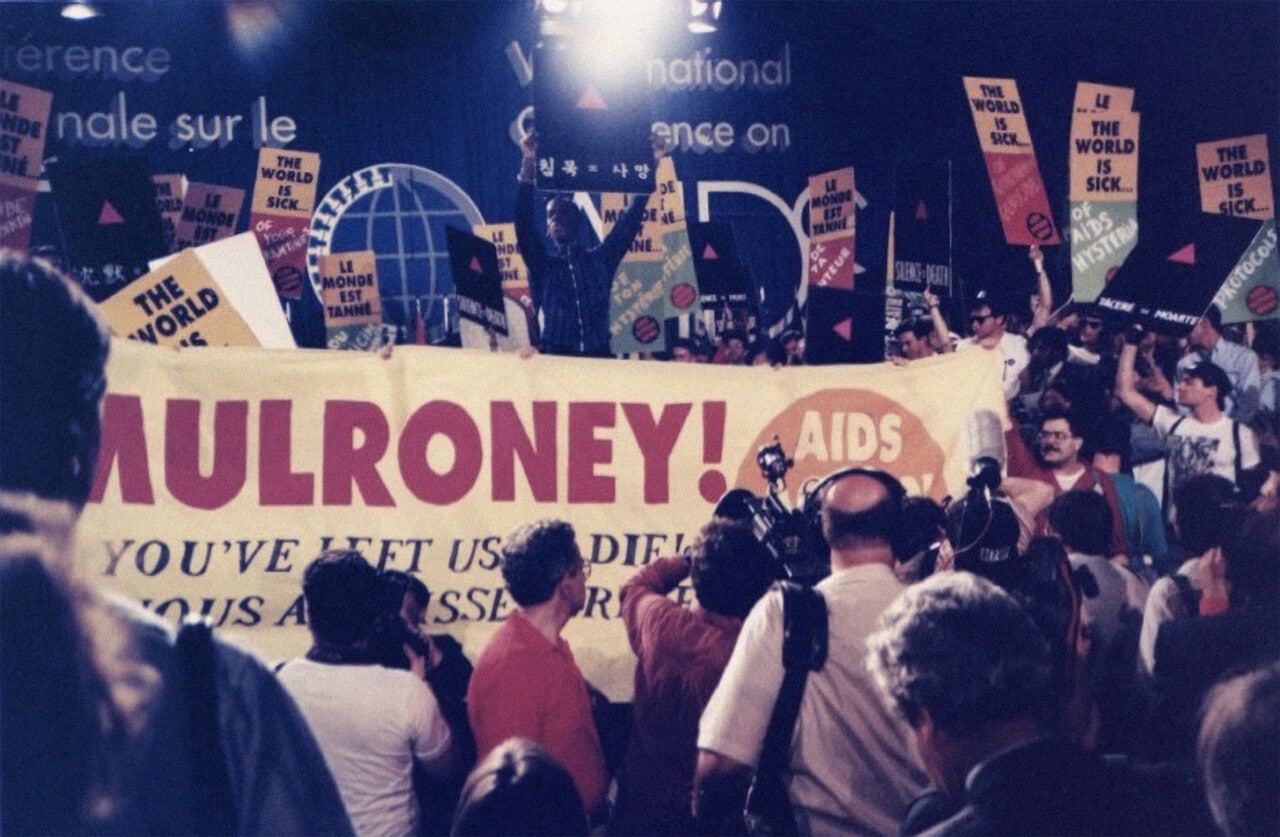
It was 1989 at the Fifth International AIDS Conference in Montreal, and Brian Mulroney was about to become the first prime minister to address the crisis by its name. But before he could reach the stage, it was swarmed by a crowd of activists.
They unfurled banners and took up the entire stage, remembered Karen Herland in an interview with the AIDS Activist History Project. “I remember so many of the people, like the doctors and officials and politicians and diplomats … looking variously surly and stern and put out and offended and frustrated and confused,” Herland said. The crowd onstage then started chanting, “Join us.”
“Hundreds of people got up on their feet and applauded at that point. And that was just amazing.”
Instead of getting a speech from Mulroney, the crowd heard from people living with HIV/AIDS. The activists read their Montreal Manifesto, which listed the government’s failures on AIDS and called for an international code of rights for people with the illness.
The stunt was a turning point in the AIDS movement, Herland said, gaining the HIV-positive community more access to the people making decisions about their health.
”People forgot that we did many of these things ourselves,” Gary Kinsman, a gay rights activist and academic who co-founded the AIDS Activist History Project, told The Breach in an interview. Kinsman was one of the first employees of the AIDS Committee of Toronto in 1983.
The gulf between the direct action of those early AIDS groups and how COVID-19 is being addressed couldn’t be greater, Kinsman said, with the response to COVID being focused on individual behaviours like masking, social distancing and hand sanitizing.
Grassroots movements around COVID have been missing in action. Kinsman said it’s urgent to remember the legacy of changes brought about by AIDS activists at the time: centering the people most affected in conversations about public health, creating more inclusive 2SLGBTQIA+ spaces, and bringing sex workers into the labour movement.
With restrictions lifted, variants on the rise, and no end to COVID-19 in sight, Canada’s left can and should be looking to AIDS activism and organizing as examples of how networks of community care build strong, lasting social movements.

A grassroots movement led by the most impacted
It was the self-organization of people living with AIDS that drove the activism, Kinsman said, so people understood that they had to take direction from the people most directly affected.
“That of course has been completely lost in the context of the COVID crisis, where it’s all about individuals and whether they’re gonna wear a mask or not, which is left up to them.”
Kinsman connected with his community through organizations like Gay Liberation Against the Right Everywhere, which organized Canada’s first Pride event to commemorate the Stonewall riots.
“One of the things we did, first of all, was to build support groups. There was this social sense that we were part of a community, we weren’t just individuals,” Kinsman recalled.
By talking to each other and sharing knowledge, the community learned that certain activities were higher risk than others. They developed norms that came to be called safe sex practices or safe practices, which also included practices around drug use.
Then, they educated each other by demonstrating how to use condoms, circulating lists of low-risk sexual activities, and providing explicit warnings against sharing needles when using drugs.
It was “something like community ethics. This was what you did to support your community,” Kinsman said.
The “organized forgetting” of AIDS activism
“Canada’s memory of that era is very scant. I think it’s because of the stigma that it affected gay people generally,” said Albert McLeod, a Two-Spirit activist with ancestry from Nisichawayasihk Cree Nation as well as the Métis community of Norway House in northern Manitoba.
Kinsman agrees that stigma has been a lasting factor that shaped how HIV/AIDS was discussed—at the time and in the years since.
“Public health was a fundamental problem for people living with AIDS and HIV because it identified us as a high risk to the so-called general population, which was defined therefore as being heterosexual, largely white, mostly middle class, mostly male,” he said. These definitions created a very political context for AIDS activism to emerge.
That has changed over the years, he said, as AIDS organizations became regulated and funded by the state and turned into more bureaucratic, apolitical actors. These organizations were once repositories of information and archives of a collective history they helped write. Some organizations fought for access to treatment for AIDS patients, even smuggling medicines over the border that were approved for use in the United States but not Canada.
Kinsman called this process the “social organization of forgetting,” and said it explains why there’s so little awareness of the AIDS activists’ struggle on the left today.

AIDS prompted a Two-Spirit resurgence
Movements today need to recognize queer politics are at the centre of progress. Spaces created to respond to the AIDS crisis were necessary for those marginalized within the queer community.
McLeod said that Indigenous queer people were isolated from the greater Indigenous and queer communities, but gained new language and visibility through AIDS activism. McLeod has been an advocate for more than 30 years with Two-Spirited People of Manitoba and the Manitoba Aboriginal AIDS Task Force.
“I like to characterize the Two-Spirit re-emergence as an Indigenous response to the HIV pandemic,” McLeod said.
In 1988, McLeod attended the inaugural Annual International Two Spirit Gathering in Minnesota. Now in its 36th year, the event began as a way for Two-Spirit people across Canada and the United States to discuss how to address the AIDS crisis.
“It’s a place where we can just be who we are authentically without having to navigate, negotiate, or explain to anybody,” he said. “We celebrate ourselves, we educate ourselves, we do ceremonies together that some may not be allowed to attend in their own communities.”
He eventually co-founded the Manitoba Aboriginal AIDS Task Force in the early ‘90s, to offer education and outreach to Indigenous people in the province, drawing on Indigenous knowledge systems.
“We worked on a couple models like the HIV/AIDS Medicine Wheel that integrated Indigenous worldviews into education about the physicality of a new virus and the medical stages of HIV infection,” he explained. “And then, talking about it from a sort of ecological/ecosystem point of view that included traditional healing, elders, plant medicines and ceremonies as part of the response.”
Kinsman said that communities of support created for AIDS activism quickly grew beyond the bounds of gay men and the gay rights movement, because it was clear that the stigma of AIDS also affected drug users, sex workers and Haitians.
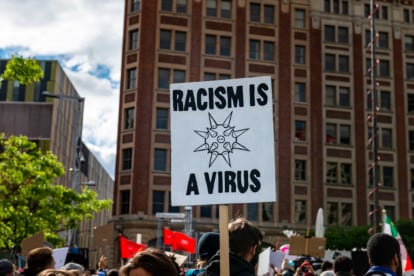
“I’m not trying to say that there weren’t some conflicts and contradictions, but there was an incredible amount of support,” he said. “People understood the impact of racism in terms of the AIDS crisis. So some of the whiteness that was dominant within the gay men’s scene at that point in time got challenged.”
Many of the sex-worker-led labour organizations that are currently pushing for decriminalization in the country also have their roots in AIDS outreach and harm reduction. From its inception as a community resource in 1986, Maggie’s in Toronto prioritized safe sex education and outreach. In 1988, they helped secure funding for the Prostitutes’ Safe Sex Project, which was the first peer education program by and for sex workers in Canada.
McLeod said the Two-Spirit spaces that were originally created to respond to AIDS have been liberating.
“It is a form of liberation when you self identify, or self name. And so it had that spiritual component to it of receiving a spiritual name, while making space within the broader gay movement,” he explained.
“It’s taken 30 years, but now we’re at the front of the acronym.”
Remembering as an act of resistance
Kinsman worked with Alexis Shotwell to revive the public’s memory of all this work with the AIDS Activist History Project.
Through interviews with AIDS activists as well as digitizations of zines, flyers, memorials, posters and photographs, the online project, which is no longer funded, aimed to document the history of AIDS activism in Canada.
The goal of the project is to help people remember the AIDS crisis and what activists accomplished, Kinsman said.
“The resistance of remembering can counteract the social organization of forgetting,” he said.
McLeod said the lack of public memorial for HIV/AIDS victims is echoing in the cultural denialism around the extent of the COVID-19 deaths. Both pandemics caused massive losses that weren’t reflected by public services or burials, he said.
“The scale of people who have died during COVID is huge, and that gets put in the back of your mind. … Sadly, Canada hasn’t done a good job about memorializing that first pandemic of HIV/AIDS either.”
Kinsman said that through the co-opting of activist organizations and the re-framing of public health through an individualistic lens, neoliberalism has undermined the work he and other activists did. However, he sees the global responses to anti-Black racism in the summer of 2020, and the No Pride in Genocide movements as glimmers of hope that new social movements can still emerge in this time of crisis.
To address COVID, “We need to actually engage in die-ins, sit-ins, occupations, to put pressure on medical and state authorities in different ways. And obviously we need to engage in all those practices in a safe way,” Kinsman said.
“The problem isn’t that people are really not following public health procedures, it’s that actually the public health procedures are a big part of the problem because they’re not based on popular education. They’ve not been based on empowering people in communities to actually organize themselves.”

I often hear that I’m lucky to have a full-time job in journalism.
Critical, bold journalism that isn’t beholden to media monopolies should be the norm—not the exception.
By supporting The Breach, you’re supporting a more robust, progressive media. Join us today.
– Katia Lo Innes, Associate Producer, The Breach