This spring, student encampments popped up across Canada to protest support for Israel’s bombardment of Gaza. By midsummer, they had been stigmatized or shut down—and media coverage helped justify it.
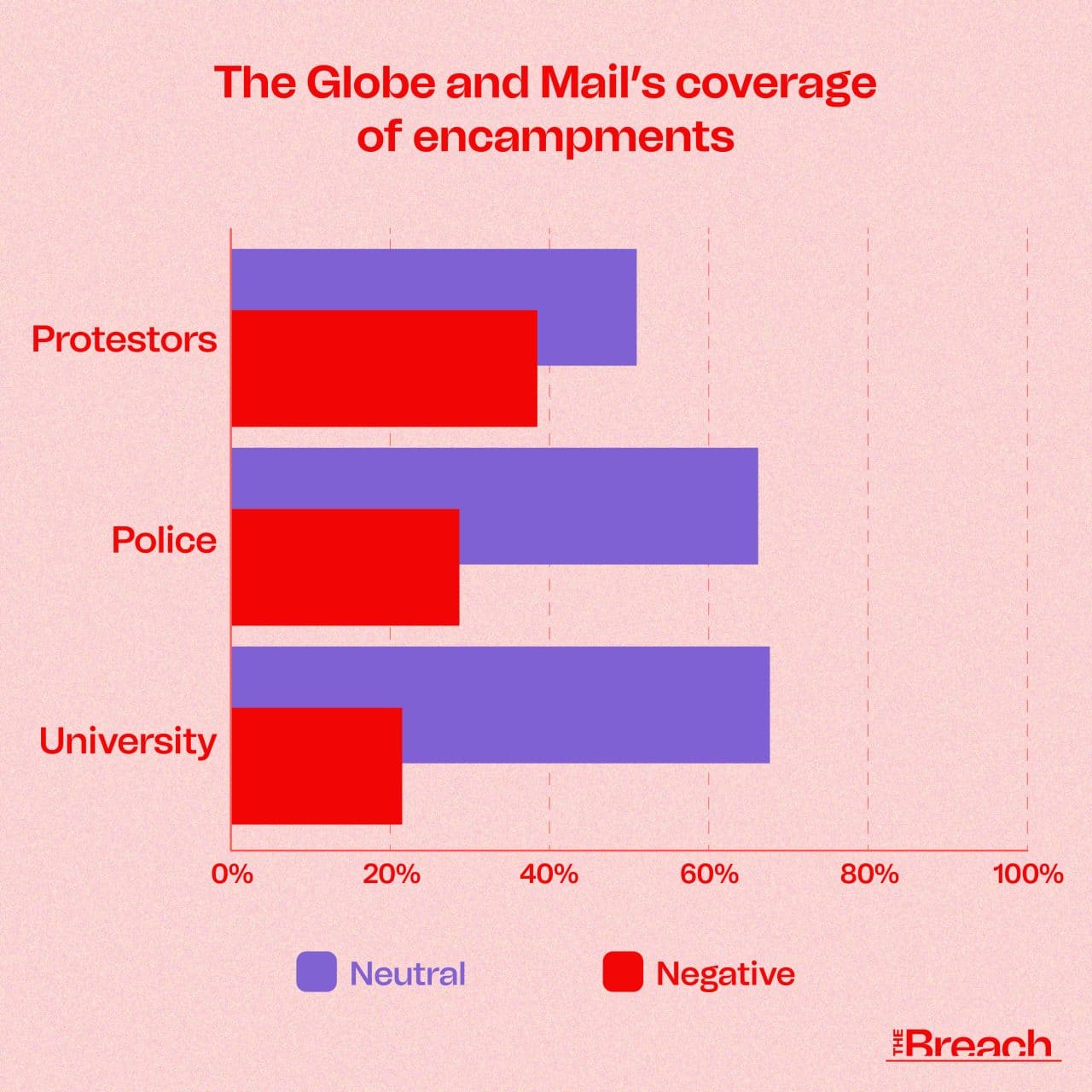
A study conducted by The Breach found that The Globe and Mail provided disproportionately negative depictions of student protesters, while more often providing neutral descriptions of police forces that in several cases violently dismantled the camps.
Nearly half of the sentences used to describe protesters were negative, including regular use of terms like “violent,” “hateful,” or “hostile,” evoking an image of dangerous camps that were in fact consistently peaceful and nonviolent.
Students were also more likely to be negatively characterized than both police and university administrators, who in almost all cases resisted calls to divest their funds from weapons manufacturers or companies implicated in Israel’s violation of Palestinian human rights.
The Breach analyzed nearly two thousand sentences in more than two hundred articles that appeared in publication’s coverage of the encampments between mid-April and mid-July, with data collected by Tech For Palestine’s Media Bias Project.
The Globe and Mail avoided the over-the-top attacks on student protesters that were seen in right-wing Postmedia publications, such as headlines in the Toronto Sun and the National Post claiming “Palestinian university encampments a threat to humanity’s values” and “Anti-Israel chaos on campus a threat to Canada.”
But the coverage in Canada’s elite paper of record demonstrated a more subtle yet still clearly distinguishable anti-Palestinian bias.
The Breach’s study builds on a series of data-driven analyses examining how Canadian media have mobilized support for government, corporate and elite interests that have long backed belligerent Israeli state policies toward the Palestinians.
‘Violent’, ‘hateful’, ‘unsafe’
While The Globe and Mail’s reporting did use critical language about counter-protesters, police, and university administration, it was student protesters who bore the brunt of unfavourable descriptions.
Students were negatively characterized in 39 per cent of the studied coverage, while similar characterizations applied just 28 per cent of the time for police and 21 per cent of the time for university administrations.
Protesters only received positive reporting approximately 7 per cent of the time, and were frequently referred to using harsh terms such as “hateful” and “unsafe.” In one article, encampment protests were described as “testing the boundaries between freedom of expression and hate speech.”
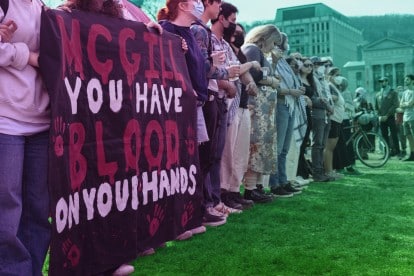
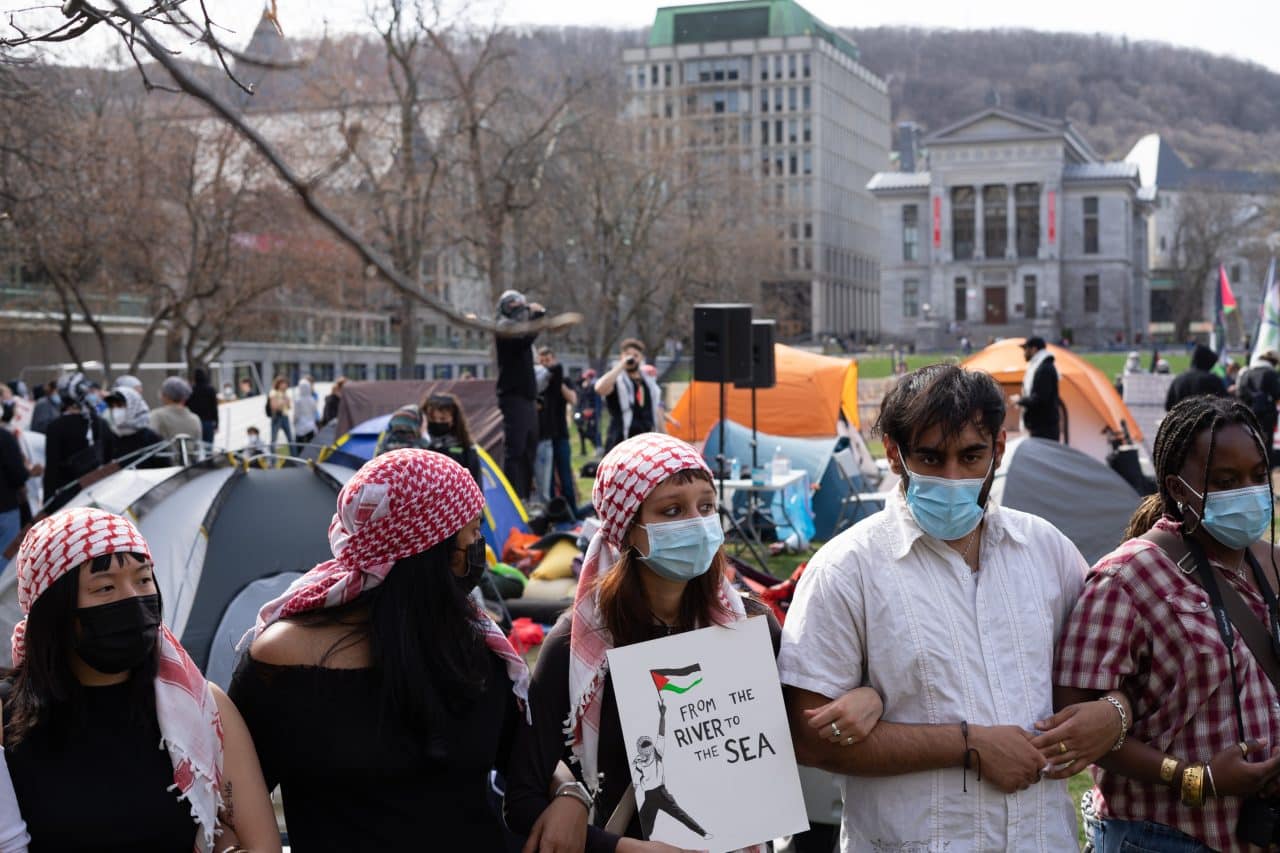
Coverage of the encampment at McGill University underscored the alleged antisemitism and hate-speech of the protesters, with safety and unsafety regularly cropping up in descriptions of protesters’ effects on campus.
Words such as “violent” and “violence” were used 69 times in 40 articles to describe the protesters.
In comparison, police forces were only described as “violent” in 10 instances.
While no comprehensive studies were done in Canada, a study by The Guardian showed that the vast majority of student encampments in the U.S. were peaceful until police intervened.
Opinion articles showed even more anti-Palestinian bias than reportage.
Coverage deemed the McGill encampment as “blight on the McGill campus and Montreal’s downtown” and condemned peaceful protests as “displays of bigotry.” Rhetoric also focused on the threat of anti-semitism on campus, frequently citing incidents of discrimination and hate speech.
In the U.S., where pro-Palestinian protesters were the targets of hostility and aggression, little attention was paid toward the actions of counter-protesters. Although counter-protesters attacked peaceful protesters on campuses such as UCLA, “violence” was only used twice to describe actions of counter-protesters.
In Canada, where confrontations between protesters and counter-protesters largely remained peaceful, baseless characterizations of encampments as hostile and unsafe were frequent.
One opinion article remarked plainly that “the tenor and pervasiveness of the protests [made] others feel unsafe.” Another stated that “with pro-Palestinian encampments now popping up at universities across the country, it is likely these displays of bigotry will only proliferate.”
The Globe and Mail did feature criticisms and negative descriptions of university administrations.
However, such criticisms were often in the forms of direct and paraphrased quotations from sources, not through journalistic description.
Casting police violence as neutral
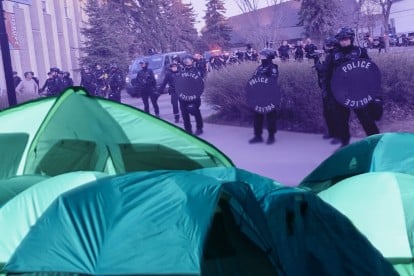
The Globe and Mail generally avoided negative descriptions of the police, instead sanitizing the actions that officers undertook to clear encampments.
When police started to remove the encampments in the US, which involved notably more violence from officers than in Canada, journalists at the publication described police as vaguely “assisting” in, “breaking up,” or “clearing” encampments.
At Columbia University, the NYPD maced, tasered, and struck protesters with batons in order to violently remove the encampment. But when The Globe and Mail reported on this incident the next morning, it simply wrote: “New York City police officers arrested protesters late yesterday after Columbia University called in police to clear the pro-Palestinian demonstration from the campus.”
Similarly, at UCLA, LAPD police arrived two hours late to a fight on May 1 instigated by counter-protesters, and fired bean bag shotgun rounds in attempts to control the crowd. Less than 24 hours later, police used flash bangs, batons, tear gas, and further bean bag shotgun rounds to aid them in the arrest of over 200 students.
The Globe and Mail’s headline about the incident read: “Police raid UCLA pro-Palestinian camp, make arrests.”
It used neutral language to downplay the actions of the Canadian police and security forces, describing how police “cleared a pro-Palestinian encampment at York,” and “halt [a] pro-Palestinian encampment at Quebec’s City’s Laval University.”
At the University of Calgary, police in body armour beat protesters to the point of several people sustaining concussions and one mother of two students having her rib fractured. Nearby, riot police at the University of Alberta aggressively broke up the protest encampment with “non-lethal rounds” and chemical irritants.
Even though tear gas is classified as a chemical agent and its use is banned in international warfare, The Globe and Mail did not draw attention to the gravity of its use when students at McGill, UQÀM and Concordia protesting for Palestine were tear gassed by the Montreal police.
The harshest language in reporting on police violence against encampments was reserved for those that were set up across Europe.
Police were depicted as “beating down protesters” and “pulling down tents” at camps in the Netherlands and Germany—a stark contrast to the language used for police actions within Canada.
Back to school consequences
In the aftermath of student encampments, a disciplinary air pervades some Canadian campuses.
In the period after dismantlement, McGill closed its usually accessible campus for a month, permitting only those with McGill IDs to enter the lower campus. As of September 3, the front gates remain closed, and extra security is present on campus.
Restrictions on protest have been put in place at UofT. Protesters are not permitted to block roadways into campus (a common occurrence during pickets and rallies), nor are they allowed to disrupt administration meetings (another common occurrence), and megaphones are outright banned. Affixing any sort of sign on campus is deemed vandalism.
These restrictions do not solely affect Palestinian solidarity protesters, but prevent any student from organizing on campus.
Restrictions have also been put in place at Western University in London. Groups are now required to get permission from university administration at least five business days before the intended demonstration. Such protests are only permitted to occur between 12 p.m. to 6 p.m. on weekdays. Faculty members have warned that these new restrictions may clash with Western’s freedom of expression policy.
Beyond adopting repressive restrictions and rules, universities are taking legal action against protesters.
Vancouver Island University is suing leaders of the pro-Palestinian camp that was disbanded in August. A similar lawsuit was introduced at the University of Waterloo, directly suing student leaders for $1.5 million, but was withdrawn by the university after the camp was disbanded.
At McMaster University, three students were banned from campus activities due to their involvement in the encampment.
Protesters have decried such lawsuits and actions as intimidation tactics, and have noted that these kinds of interactions with university administration have left them feeling alienated by the institutions they pay to attend.
University admins have also engaged in a campaign of misinformation and unfounded allegations against protesters.
McGill President Deep Saini claimed that university staff were prevented from leaving a building occupied by protesters, which was denied by Dean of Students Robin Beech. Similarly, University of Victoria president Kevin Hall wrongfully accused protesters of an unrelated knife incident on another part of campus.
Such statements were amplified by media outlets like The Globe and Mail.
-files from Helen Jacob

The Breach’s investigations don’t just inform our readers—they force the powerful to react.
An exposé on blood plasma privatization led to national headlines. Our revelations about the government’s cozy connections to Big Pharma sparked a parliamentary probe. A report on high-tech price-fixing by mega landlords resulted in a criminal investigation.
From activists to elected officials, people are using The Breach’s journalism to push for transformative change.
– Dru Oja Jay, Board President, The Breach