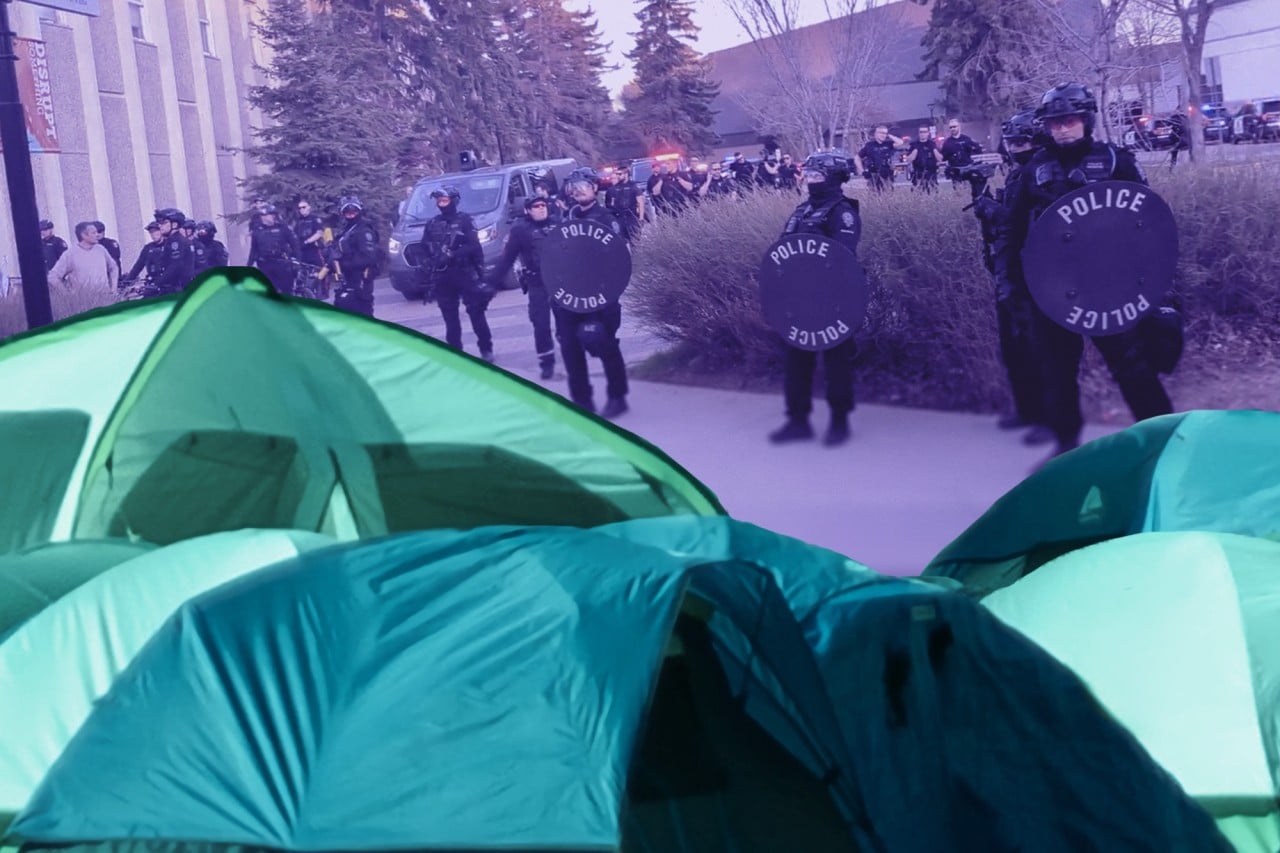
As Katy Anderson drove home from campus that night, she kept checking over her shoulder. Each time she made a turn—six times in total, she remembers counting—two police vans trailing behind her turned as well.
“They followed me all the way until I reached my parking lot at the back alley of my apartment building,” said Anderson, a journalist and PhD student at the University of Calgary.
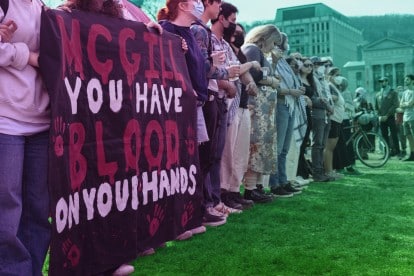
Earlier that night, she was among several students and community members injured in a police crackdown that, at the behest of the University of Calgary, dismantled a pro-Palestine encampment set up the same day on the campus.
Anderson suffered a concussion, having been hit over the head with police shields, as well as being kicked, pepper sprayed, and stunned by a flash bang grenade that landed next to her.
The day after, U of Calgary president Ed McCauley wrote in a statement that “the police report no injuries.”
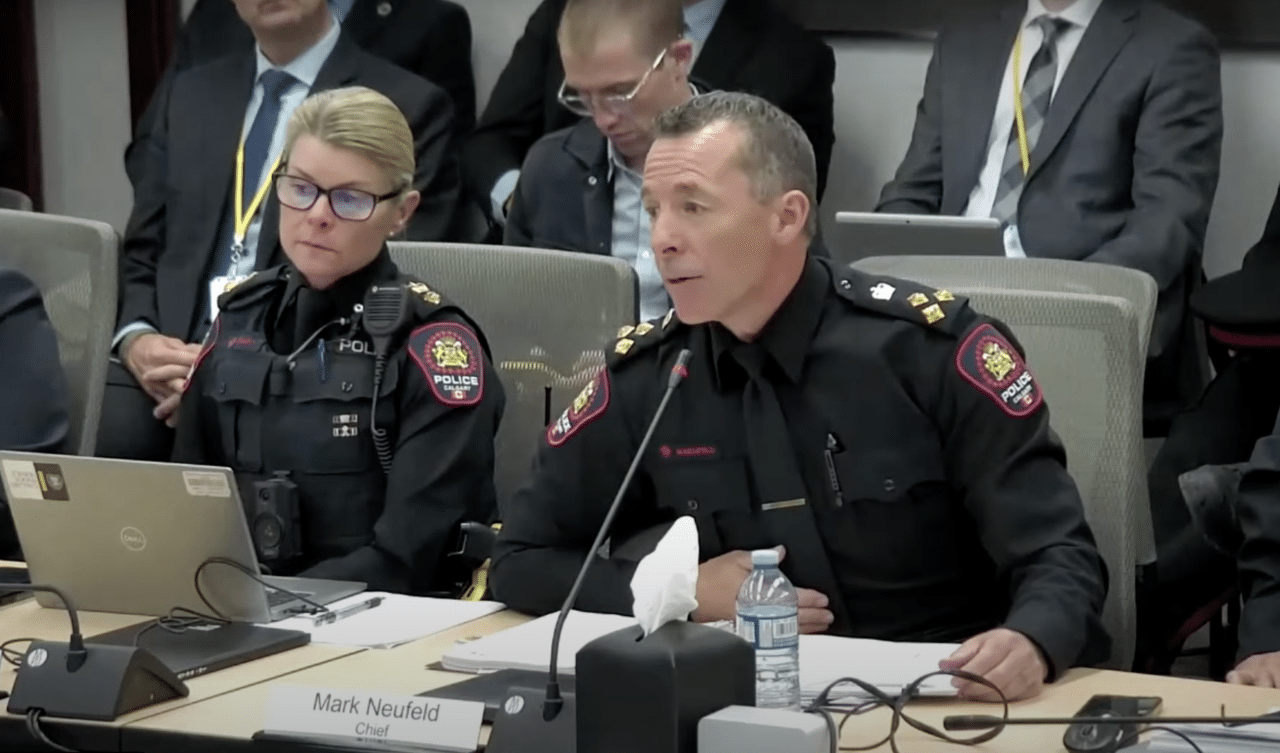
Three weeks later, Calgary Police Chief Mark Neufeld told a police commission hearing that he still couldn’t answer questions about injuries that night. The Alberta Serious Incident Response Team—made up of police and “civilian investigators”—was investigating, he said, whether “social media accounts and reporting of serious injury…are, in fact, accurate.”
While the raid in Calgary was one of the most dramatic, the whirlwind of unfounded allegations and police violence that student protestors experienced there played out similarly across the country. It was part of a pattern in responses to encampments, according to interviews The Breach conducted with more than 20 students and organizers from six pro-Palestine encampments.
At universities in Calgary, Edmonton, and York, police did what universities asked of them right away, dismantling encampments on the very first day.
At other universities where police didn’t want to step in without a court injunction, universities deployed campus security and hired private security guards to engage in surveillance, in some cases long before encampments sprung up.
According to recordings and documents obtained by The Breach, presidents at universities of McGill and Victoria made false claims about student actions and spread misinformation about violence that students were not responsible for. In another case, a professor at University of Toronto conferred with police after a student made a short presentation about the Israeli massacre of Palestinians in class.
In public statements that were frequently amplified by the media, university presidents accused encampments of being unsafe spaces and spreading hatred. But in spite of the heightened surveillance, administrators from Victoria to Toronto have still shared no evidence of their public claims.
Students say the misinformation spread by universities undermined public support for their demands—mainly, for universities to disclose and divest from companies that are arming Israeli aggression against Palestinians, and to cut academic ties with Israeli universities that are aiding the occupation of Palestinian territories. But students say setting up encampments and escalating their demands through office occupations did bring administrators to the table, after other forms of protest had been disregarded.
“This encampment has been very successful because since we started, we went from [the university] not talking to us, to just rejecting the demands, to now negotiating a deal,” said Mohammad Yassin, a Palestinian student and media spokesperson for the former encampment at University of Toronto.
Misinformation from Calgary police, university president
In the aftermath of the police raid in Calgary, Anderson and others who were there that night were shocked by the misinformation spread by the police and the university administrators.
For his part, U of Calgary president McCauley blamed potential counter-protesters, saying it was necessary to remove the encampment by force because “it is possible that…in the middle of the night a camp would have found itself in immediate and dangerous conflict with counter-protesters.”
Police chief Neufeld claimed there were “projectiles in the form of bottles” thrown at officers and that protesters grabbed police shields, thus provoking police to advance on those who remained at the encampment after 11pm.
In an interview with The Breach, Anderson said she listened to the police chief’s testimony with her jaw agape, saying it did not reflect what had happened that night.
According to Anderson and three other protesters who spoke to The Breach and shared videos of the night, the “projectiles” were small, flimsy plastic water bottles that protesters were throwing to each other for hydration. And with protesters standing arm-in-arm and singing in a line eight feet away from the line of police officers carrying shields, they said there was no way for anyone to grab a police shield before cops began their advance.
All who spoke to The Breach said encampment members were in the process of complying with the decampment order, when police suddenly advanced on them.
Most shocking to Anderson and others was the police claim that they needed a third party to investigate whether their actions that night had caused injuries.
“I was hit a few times in the face with a shield, I had my glasses broken, I was kicked in the legs,” said Leo Hooper, a Mount Royal University student who was at the Calgary encampment.
“At least four people left that night in ambulances, some of them that the police put in ambulances,” Anderson said. “So for them to say that there were no injuries, how can that be?”
At the Calgary police commission hearing in late May, police chief Neufeld said he has regularly been meeting with police across Canada to discuss pro-Palestine protests, and said his department “began a dialogue with post secondary institutions in April” in anticipation of an encampment that wasn’t set up until May. He said he would not be surprised if universities were taking a similarly coordinated approach.
The University of Calgary did not answer The Breach’s questions in time for publication, and Calgary Police Service said they cannot comment further because “this matter is under review by the Alberta Serious Incident Response Team.”
With the exception of UBC, each of the universities contacted for this article declined to answer questions, and either ignored the media request or pointed to existing statements on their websites.
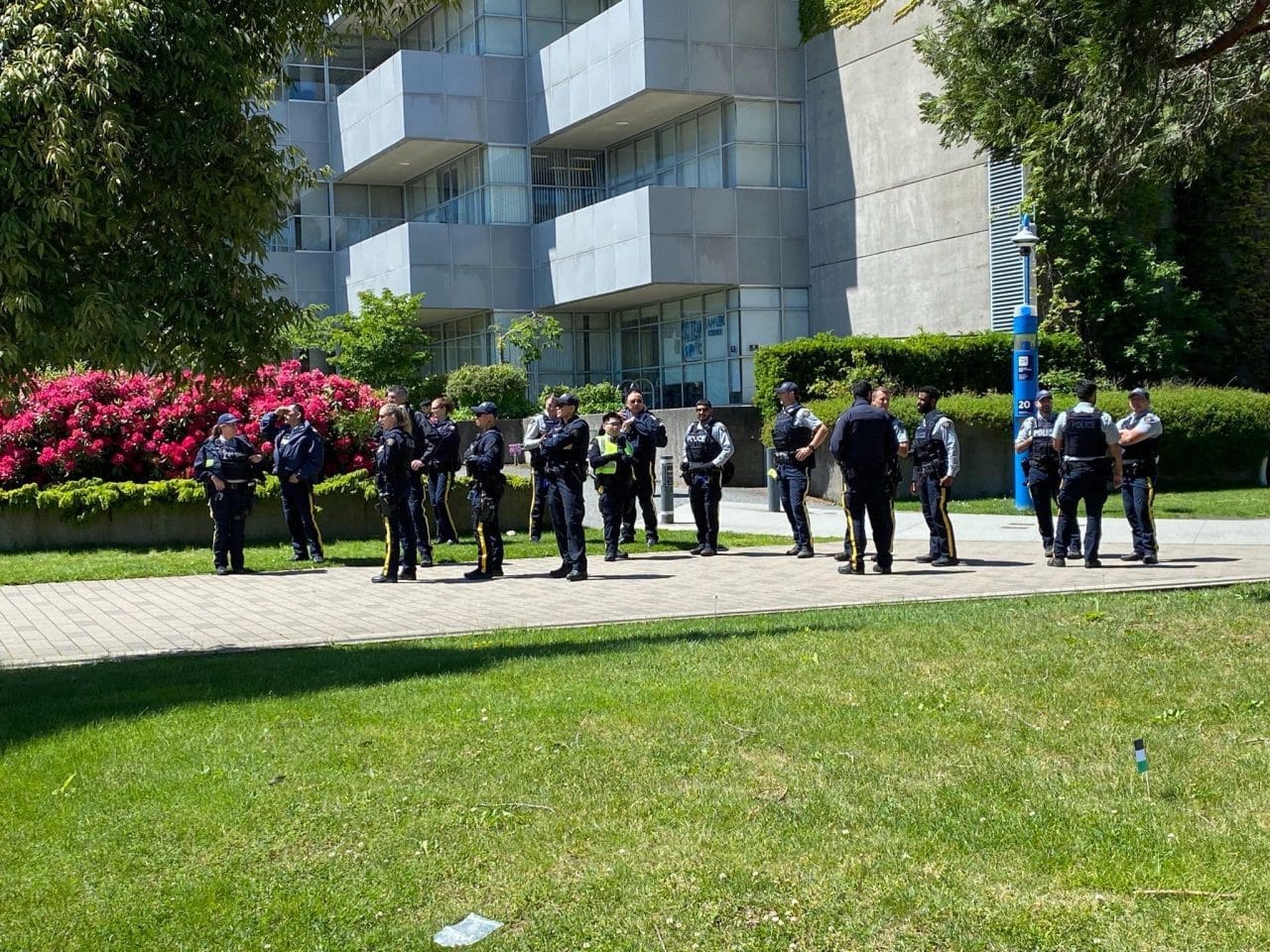
At most university encampments across Canada, including University of Toronto, McGill and University of British Columbia, police took a different approach, initially refraining from arresting students on campus.
“This was not them suddenly growing a conscience,” said Irina Cerić, an assistant professor of law at the University of Windsor.
“They’re saying, ‘this is a civil matter [and] if you’ve got these people on your property and you want to eject them, that’s not necessarily our business unless they’re committing crimes.’ Police weigh this sort of decision-making against their own resources, against how it’s going to play in the public.”
McGill alleges violence, despite knowing it was untrue
While pro-Palestine students across Canada struggled to get meetings with their universities, administrators at UBC and McGill met with pro-Israel stakeholders and university community members.
According to a recording obtained by The Breach of an internal faculty and administration meeting at the Dean of Students’ Office at McGill University in late May, one individual voiced her fears about the encampment, comparing it to a Nazi death camp
“There’s [a Palestinian flag] hanging between two of the main arches,” she said. “Am I the only one who goes into Molson stadium…and imagines it says ‘Arbeit Macht Frei?’ It just feels like you’re walking into Auschwitz when you go through that gate on the other side.”
The German phrase translates as “work makes one free” and was inscribed above the entrance to the Auschwitz concentration camp in Poland, where historians estimate over a million people were killed in five years.
A different unidentified administrator then asked the individual where the arches are located, and the two pinpointed the vicinity.
A recording of another Dean of Students internal meeting in June revealed the dean’s surprise that after beefing up security for convocation, pro-Palestine messages from graduates and students “didn’t really interrupt the proceedings. It was nowhere near as bad as I was expecting.”
On June 6 students occupied the administrative James building in an effort to bring the administration to the negotiation table. In response, McGill called the police who, arriving in riot gear, pepper sprayed and arrested 15 people inside and outside the building.
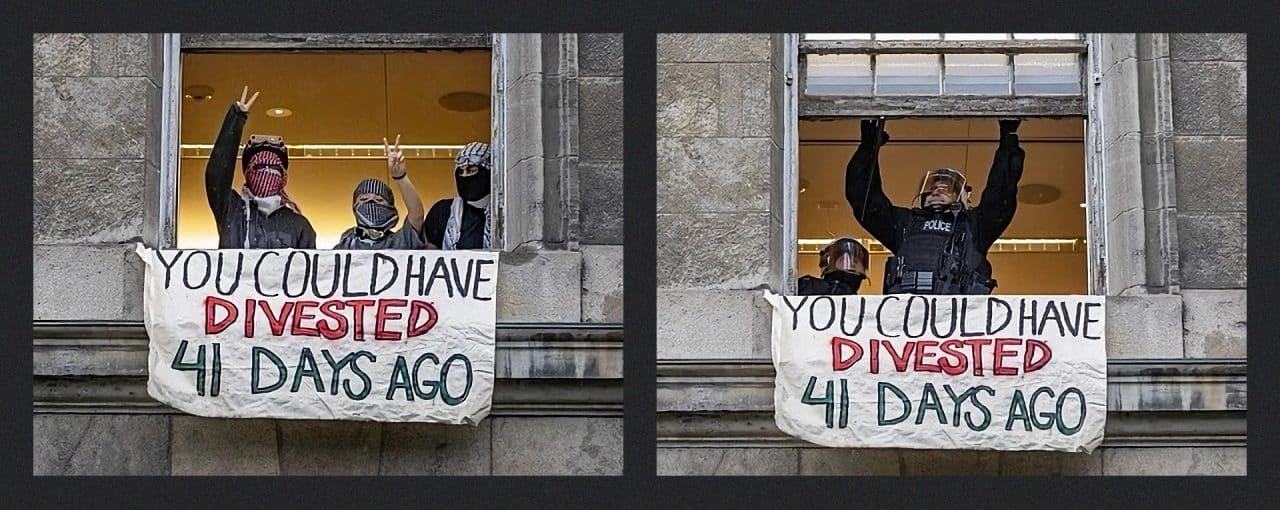
President Deep Saini claimed that staff in the building were prevented from leaving, but according to recordings obtained by The Breach, the Dean of Students knew this was not true.
In the internal meeting in June, McGill’s Dean of Students Robin Beech described visiting the occupation and acknowledged that there was “no sense that anyone was prevented from leaving the building, though. So I’ve heard people say that they were taking hostages. But no, that’s not true.”
While protesters did not impede anyone from leaving, headlines the next day quoted the university administrators on how the action was meant to “threaten, coerce, and scare.”
McGill president Deep Saini said students were chanting “violence now”—a claim repeated in the Montreal Gazette the next day.
Jessica, a campus community member who was present outside the James building occupation on June 6 told The Breach that no such slogan was chanted. Other interviewees who were present that night but did not want to be quoted confirmed this.
“The central demand to the McGill administration is ‘divest now’,” she said. “I don’t know why anyone would say ‘violence now,’ that doesn’t even make sense.”
At the protest outside the building, Jessica says police aimed tear gas canisters at protesters in close range.
“When we see McGill saying, ‘these people are violent’, it’s distracting from the fact that protesters for Palestine at McGill are actually far more likely to be victimized by violence,” she said.
McGill University has not responded to The Breach’s questions about their statements and the June 6 incident.
UBC and U of T involved cops on slimmest of pretexts
Long before setting up encampments, students had hosted educational events, made art, held protests, and walked out of classes in their efforts to get universities to respond to their demands.
Students say these “softer approaches” were either ignored or their institutions reacted by increasing campus security surveillance or involving the police.
In November, students at UBC had painted the Palestinian flag, the words “Israel’s killing children again. Enjoy your weekend,” and the Instagram handles of journalists in Gaza on a cairn on campus.
After the university covered the block of cement with a tarp, a third year undergraduate student named River—their name has been changed for fear of reprisal—and a friend were seen removing this tarp by a campus security officer. The security guard called the RCMP on them, citing theft of the tarp, and according to River he accused them of hate speech for the words written on the cairn.
The UBC spokesperson confirmed that police were called because the students did not share their names with campus security nor immediately return the tarp to the cairn.
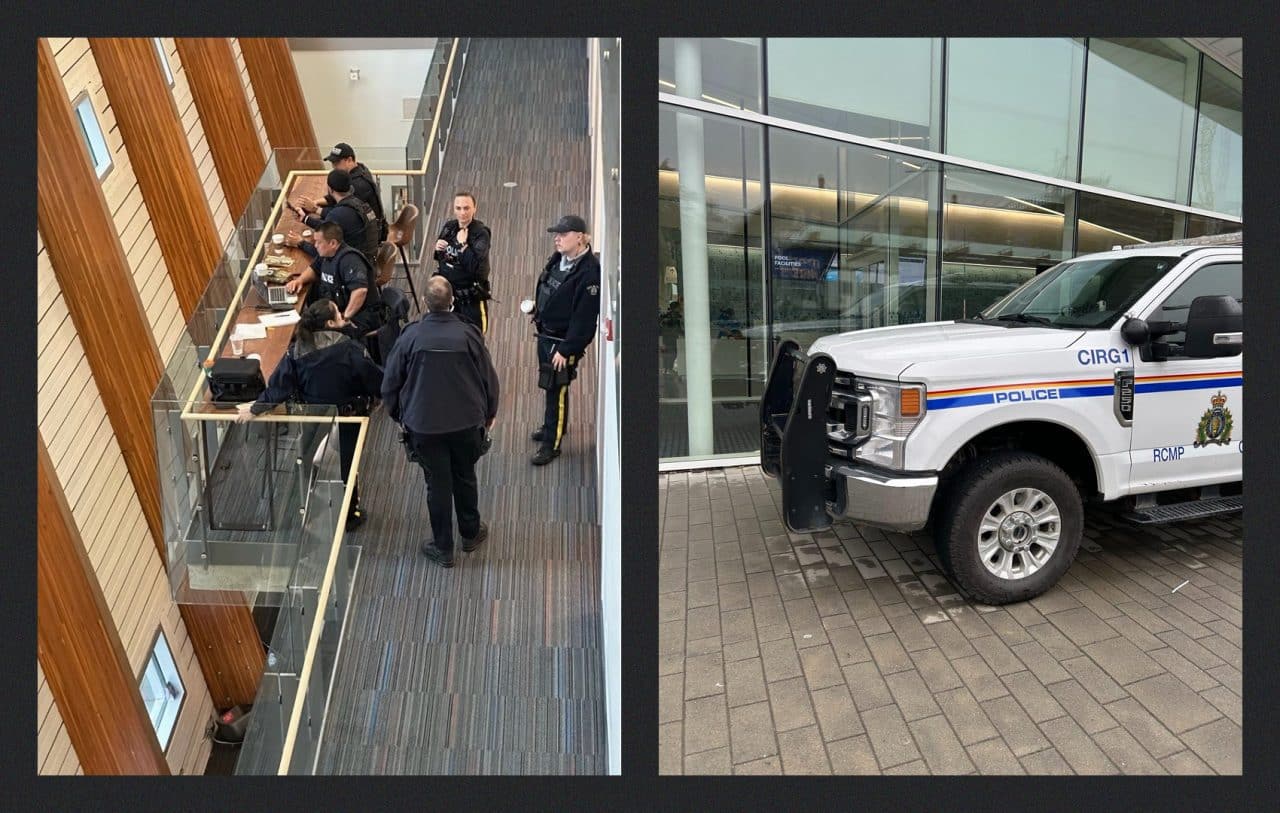
That same month, four provinces away at the University of Toronto, a professor conferred with police after undergraduate student Kalliopé McCall gave a presentation in class about the Israeli military’s massacres in Gaza.
McCall made a two-minute appeal to classmates, ahead of her team’s oral presentation about how the history of persecution has shaped the Romani musical style, in a course called Wars, Diaspora & Music.
According to a complaint she later filed with the UofT Anti-Racism and Cultural Diversity Office, the professor interrupted McCall, said it was inappropriate, called for objectivity in the classroom, “in an angry, rude tone,” and threatened her grades. Later, the complaint says, a Palestinian student who had left the class early saw a Toronto Police car sitting outside the building and witnessed the professor speaking with an officer.
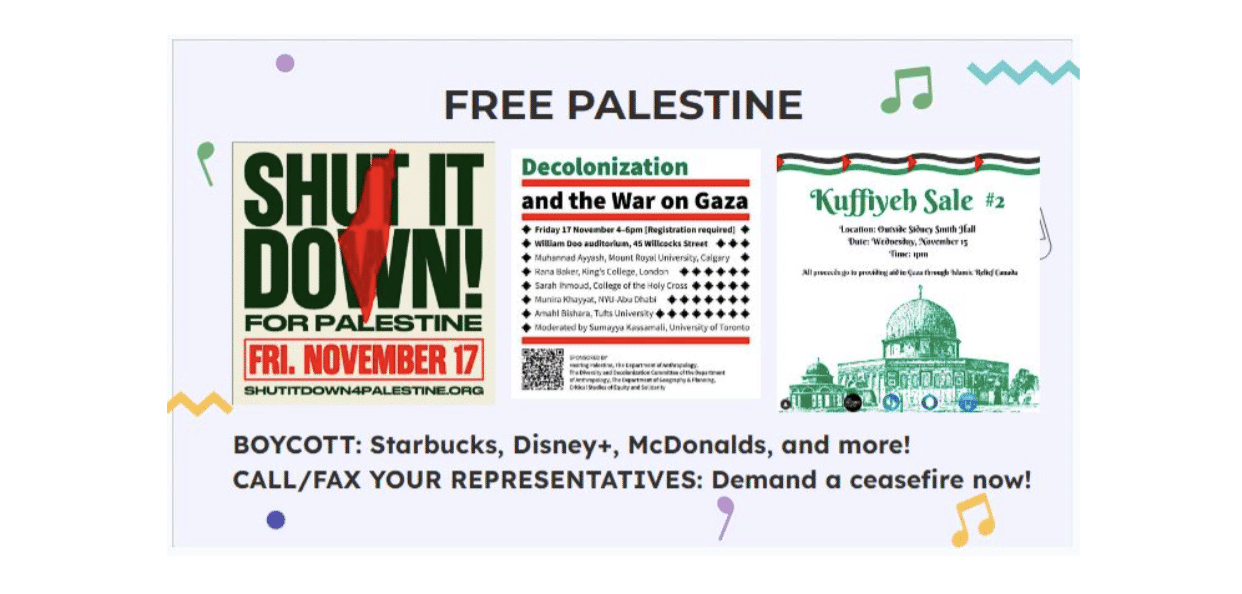
“Because our course was about war and diasporas, and our presentation was about genocide, I felt it was an appropriate connection to make,” McCall wrote, sharing a slide displayed during the presentation. The slide invited students to demand a ceasefire in Gaza, boycott companies like Starbucks, Disney Plus and McDonalds, and attend lectures about decolonization and a keffiyeh sale on campus.
“I felt like crying and I was shaking for the whole two hours after,” McCall wrote.
In response to The Breach’s questions about how the university addressed McCall’s official complaint and the nature of the professor’s conversations with police as witnessed by students, the University of Toronto shared one sentence: “The professor confirms that police presence was not requested.”
University of Victoria muddies waters about assaults on campus
Two weeks after the pro-Palestine encampment was set up at the University of Victoria, a man was arrested for using a knife to threaten staff at the First Peoples house on campus.
In a statement, the local Saanich Police Department wrote that, “Although it is believed the [suspect] was camping on campus, he was not believed to be part of the protest encampment.”
The same day, however, the university issued a statement saying “it is not yet known if the suspect was associated with the encampment.” A day later, President Kevin Hall wrote another statement blaming students for the man’s presence on campus.
“It is incredibly irresponsible for encampment organizers to encourage other members of the community who are not affiliated with the university to occupy parts of our campus,” Hall wrote.
But students and faculty at the encampment were the man’s main targets.
According to testimonies and an email chain seen by The Breach, the protesters had made multiple complaints about this individual to campus security, including sharing videos of him threatening students, a week before Hall’s statements. The man—not a member of the university community—had broken into the camp and assaulted several students and staff multiple times.
“He was there [since] the first day that we set up. It had been about two weeks of everyday circling us, mocking us, saying racialized slurs, homophobic slurs, being antisemitic, being anti-Palestinian,” said Snakes, a graduate student at the encampment whose camp name is being used upon their request for fear of reprisal. “When we had brought this to the attention of campus security they told us they would intervene and they didn’t.”
Multiple students described how the man ignored their de-escalation efforts, shoved, punched, and pushed people, and caused several injuries.
“What we see is that the increased police, increased private security, and increased campus security, not once have actually prevented these instances of assault and harm on campus,” Snakes said.
In Hall’s statement, he also claimed encampment members committed vandalism and had been seen riding bikes through the library one weekend, and shouted obscenities at touring high school students. Administrators did not share evidence of these claims.
Neither UVic nor Saanich Police responded to requests for comment.
‘Evidence of violence largely hearsay’
At the University of Toronto, the university was granted a court injunction that would allow police to arrest and remove protesters by force, due to trespass, if they didn’t leave on their own.
Trespass was the one argument that the Ontario Superior Court of Justice found compelling enough to grant an injunction against the UofT encampment.
The judge, however, did not find the administrators’ arguments around hatred and antisemitism to be accurate.
“In my view, the University has not demonstrated a strong prima facie case in relation to violence or the antisemitic nature of the expressions used within the encampment itself,” wrote Justice Markus Koehnen in the reasons for his decision about the UofT encampment. “As set out earlier in these reasons, the evidence of violence is largely hearsay, has not involved either the named respondents or occupants of the encampment and is relatively isolated in nature.”
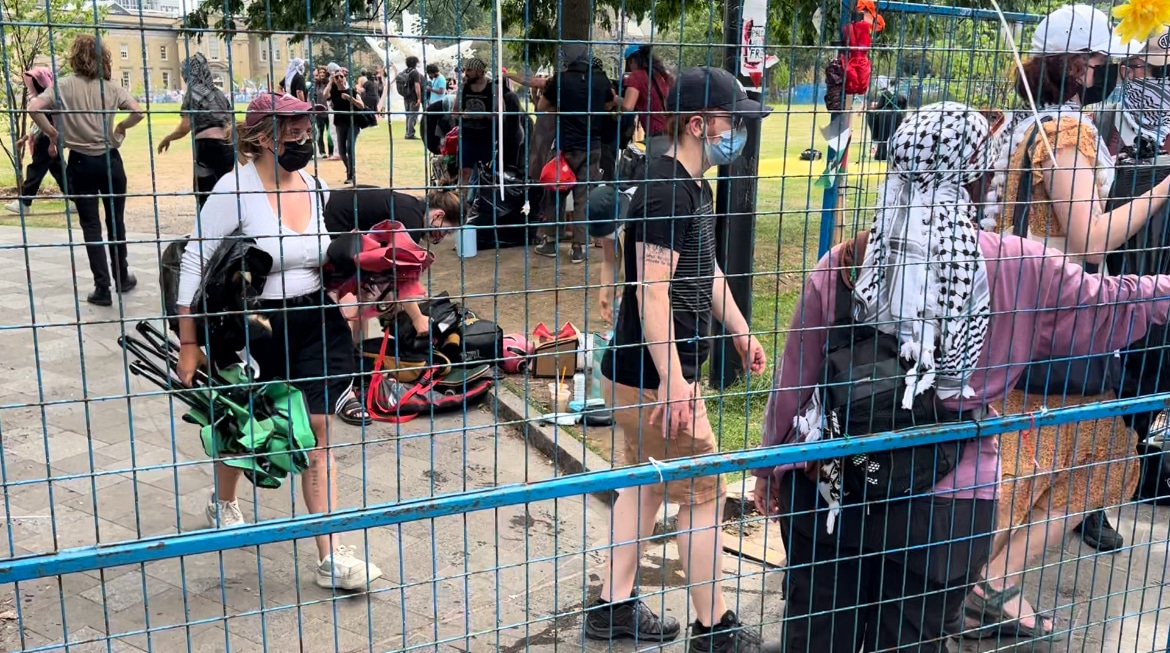
Since the UofT injunction was granted and the protesters decided to walk away instead of facing Toronto Police’s planned brutality, some encampments across Canada, like Waterloo and UBC, have followed suit. Others like UVic, Vancouver Island University, Dalhousie University and Memorial University are still fighting to have their demands met.
At each encampment, students have had their own de-escalation tactics to manage counter protestors, and have taken steps to create safe, welcoming, and inclusive environments. That hasn’t stopped presidents from repeating these claims without evidence and hasn’t stopped news from covering what they say.
“Most of the media has really just picked up on whatever the university has said and taken that as gospel,” said Yassin at UofT. “We’re simply students, we’re not an institution, we’re not backed by big power, and as such, the media doesn’t take us as seriously as they do, the larger institution that we’re protesting.”
Despite constantly having to fight the image of being hateful, pro-Palestine students, faculty and community members at universities across the country are celebrating the fact that encampments brought attention to the cause and forced administrators to engage with their demands.
Escalations, like occupying Simcoe Hall at UofT, resulted in students getting a long-requested meeting with the university president for the first time.
And in one breakthrough case at the University of Windsor, encampment members left voluntarily after the university agreed to several key demands, including disclosing public investments, aligning investments with human right principles, expanding research relationships with Palestinian universities, and pledging to not pursue any institutional ties with Israeli universities.
But the federal government is threatening to intervene in the Windsor agreement, and no university has yet agreed to the main ask: fully divest from companies enabling and profiting off of Israeli aggression in Palestine.
Despite experiencing a brutal police crackdown, students like Katy Anderson at the University of Calgary continue to protest on campus, hosting gatherings, teach-ins, keeping up the pressure on their administration.
“Were we challenging power? We were,” Anderson said. “But we weren’t being violent, we weren’t saying hateful things.”
“And if you can’t do that on university campuses, where are you supposed to?”

“It’s about getting to the bottom of things. It’s about unveiling who has the power and what they’re doing with that power.”
Linda McQuaig, journalist and author
As a non-profit, free from powerful corporate interests, we invest in investigations and uncover the cover-ups. Sustain our journalism for transformation.
Palestine | McGill tried stifling classroom discussion of Gaza, internal emails reveal
Palestine | Canadian students camping for Gaza aren’t antisemitic—they’re building brave new alliances for justice
After Selina Robinson met with UBC president, Gaza statement disappeared
8 comments
Comments are closed.
This web page freezes so I can read the article. Right now, I can’t scroll up or down. I get something like 3 seconds before the page freezes and I can’t scroll. Brave browser.
we have al heard the comments from Jewish students claiming they are threatened, and that the protesters are anti-semitic. They choose to ignore that the Israeli government is the target, not people of the Jewish faith, or nationality. Is being anti-Trump’s policies an indication of being anti-American, or just a promoter for a fairer, just, world?
Way back in the 90s, I participated in some protest camps like this and saw the same kind of nonsense directed at us. I came to the conclusion that these kinds of methods were mostly futile. People should not be encouraged to get themselves beat up and arrested, consequences to their personal lives, especially to prove really trivial points.
Until you are trained and equipped to repel police and vigilante attacks, organize quietly under the radar. Once you are able to defend, police and the hegemony behind them usually collapses quickly.
The hegemony in Canada is strongly committed to Israel. If you are going to challenge a hegemony, you have to go at it to overthrow it, dismantle it in detail. This kind of hegemonic power rarely gives in to any kind of pressure. When it does, it is usually to gain time to regroup before retaliating.
If people find the reasoning above to be rash and radical, then okay. It is fascism for now. When people finally get it, they can have freedom.
It’s not antisemitism, it’s anti Netanyahuism.
I wish you’d covered the police violence and surviellence at York University. They sent nearly a hundred cops in full riot gear, mounted police, and destroyed and stole personal property. They also assaulted one and arrested one student who was following their orders and leaving. Since then, YorkU has hired private security to patrol the space. Two of these private security pigs told a student they had to put away their Palestine flag, because “the university is just being careful, they don’t want something to happen again”. There is also heavy police presence on campus space in general. They also called cops on CUPE3903 striking members in March, and left many student-workers bruised up and one arrested. YorkU deserves so much more attention for their complicity
Too bad there wasn’t an easy space to comment and interact with other people who know a genocide when they see one……..and a fascist shut down as well, even if its happening at what we believed were Canadian universities.
I find it sickening that EDUCATION facilities RETALIATE against Canadian Charter Rights & Freedsoms – students don’t want to ‘support’ any WAR criminals, maybe the University does tho f. the $$. Those students make me a PROUD Canadian. It takes COURAGE to stand ALONE for HUMANITY.
Very informed Jewish voices such as Gabor Matte*, Illan Pappe, Miko Peled, Norman Finklestein, and Naomi Klein** help clarify how a fundamental element of the main Israel vs Palestine problem has been about a century’s worth of deceitful Zionist propaganda – which most Jewish children around the world have been submitted to – from childhood through to adulthood.
A good intro to the truth about Zionism:
* How Gabor Maté Unlearned Zionism – YouTube
https://www.youtube.com/watch?v=m8pK34-9p4w
Old and new Zionist NGOs created to influence governments, the mass media, and educational systems have deceitfully perpetuated that Zionist agenda – falsely claiming to be doing so in defence of Judaism against antisemitism. Many Jews who have seen through the deceitful Zionist propaganda have spoken up, and often pay a heavy price for doing so. Mass media exaggerate neoliberal-serving claims that foreign governments such as Russia and China have serious influence upon our neoliberal NATO-connected governments – but are silent about the far more influential Israeli/Zionist lobbyists’ manipulations, which have blatant anti-democratic – and pro-military-industrial – influence on NATO governments. The genocide in Gaza has exposed such Zionist/Israeli connections to an unprecedented degree – breaking the bubble of what has been a very successful Zionist agenda in many countries for decades.
Although the above article in The Breach doesn’t refer to that Zionist influence, I think its highly unlikely that it didn’t play a substantial behind-the-scenes role – even if it was just residual brainwashing that inspired pro-Israeli students to counter-protest against the students who on clear moral grounds protest the genocide against Palestinians. Consider:
** Naomi Klein: Jews Must Raise Voices for Palestine, Oppose “False Idol of Zionism” – YouTube https://www.youtube.com/watch?v=U75KcMUjMyI