McGill University’s administrators encouraged deans and instructors to bar any discussion of a student referendum on Israel’s assault on Gaza, following complaints from pro-Israel community members, emails obtained by The Breach reveal.
In the fall, McGill students voted on a policy put forward by the student union, calling on the university to “condemn the genocidal bombing campaigns and siege against the people of Gaza,” and to divest from any implicated companies.
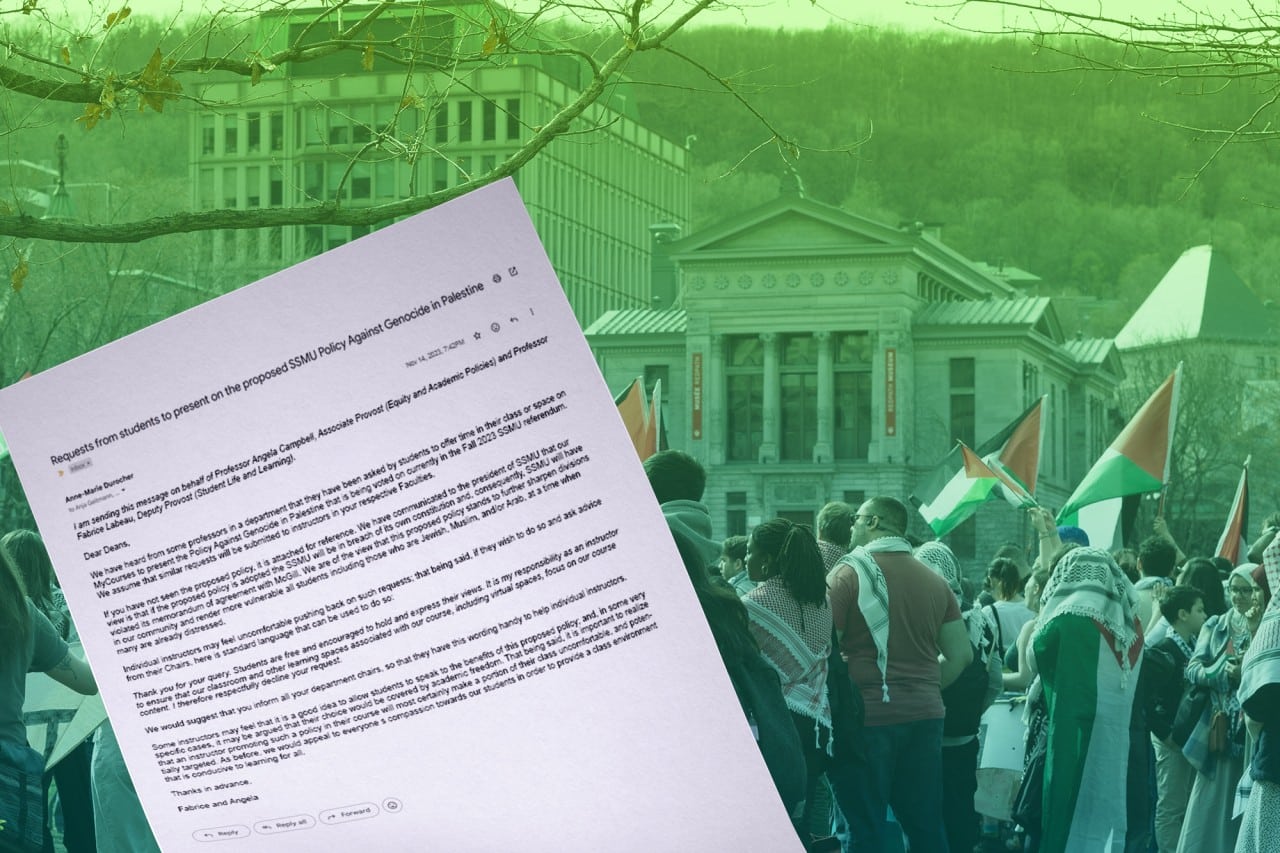
But a week before the referendum, McGill’s administrators emailed deans a template that instructors could use to reject any classroom discussion, warning faculty that discussion could leave students feeling “uncomfortable” and “targeted.”
The policy was eventually supported by 78 per cent of student voters, but its implementation has been blocked by an injunction backed by B’nai Brith Canada.
The revelation comes a week after McGill president Deep Saini denounced the month-long Palestine solidarity encampment on the campus in a Montreal Gazette op-ed, accusing the protestors of “eschew[ing] meaningful conversation” with the administration.
“To educate, to learn, to research, universities must welcome debate and challenge convention,” Saini wrote.
However, the emails obtained by The Breach in a freedom of information request show that the university’s administrators did not welcome any debate, but tried to shut it down.
In mid November, associate provost Angela Campbell and deputy provost Fabrice Labeau emailed deans with standard language to be shared to instructors who “may feel uncomfortable pushing back” on requests to discuss the upcoming vote in classrooms.
“Thank you for your query,” reads the administration-approved template. “Students are free and encouraged to hold and express their views. It is my responsibility as an instructor to ensure that our classroom and other learning spaces associated with our course, including virtual spaces, focus on our course content. I therefore respectfully decline your request.”
Assistant professor of Russian and German Cinemas Daniel Schwartz told The Breach that in his seven years teaching at McGill, he’s never received an email from the administration that suggested how he should treat a political issue on campus.
In their email, the provosts explained to deans the administration’s opposition to the policy on the grounds that it “sharpen[ed] divisions” within the university community and their view that the policy violated the student union’s memorandum of agreement with the university.
They suggested that faculty may have the academic freedom to choose for themselves what to discuss in their classroom, but warned of promoting discussion of the policy.
“Some instructors may feel that it is a good idea to allow students to speak to the benefits of this proposed policy; and, in some very specific cases, it may be argued that their choice would be covered by academic freedom,” reads the email.
“That being said, it is important to realize that an instructor promoting such a policy in their course will most certainly make a portion of their class uncomfortable, and potentially targeted,” the email continued. “As before, we would appeal to everyone’s compassion towards our students in order to provide a class environment that is conducive to learning for all.”
Last week, a Quebec judge granted a temporary injunction against McGill’s student union Students Society of McGill University (SSMU), ordering it to refrain from ratifying or implementing the policy until a court could decide whether the policy violated the union’s constitution and bylaws.
In 2022, McGill threatened to cut off SSMU’s funding after it adopted a similar Palestinian solidarity policy.
‘Shut down their political agenda’
Other emails obtained by The Breach show that McGill administrators’ warning to instructors was preceded by messages from pro-Israel community members asking the university to intervene against the policy.
One letter, whose author is redacted, is addressed to McGill’s provost Christopher Manfredi and draws his attention to the student union’s upcoming referendum.
“While I fully realize the autonomy the SSMU has, it is time to shut down their political agenda,” the author writes.
A McGill spokesperson told The Breach that the administrators’ template language was offered to “those who preferred not to speak to the issue,” and denied that it intended to discourage discussion of the policy.
“The paragraph explaining the administration’s position on the proposed policy was to provide clarity around the University’s stance of taking into account the entire student body, and McGill community when addressing the conflict,” said McGill. “This clarity was requested by professors who have reached out to the administration.”
McGill did not answer questions from The Breach as to whether they had disciplined any instructors over discussion of the anti-genocide policy in their classrooms, nor did they clarify whether promotion of the policy was covered under academic freedom.
McGill’s eventual directive, Professor Schwartz acknowledged, “doesn’t explicitly say what you can and cannot say.”
“I think it nudges more in the direction it would like to see things go,” he said. “The direction in this case is ‘best not bring it up at all, maintain an air of neutrality.’ But this neutrality is always one that is not going to speak about a genocide that’s ongoing in Gaza at this particular moment.”
Ahead of the referendum vote on the Gaza policy, Schwartz allowed a student to make an announcement in class and share a QR code to the online ballot. It did not result in a complaint from any students.
“But if that had happened, and a student had raised a complaint against me, then that could potentially lead to some kind of disciplinary hearing,” Schwartz said. “That was basically the university more or less signaling that this would not be an open and shut case of academic freedom. They were giving themselves wiggle room to see how they would handle different cases as they came up.”
Schwartz said he doesn’t know of any instructors who have faced any disciplinary action for allowing discussion of SSMU’s policy within the classroom.
“I think it’s hypocritical for McGill to pretend they are benevolent administrators who want to reconcile with their student body, and in another moment end any classroom discussion about the issue,” said undergraduate student and Independent Jewish Voices-McGill member Mara Thomspon.
Going into her fourth year at McGill, Thompson says classrooms should be a place where students can have well-facilitated discussions led by instructors.
In a letter to the McGill community on Wednesday, president Saini lamented how the police had not yet intervened to dismantle the encampment.
He claimed student representatives have walked away from the negotiating table, but students familiar with the talks said the university has refused to put anything concrete on the table to meet their demands.
McGill’s spokesperson said the university “welcomes and celebrates respectful and engaged discourse, extending robust protections to academic freedom and freedom of expression and assembly. Instructors are free to extend or utilize time in their classrooms to allow productive and constructive debates to take place, while retaining a focus on the course subject matter for the benefit of all students in their class.”

The Breach’s investigations don’t just inform our readers—they force the powerful to react.
An exposé on blood plasma privatization led to national headlines. Our revelations about the government’s cozy connections to Big Pharma sparked a parliamentary probe. A report on high-tech price-fixing by mega landlords resulted in a criminal investigation.
From activists to elected officials, people are using The Breach’s journalism to push for transformative change.
– Dru Oja Jay, Board President, The Breach
Palestine | CBC has whitewashed Israel’s crimes in Gaza. I saw it firsthand

Palestine | Canadian students camping for Gaza aren’t antisemitic—they’re building brave new alliances for justice
Campus Activism | Historic student movement for Gaza reaches Canada

3 comments
Comments are closed.
I admire “Breach” for its impartial and critical approach. Usually, it is rare in mainstream media.
Congratulations! What the students are agitating about is neither anti-semitism nor political but purely condemning genocide.
I admire “Breach” for its impartial and critical approach. Usually, it is rare in mainstream media.
Congratulations! What the students are agitating about is neither anti-semitism nor political but purely condemning genocide.
Selling a place goes beyond merely exhibiting a sell indicator. Utilizing a certified professional might simplify the process, ensuring a prompt transaction at a desirable rate. These specialists hold deep knowledge of the housing scene, proficient at increasing exposure and tackling issues, all of whilst managing the necessary documents.