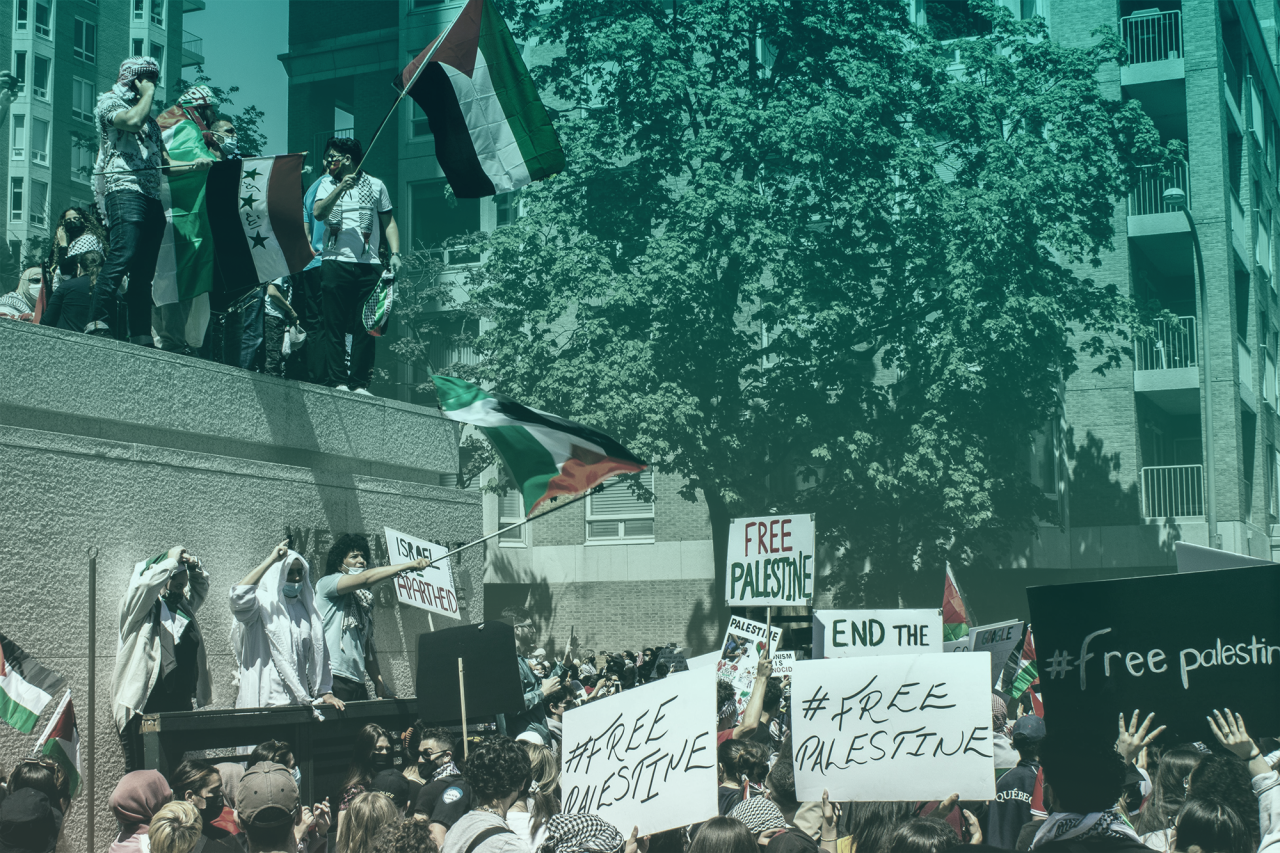
The federal Liberals have been promising new laws on what they call hate crimes, acts of violence that are motivated by prejudice and bias.
But the acts most often cited by the government—assaults of minority groups, vandalism of places of worship, and violent threats—are already illegal in Canada.
So Prime Minister Mark Carney’s government is instead targeting words, slogans, and symbols as the presumed sources of violent behaviour.
Introduced two years into Israel’s genocide in Gaza, the proposed “Combatting Hate Act” is a bait-and-switch, a cynical attempt to blame public demonstrations and expressions, especially those in solidarity with Palestine, for wholly unrelated acts of violence.
The proposed law treats people who are expressing themselves in public as criminals-in-waiting, and gives police more discretion to read their minds, interpret their motives, and arrest them.
The government is essentially conceding that while new laws can’t stop violence, they can shift responsibility for it to groups the mainstream Canadian public already fears.
Up until 2018 it was illegal in Canada to scare the British monarch, and the crime of “alarming the Queen” could result in a prison sentence of 14 years.
In the same way, this proposed law normalizes the anxieties of the privileged classes, and seeks to silence people whose presence and resistance makes power uncomfortable.
What does the Act actually accomplish?
There’s so much duplication, broadness and vague language in the Combatting Hate Act, it seems like there’s little value in updating the relevant sections of the Criminal Code.
In Canada, police can already claim that a certain criminal act is motivated by hatred toward a protected group, and is therefore worthy of a stronger sentence upon conviction.
The Act would make a hate-motivated crime a specific offence with its own penalty. Given that police have spent years broadly labelling Palestine solidarity demonstrations as suspect for criminal hate, the new provision will give police the tools to further crack down on Palestine activists.
The Toronto police violently attacked and arrested two protesters who carried Palestine flag. pic.twitter.com/oN7WhqnRgz
— Nur Dogan (@nurdogandiyorki) June 8, 2024
Police in Toronto, for example, claimed in early 2025 they had laid 523 charges “in relation to hate crimes” since Israel’s siege of Gaza began. However an analysis of arrest data by The Grind showed that fewer than 20 charges were for actual hate crime offences.
Given that the Act also removes the need for a provincial Attorney General to approve the laying of hate crime charges, police would have even more discretion to play out their biases.
The law would make it illegal to obstruct or intimidate someone trying to enter a place of worship, child care centre, school, or “other places primarily used by an identifiable group.”
Again, it’s already illegal to obstruct a religious ceremony, and to interfere with a property out of hate, prejudice, or bias. As the Canadian Civil Liberties Association has pointed out, the most likely targets of this new provision will be people who want to demonstrate near their own community spaces, places of worship, and schools.
People are rightfully calling out their own community institutions, not for practising their faith, but for supporting the genocide in Gaza – like the anti-Zionist Jews who’ve protested outside the synagogues that host real estate shows selling illegally-occupied land in the West Bank.
Many groups that resent public criticism of Israel’s genocide in Gaza misrepresent these demonstrations, saying they are meant to target and intimidate Jewish people. They celebrate the government’s moves to narrow public space and muzzle dissent that makes them uncomfortable. The ruling classes are anxious, the Queen is alarmed.
The most original part of the proposed law is also the most absurd: it criminalizes displaying certain symbols associated with terrorism or hate against an identifiable group, as well as symbols that even resemble the ones in question. Under this law, it would still be legal to simply display any of the symbols in question. For a conviction, the Crown would have to prove the symbol was being displayed with hateful intent.
The law targets symbols associated with groups on Canada’s terror watch list, which is managed by Minister of Justice Sean Fraser and can be updated at any time. Given the Liberal government’s decision last year to add Samidoun, a pro-Palestine community organization, to this list, it’s impossible to separate the government’s stated goal of combatting hate from a specific scapegoating of Palestine activists.
More broadly, our governments cannot be trusted to maintain lists of unacceptable ideas or beliefs, and to go after people who express them. From the ban of the Palestinian kuffiyeh in the Ontario legislature to federal no-fly lists, we see that public officials are obsessively concerned that Muslims and Arabs are a threat to national order.
The more we argue about an individual’s motivation for waving a flag or saying a slogan, the less we focus on Israel’s genocidal siege of Gaza that the protests decry. A heavy-handed government approach does not seek peace or safety, it merely aims to silence the forms of dissent and demonstration it finds most threatening.
The recent stabbing of a Jewish woman inside an Ottawa grocery store, and the swarming of a Muslim woman outside a pizza shop in Oshawa, suggest that some people are indeed acting out their prejudices. But interpersonal racist acts in Canada are not new, and won’t be stopped by governments that add fuel to the fire through systemic discrimination, anti-Muslim watch lists, Indigenous dispossession, and racist policing.
Now would be a great time for a widespread and thoughtful public education, not to whip up new fears of flags and protests, or to condemn a vague notion of “hate,” but to promote the values of anti-racism and anti-discrimination in Canada. But instead, this work must fall to ordinary people in their workplaces, schools, and social spaces. The government is too busy posturing, and shielding its own narrow constituencies from reality.

When I went to journalism school 10 years ago, my parents thought that they would eventually read my articles in The Montreal Gazette. Today, that newspaper is a husk of its former self. But I get to explain that I’m working towards critical, independent, and sustainable journalism.
Want to be a part of the future of journalism? Support our work with a monthly contribution. Sign up here.
– Amanda Siino, Development Director, The Breach
Police | Bubble zone protest bans ‘unjust’ and ‘dangerous’: critics

Palestine | Canadian lawyers borrow from U.S. playbook to quash Palestine solidarity

Foreign Policy | The feds refused to repatriate a Canadian citizen detained in Syrian prison. Then she died.

2 comments
Comments are closed.

I am concert about this law. Watching the UK and the mass arrests of elders. Disabled, faith leaders. Peaceful protesters non violently holding a sign say they supported a Pro Palestinian group has been challenged by many who ser it as significant over reach. Thankfully the government in Scotland is reviewing this law. If that is what Canada wants to duplicate. We are in trouble
If the ruling elites are getting nervous we must be doing somethng right. Thing is…..the silence about Gaza is over……Canada is still playing catch up…but soon, I expect to see more well known community leaders at the weekly protest against the genocide.