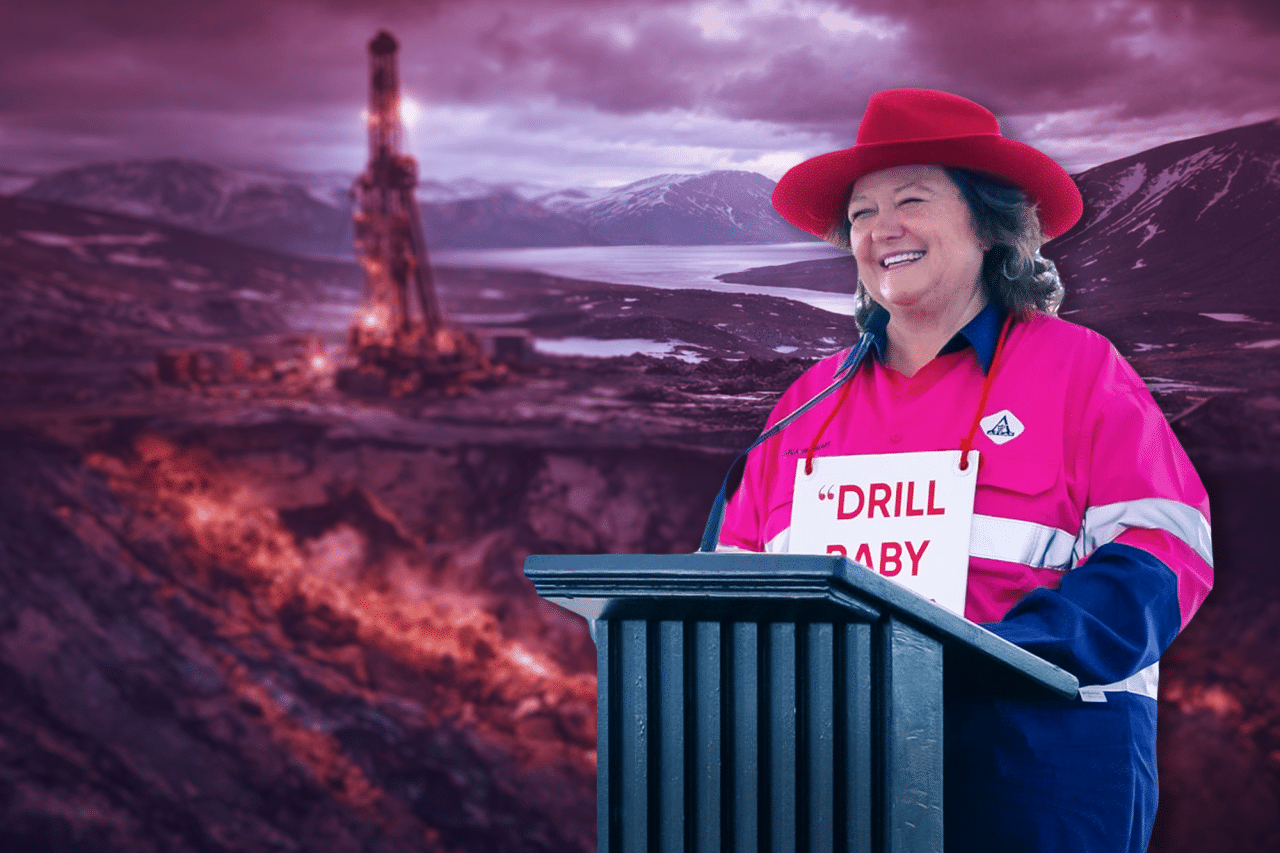
The richest person in Australia is hoping to mine copper in Nunavut. Her track record? A family history of anti-Indigenous racism, a woo-then-sue mining playbook, and a precedent of “bullying” in Canada.
Gina Rinehart is a household name in Australia. The 72-year-old built her $37 billion fortune by mining for iron in Australia. Styling herself as a cowboy, she also runs an empire of cattle production.
Rinehart is notorious for a pattern of investment by her company, Hancock Prospecting, and its subsidiaries that’s played out in whole or in part in Ecuador, Chile, Australia, and Alberta. Her companies buy partial stock in existing mining projects, aggressively expand existing operations, attempt to woo local residents, and, failing that, try to crush opposition with lawsuits.
Now, as Rinehart expands her mining empire into the global copper market, she’s eyeing Canada’s far north.

An inheritance of racism
In September, Rinehart spent $8.77 million AUD to buy a stake in the Australia-based White Cliff Minerals. The funds are to be used to significantly expand White Cliff’s copper drilling in western Nunavut.
White Cliff Minerals owns more than 2,000 square kilometres of land in Nunavut. The company says it plans to carry out drilling across an 11 kilometre region and will potentially expand mining to veins that are 72 kilometres in length.
The nearest community to the copper exploration is the hamlet of Kugluktuk, 75 kilometres to the east. About 90 per cent of its residents are Indigenous, mostly Inuit.
Rinehart and Kugluktuk may make for uneasy neighbours.
Rinehart has been criticized for her refusal to condemn racist comments made by her father, the late mining magnate Langley Hancock. He founded the company Rinehart now owns. On Australian national television in 1984, Hancock called for the government to sterilize the water that unemployed Aboriginal people drink.
“The ones that are no good to themselves … I would dope the water up so that they were sterile and would breed themselves out in the future, and that would solve the problem,” he said.
Rinehart has faced strong criticism in Australia for failing to apologize for her father’s comments, which some have viewed as a call for genocide.
The controversy was renewed in 2022 when Rinehart cancelled her $15-million sponsorship of Australia’s national netball organization after Indigenous player Donnell Wallam said she didn’t want to wear a uniform with Hancock Prospecting’s logo on it, because of Hancock’s racist comments.
And in 2024, Rinehart raised her global profile once again after she demanded that the National Gallery of Australia remove an unflattering portrait of her by Aboriginal artist Vincent Namatjira.
First courted, then taken to court
This is not Rinehart’s first Canadian project. She was involved in the proposed Grassy Mountain Coal Project, an open-pit mine planned in the Alberta Rockies which would have dug up 4.5 million tonnes of coal each year for more than two decades.
Rinehart first tried to charm locals into supporting the project, with Hancock Prospecting sponsoring annual Australia Day fundraising bashes, opening a newly rebuilt golf course, and matching funding for a local seniors’ association.
But residents weren’t won over. Tens of thousands of people signed a petition opposing the mine over concerns it would pollute the river that provides water to communities downstream. The Alberta Energy Regulator subsequently rejected the project.
Then Rinehart and her companies changed their tone. Her companies sued the provincial and federal governments, first for $7 billion and later for $2 billion.
Hancock Prospecting and its subsidiary, Northback, claimed that the governments unfairly changed coal-mining rules and “capriciously” killed the companies’ coal project.
The Southern Alberta chapter of the Canadian Parks and Wilderness Society (CPAWS) has been keeping tabs on Hancock Prospecting’s mining interests since 2015.
“They will not take no for an answer,” Katie Morrison, executive director at CPAWS, told The Breach. “They appear to believe that they can bully their way to approval.”
Rinehart appears to still be trying in Alberta. Last month, her company was reportedly preparing a new, scaled-down proposal for the Grassy Mountain coal mine.
This represents a pattern of behaviour from Hancock Prospecting. When governments or locals push against their mining projects, they drop the charm offensive.
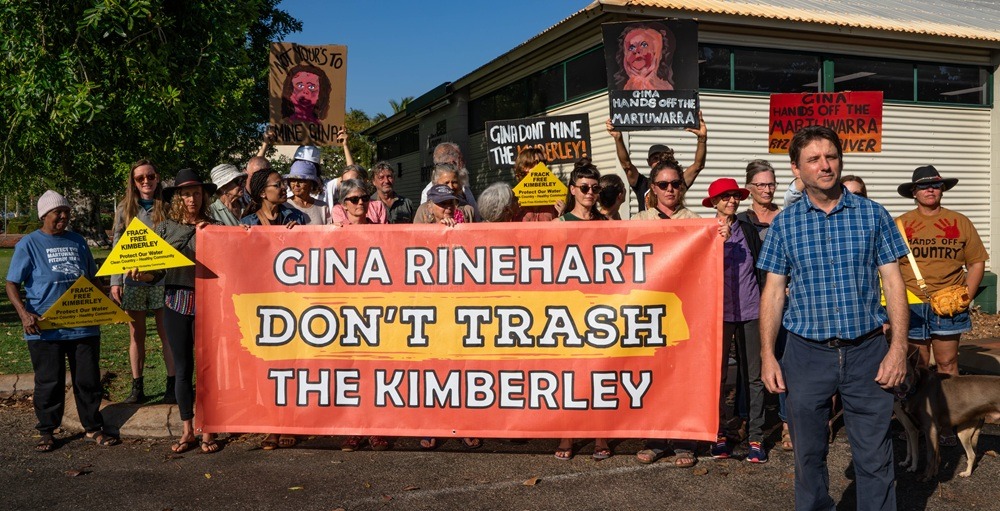
In Ecuador, Rinehart’s mining concessions have been overrun by illegal gold-diggers and plagued by violent crackdowns by police and soldiers on peaceful protests. Hanrine, a Hancock subsidiary, has denied any wrongdoing. But when local groups successfully filed for an injunction to affirm their right to protest and control who entered their lands, Hanrine filed a legal case against the national police, arguing that they failed to protect the company’s rights to pursue business.
Hanrine also sued a member of Ecuador’s National Assembly who opposed mining in the region. They later were involved in a legal dispute with Chile’s state copper mining company over control of mining in Ecuador
And an oil and gas company partly owned by Rinehart sued the state of Victoria in Australia for $2.7 billion AUD after it attempted to ban onshore gas exploration.
The Breach asked the office of Nunavut’s premier if Rinehart’s history of suing governments is raising concerns for the territory. While they did not respond directly to the question, a spokesperson offered that “All mineral exploration and development activities in Nunavut are expected to meet applicable regulatory and permitting requirements, regardless of a company’s ownership or investors.”
Neither White Cliff Minerals nor Hancock Prospecting responded to multiple requests for comment.

‘We need an outlet, a source of information that is credible, that is progressive, that we can cling to and believe in’
David Suzuki
Want to support journalism you can believe in? Become a sustainer today.
Indigenous Sovereignty | Canada’s new fast-track laws double down on false promise of ‘economic reconciliation’

Indigenous Rights | Imagining an economy for Nunavut beyond extraction

Indigenous Sovereignty | Behind a facade of Inuit self-determination, profits flow south