Donya Ziaee: Welcome to The Breach Show, featuring sharp analysis on politics and social movements in Canada. I’m your host, Donya Ziaee, and my guest today is Nav Persaud. He is the Canada Research Chair in Health Justice at the University of Toronto and a family physician.
Today we’re talking pharmacare. The Liberals and the NDP are both calling it a historic piece of legislation. And it does feel historic. After years and years of lobbying by Big Pharma and the insurance industry to stop any progress on universal single-payer pharmacare, we finally have a bill that gives us the framework for exactly that. Now, of course, the coverage is limited for now and there are some important questions about whether we can get an expanded list of drugs covered under a similar model, which I’m sure we’ll get into.
But first, Nav, what were your initial overall reactions to the bill? You know, two years ago, when the Liberals and the NDP first signed their confidence and supply agreement, you wrote somewhat pessimistically that the deal was just more “pharmacare pantomime” and that our elected leaders will wave around pharmacare blueprints, but never put their work boots on. The status quo will persist and we will keep paying the price.
Okay, we have a pharmacare bill now. Do you feel any different?
‘A meaningful step forward’
Nav Persaud: Well, the status quo does persist today. You know, the bill is not passed. And even when the bill is passed, it is only going to address treatments for diabetes and contraceptives. And also it’s not even clear that those medicines would be publicly funded immediately. So for now, people who can’t afford medicines will continue not taking them or making really difficult decisions about whether they buy food or medicines or pay their rent.
But I think the bill is a meaningful step forward. It does squarely bring certain medicines within the publicly funded system. So in that respect, there is a lot to be hopeful for in the bill. And it is easy to imagine that this bill could have been a step away from including medicines in our publicly funded system, notably the federal dental program, which does double down on this American-style private-public mashup of insurance. And I understand that similar proposals were contemplated for medication access. So, in the respect of including medicines in the publicly funded system, the bill is very strong actually.
Ziaee: Yeah, there was a good while when a lot of us thought we’re going to go to the dental care route with pharmacare: have it administered by a private insurance company, have it be means tested, etc. But let’s get into the specifics of what’s actually in this bill. So, we have two classes of medications for birth control and diabetes that are going to be covered through what we’re being told is a universal single-payer model.
Can you speak a little bit about the significance of that and the kind of difference it’s going to make in people’s lives?
Persaud: It will be helpful. I have many patients with diabetes who have trouble affording medications and either don’t take the medicines as prescribed or have to forego other necessities. For example, for diabetes, sometimes people have trouble affording healthy foods like fresh fruits and vegetables, partly because of the cost of medicines and because of all of the other financial pressures people are under. So it will make a big difference for people as soon as diabetes treatments are publicly funded.
Contraceptives are extremely important and like other medicines, access is a human right. So access to contraceptives will also make a big difference for people and decrease cost pressures. So there is going to be that initial benefit to some individuals.
Most medicines won’t be covered—at least, not right away
Unfortunately, most conditions are left out. So, asthma, COPD [chronic obstructive pulmonary disease], bipolar disorder, depression, schizophrenia, all mental health, hyperthyroidism, hypothyroidism, you could name dozens of conditions that will not be addressed. And even actually for the same individual. So someone with diabetes and asthma will have their diabetes medicines covered, but not their asthma treatments. And it doesn’t really make sense from a health perspective or a public policy perspective.
Clearly, there was a negotiation that resulted in at least a small list of medicines being publicly funded soon and hopefully in the future there’ll be a comprehensive list of medicines that will be publicly funded that is explicitly addressed in the bill.
Ziaee: The bill does lay out a plan for the Canadian Drug Agency to develop a national formulary. So in other words, a list of essential medicines that would be covered under a national universal plan. But the health minister, Mark Holland, was pretty noncommittal about whether any additional medicines would be covered under a similar model. And I just want to play a clip of what he said at the press release when he announced the bill.
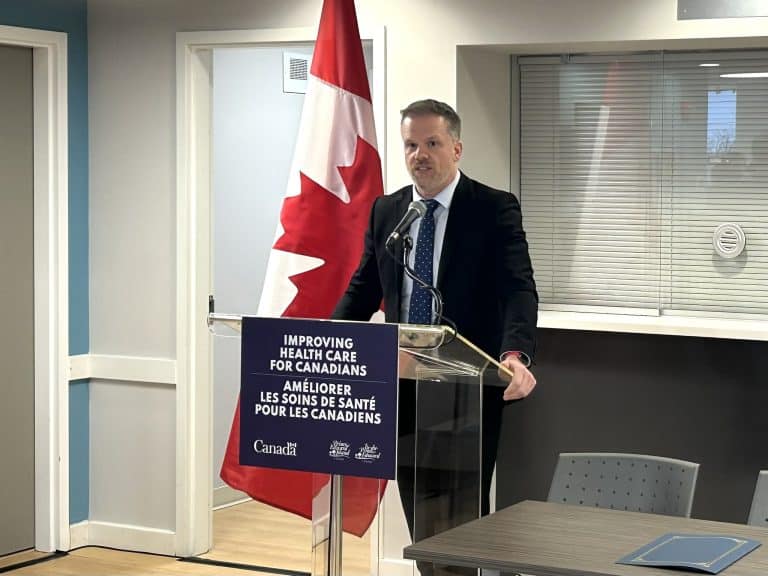
Holland: “This is a proof of concept opportunity to try on two drugs on a universal single-payer model and then we’re going to have an opportunity to evaluate the effectiveness of that model and I think in a real-world sense we’re going to be able to look at the P.E.I. model which is based on a different approach to see what is the effectiveness of that model. I think the question that Canadians are going to ask once they get an opportunity to look at that data is to say what is the most effective, efficient model to get to full coverage to make sure that everybody can afford their medication and that we choose the system that’s right for that.”
Ziaee: Right, so proof of concept, further evaluations. Are these just fancy ways of saying we’re gonna weasel our way out of this in the future?
Persaud: Hopefully not.
I mean, I don’t think there’s actually a need to study further what’s going on in Prince Edward Island versus what’s going to happen with this federal program. The studies have shown that publicly funding medicines improves health, reduces direct costs related to medicines and also decreases total health spending because people are healthier. The different mechanisms for insuring medicines have all been studied, multiple government reports have been written. They all point in the same direction: including medicines in our publicly funded system.
To me, that’s what pharmacare is. We already have a publicly funded health-care system for seeing a doctor, being admitted to the hospital, having a heart transplant. And what we need now is to continue with that publicly funded system for health-care services and include medicines within it. It would not make sense to create a separate system or to create multiple different public plans or to try to combine public plans with private plans in a new way. All of those proposals sound a lot like what we have right now, [which is] a broken system.
Ziaee: Yeah, and it was interesting because he kept referring to this phase of the pharmacare plan as a pilot project. And, you know, I forget who it was who said Canada is just a country of perpetual pilot projects. And like you say, we’ve had study and study after study and commission after commission telling us that publicly funded single-payer universal pharmacare is the most cost-effective and fairest way to go. So why this reluctance to just commit to that model, not just for these two classes of drugs, but beyond that?
Persaud: I also am concerned by the proof of concept type language, especially as it pertains to a human right: access to life-saving treatments. This idea that we might just take some time to think about whether or not the rights people have to access treatments that will prevent them from having heart attacks or strokes can be—that the government can decide whether or not to respect the right for people to have access to medicines that could save their lives.
So I think the sense in which I think the bill is encouraging is that it doesn’t just call for more study or another commission. It does actually provide some people with access to publicly funded medicines. And I think unless that mechanism is tampered with or undermined, it will actually prove to be an effective way of administering and providing medicines.
First phase could raise hopes for universal program
Ziaee: And are you hopeful that once this phase rolls out and people start seeing the benefits of walking into their pharmacy, picking up the medication they want completely free or their loved ones getting free access to diabetes and birth control, are you hopeful that that’s going to create or raise expectations among Canadians to demand more and want to see that list expanded and for the program to be solidified?
Persaud: Yes, I am hopeful. Pharmacare is already supported by more than 80 per cent of Canadians, maybe as high as 90 per cent, depending on the nationally representative survey that you look at. And I think that when people get access to medicines for free, in the same way that they get access to health services for free, it will strengthen even further the support for pharmacare among Canadians.
And so I do hope that will be part of a cascade towards implementing pharmacare fully. You alluded to some potential headwinds in lobbying against it, and I think that is the main threat. I think some of the comments made when the bill was announced maybe do signal that the government is still open to hearing from lobbyists, notably the private insurance industry and the pharmaceutical industry that oppose pharmacare. And it’s totally rational for these companies to oppose pharmacare because they are profiting from the current bloated system. And each dollar that pharmacare saves, [is] maybe a dollar in less revenue for them, and pharmacare is expected to save billions.
Ziaee: One thing that I noticed the industry is glomming onto is the fact that the bill only says that the health minister has to “consider the Canada Health Act,” but not that any further implementation of the program has to be based in the Canada Health Act and based on the principles of the Canada Health Act and we heard a representative from the industry lobby say, “Well, hey, does this mean that the provinces can choose whether or not they want it to be publicly administered or if they can have it run by a private insurance company?” And I did want to hear what your thoughts are or how optimistic you are that we will be able to safeguard the publicly administered nature of this.
Now is a critical time to show support for pharmacare
Persaud: I think this is a really critical time. This might be the most critical time in the development of pharmacare in Canada. I think now is the time for people who support pharmacare to speak up. And to me, pharmacare means including medicines in our publicly funded system. It does not mean elaborating on a patchwork of private and public plans. The case for pharmacare has always been strong. It’s as strong now as it has ever been. But the fundamental reasons for including medicines in our publicly funded system—it hasn’t happened yet and we do need to think about why it hasn’t happened yet when we are thinking about what might happen in the next year or 18 months.
I think one of the main reasons we haven’t had pharmacare yet, despite broad public support that obviously crosses political lines and multiple government reports that have recommended pharmacare is that there has been intense lobbying against it from private insurers and from the pharmaceutical industry.
Ziaee: I work at the Council of Canadians where we looked into the lobby registry and we found that lobbying by the pharma and insurance industries increased by four times since the confidence and supply agreement came into effect. They’ve just been relentless. And Health Canada has basically had an open-door policy for these lobbyists, even though they were refusing to meet with many people from civil society and health-care advocacy.
You also wrote a little while back about some of the lies that the pharmaceutical and insurance industries have been pushing in the lead-up to the legislation, basically to manipulate public opinion. Can you speak a little bit more about how those industries have tried to poison the public debate around pharmacare?
Persaud: I think there’s sometimes this vague claim that private insurance is going to be more efficient than the government and this sort of vague smearing of publicly administered programs as being inefficient and bureaucratic. And obviously, It’s appropriate to be skeptical about the government and to hold the government to account, but since we already have a public health-care system, when it comes to health-care services, it would be virtually impossible to make insurance more efficient by adding onto it a totally separate private set of insurance plans just for medications. People already have a health card and the proposal would be for health cards to provide you with access to medicines in the same way that they provide you with access to health-care services.
So there really is no way that efficiency is going to be introduced by a greater involvement of private insurance. Private insurers will claim that they secure good prices for medicines and that they help to provide access to medicines. The reality is we pay more per capita for medicines in Canada than is paid in other comparable countries, like New Zealand, Australia, or the United Kingdom. And one of the main reasons for that is because insurance companies take a percentage of each claim, so they prefer higher drug prices. So they both benefit from drug prices in taking a percentage of each claim, and they play a role in determining what prices will be paid for medicines. And the result is exactly what we have: high drug prices.
Ziaee: Not to mention that if we have bulk buying power, if the country is negotiating on behalf of everyone, that could also bring drug prices down, right?
Persaud: Yeah, exactly. So in other countries that use bulk purchasing, they enjoy much lower prices. Then in Canada, for example, you can purchase in New Zealand medicines that are produced in Canada at a lower price in New Zealand than they are sold here. And it is because private insurers prefer higher drug prices. But when a government negotiates drug prices, the prices are inevitably going to be lower.
I think the other point to remember about these private insurance plans is that they are publicly subsidized. Even though private insurance plans are unfair in the sense that only some people have access to them, they’re actually publicly subsidized. Those people lucky enough to have a relatively high-paying job, usually white-collar type jobs that come with private insurance, those are supported by public dollars paid by everyone.
In 2016, the estimate from the federal government was that non-taxation of these extended health benefits represented around $2 billion of lost revenue or foregone revenue for the federal government. So, when private insurers are talking about their efficiencies, what they might not be mentioning is that they receive this $2 billion benefit at least from the federal government. So, I think it’s also important to remember when these private insurers oppose pharmacare that at the same time, they seem to support and accept corporate welfare. So, my take on it is they are much more in support of corporate welfare than they are pharmacare.
Big Pharma pushed fear-mongering campaigns
Ziaee: Yeah, absolutely. And there was so much fear-mongering that they did. Running public campaigns basically saying, you know, pharmacare would wipe out all your workplace benefits. You would no longer have access to the medicines you need. It would cannibalize all existing plans. It would be a disaster for Canadians. And, like you’ve been saying, they’ve been lobbying hard to make sure that any national pharmacare plan leaves these private plans untouched and only addresses those who “fall through the cracks.”
Within that, there was one statistic that we heard repeated over and over again, that I also heard politicians repeating, which was that 97 per cent of Canadians already have access or are eligible for a private plan. So it’s really only 3 per cent of the population we’re talking about who need support from the government. So, whatever pharmacare plan we have, let’s focus it on that group. You wrote about why that is basically a lie. Can you elaborate on that?
Persaud: Nationally representative surveys have repeatedly shown that millions of people report not taking medicines because of the cost. Certain numbers are thrown out there, 97 per cent, 99.5 per cent of people have coverage. It’s not true. The reality is people have trouble affording medicines. That’s what people say, that’s what the numbers say, that’s why repeated government reports, academic reports, nationally representative surveys have all found the same thing that cost-related nonadherence to medicines—not taking a medicine because of the cost—is very common in Canada. And there are so many problems with the sort of statistics put out there from industry lobbyists.
One of them is also that even for people who are fortunate enough to have private insurance, many individuals have trouble affording the copayments or the initial payments that need to be made. And so they still may not access those medicines. That is probably the most expensive form of insurance because you’ve already indirectly paid the premium and you may not know how much because the way employer-based insurance programs work is you never actually see the number your employer pays…So that’s already been taken out of your paycheque, but then you can’t access the program because there’s a certain amount you need to pay.
So, if you asked me to design the worst system in the world for insuring medicines, it would be pretty close to what we have right now, this mashup of private and public insurance that is reminiscent of problems in the United States’ health-care system.
Ziaee: The Liberals have been kicking this can down the road for many years. You pointed to part of the reason for that being the relentless pressure from the corporate lobbyists. And you know, in the last few months, there’s been all this breathless coverage about the Liberal-NDP negotiations over pharmacare: will they? Won’t they? Will the deal break down? Will the government fall? And now after all these years, the Liberals suddenly seem more willing to stand up to corporate interests and deliver on this pharmacare promise. What do you think finally move that needle?
Persaud: Well, I’m glad that it has moved. I don’t know exactly what moved it. Certainly, it seems like things are moving in the right direction. I believe the confidence and supply agreement between the Liberals and the NDP is actually called: “Delivering for Canadians Now.” And I remember when that was announced, I was hoping that it did mean that we were going to get pharmacare right away.
I was very concerned in the fall when the bill was due and did not appear that it meant industry lobbying had prevailed. So that’s all the more reason I was relieved to see an emphasis on single-payer public funding of medicines here. There have been other examples in the past where the NDP and Liberals have worked together toward progressive policy. And if we end up getting pharmacare actually implemented out of this confidence and supply agreement, then this would be another example of two political parties working together to do something that perhaps neither of them could have done independently.
Grassroots advocacy was successful
Ziaee: Not to mention all the grassroots pressure and organizing that was done by patients, health-care advocates, people like yourself.
Persaud: I think the advocacy from individual patients and patient groups has been very important to helping politicians and others understand what’s at stake here. When people are saying, “There’s this medication that I need to stay alive and I have trouble affording it,” that’s very difficult to completely ignore. Unfortunately, those calls haven’t necessarily always led to action with the sense of urgency that is appropriate to this situation where people’s lives are at stake, but at least it has eventually led us to this point where we could over the next year or year and a half actually see medicines being included in our publicly funded system.
Ziaee: So what will you be looking for in the next coming weeks and months as the bill gets debated and negotiated?
Persaud: The first step would be creating a rigorous list that truly does meet the needs of everyone. And then it will also initially be interesting to see how provinces respond to this proposal that’s limited just to diabetes treatments and contraceptives.
And after that: how provinces work with the federal government to actually implement diabetes treatments and contraceptives. Would it be possible for provincial governments to say no and maybe administer by themselves a public program that could address just those two treatments? Some provinces could afford to do so, whereas probably no province could afford to take on all medicines. So you know, this test of just two categories of medicines isn’t necessarily going to be a true test of what would happen if the government simply implemented pharmacare in the way that’s been recommended many times.
Ziaee: It will be interesting, if we have divergences among provinces, how the public is going to react to that as well.
Provinces tried to opt out of Medicare, too
Persaud: Exactly. I think ultimately, if you’re paying hundreds or thousands of dollars for a medicine that’s publicly funded in other provinces, you’re going to wonder why. And eventually, people will start asking their provincial representatives what is going on and why they’re being left out. When Medicare was being introduced in the 1960s, there were some provinces that protested. Those provinces were Alberta, Ontario, and Quebec. And now we’ve seen some of those same provinces balk at pharmacare. Eventually, those provinces signed on to Medicare because it made perfect sense.
Ziaee: Mm-hmm. Sounds familiar.
Persaud: It can make sense for premiers of provinces to posture that they’re not going to do this and maybe they’re trying to win a concession somewhere else. It could be a negotiating tactic, but ultimately it would not make sense for provinces to turn down federal funds that would improve access to treatments and make people healthier and save people money. So it would make alternatively perfect sense for provinces to sign on and implement pharmacare.
Ziaee: Well, there is a lot to watch for in the next few months. Thanks so much for joining us, Nav.
Persaud: Okay, great. Thanks so much for your coverage of the issue and I appreciate you engaging me.
Ziaee: Of course. Nav Persaud is the Canada Research Chair in Health Justice at the University of Toronto and a family physician.
If you like what you’ve heard on The Breach Show, please subscribe to our podcast or YouTube channel. if you wanna support our work, please become a sustaining member to help us produce more journalism for transformation. You can do that at breachmedia.ca/support. Thank you for listening.

“It’s about getting to the bottom of things. It’s about unveiling who has the power and what they’re doing with that power.”
Linda McQuaig, journalist and author
As a non-profit, free from powerful corporate interests, we invest in investigations and uncover the cover-ups. Sustain our journalism for transformation.