
Paula Kielstra loved her job at Library and Archives Canada, but when she received a letter saying positions in her unit would be hit by a wave of federal cuts, she hand-raised to be laid off.
The policy advisor and mother of two said it was “a very difficult decision” that has thrown her family into financial distress, but it gave her a chance to support her son with special needs.
Kielstra is just one of 10,000 federal employees who lost their jobs under the Trudeau government’s cuts, a quiet round of “workforce adjustment” that began last year and is still playing out across departments.
Now, Mark Carney is dramatically expanding those reductions, unveiling in the budget last week a sweeping plan to “right size” the federal bureaucracy.
To achieve that, Ottawa intends to eliminate about 10 per cent of federal public service jobs—an estimated further 30,000 positions by the end of 2029.
For those caught in the crosshairs, the human impact has been immediate and profound.
Public servants writing anonymously online—in particular on the popular Reddit channel r/CanadaPublicServants, which has more than 100,000 members—describe confusion and anxiety in their workplaces.
“It’s really frustrating because a lot of public servants voted for Carney under the impression that their jobs would be better protected with a Liberal agenda, as opposed to a Conservative one,” Kielstra told The Breach. “There’s a sense of betrayal that certain policies, particularly military and defence spending, are being prioritized over the public service which delivers so many essential services.”
The government has offered a “voluntary departure” option to full-time permanent employees affected by the layoffs, allowing them to take a payout based on their years of service.
While the government says it hopes to minimize layoffs through voluntary departures and a $1.5 billion early-retirement incentive, the scale of the cuts means that thousands of public servants will still lose their jobs.
Managers still don’t know which programs will be slashed, and those early-retirement packages, while appearing generous on paper, would still leave many people short.
Even those eligible for the incentives say the math doesn’t add up: pensions remain tied to years of service, and most workers simply can’t afford to retire early in today’s economy.
Departments have been instructed to prepare for “streamlined operations” and “program rationalization,” bureaucratic euphemisms that in practice will mean fewer staff delivering fewer services to Canadians.
It is set to compound the strain on Canadians trying to access pensions, Employment Insurance, and passports. Every position lost translates into longer waits, bigger immigration and permit backlogs, fewer people to fix errors, and diminished service for Canadians who rely on myriad programs daily.
The irony of this retrenchment has not been lost on observers. Just months ago, the Liberals recaptured Conservative Party leader Pierre Poilievre’s Ottawa-area seat in part by warning that his plan to slash the public service would devastate the region’s economy.
Poilievre’s proposals were widely understood to mirror Donald Trump and Elon Musk’s joint effort to take a sledgehammer to the U.S. federal workforce—driven by the same ideology that frames regulation as “red tape,” foreign aid as “putting America last,” and public servants as out-of-touch “liberal elites.”
Now, Carney is advancing an austerity agenda with many of the same measures. The only difference seems to be in the rhetoric deployed to deliver the bad news.

Cuts dressed up in compassion
Kielstra’s experience tracks with others who have already lost their jobs. A former Canada Revenue Agency (CRA) employee, laid off in April 2024, described the cuts as sudden and demoralizing and leaving a big impact on service delivery.
“That means delays,” said the former employee, who asked that their name not be used. “We managed information for IT and infrastructure projects—things like planned and unplanned outages, or long-term database consolidations. When something suddenly happens, you drop everything else and focus on that, which pushes everything else back.”
They said the layoffs were timed to prevent workers, many of whom were brought on in a hiring spree during COVID, from becoming permanent.
“In my role, you move to full-time permanent after three years,” the former employee said. “COVID-era hiring was hitting that mark, and they ended a lot of contracts early to avoid conversions. We were told it was a ‘reallocation of government services,’ but that language was blindsiding—no one expected actual terminations. It felt like the euphemisms were used to hide what was really happening.”
The civil servant, who entered the public service through the Federal Student Work Experience Program (FSWEP), said the experience has left many young employees disillusioned. “As a young Canadian, I thought I could have a career in public service,” they said. “I transitioned to formal employment after graduating, and then terminated six months later under this ‘cost reduction strategy.’ It’s demoralizing, especially when you hear that executives still got bonuses last summer while we got the axe.”
Finance Minister François-Philippe Champagne insists the government will be “very compassionate” in how it manages the layoffs, a distinction that does little to reassure workers who will now need to enter the job market in an unstable economy.
For thousands of workers in the National Capital Region of Ottawa–Gatineau, where upwards of 20 per cent of the employed labour force works in public administration, the impact will be devastating.
“Stripping down our capacity to get stuff done means that worse advice is being given to Cabinet,” said Nathan Prier, president of the Canadian Association of Professional Employees (CAPE), a union that represents 28,000 federal employees, including economists, policy analysts, researchers, translators, statisticians, and interpreters. “A lot of smart people who specialized and got to know a sector or program very well are just being taken away from that because of an arbitrary austerity target.”
“Mark Carney was the one to say during the election that there are no libertarians in a crisis. But here we are just taking out the deficit on public servants—and public servants didn’t cause this deficit. The government is promising things to Canadians that they then can’t pay for because of their massive tax cuts.”
Prier said that the federal government’s growing reliance on contractors has hollowed out institutional capacity and morale. That concern is backed by data: in 2023–24, Ottawa spent $20.7 billion on outsourcing overall, up from $14.7 billion just three years earlier. But more spending on outsourced services doesn’t mean more work is getting done. A January 2025 report from the Parliamentary Budget Officer found that in four major departments, including Employment and Social Development Canada (ESDC) and Public Services and Procurement Canada (PSPC), outsourced IT services cost between 22 and 26 per cent more than if the work had been done in-house.

The racial and gender costs of austerity
Many departments are still reeling from recent Trudeau-era cuts. The Canada Revenue Agency (CRA) has lost nearly 7,000 positions this year, leaving tax call centres and benefits offices stretched thin. ESDC has also seen losses accumulate, while Immigration, Refugees and Citizenship Canada (IRCC) cut almost 2,000 jobs during the last culling exercise—a move that coincides with Canada’s rightward shift on immigration as well as cuts to foreign aid and international humanitarian assistance.
The impact of those losses will not be felt evenly. According to a recent analysis by David Macdonald and Katherine Scott for the Canadian Centre for Policy Alternatives (CCPA), the government’s planned staffing reductions will disproportionately affect women, racialized and Indigenous workers, and employees with disabilities.
Departments like ESDC, Indigenous Services, and IRCC, which employ the highest proportions of female, Indigenous, racialized, and disabled workers, are also slated for cuts. Meanwhile, at the RCMP and Canada Border Services Agency, which employ smaller proportions of women and racialized workers, Carney plans to add 1,000 new jobs for cops and another 1,000 for border officers.
The CCPA warns that these cuts threaten to reverse decades of progress in employment and pay equity, eroding one of the few areas where the federal government has historically led the broader labour market.
The early departures of senior and mid-career public servants will also strip the federal bureaucracy of institutional knowledge built up over decades. That experience will likely create yawning gaps in expertise that will be challenging to replace. This loss of corporate memory threatens not only the Liberal’s much-vaunted “productivity,” but the ability of departments to respond to crises and maintain continuity in program delivery.
When service delivery falters, it frustrates those accessing programs and services and erodes trust in the public institutions Canadians depend on. Each delay, error, or unanswered call feeds the perception that government can’t meet basic needs. That dissatisfaction becomes self-reinforcing: weakened public services undermine confidence in the system, creating a feedback loop that governments can exploit to justify even deeper cuts down the road.
Under Carney, the focus is on results, not rebuilding. In practice, that means demanding that departments “do more with less,” a familiar austerity mantra dressed up as modernization.
The first wave of cuts will hit the “term,” “casual,” and student positions that serve as entry points for young people, particularly graduates in the humanities and social sciences hoping to get their foot in the door of the federal public service. These short-term and temporary roles are typically the first to go in a reduction exercise.
‘Rightsizing’ the public service?
The size of the federal workforce has long been a political flashpoint. Under Stephen Harper, the public service shrank significantly in the government’s final years, as budget reductions and hiring freezes hollowed out departments.
Public sector unions argued that the subsequent growth by more than 100,000 civil servants under the Trudeau government was simply an effort to rebuild capacity and restore services after years of austerity.
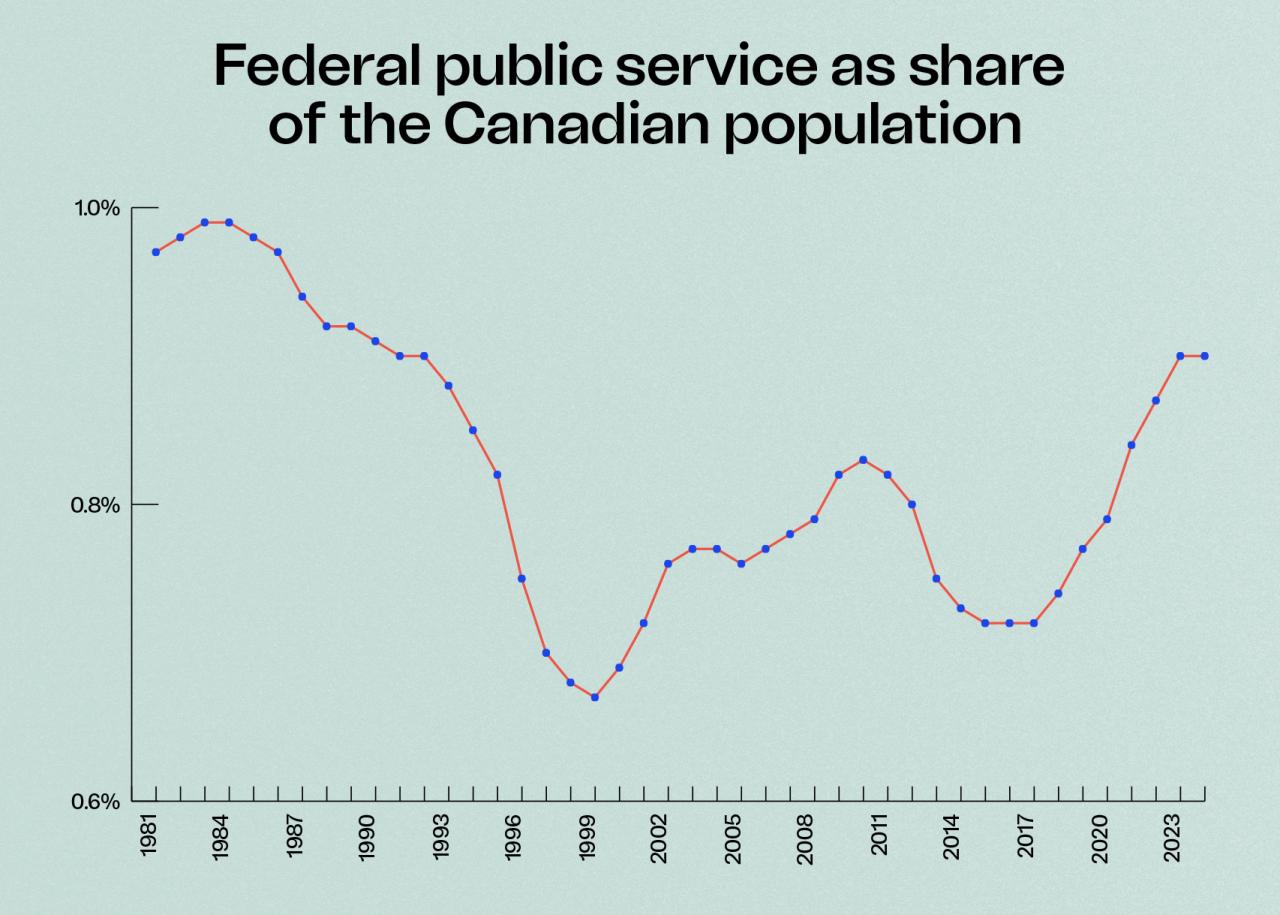
But if you measure the size of government against the country’s overall population—a more accurate way to gauge its impact—a very different picture emerges. The federal state, measured this way, actually peaked in the early 1980s. Then, as neoliberalism became ascendant, rounds of cuts through the 1980s and 1990s steadily shrank its size.
Seen in this light, the Trudeau Liberals had merely interrupted a decades-long trend toward smaller government, but had still not returned it to its pre-neoliberal scale.
Indeed, even with that expansion, the proportion of federal employees to Canada’s population remains lower than it was in the early 1980s, when the public service represented nearly one per cent of the population.
“There is no ‘right size’ for the public service,” said Prier. “That’s just a nonsensical term. If you promise things to Canadians, somebody has to do the work. That should be career public servants that you’re really investing in so that they can weather crises like this the next time it comes around.”
Beneath the official talk of “streamlining,” workers say it feels like a rollback to pre-pandemic staffing levels, an austerity cycle they’ve lived through before, only this time under a government that seemed to promise something different.
For Carney, the cuts are framed as a necessary correction to years of ballooning expenditures; for those who work inside the public service, they signal a return to an era of uncertainty, attrition, and demoralization that many thought could finally be in the rearview mirror.
“It’s absolutely clear that there’s a lot of fear amongst my colleagues and a lot of anxiety,” said Kielstra. “It’s a very stressful time to experience job insecurity at the same time that there is economic instability happening all around you.”

When I went to journalism school 10 years ago, my parents thought that they would eventually read my articles in The Montreal Gazette. Today, that newspaper is a husk of its former self. But I get to explain that I’m working towards critical, independent, and sustainable journalism.
Want to be a part of the future of journalism? Support our work with a monthly contribution. Sign up here.
– Amanda Siino, Development Director, The Breach
Federal Government | A budget for tanks, banks, and oil barons

Inequality | Canada’s hidden tax crisis is stripping $15 billion from the economy every year

Federal Government | Snap out of denial—Mark Carney’s rightward-rushing agenda is just getting started
4 comments
Comments are closed.


If this becomes the last time scared little people clinging to the vacant centre fall for the conservative/liberal dance, Carney’s decision to go with the billionaires and corporations might be worth it.
Closing in on my 8th decade, its all I’ve seen from my fellow Canadians….a fear based dance between the two old parties, both of whom are bank rolled by the high rollers.
We won’t have austerity for billionaires and living wages for workers until we imagine something other than neoliberal capitalism. Low taxes, more cuts to regulation and privatization is all that mind set has ever had to offer the people.
And if we factor in the assault on human rights that have happened in privatized long term care and the precarity industries, we should all be ashamed.
We Canadians don’t yet have our elbows up….nor can we imagine, let alone work toward, the prosperity that an actual Care Economy could bring with it.
If the public servants are doing such a great job and service will suffer with cuts why after Trudeau increased the public service by 40% hasn’t service improved? I would bet there isn’t a single government service that runs on-time and within budget.
A recent Auditor General’s report found that Canada Revenue Agency (CRA) call centre agents provided inaccurate information 83% of the time for general individual tax questions, as detailed in this CBC News article. The report, released in October 2025, tested call centres by asking various questions and found that only 17% of the answers provided for individual tax issues were accurate… my main concern is that these employees are probably not effective outside of their specific role and will end up a strain on other supports that are needed for the disabled and those with mental health issues.
The reality of the situation is that productivity tanked across the public sector after Covid. I know, I’m a public sector worker. People went to working from home and they became ghosts. You’d be unlikely to get a reply back from most people within a day. They just stopped working. To make up that shortfall in productivity the government went on a hiring spree but the internal culture was so broken that it made no difference. There are some honest hard working people obviously but there is a huge group of people that are simply coasting and doing almost nothing. The work culture in the public sector is horrendous and always has been. It’s always been generally accepted that people would do virtually no work in the last couple of years leading up to retirement but Covid fundamentally made things worse. Now people not working is just accepted generally. There is a ton of dead weight and cuts are needed. But one important thing is that the work culture needs to change and that will require management changes not just staff cuts.