
Martin Lukacs: Welcome to The Breach Show, featuring sharp analysis on politics and social movements in Canada. I’m your host Martin Lukacs.
Anti-immigrant sentiment is blowing across Europe and North America. Here in Canada, right-wing politicians and media, like never before, are scapegoating migrants for the crisis in affordability, housing, jobs, and public services, diverting attention away from the corporate profiteering and government cutbacks and austerity that in fact underlie those issues.
As public opinion on the immigration has been pushed rightward and the Conservatives have taken a steady and sizable lead in polls, we’ve seen the Liberal government caving in and conceding ground.
They’ve shelved a promised and historic plan, hard-fought for by the migrant justice movement, to offer permanent resident status to hundreds of thousands undocumented people, the most vulnerable, underpaid, and exploited workers in the country.
As a backdrop to all this, we’ve just witnessed in England where the stoking of xenophobia can take us, with racist riots unfolding in several cities in early August. Far right mobs tried to set fire to hotels housing asylum seekers, targeted mosques, and assaulted racialized people.
Today, to cut through the spin and the slanted and shallow analysis, we’re talking to Syed Hussan, a long time organizer and executive director of the Migrant Workers Alliance for Change.
Hussan, Thanks for joining us.
Syed Hussan: Thank you for having me Martin.
Lukacs: I want to start with what’s making headlines in Canada this week.
This past week, Canada’s temporary foreign workers program is being panned from all quarters. On one hand, there are criticisms from the right and center about how the program has expanded its low-wage stream, bringing in more farm workers, more cooks, more fast food workers. At the same time, a UN report just came out calling it a “breeding ground for modern slavery.” That echoes the concerns that organizations like yours, Hussan, have been campaigning around for years.
Can you break down for us how this program works and what the problems are with it?
Syed: The temporary foreign worker program is one of the many temporary immigration streams in Canada, and what it is, is that low-wage workers in particular, but also high-wage workers, can come to the country if an employer can prove that no Canadian citizen or permanent resident can do that same job.
Its key condition is that you are tied to your employer, which means you cannot change jobs. In most cases, low-wage workers are living in employer-controlled housing. So farm workers, fishing workers, domestic workers, are living in employer-controlled housing. We also see this with other industries.
And so that means that when you’re facing wage theft, when you’re facing human rights abuses, violations, health and safety concerns—if you speak up, then automatically, the employer has the ability to fire you and kick you out, right? So what they can do is they can force you out of the country. Even if you are able to remain in the country, you can’t get another job because you’re tied to your employer, and they can evict you and so you’re homeless.
So, when speaking up against abuse means eviction, homelessness, deportation, not being able to get your economic basic resources, and being also blacklisted—that means not being able to come back—then obviously there’s a fundamental power imbalance. And so migrant workers can’t protect themselves.
This is what Tomoya Obokata, who’s the U.N. rapporteur on contemporary forms of slavery, is talking about. Canada, right now, sees about two million people coming into the country each year on some sort of a temporary worker program, including students, if you include refugees.
Now, almost all of those people are in low-wage jobs. Almost all of them will not be able to get permanent resident status, and they will leave. The economy is getting this massive influx of around two million people, year over year, who are coming in, working in low-wage jobs, facing exploitation and abuse, and then eventually being kicked out and replaced by others.
The economy clearly needs those workers, but deeply entrenched racism has meant that only about half a million are being given permanent resident status. Imagine if two million people stopped paying taxes tomorrow. This economy would actually collapse. Our entire economic system now requires a deeply exploitable workforce that pays in its system but doesn’t get enough out of it back.
Lukacs: I’ve been struck by how the Conservatives, who have been making hay with the problems with the temporary foreign worker program the last week, are turning it into this partisan battering ram, using fake concern for the working class to attack Trudeau. This seems to be an incredibly rich development, because exploitation of temporary workers has always been a bipartisan project in this country. The seasonal workers program, the living caregivers program, these have dated back decades. My understanding is that it was Conservatives themselves who actually launched the low-scale workers program that now they’re criticizing the Liberals for expanding
Syed: Absolutely. I mean, as you said, it’s a bipartisan project, the Conservatives and the Liberals.
It makes sense to think about it as an eight-year cycle, when new Conservative, Liberal governments come in. They spend the first six years largely increasing temporary migration flows—and here I want to again expand from temporary foreign workers—allowing huge numbers in, and then in the last two years of their mandate, they begin to attack and close the border. It’s almost like they tell the ruling class, “Okay, you get six, three years, and then we’re gonna attack you.”
We saw this with the Conservatives in 2014 when Jason Kenney reformed the immigration system after allowing this massive expansion. And then, they turn anti-immigrant at the end of the cycle, because until then, they also need the exploitable workforce. I think the Conservatives and the Liberals are actually in the same game where racism versus the interests of the ruling class are at odds. If you read The Globe and Mail, for example, you’ve got a lot of commentators calling on businesses to step up and defend the Canadian immigration system.
Lukacs: I was just reading The Globe this morning, and it seems like the corporate classes’’ reaction has basically been like, “Whoa, whoa, whoa, let’s not get carried away with our criticisms here. We prefer to have access to a cheapened and vulnerable pool of labour.” And their preference seems to be that we turn it on and off as our labour needs fluctuate
Syed: Absolutely. Let’s just think about this. Zoom out for a moment. At the height of COVID, there were people celebrating essential workers. The huge understanding being that those essential workers are migrants. We had this focus on the essential workers, celebration of migrants, the realization of the housing crisis, and simultaneously a real broader conversation—a populist conversation—emerging around pandemic profiteering, the ways in which grocery stores were raising prices.
Now fast forward two years later, and suddenly, those migrants are now responsible for the housing crisis. The ones who were celebrated. And no one’s talking about the corporate class. It’s a victory for the ruling class to have successfully reframed the debate away from speculators and billionaires and the failures of all of the provincial governments across the country, who deeply underfunded essential services, who can now all blame refugees or migrant workers or immigrants. I think we’ve watched ourselves being played this way, and have not been able to respond or successfully defend the emerging support for working class people that emerged in COVID-19 and is all but dissipated and has turned into actually attacking workers, in unions as well as migrants.
Lukacs: You were critical of this trend very early on. You wrote an article for us called ‘The media is blaming immigrants for the housing crisis. They’re wrong.’ Do you want to talk about the scapegoating that has been playing out, not just on housing, but really across the board?
Syed: Absolutely, I think this is really fundamental. It’s very rare for us to be able to actually project trends. You can’t really close the borders and see what would happen to the housing market with immigrants, because how do you assess?
But in COVID-19, Canada actually closed its borders. There were no new migrants or immigrants coming. Almost zero, right? The rate of entry fell to almost zero. No flights are coming in, and we saw a historic rise in the housing crisis.
Similarly, we know that the people who are living in employer control housing are not the ones who are out there raising the rent of a one bedroom apartment in downtown Toronto etc. We also see that places where there are very few migrants, or very large numbers of migrants, are seeing the same rise in housing prices.
This is a result of the massive increase in speculators. I think this is a result of the lack of rent control, and it’s a result of the fact that many people bought homes and saw the price of their homes rise incredibly. Of course, report after report after report has shown that speculators and developers are refusing to build more homes. In fact, a recent report found that the housing stock of one bedroom apartments in the Greater Toronto and Hamilton Area is such that it could house people for the next thirty-six months. There are too many homes and not enough people, which is the absolute opposite of what we all have been led to believe, which is that there are too many people and not enough homes.
There has been a complete divergence between fact and the myth that the media has pushed out. The Liberals have actually accepted [this]. I mean, the first media article that comes out linking housing and migration is last June, right?
We’re sitting in September 2024, and it’s [become] the God’s word. It cannot be questioned. You can actually see the Liberal government initially saying that’s not true, but then realizing that they couldn’t actually accept it and their only choice was to look like they’re clamping down on immigration. They have made a series of moves to close the border in various ways, and the media and the premiers have been working together to make this the key story.
Lukacs: Let’s talk about the Liberals. Your organization and many others have been running a campaign for these last years that really builds on the work of a generation, to push for status for undocumented people in this country—a campaign for regularization. In 2021, the Liberals actually pledged to explore ways to do that. It seemed like hopes were quite high as the campaign progressed.
Talk about the goals of the campaign, how it’s gone and where, where it stands now in this political moment.
Syed Hussan: On March 15, 2020, the day that COVID was declared as a WHO emergency, we had already been kind of seeing what was happening around the world, and we launched a call for rights for migrants in Canada on that same day. But on June 1, 2022, three and a half months later, after deep assessment with our membership, we launched the newest phase of the Status for All campaign.
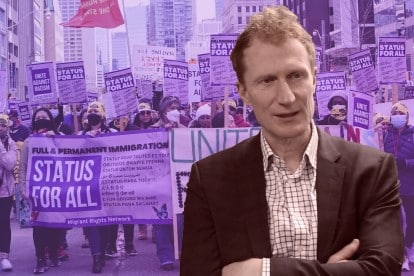
Because, first of all, there was no other choice, right? But also, it felt winnable, that we could actually organize in this massive wave. Over 2020 and 2021, almost monthly, there were demonstrations in between five to fifteen cities across the country by the Migrant Justice Movement. In total, hundreds and hundreds of thousands of people took to the streets in this period, over and over again, massive demonstrations that really pushed the Liberal government in the last election to promise a series of pro-immigration reforms.
Of course, this last 12 months of blaming migrants for the housing crisis and the affordability crisis has really put a stop to many of these campaigns. What has happened is that the focus is so much on the numbers of migrants that the question of their rights has largely been pushed into the background. The Liberals are actually spineless, and they’re copying the Conservative playbook. They really believe that if they do anything that’s pro-immigration right now, they’ll lose votes, and if they come out in this soft way to be anti-immigrants, which they define as a “rational, fair immigration policy,” that’s just code for racist and closed borders, that they’ll be able to recuperate their vote.
I would say the Migrant Justice Movement has become incredibly strong—much stronger than it has in the past—but the balance of forces, and also the context, has shifted in front of us. What has been incredibly disappointing, is that we were able to get a proposal to Cabinet on May 28 of this year—a proposal that we would be able to support—for a comprehensive regularization program of the likes that has never been seen, not just in Canada, but anywhere in the world. A broad, inclusive program.
The Cabinet decided, and Justin Trudeau decided, that it was not the “right” moment. The Liberal minister saying, “I support regularization, but the people aren’t ready.” It’s like, well, the people aren’t ready because you’re not making them ready. In fact, you’re doing the opposite, because you’ve been slamming the door.
The Liberal policies that have happened in the last year: there’s been a cap on international students, particularly, there’s been a cap on family members of study permit. You can no longer bring in your family. There’s a cap on the number of permanent residents. This has been capped at half a million. There’s a reduction in temporary foreign workers. There’s a visa that’s been imposed on Mexico, and a number of other policy changes making it harder and harder for migrants to come here or to be able to get permanent resident status here.
Within that vein, they’re also unwilling to do a regularization program. But again, I think it is also because we have not been able to master the kind of massive movement that would take in this moment to win such a thing. We have gotten support from a huge coalition of over five hundred major civil society organizations, almost all the major labour unions in the country, all the major environmental groups, churches, etc., have written letters of support.
But they have seen that their membership is now being convinced that the problem is too many immigrants, and I think that because we were not able and they were not able to educate members, the kind of public support has shifted. We can neither place the blame entirely on ourselves, neither can we absolve ourselves entirely of this moment. But I do believe that it’s not over, right? I think it’s important to remember that the Liberals will remain in power for at least another fifteen months. If we just say, “well, they’re slain ducks. Pierre Poilievre, and the Conservatives are rising high in the polls, and therefore they’ll just determine all the policies,” then we have a problem.
Our intention is to simultaneously push back against racism and to win immigrant justice from this government, in this timeline, in this mandate, and it requires the support of all social movements in the country. I think it’s because we have to show a win on immigration, to push back against racism, as a way to make wins on all other working class issues. Because how can you win on working class issues when people believe that the problem is immigrants and not the bosses? I think we still have a window, but it is even more uphill of a march to try and win regularization. At the same time, I think we will see the Liberals do smaller programs. They will try to keep everyone happy.
Lukacs: Speaking of that, talk about the victories that you have won. I don’t think many of our listeners would even know about this, but in June, the coalition working on this did achieve a great victory, which was that care worker migrants, who have laboured under extremely precarious and vulnerable situations here, were able to win permanent resident status on arrival. Can you talk about that?
Syed: Let me situate this within the last three years. We stopped a hundred thousand deportations when we were able to win a renewal of the postgraduate work permit. We won the first program for regularization—first of guardian angels in Quebec, and then of construction workers in the GTA. We won a massive increase in rights for people through various programs.
We’ve actually been, over the last three years, extending, expanding the rights of migrants at this massive scale, because of both the social power that we’ve built, as well as the public support. I think part of what that did is that domestic workers have been coming here for over half a century, working class women living in employers homes, often taking care of children. Secondly, the elderly will now be able to come with permanent resident status on arrival. We were able to have won that policy early enough that this change in the culture, so to speak, was not enough to stop it.
The other thing is to just say that struggle works. We have seen more victories than I thought were possible, frankly, and that the loss, potentially, of a comprehensive regularization program, is not written in stone.
I think we also have to see what’s happening with the care economy in general. We are seeing that the federal government has been really expanding childcare, pharmacare, dentalcare. There’s a broad appreciation and understanding of care as the Canadian public ages and the birth rate is so low. We are hoping to see more positive changes, at least for migrants in that sector.
Lukacs: You mentioned the prospect of a right-wing Poilievre government in 2025. Let’s talk about Poilievre’s approach.
He seems to be playing a kind of interesting game, playing both sides. He’s definitely voiced a commitment, though vague, to a more restrictive immigration system, but he seems to also have strayed away from more openly anti-immigration politics, and he seems to be wanting to build in immigrants into his electoral coalition. Can you talk about what the prospect of a Poilievre government might hold?
Syed: The first thing I want to say is that we need to not take it for granted. I think there has been a lot of talk on the left of sort of just accepting this as fait accompli, and it cannot be the case. We must not give up now, no matter what.
We have to build our defenses and build our capacity to live through a right-wing, populist Conservative government. What I think is that the federal Liberals have largely enacted almost all the policies that the Conservatives would. They have capped, as I said, permanent residents. They have capped temporary foreign workers to five per cent. They also capped all temporary residents to five per cent of the population. They have cut international student numbers. They’ve shut out family members. They were going to expand family member work permits to TFWs that they’ve withdrawn.
All in all, I think the Conservatives actually have been very successful in forcing the Liberals to make the policy changes that they would have done. It doesn’t seem necessary for Poilievre to publicly say it, because they’re in meetings and they’re making moves, and they’re making demands of the Liberals and the Liberals are accepting them. That’s one massive issue because, as I mentioned, we’re in this moment where racism and anti-immigrant policy is something that both parties are more or less aligned on.
So will things get worse? Under a Conservative government, yes, but right now, the Liberals are doing so much of their work anyway. And then, yes, the premiers have been the ones who’ve been blaming immigrants for the housing crisis, the affordability crisis, etc. At the same time, we see Premier Ford in Ontario attacking migrants for the housing crisis and the healthcare crisis and, of course, anti-Palestinian racism around protests. We see Legault, for example, saying there are too many refugee kids in our schooling system, and that’s what’s causing a crisis in Quebec. In P.E.I., Dennis King, really turning these sort of eight hundred former graduate international students as the key way in which he’s been able to absolve himself of all of the underfunding of healthcare, education, etc.
In the last premiers meeting, David Eby, Wab Kinew—NDP premiers—also saying that there are issues with so-called “absorption capacity,” which is sort of code for saying: “too many people, not enough services, and the federal government is responsible, and we want more money and funding for it.”
The premiers across the country have also really been carrying water on this. I think the way in which the debate flows out in Canada is so different than the United States or the U.K. I was looking at the Republican National Convention, and they had these signs that say “mass deportations now.” And promises of increasing deportations.
Well, deportations are massively increasing under the Liberal government, but without that same kind of rhetoric that accompanies it. So the policies are being changed, regardless of the diatribe and the discourse that surrounds it. I think that we have to be very cued in. Next year, there’s going to be fewer international students than even projected. There’s going to be fewer migrants, and Canada’s entire GDP growth is based on immigration, so people are actually going to face a greater economic crisis. It’ll be blamed as inflation, prices will still go up.
That’s what we saw in the U.K. People marched for Brexit. Brexit actually made the economy worse, and then they became more anti-immigrant, and now there are race riots in the streets. The thing is, shutting down the border actually doesn’t solve the problem, because they’re not responsible for the problem. We are headed in that direction, even without the blatantly anti-immigrant sentiment.
Now the other thing is, migration policy is not the same as immigrants in the voter base. So, absolutely, the Conservatives have huge resources on the ground, in the suburbs of all of the major urban centers, working the Tamil vote, the Filipino vote, the Punjabi vote etc., in the attempts to win elections. A lot of immigrants are just as convinced by this rhetoric, that there are queue-jumpers, people are coming too quickly, they didn’t follow the policies, and now there’s too many people. It’s not that immigrants are pro-immigrants. Do you know what I mean? Like, “shut the door behind us” is a long-term immigrant strategy, and we should not confuse the two.
Lukacs: What I hear you saying, is that dynamics around immigration politics are different here than in the U.K. and the U.S., that a lot of the policies themselves enact similar kinds of exclusionary violence, but yet, we don’t have a need for the same kinds of ugly nationalist rhetoric that might also precipitate those kinds of riots that we’ve seen in the U.K..
Syed: Exactly. At the same time, I want to say that there is a massive increase in racism. Our members are experiencing more violence in the street. We’re seeing more discrimination on the job. We’re seeing people being blamed. We’re seeing people being turned away. The hate mail that I’m receiving has increased on every one of our staff people, our phone calls, our social media, comments, messages. On all sides we’re seeing the racism drum beating louder, and I think that we cannot wait until there are riots on the street to do something about it. I mean, that’s why on September 14 and 15, we’re doing these ‘Say No to Racism! Say Yes to Immigrant Justice!’ actions across the country.
We’re putting out constant materials now explaining how it’s landlords responsible for the housing crisis, billionaires for the affordability crisis. Blame the ruling class, and not immigrants. I went to a protest in Toronto against so-called mass-immigration. There were just a hundred people. But it’s not going to happen at that level. It’s happening at the level of policy. It’s happening with premiers. It’s happening with austerity. People are being shut down. People are being pushed out. As anti-immigrant rhetoric increases, pro-migrant policies, including with regularization, are being set aside.
The conditions on the ground for migrants are getting worse. The [conditions for ] immigrants are getting worse, [for] workers are getting worse. There’s a distraction from the core issues. As I said, what it has most successfully done, is that it’s distracted us from holding the billionaires, the speculators, the bankers, responsible for the immiseration of the working class that began, really in this newest, most expedited phase during COVID-19, and has just been increasing when we are all suffering in this massive crisis. It’s impossible to make ends meet for most people, and they have all been convinced the problem is migrants and immigration. The old chant used to be unemployment and inflation are not caused by immigration. That’s bullshit. “Get off it, the enemy’s profit,” right? This is a chant from the eighties. And every time we have unemployment and inflation, you see the racism train pull into the station, and it did right on time.
Lukacs: For slogans like that, we can go back even further to like the early socialists of the precursor of the NDP, they used to say: “No alien but the capitalist.”
Syed: I have one of those posters from the Winnipeg general strike. I think that taking on the question of racism is the fundamental question of this moment. Every social movement organizing in this country must put resources towards stopping the rise of racism for their own self-interest, because racism is a strategy to distract the working class from holding those truly responsible accountable.
Lukacs: One of the great quotes I’ve seen from the U.K. anti-racist response has been: “the enemy arrives by limousine or private jet, not by migrant boat.”
Syed: Why is it that we have a problem with housing? Why is it that we have a problem with healthcare? Why is it that we have a problem with affordability? You cannot understate the rule of billionaires. Then, of course, people will blame migrants.
The other thing is, what has happened over the last ten, fifteen, years is these small towns across the country have seen international students of colour, migrant workers of colour, arriving in their communities. That has changed the social makeup of those places, with positive and negative results.
There has been no real attempt to educate people about what it means when there are two million people coming in each year. They’re not just going to Toronto, Montreal, Vancouver anymore. Particularly—and it varies—small towns are different. I’m not saying it’s just a sort of populism and negative stereotypes, but the presence of racialized people in communities which have mostly been white, has shifted, and it is shifting. I think for a lot of activists who are not in rural communities and small towns, they don’t see it. We travel across the country organizing. People are really needing to come to terms with this. I think that this is a breeding ground that could go either way, and we must rise to the occasion and deal with the complexity of it. People can’t just be expected to see newcomers arrive in their communities and have no explanation.
Lukacs: Hussan, thank you for talking to us about this moment of great peril, but also of great opportunity for making advances for our progressive movements. Where can we check out information about the work that your organization is doing?
Syed: The public joint national campaign is under the umbrella of the Migrant Rights Network. So it’s @migrantrightsca, on Twitter, Facebook, Instagram, and migrantrights.ca is the website. Sign up and join the actions on September 14 and 15.
Lukacs: If you like what you’ve heard on The Breach Show, please subscribe to the podcast or our YouTube channel. And if you want to support our work, please become a sustaining member to help us produce more journalism for transformation. You can do that at breachmedia.ca/support. Thanks for listening.

When I went to journalism school 10 years ago, my parents thought that they would eventually read my articles in The Montreal Gazette. Today, that newspaper is a husk of its former self. But I get to explain that I’m working towards critical, independent, and sustainable journalism.
Want to be a part of the future of journalism? Support our work with a monthly contribution. Sign up here.
– Amanda Siino, Development Director, The Breach
Immigration | Canada deporting highest level of migrants in a decade, despite promises to let more stay
Immigration | Deportation of frontline worker shows violence of Canada’s immigration state
Migrant Justice | “Perfected in Canada”: the racist exploitation of migrants

1 comment
Comments are closed.
Canada doesn’t have the resources to support any immigration.