
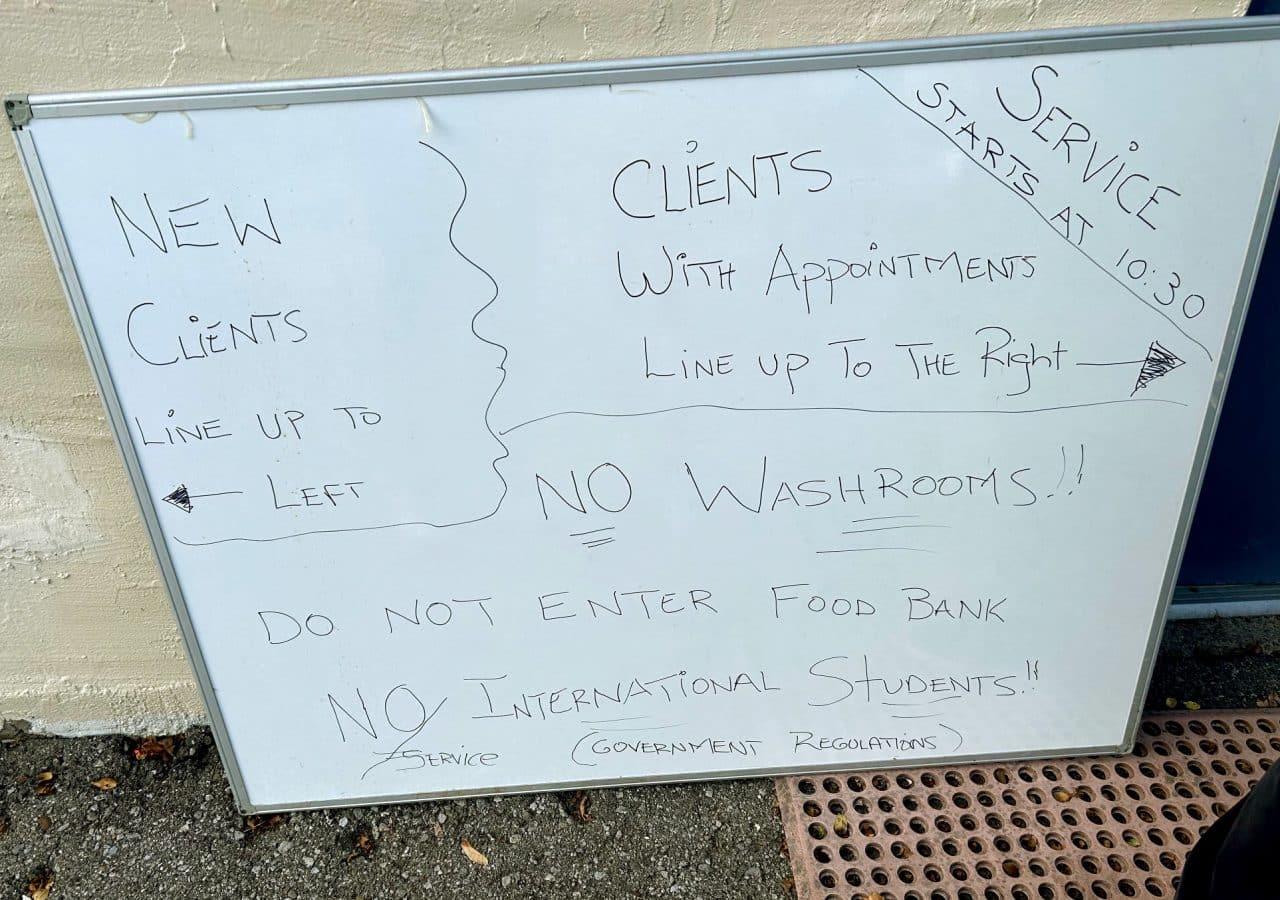
The message on the whiteboard outside a food bank in Brampton, Ont. went up in November: “No international students!!”
Shared on social media, the message brought attention to the Ste. Louise Outreach Food Bank. Its president welcomed it. Canadian food banks are there “to help local residents, not to help every John Doe that jumps off an airplane,” she told the National Post.
On the heels of media coverage, international students are being framed as opportunistic immigrants stealing resources from hard-working and impoverished Canadians—spurring a new wave of resentment.
But not only are international students working—they’re doing the work that few others want to do: as warehouse workers, delivery drivers, and restaurant staff, often working under-the-table for employers who abuse the precarity of their immigration status to withhold pay.
For most students, these kinds of jobs are the only way to get around a government-imposed limit of 20 hours per week.
In Nov. 2022, the federal government removed this limitation, but it is set to return at the end of the year, forcing these students back into unregulated, off-the-books jobs for less than minimum wage.
In a press conference earlier this month, Marc Miller, minister of immigration, refugees and citizenship, let the cat out of the bag.
“You have industry and low-skilled labour, whether it’s big box shops or others looking for cheap labour and wanting to maintain a 40-hour work week for some of the students, [competing] with the labour gap we face in this country,” he said. “We need those people working, and why not if they’re paying a whole heck of a lot of money to come to Canada and study? Why should we deny them that right?”
Miller openly said what has long been true: Canada is using its 800,000 international students to prop up its fledgling labour market—as well as its under-funded colleges and universities.
In fact, it’s the systemic underfunding of public education in Canada that has created, in effect, an indentured class of student-labourers, a sub-stratum of the Canadian workforce forced to labour in service of the Canadian economy while being openly reviled by much of the public.
Decades of austerity behind exploitation of international student labour
The crisis of international student exploitation has been decades in the making.
According to one CUPE report, government funding made up 81 per cent of the operating revenue of universities in 1985; by 2015 it accounted for only 50 per cent. To fill the gap, Canadian universities have relied increasingly on donations, private investments, and tuition hikes for both domestic and international students.
Today, the average domestic undergraduate student pays $7,000 a year in tuition. International undergraduate students, by contrast, pay $38,000 a year. Before the COVID-19 pandemic, international student tuition made up 37 per cent of total tuition revenues for Canadian universities and 68 per cent of tuition revenues for colleges.
As tuition increased along with the cost of living, these students have been forced into the labour market. This has been especially pronounced at the college level, where shorter programs are easier to get into but provide fewer prospects for employment and therefore, permanent residency.
In the last two decades, there has been an eightfold jump in the number of college students who are working.
These numbers are likely significant under-estimates, given that at the time international students were bound by a 20-hour work limit, forcing many to work under the table in Canada’s estimated $68-billion informal economy.

While Canadian international students are required to present a chequing balance of $10,000 to prove their ability to independently fund their living expenses, this measure has little to do with ensuring their well-being and self-sufficiency.
To scrape together that amount, as well as the tens of thousands required for tuition, it is not uncommon for students to take out loans against their families’ homes, businesses, and land. These loans, offered by everyone from venture capitalists to garden-variety loan sharks, plunge these students into crushing debt.
Recruiters and agents for Canadian universities—who are paid on commission, taking a cut from their tuition payments—often dangle the promise of gainful employment. Most students come here with the expectation of working a part-time job to supplement their income. For those without the requisite economic support, or with particularly steep debts to pay, this promise of employment is not a matter of supplementation, but survival.
Upon arrival, students are left to fend for themselves, cut off from the bulk of bursaries, grants, and scholarships available to domestic students, and ineligible for most government support.
During the pandemic, as the retail and food-service industries slimmed down their workforce, international students faced the worst of the pandemic. Those “lucky” enough to find work in warehouses faced some of the worst COVID outbreaks seen in the country; those who didn’t were left stranded.
By 2021, funeral homes in Brampton and Mississauga began raising the alarm about the sharp spike in suicides amongst these students. According to CBC News, just one of these funeral homes last year repatriated 33 bodies back to India, the country from which Canada sources 40 per cent of its international students.

A crude economic calculus
As of 2024, Canada is reaching the 10-year anniversary of the federal government’s International Education Strategy Plan, which planned to attract “more than 450,000 international students to Canada by 2022” and see “international student expenditures rise to over $16.1 billion.”
In a way, the crude economic calculus of this plan has been a resounding success. Canada brought in more than 800,000 international students in 2022, who contributed more than $22 billion to the economy.
But little effort has been made to measure the impact of this extractive policy on the students themselves. There is little data on the number of students forced to work under the table, or on deaths and workplace injuries suffered by these students, or what has happened to the roughly 70 per cent of international students who since 2000 never made a life in Canada after their study period concluded: those who were dropped back in their home countries with little to show for their Canadian experience but the weight of debts that demand repayment, and the illusory prestige of a Canadian education.
If Canada is to continue extracting so much from these students, the day will come when this ceases to be a country worth studying in. When that day comes, Canadian universities and colleges will be forced to confront the humanitarian crisis they have created in exchange for a few billion dollars in tuition, and the Canadian state will have to be held accountable for creating the conditions that led to their exploitation.
Until then, we cannot deny these students the modicum of support available to them on the ground, including access to food banks. It actually is Canada’s responsibility to help “every John Doe who steps off an airplane.”

“We need media that enlarges the sense of what’s possible.”
Naomi Klein, journalist and author
Want to support hope-fuelled journalism? Become a sustaining member.
The movement that’s won back $650K in stolen wages for international students
Corporate Power | Grocery giants are screwing Canadians—and farmers have proof

Capitalism | How Canada’s grocery ‘cartel’ doubled its profits while food bank lines grew

8 comments
Comments are closed.

Bang. On.
Translate into Hindi. Share widely.
It takes the average Punjabi family 74 years to afford on year of education in Canada. And Canada brings in 21 billion dollars a year from international students.
Colonialism.
How many years until we look back in shame thinking how could we have done that?
So much for community colleges. Bill Davis is turning in his grave.
The colleges virtue signal with Equity, Diversity and Inclusion committees / training all the while putting foreign students into classes designed for domestic students–classes many international students cannot understand–desperate confused students use AI, the college winks, denies there’s a problem, students pass, ka-ching! Your submarine sandwich is cheap and filling.
You can’t blame the Food Banks from refusing these International Students, their numbers are simply overwhelming, food banks as with the rest of Canada’s infrastructure isn’t prepared to handle the massive influx of students/immigrants. Everything from housing, the economy and even societal acceptance of new immigrants isn’t where it needs to be. This whole idea of diversity isn’t drawing people together is dividing people more than ever. The students wishing to come here need to do their own research and pathfinding before they leave their home countries, the streets here in Canada are not paved with milk and honey as they believe.
Bang. On.
Translate into Hindi. Share widely.
It takes the average Punjabi family 74 years to afford one year of education in Canada. And Canada brings in 21 billion dollars a year from international students.
Colonialism.
How many years until we look back in shame thinking how could we have done that?
So much for community colleges. Bill Davis is turning in his grave.
The colleges virtue signal with Equity, Diversity and Inclusion committees / training all the while putting foreign students into classes designed for domestic students–classes many international students cannot understand–desperate confused students use AI, the college winks, denies there’s a problem, students pass, ka-ching! Your submarine sandwich is cheap and filling.
Clown comment really. No one forces you to come to Canada. You sign up struggle and then cry about it. Just because you pay massive fees gives you no right to PR. Clown comment.
I am mostly thrilled by your objective reporting. I do hope those charged with decision making find a way to balance the country’s political economy strategy and the plight of international students quickly. More grease to your elbow.
This unfortunately is true.
And it’s hard to see it when you’re outside Canada.
Most news articles and discussions about this can’t be seen outside Canada, as these web domains block any access outside Canada.
We rely mostly on official information (government of Canada) and influencers on social media.
The picture painted by the government and these influencers are not true.
I had a business of my own before leaving my home country. I liquidated everything to come to Canada, only to be locked into low wage jobs and absurdly expensive education. The program I’m enrolled is from a federal university, but it feels like an “English for newcomers” program with a few extra, and shallow, courses. It doesn’t have depth, if anything is more like a money grabber.
The worst decision I ever made was coming to Canada, and I consider Canada responsible for not putting all the cards on the table, before I got here. To all of you pseudo patriots reading this, don’t worry. I’ll leave your dreadful country as soon as I can and I promise I’ll never be back.
You, thinking of coming to Canada to “study”:
Don’t come, it’s not worthy. The “education” is subpar, the experience is non-existent, there’s only heavy work and low wages awaiting you. You’re better off in your country, where you have rights and you’re not forced to live like a third rate immigrant.
I wonder if the same reasoning is used for the large immigration numbers as well as not recognizing some foreign education credentials – is it just a way to get cheap labor?
The whole government is in thrall to corporations which exploit the country and citizens to the greatest degree that they can get away with; it’s not just international students. That is what a country is, a set of borders made by rich people to tell other rich people, “only we are allowed to exploit all within these borders and may, if paid enough, will allow others to do the same”.