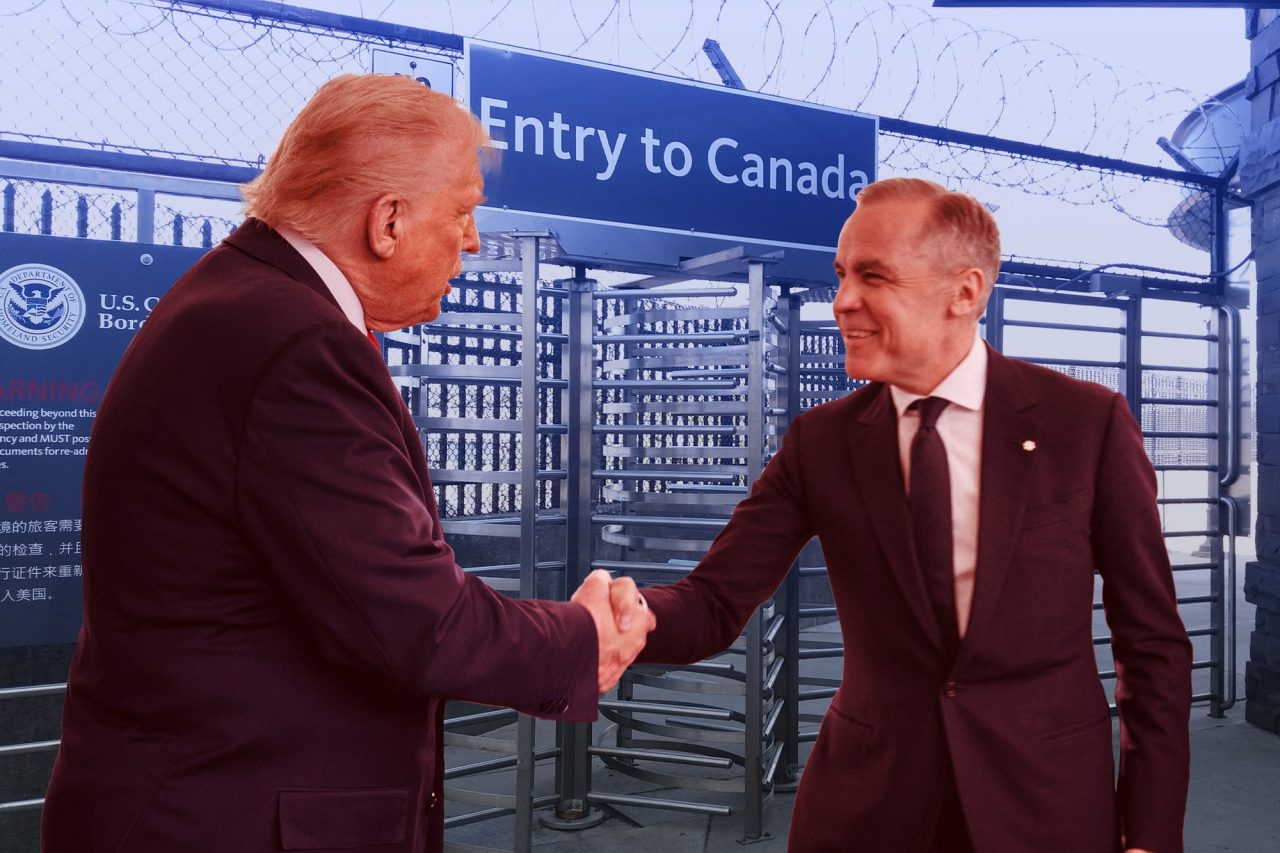
For all the talk of a nasty break-up, Canada and the United States are still very much in sync—especially when it comes to shutting the door on refugees.
Just weeks ago, Prime Minister Mark Carney solemnly declared that the “old relationship we had with the United States, based on deepening integration of our economies and tight security and military co-operations, is over.”
Carney didn’t say who was ending the relationship, and almost immediately started hinting he hoped to patch things up. When you both want the same things, it’s hard to walk away.
Carney’s first border plan, an expansive omnibus bill called the “Strong Borders Act,” renews and deepens the Canada-U.S. border security partnership and keeps Canada aligned with U.S. President Donald Trump’s racist scapegoating of immigrants and refugees.
The bill, introduced by federal Liberals last week, promises to “protect the asylum system against sudden increases in claims by introducing new ineligibility rules.”
In other words, Carney’s plan paints refugee claimants as a threat to the very system created to support them. This mirrors the U.S. administration’s framing of asylum seekers as dangerous, rather than as people who deserve protection and priority.
The border bill would empower government officials to pause accepting new immigration applications—and to alter, suspend, or even throw out existing ones, including refugee applications—if deemed in the public interest. This could mean that refugee claimants are denied access to a hearing before a potential deportation, experts warn.
The bill also sets a one-year deadline for claiming refugee status and severely limits the ability of migrants who fail to use official ports of entry from the U.S. to make a refugee claim.
It would also expand the government’s powers to share an applicant’s personal information between departments and with other jurisdictions. Advocates fear this will allow provinces and other government agencies to track unwanted immigrants and target them for deportation.
The Migrant Rights Network, a migrant justice organization, warns that Carney’s law “aims to create a mass deportation machine,” with new ministerial authority to cancel permits for entire groups without due process.
Don’t let anyone tell you Canada is being dragged back into this relationship.
Our government is renewing a vow long shared by both countries: that Canada and the U.S. must never be overrun by refugees, especially those coming from the Global South.

Two nations in sync
In recent years, both Canada and the U.S. have shown a clear alignment in their priorities about which people seeking refuge are able to resettle in their respective countries.
After Russian President Vladimir Putin launched his invasion of Ukraine in 2022, Canada created several distinct programs to transport, resettle, and support Ukrainians.
The government accepted an unlimited number of applications from Ukrainians. It received more than a million applications, and approved 80 per cent of them. Through the Canada-Ukraine Authorization for Emergency Travel (CUAET), the government fast-tracked immigration and accepted more than 298,000 Ukrainians fleeing the war.
The U.S. outreach to Ukrainians was similarly robust, with 280,000 people arriving there through the Unite For Ukraine program.
By contrast, a 2024 program Canada created for Palestinians in Gaza after Israel began its siege there had accepted only about 5,000 applications by February, and resettled just 620 people.
During the same timeline, the U.S. accepted only 31 Palestinian refugees.
Canada and the U.S. are often in sync not just about which refugees are invited into their respective countries, but how to deal with those who apply once they’ve arrived.
A defining feature of the U.S. immigration system is the wide discretion its officials have to evaluate refugee claims. For example, people wanting to claim refugee status typically have one year to file an application.
As the American Immigration Council points out, many potential refugees “may never know that a deadline exists. Even those who are aware of the deadline encounter systemic barriers, such as lengthy backlogs, which can make it impossible to file their application in a timely manner.”
Carney’s border proposal seeks a similar application limit of one year after first arriving in Canada. If a person’s homeland becomes unsafe after a year of temporary residence in Canada, they would be excluded from making a claim.
The time limit would apply retroactively to anyone who has arrived in Canada since June of 2020, which expands the pool of immigrants who could ultimately face deportation. The Liberals also seek to eliminate refugee hearings for those who cannot meet the year-long residency deadline.
Perhaps most troubling, Carney’s bill seeks to give immigration officials the right to “cancel, suspend or vary a visa or other document.” The government could suspend new applications, including refugee claims, or cancel those already in progress, if it decides such an action “is in the public interest.”
Many critics are comparing this rule to Trump’s decision to suspend refugee claims at the U.S.-Mexico border after citing an emergency due to unwanted migration.
Yet Carney’s plan isn’t simply a copycat move—it’s part of a longstanding Canada-U.S. colonial alignment on immigration that has historically led the two countries to exclude and persecute the same refuge-seeking populations.
Each country drafted or passed laws to limit the immigration and movement of Black people and Chinese people.
When hundreds of Jewish refugees fled the Nazi regime and sailed across the Atlantic from Germany in 1939, both Canada and the U.S. turned them away.
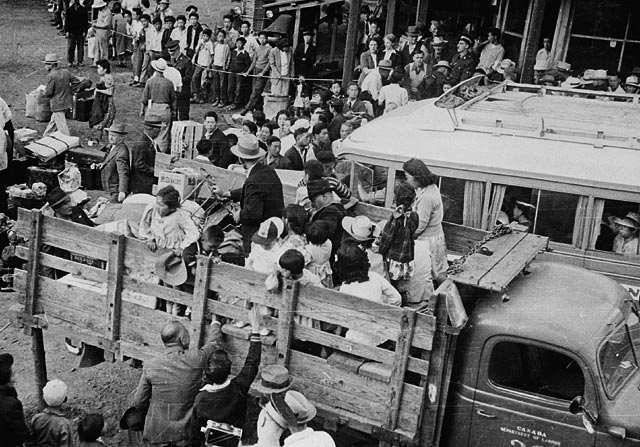
Both countries subjected their Japanese populations to forced internment during World War II, and both expelled many Japanese residents after seizing their homes and property.
And of course, both of these countries claimed their respective rights to enact all this violence by colonizing Indigenous peoples through war, expulsion, and assimilation.
With so much historic and modern consensus on both overseas and inland immigration, it makes sense the two countries would also seek to control refugee movements across the Canada-U.S. border, the longest shared border on the planet.
The ‘safe country’ fallacy
In recent times, the Canada-U.S. immigration pact has become more formalized, and the two countries have partnered to bypass their responsibilities under international refugee law.
In 2004, Canada and the U.S. signed an agreement declaring one another as safe countries for refugees. The Safe Third Country Agreement (STCA) essentially bars migrants who arrive in Canada from then seeking asylum in the U.S., and vice-versa.
The mutual benefit from this arrangement encourages each country to classify the other as safe, even when conditions change. Despite Trump’s ongoing terror campaign against refugee claimants, and his every effort to rewrite asylum norms, Carney has not even hinted at a desire to review the STCA.
A federal government website on the STCA says that “only countries that respect human rights and offer a high degree of protection to asylum seekers may be designated as safe third countries.” It helpfully adds that, to date, “the United States is the only designated safe third country.”
If Carney’s border bill passes, it will slam the door on refugee claimants from the U.S. who were previously eligible to apply here. The notion of the U.S. as a safe country would be reinforced, despite all growing evidence to the contrary.
Discover Canada, the federal government’s official citizenship guide, boasts Canadian pride in the Underground Railroad, which brought enslaved Black refugees from the United States into Canada.
But the mythology is undermined by our present dealings with the U.S., as we ignore policies and plans that persecute trans people, toss citizens and non-citizens into foreign prisons, and ban immigration from entire countries.
Any lessons from the Underground Railroad are now ignored as we deepen our complicit partnership with the U.S. and the broader anti-immigrant Western powers coalition.
Who knows how long we can keep up this “us against the world” fantasy, in which we owe ourselves every safety and comfort while we keep others away.
The raids, arbitrary detentions, and deportations currently playing out in our fellow “safe” country are not very reassuring.
Likewise, Carney’s first pitch for safety—a bloated law to separate families, violate privacy, and build administrative walls—will likely inspire far more fear and paranoia.
The difference is that Trump campaigned on a reckless immigration agenda, while Carney campaigned on being a sensible check on Trump’s worst impulses.
So far, only one of them has kept his word.

‘We need an outlet, a source of information that is credible, that is progressive, that we can cling to and believe in’
David Suzuki
Want to support journalism you can believe in? Become a sustainer today.
Immigration | Migrants are building Canada’s homes—while getting blamed for housing policy failures

Immigration | ‘Deeply hypocritical’: Pierre Poilievre slammed ‘illegal border crossers,’ but his own relative crossed and stayed

Migrant Justice | 6 ways Justin Trudeau is misleading Canadians about immigration

5 comments
Comments are closed.


Sovereignty was fully surrendered by Jean Chretien when he ratified the NAFTA. The Mulroney government started the process with their FTA which gave US interests the same status as any Canadian. And let’s not forget that it was CANADA that insisted on the FTA – not something foisted on us by Americans. We actively pursued a surrender of sovereignty and willingly entered an economic union. There can not be border laws at odds with one another if was have a unified economic interest.
We need a robust consultation regarding immigration policies and capacity. And a revamping of the systems and resources for newcomers when they get here. Toronto has been overloaded with no housing supports. So people are in crisis and cannot assimilate into society. This affects the families and kids. Housing, education and employment supports need to be planned for. As a daughter of an immigrant I support policies of openness and acceptance. But to bring people in without resources is not right. A full immigration policy keeping the merit system and allowing for refugees is needed.
The difference between Ukrainians and Palestinians is the former is not calling for the death of all Russians, even in their current country , while the Palestinians routinely call for the death of all Jews. So which group should we allow into the country?
Thank you for this “border bill” story. We were sold a bill of goods with Carney, welcome to our new neoliberal govt, not what we voted for. Resist! “Elobs up” turned into “suck up” to Trump!
This isn’t quality journalism. Too many “experts say…” and things that “could ” do this or that. And confusing sentences like “But the mythology is undermined by our present dealings with the U.S., as we ignore policies and plans that persecute trans people, toss citizens and non-citizens into foreign prisons, and ban immigration from entire countries. ” These are American policies that we are ignoring according to the writer. You might as well throw in every other American policy we are ignoring, like the death penalty, abortion restrictions, nuclear weapons, etc. I think it’s much more productive to hold our politicians to account for their responsibilities. It takes a bit more work than focusing on the American outrages. Our politicians have a responsibility to US. If they rant and howl about jurisdictions outside of their power it might feel good to you but it does nothing.