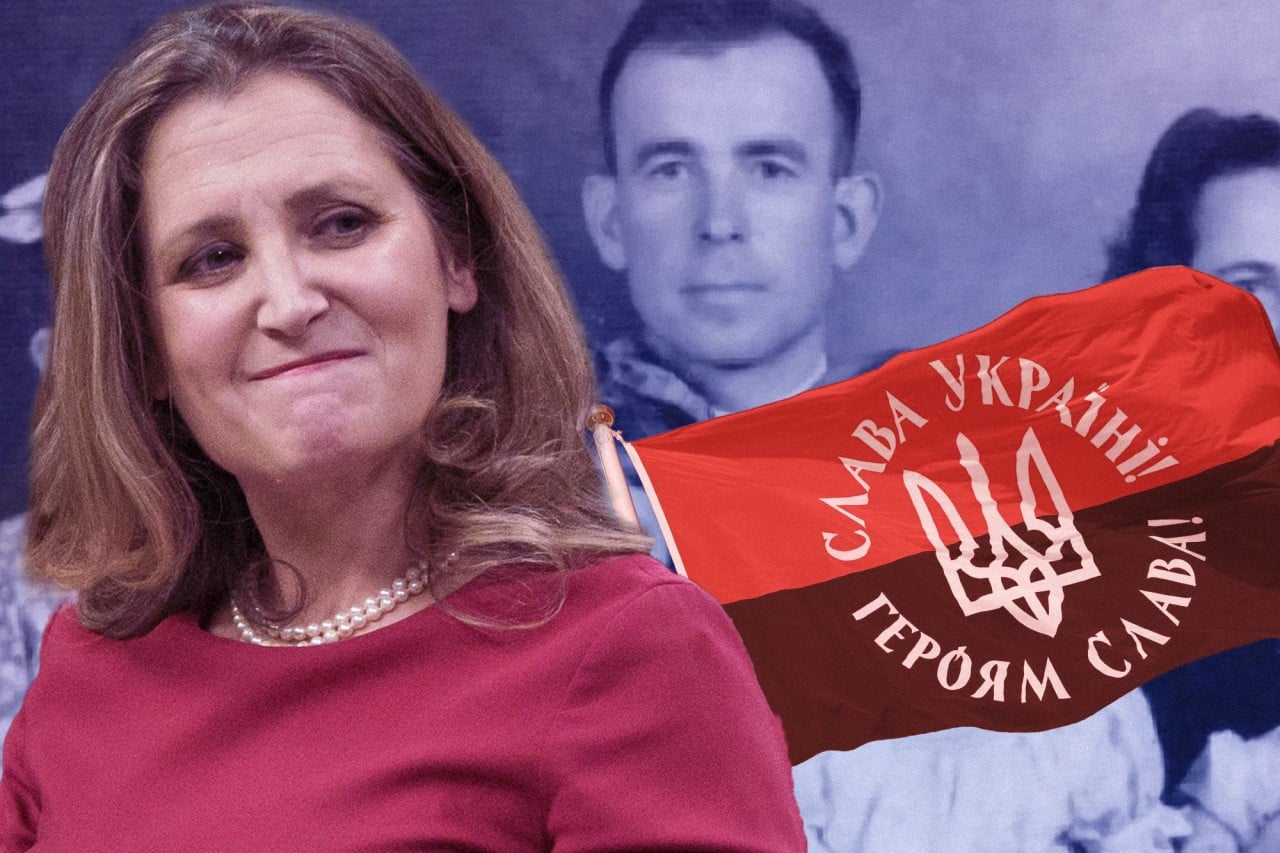
The standing ovation accorded to a Second World War Ukrainian Nazi unit veteran in Canada’s House of Commons in the autumn of 2023 shocked Canadians—and the world.
I was not surprised because I had already spent three years learning about two people, Mykhailo Chomiak and Ann Charney, whose parallel lives during and after that war highlight the complex and disturbing story of Ukraine and Canada’s post-war Ukrainian Canadian community.
Ann Charney was two years old when she and her Jewish mother evaded their certain death by hiding out in a hayloft in the Ukrainian countryside. Ann spent two long years in that attic. She and her mother survived the war, and ultimately made their way to Montreal. There, Ann has had a brilliant career as a novelist and journalist.
Mykhailo Chomiak, Chrystia Freeland’s grandfather, spent the war working for German military intelligence as the editor of an influential Ukrainian newspaper celebrating Hitler and promoting a virulent form of antisemitism. After the war, Chomiak and his family were easily accepted as postwar immigrants to Canada, along with thousands of other Ukrainian Nazi collaborators and former SS men. Chomiak settled in Alberta, where he continued to work for extreme right wing causes.
In Family Ties: How a Ukrainian Nazi and a living witness link Canada to Ukraine today, I tell the stories of these two during the war, and afterwards, bringing their stories up to date through research in Ukraine today. When I visited Chomiak’s relatives in Ukraine, I found the themes of ethnic hatred and antisemitism strongly in play today in public support for the war with Russia.
Canadian descendants of pro-Nazi Ukrainians often do not acknowledge this connection of past to present. Mykhailo Chomiak’s granddaughter Chrystia Freeland has a leading role in the Trudeau government as minister of finance and deputy prime minister.
In itself, having a grandfather with such a record was no great scandal for Freeland—she could not be held responsible for the sins of her grandfather. But when the story first came out, Freeland would not admit the facts. She had described Mykhailo Chomiak as one of the great inspirations in her life and dismissed the stories about his Nazi collaborating past as Russian disinformation. Like many others, she remains in denial about her grandfather’s role promoting the Nazis’ policies and the Holocaust in Ukraine.
That role, as I learned from a journey that took me into the archives and through Poland and Ukraine, could under today’s laws find him being prosecuted for the crime of genocide.
Chrystia Freeland’s evasions
In her candidate profile when she first became a politician, Chrystia Freeland played hard on her family’s immigrant past. “I’m also a proud member of the Ukrainian Canadian community,” she wrote in her political biography. “My maternal grandparents fled western Ukraine after Hitler and Stalin signed their non-aggression pact in 1939. They never dared to go back, but they stayed in close touch with their brothers and sisters and their families, who remained behind. For the rest of my grandparents’ lives, they saw themselves as political exiles with a responsibility to keep alive the idea of an independent Ukraine.”
Very little of that statement is accurate.
Her grandfather, Mykhailo Chomiak, did not flee Lviv in August 1939 when the German-Soviet nonaggression pact was signed. He was living in Lviv with his maternal relatives, the Blavatskys, until the end of October 1939, when he left for Krakow with his cousin.
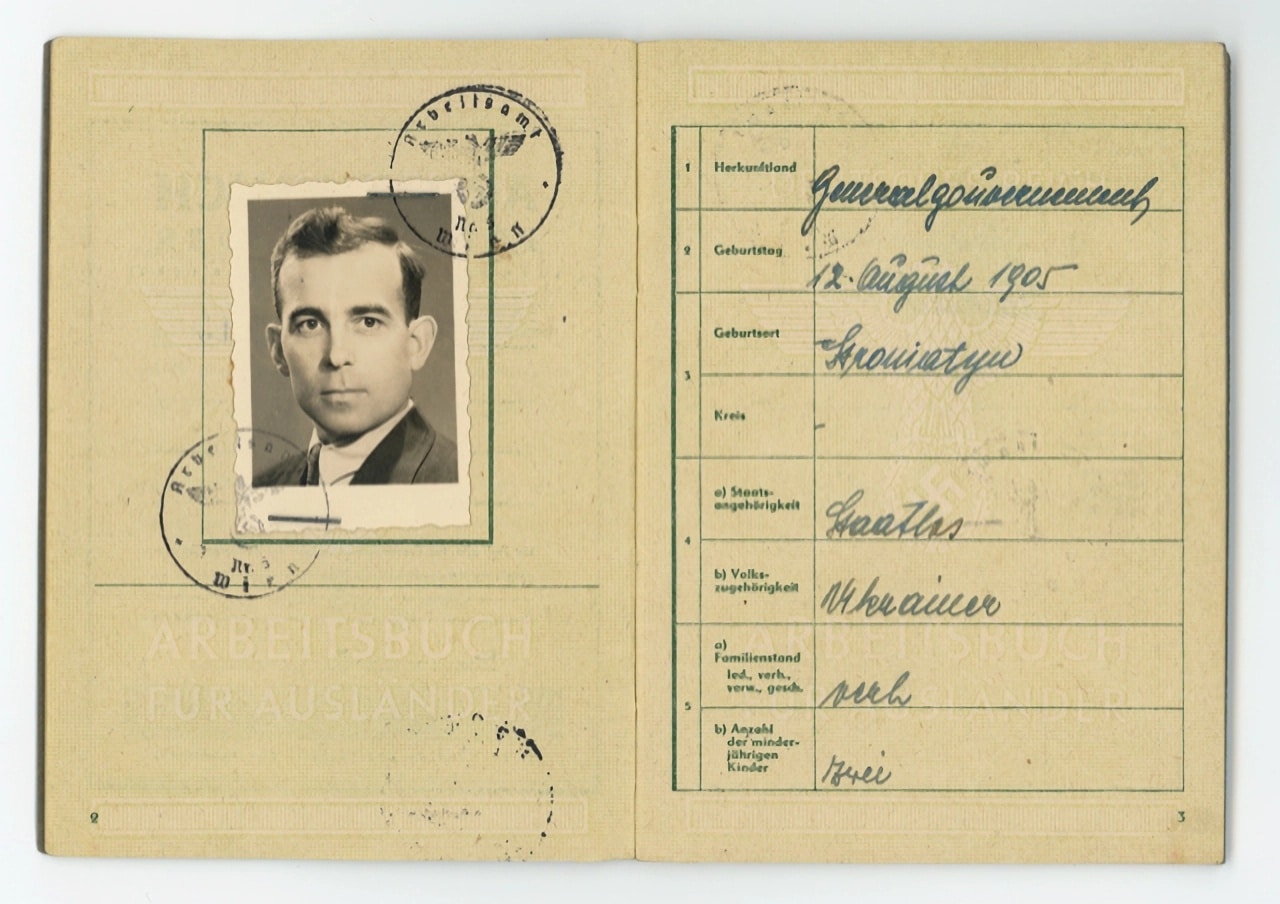
Freeland’s assertion that her grandfather never went back is also not accurate. Alexandra Blavatska describes in detail Chomiak’s visit back to Lviv within weeks of the Nazi invasion in 1941—about the same time that the pro-fascist Organisation of Ukrainian Nationalists militia was carrying out the brutal Petliura pogrom in the streets of Lviv—to tell her and her mother about how her father had passed away a month earlier. There were also references to Chomiak’s visits back to Stronyatyn in letters from his brother Volodymyr in 1943 and photos from a tour of Galicia he took in the same year in his archives in Edmonton.
But the more important elements of Chrystia Freeland’s story are not its inaccuracies, but the enormous amount of information she leaves out. In her telling, her grandparents leap through time and space from 1939 Lviv to the 1945 displaced persons camp in Germany without mentioning Krakow, or Mykhailo’s job as editor-in-chief of the virulently anti-Semitic Krakivski Visti newspaper, his substantial salary from German military intelligence, or his daily collaboration with the SS and the Gestapo over a five-year period from March 1940 to April 1945.
Criminal culpability?
But when I looked at all of the known facts about Chomiak’s life, there was still an unresolved question. He was clearly a Nazi propagandist as editor of the Krakivski Visti, but what, if anything, was he guilty of in a legal sense? I tried to piece together an answer during a trip to Krakow after my last trip to Ukraine before the Russian invasion. I took the train from Lviv to Krakow and spent a day following Mykhailo Chomiak’s footsteps in the city.
I had a morning coffee on a terrace at the market square in the old city in the shadow of the gothic tower that dominates it. Very little had changed in the square since the 1940s. In fact, the major features of the square — the ancient shopping concourse, St. Mary’s Basilica and the town hall tower — have all been in place for six hundred years or more.
The only real difference from the 1940s when Chomiak was living in Krakow was in the name and the decor. In the 1940s, it was called Adolf Hitler Square and was decorated with dozens of Nazi banners. Chomiak would have crossed here many times, when he was walking between the UCC offices south of the square at 26 Grüne Stra.e (now Jozefa Sarego Street) to Jagiellonian University, a block to the north, where he did his Masters in the evenings. Chomiak’s first apartment was nearby, but later he would move to the apartment on the Vistula River, which was only minutes away from the newspaper that had been seized from the Jewish owner, Mojżesz Kanfer, who was later murdered in the Belzec death camp.
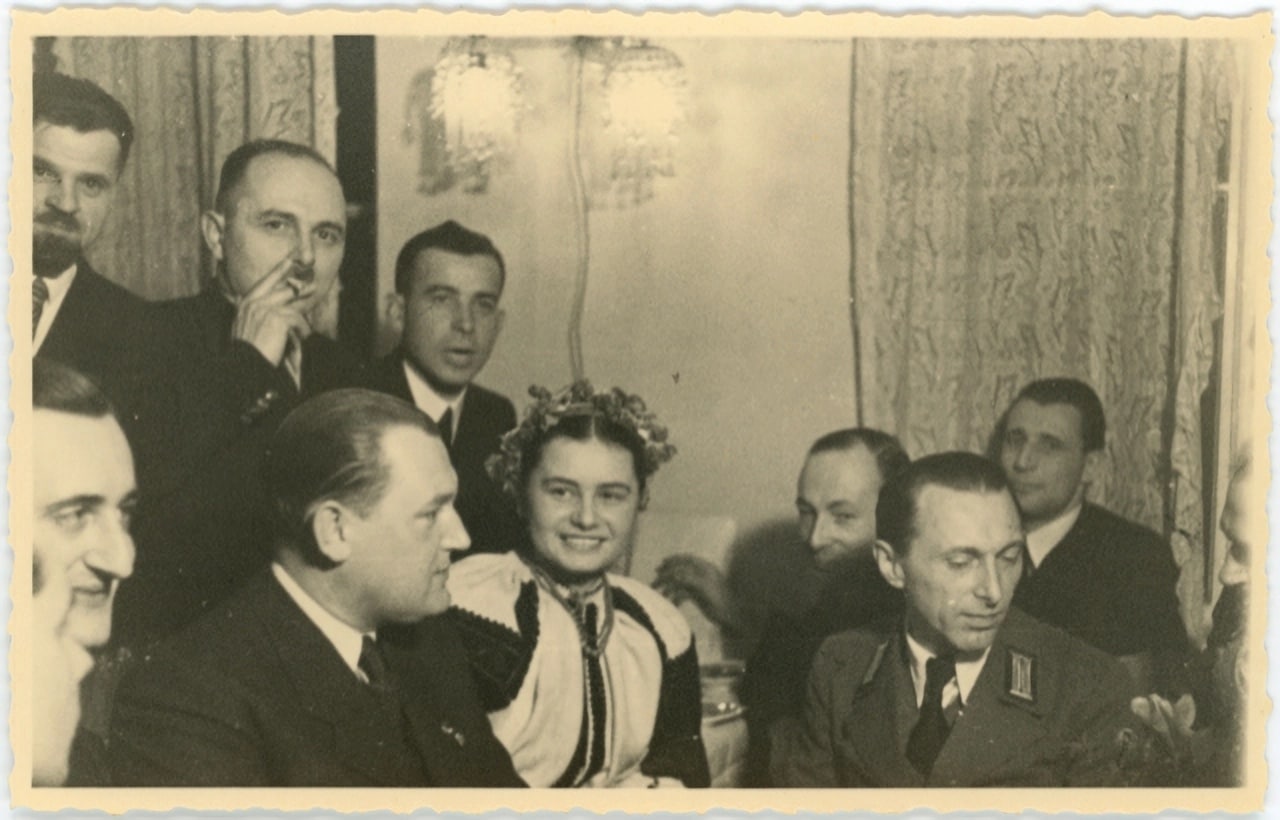
Regarding criminal culpability, an official investigation against Mykhailo Chomiak had been opened by Polish war crimes investigators on April 23, 1966, but it was clear they had lost track of him because his last known address was given as his apartment in Krakow.
So the question of whether or not Nazi propagandists like Chomiak, (and other propagandists like Samchuk and Dontsov who also fled to Canada) could have been charged with war crimes remained open. We do know, however, that publishing Nazi and anti-Semitic propaganda was a crime in Chomiak’s day — Julius Streicher was hanged at Nuremberg for it. And it remains so today.
In the 2000s in Rwanda, two journalists, Ferdinand Nahimana, a founding member of Radio Television Libres des Mille Collines, and Hassan Ngeze, editor of the Hutu extremist newspaper Kangura, were given life sentences, the harshest penalties in the Rwanda war crimes trials, for the promotion of the hatred that led to the killing of more than 500,000 Tutsis.4 Chomiak, Samchuk and Dontsov were clearly publishers of “hate media” during the period. Even Chomiak’s son-in-law, historian John-Paul Himka, says the Krakivski Visti was “vehemently antisemitic” and “helped to create an atmosphere conducive to the mass murder that occurred in Galicia between 1941 and 1944.”
I had the address of the Krakivski Visti and Chomiak’s flat on the river, and I walked through the fall sunshine, past the Wawel Castle, where the Nazis set up their General Government, and where Chomiak’s Nazi liaison and friend, Emil Gassner, had his office. From there, it was less than a ten minute walk along the broad Josefa Dietla Avenue to the Krakivski Visti office at Elizy Orzeszkowej 7.
Today, it remains the same nondescript low-rise office building that it was in January 1940 when Mykhailo Chomiak stepped through the doors, first as associate editor, then two months later as editor-in-chief. It was during that period, from the spring of 1940 to the beginning of April 1944, that the paper he managed published scores of anti-Semitic articles, references and cartoons.
Mykhailo Chomiak’s apartment overlooking the Vistula River was just two short blocks from the Krakivski Visti office. Chomiak would likely have gone home for lunch to enjoy the company of his children and devoted wife. Then he would return to the office to put another edition of the paper to bed with articles promoting the Nazi program of extermination.
The case of Chomiak’s defenders crumbles
When pressed, Chomiak’s defenders say that Freeland’s grandfather had no choice. He was somehow forced into the position of editor and he could not defy the Germans — to do so would have meant certain death. This is not borne out by the facts. In January 1940, Chomiak had been hired as associate editor. The first editor was Borys Levytski, fired from the paper two months later by the General Government overseers in the Gestapo for straying too far from the official line. They demanded a more compliant editor — someone who would take careful readings of what the Nazis wanted before publishing, and Mykhailo Chomiak was given the job.
What is important to note here is that after Borys Levytski was fired for breaking the Nazi publishing rules, he was not harmed in any way. He simply moved to Warsaw and eventually joined the underground fighting the Nazis. The option of refusing to continue as editor was always available to Chomiak.
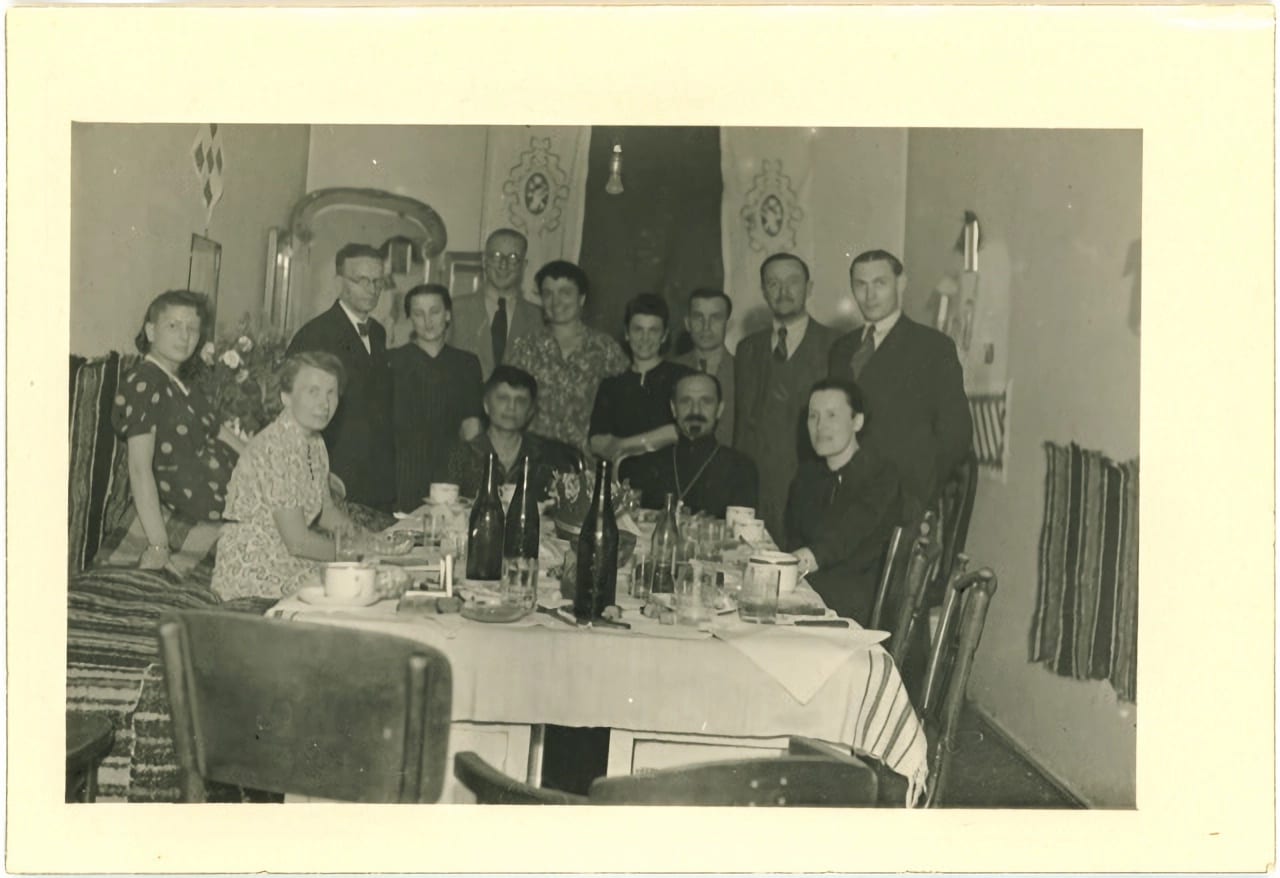
It wasn’t even the case that it was his only hope in employment. The relatives he fled with, his cousin Dmytro Blavatsky and Blavatsky’s cousin Genko Lovitskyi, both secured jobs as lawyers in Nazi-occupied Poland. Lovitskyi opened a notary office in Lublin and Blavatsky was appointed as judge in a court in Chelm. If Mykhailo Chomiak, himself a lawyer, had walked away from his job as Nazi propagandist, he could have found employment in the legal profession with Lovitskyi or Blavatsky. This was especially so after 1943 when he graduated from Jagiellonian University with his Masters degree.
Chomiak’s defenders also raise the defence that even though he willingly took and remained in the job, he was forced to publish the anti-Semitic articles and did not really believe in their content. But apart from the fact that he could have left the job at any time, there is evidence that the anti-Semitism in the Krakivski Visti mirrored his own.
In Chomiak’s personal papers, there is a copy of his letter to the Nazi authorities listing fifteen pieces of furniture which he said had been left behind by “the Jew Dr. Finkelstein” in his first “Aryanized” apartment. Chomiak wanted permission to move all these furnishings to his second apartment and he asked the authorities to reimburse him for the expenses he had incurred in cleaning the place. The “apartment I was assigned . . . was a former Jewish property,” he wrote, “and it was so verminous and filthy, I was forced to refurbish and disinfect the whole apartment at my own expense. I am forced to disinfect the apartment a second time with gas candles as not all bugs were killed during the first disinfection.”
This mirrored Chomiak’s presentation of the Jews in Krakivski Visti that Ernest Gyidel covers in his PhD thesis in a chapter entitled “A School of Hate: Images of Poles, Russians/Soviets and Jews in Krakivski Visti.” In the paper, Gyidel says, it was not uncommon “to associate Jews with dirtiness, bad smells, infectious diseases and visual repugnance.”
Gyidel also found a few telling references to the Jewish community. In Chomiak’s postwar correspondence, he singled out the anti-Semitic chapter in a friend’s book that repeated many of the anti-Semitic tropes Chomiak had propagated at in the Krakivski Visti — that the Soviet Union was a Jewish state, Jews were a nation of exploiters, Jews exploit other nations because they consider themselves “chosen people,” Jews control the press, Jews dream of global domination etc.
Chomiak praised the author for his “bravery” in writing a book that showed the “decisive influence of Jewry” in Ukraine and Chomiak recommended the expansion of the anti-Semitic chapter into a separate book.
Chomiak was careful to avoid the subject of Jews in articles he wrote on politics and culture for Ukrainian publications in Canada. But what is missing from all of his writing and all of his paper is any acknowledgement of sympathy for the people he saw destroyed before his eyes in Krakow.
Undeniable antisemitism
Historian John-Paul Himka described the beatings, rapes and murder of Jews on the streets of Krakow between 1939 and the spring of 1941 that Chomiak would have encountered in his daily life. In fact, even though many Ukrainians had been uncomfortable with the special series of anti-Semitic articles he personally commissioned in 1943, Chomiak defended them.
Gyidel found two letters by Chomiak in 1943 in which he addressed the series. In the first letter, from July 10, Chomiak defended the publication of articles about Jews: “I have to confess that we have written enough on the Jewish subject, and we [also] have heard enough of disapprovals from many people that we are conducting or, rather, justifying the action against the Jews, also for our dishonesty and provincialism, and our escape from reality and responsibility, but that is a minor matter. To us it seems that we are approaching every matter in the most objective way and that we strive to cover those problems which life pushes onto us or throws at us. We strive to do this «sine ire et studia» [without anger and zeal].”
A month later, in a letter from August 20, Chomiak described the reaction to the “Jewish” articles as mixed: “Many people are upset that we are touching upon this sensitive theme in such conditions in which we are now forced to live. It is also true that very many people express their approval of the good manner in which the authors approach this painful problem.”
So was Chomiak’s approach to this “painful problem” a war crime? Someone who could help me answer this question was Noah Weisbord, a professor of law at McGill Univerity and one of Canada’s leading war crimes experts, who had worked as law clerk to the prosecutor at the International Criminal Court. Noah was the author of The Crime of Aggression: The Quest for Justice in an Age of Drones, Cyberattacks, Insurgents and Autocrats.
That evening—from a tiny Krakow hotel room across the street from the old Krakivski Visti—I sent him a file with the anti-Semitic articles from Chomiak’s paper that Ernest Gyidel had put together for his University of Alberta PhD thesis and I asked the simple question: Could Mykhailo Chomiak have been prosecuted for the crime of genocide under existing laws?
Liable for prosecution
Weisbord had read the file on Mykhailo Chomiak, which was based on the information on the Krakivski Visti and Chomiak’s role at the paper described in Ernest Gyidel’s PhD thesis. Noah said that from what he had seen in Gyidel’s PhD thesis, prosecutors would have had the type of evidence they needed to indict someone for genocide. As the editor of a paper—which Gyidel had shown had been churning out anti-Semitic propaganda during the Holocaust—Chomiak met the mens rea and actus reus requirements of guilt under international law, where inciting genocide is tantamount to committing it.
In Canada, the wording of the actual charge would be “advocating or promoting genocide.” According to Bill C-63, which was before Parliament for a first reading in February 2024, “Every person who advocates or promotes genocide is guilty of an indictable offence and liable to imprisonment for life.”
At the same time, Noah pointed out that the genocide law in Canada wasn’t retroactive, and prosecutors take many factors into account in the decision of whether or not to pursue a case. Nevertheless, on the strict question of whether systematically publishing hate about a group that was undergoing a physical genocide, like the Jews of Eastern Europe were at the time, you could be liable for prosecution under the genocide law in Canada.
When I met again with Ann Charney, I told her about Weisbord’s opinion on Chomiak. She wasn’t surprised. The law was clear that advocating genocide was a crime.
But she doubted that even if Chomiak was alive and the genocide law was retroactive, anyone in Canada or in the Hague would actually prosecute him. Experience had shown that Ukrainian Nazi collaborators in Canada were a protected species.
This is an adapted excerpt from Family Ties: How a Ukrainian Nazi and a living witness link Canada to Ukraine today published in October 2024 by Lorimer.

I often hear that I’m lucky to have a full-time job in journalism.
Critical, bold journalism that isn’t beholden to media monopolies should be the norm—not the exception.
By supporting The Breach, you’re supporting a more robust, progressive media. Join us today.
– Katia Lo Innes, Associate Producer, The Breach
Ukraine | As solidarity with Ukrainians flourishes, cherished colonial narratives are being challenged
Climate Crisis | A Good War in the era of bad wars
War | Canada’s long road to the front line of Ukraine crisis
12 comments
Comments are closed.

Good historical work on the part of the author and other people who are working on the subject. With the admission that Chrystia’s only transgression is one of denialism, I find this whole attempt to somehow link Chrystia to Nazism is rather pathetic and disengenious. My generation does not need to answer for the crimes that my parents commited. We did not commit them, we do not support these crimes, and neither does Chrystia. The other theme: Ukraine has Nazis therefore they must be invaded, is totally ridicules. We have Nazis in Canada.
Chomiak Freeland does support those crimes. She waves the blood-and-soil banner, wears the same shirts-with-symbols as e. g. Tyanibok, and enthusiastically applauds Hunka in parliament.
“The other theme: Ukraine has Nazis therefore they must be invaded” – that’s the fallacy called ‘straw man’. It was and is not Russia’s position at all.
She has repeatedly shown her vile racist hatred of Russia and her Ukrainian fascist nationalism. She did not fall far from the tree.
I am disappointed. Personal attack on Minister Freeland. A child is not responsible for their parents’ choices. Cultural heritage is not a choice either; but embracing our past is a part of life. We can share the positive easily- the negative is a personal journey of healing. Inter-generational healing includes difficult truths. We all need to honour vulnerability and the processes of facing history and ourselves. Canadians have some truth and reconciliation steps to take – still. I wonder what kind of coverage you might give to citizens who lived in Ontario during the 60’s scoop?
Chomiak Freeland certainly is responsible for what she herself supports: current ukrainian nazism.
Are there ukrainian nazis? The method to reply is obvious:
● find at least one good source on the nazi ideology (it should be at academic level);
● in it, learn about a number of characteristics of nazi ideology;
● check out if such characteristics occur in certain ukrainian ideology and practice, and among certain Ukrainians who some refer to as “nazis”.
… Yes, they do.
the Führer prinzip, a pure ethnic ukrainian population, which may be brought about by force, a homogeneous culture, racism, nationalist mythology, territorial expansionism.
The sons of a Ukrainian Canadian friend of mine denounced their own grandfather as a known Nazi sympathizer. The friend broke of all contact with his father years ago when his father commented on the ‘Jewishness’ of his grandsons. My friend is married to a woman with Jewish heritage in her family. Hurtful, disgusting, malicious.
The story ‘is what it is’. The story is also irreverent to who/ what Ms. Freeland is to-day. In my view, Ms. Freeland is smart , sensitive and balanced person. She continues to work FOR Canada as a community of people. I, personally admire her!
Perhaps Peter Mcfarlane could start working on another book.
With a little research and digging it would be an easy job linking many Canadians, alive today, to the genocide that turned many immigrants into millionaires.
I have not read McFarlane’s book, but the excerpt you publish does not make the case that Chrystia Chomiak “leaves out” an “enormous amount of information” in her accounts concerning her grandfather. As McFarlane mentions, John-Paul Himka has described Myhkhailo Chomiak’s heinous record in detail in an academic article written in collaboration with Chrystia Freeland: “Krakivski visti and the Jews, 1943: A Contribution to the History of Ukrainian-Jewish Relations during the Second World War,” https://www.academia.edu/30900649/Krakivski_visti_and_the_Jews_1943_A_Contribution_to_the_History_of_Ukrainian_Jewish_Relations_during_the_Second_World_War, freely available on the Web.
I hold no brief for Chrystia Freeland and her vociferous pro-imperialist anti-communism, but I think you might be better advised to direct your support of Bill C-63 to identifying the contemporary pro-Israel advocates and promoters of genocide against the Palestinian people. Himka’s web page contains a wealth of articles explaining the complex context in which Ukrainian politics unfolded in reaction to both Stalinist and Nazi aggression and atrocities during World War II. Not to excuse, but to understand. And BTW, the Nazi collaborator Chomiak was not himself a Nazi; he was not Aryan.
What could validly be argued against Deputy Prime Minister Freeland and other members of her government is that their current defense of Israel makes them guilty of promoting genocide against the Palestinians.
The commenters don’t seem to realize that Freeland has repeatedly described her grandfather as an anti nazi when the truth was opposite. He was a collaborator and rabidly anti Soviet…the folks who were fighting hitler. Freeland has aligned herself with right wing Ukrainians and is anti Russian …even when that country is no longer socialist. These two facts blind her to truly representing the needs of Canada. I can’t wait to read the proof in this book. Thank you!