
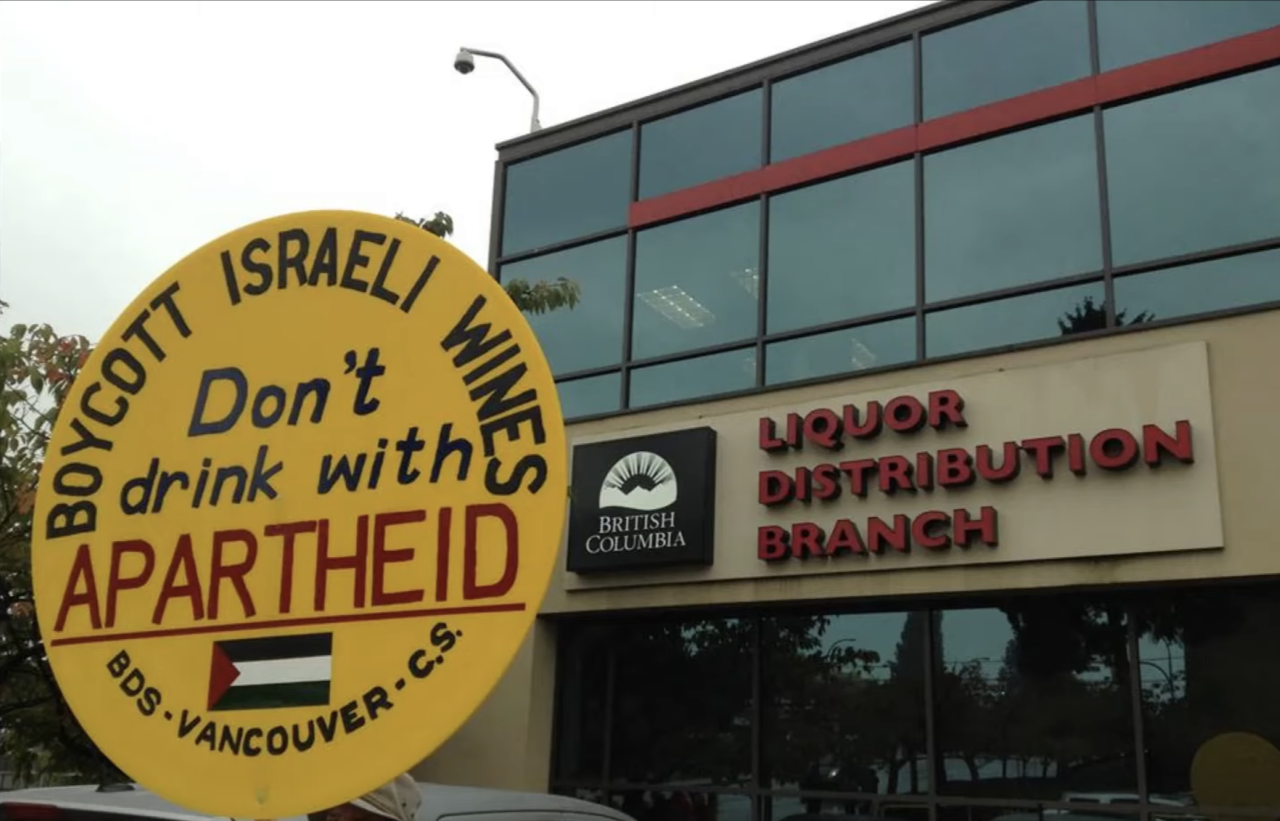
The Israeli government secretly hired a Toronto law firm in an effort to stop the Canadian government from accurately labeling wines from Israel’s illegal settlements in the Palestinian West Bank, documents reveal.
The intervention by the Israeli Ministry of Justice, which took place between 2019 and 2021, came in the midst of a multi-year legal battle launched by Palestinian solidarity advocates to challenge the federal government’s refusal to comply with international law and clearly mark the Israeli settlement wines.
The Israeli ministry paid Torys, a top-tier firm in Toronto, to provide advice on food regulations, prepare “talking points” for use in “discussions with the Canadian authorities,” and attend court hearings on its behalf so it could remain publicly undetected.
The firm warned the Israeli government that a Canadian precedent might be followed by other countries, including in Europe.
Despite several rulings in favour of accurate labelling by the Canadian Food Inspection Agency and United Nations resolutions obliging governments to economically distinguish between Israel and the occupied Palestinian territories, the federal government has yet to fully comply.
“This is an outrageous example of covert foreign influence,” said Michael Bueckert, the vice president of Canadians for Justice and Peace in the Middle East. “The Israeli government is using deception to prevent Canadian authorities from adhering to international law. This undermines trust in the integrity of federal regulations and may help to explain why Canada’s decisions have put the interests of Israeli settlement wineries above all else.”
The labelling case first arose in 2017, when David Kattenburg, a Canadian scientist and child of Holocaust survivors, lodged a formal complaint that wines produced in illegal Israeli settlements in the West Bank were being mislabelled as “Products of Israel.”
The food inspection agency, which is responsible for labelling decisions, initially took Kattenburg’s side, but reversed course after pressure from the Israeli embassy and pro-Israel lobby groups, with the federal government arguing that the West Bank could be considered Israeli territory under its Canada-Israel free trade agreement.
Kattenburg then took the fight to Canada’s Federal Court, which agreed with him that saying these were wines made in Israel was “false, misleading and deceptive.”
The Canadian government appealed that decision, and as the various parties awaited a ruling from a court of appeal in 2021, the Israeli ministry intervened to try to shape the fallout of the decision, according to email correspondence between them and Torys.
Though the appeal court finally kicked the decision back to the food agency, which ruled again that the wines should be accurately labelled a year later, it has to date still not taken any action.
But Bueckert said the legal situation has only become clearer in recent years.
He pointed to an advisory opinion in 2024 from the world’s highest court, the International Court of Justice, that governments must not engage in trade dealings with Israel if that entrenches its “unlawful presence” in Palestinian territories.
“Not only is it wrong for Canada to fail to label products from settlements, but Canada is violating the world court opinion by allowing any trade to continue with Israeli settlements,” Bueckert said. “This is why it is critical to push for Canada to cancel the Canada-Israel Free Trade Agreement and prohibit all trade and investment dealings with settlements.”

Legal advice to ‘enrich’ Israel’s approach to Canadian government
The revelations come from leaked documents from the Israeli Ministry of Justice that were published in 2024 by non-profit collective Distributed Denial of Secrets but have never been reported on before.
European media have previously used the trove of documents to show how the same Israeli ministry intervened in different countries to defend Israel from facing accountability for its violations of Palestinian human rights and international law.
This included colluding with spyware maker NSO Group to suppress legal evidence in the United States, secretly intervening in a case brought in Holland by a Palestinian victim of an Israel military dog attack, and spending hundreds of thousands of euros advising Israeli soldiers who might be arrested in France as war criminals.
According to the documents, the Israeli government originally hired Torys in 2019, in the wake of the first Federal Court decision over the wine labelling. The legal firm warned what might happen if the government didn’t challenge the ruling: “If the decision is not appealed, the decision will stand and other courts may rely on it in the future,” they wrote. “The decision may be used by those involved with the BDS campaign in Canada and across the world.”
Ultimately, the Canadian government did appeal it.
In the summer of 2021, as those hearings were proceeding, documents show officials from the Israeli Ministry of Justice reached out to Torys to find out whether they could anonymously attend the court hearings over Zoom.
When that proved impossible, Israeli officials agreed to pay for a junior lawyer at Torys to attend on their behalf.
Soon after the Court of Appeal gave their ruling, sending back the final decision to the Canadian Food Inspection Agency as the proper authority, Israeli officials reached out again with another request.
They had decided that “our preferred course of action is for the Israeli Ministry of Foreign Affairs to arrange a call with Global Affairs Canada in order to discuss the recent judgement,” said one of their emails.
As the Israeli government prepared to try to influence the next stage of decision-making, they asked for the legal firm to prepare “talking points” to be used “to enrich our discussions with the Canadian authorities.”
Israeli officials speculated about arguments that might be “compelling under Canadian law,” including that it wasn’t necessary to indicate if wines came from “settlement areas,” as this “isn’t relevant information for consumers in making their choice as to which wine to buy.”
They specified to Torys that they were interested in advancing arguments that would complement those the Canadian government had already been making in court.
“We are interested in raising arguments which were not already raised by the Canadian government or an expansion on good points that they raised in order to strengthen their arguments,” they said.
Torys provided the talking points, though these are not included in the documents published by Distributed Denial of Secrets.
It is unknown whether such meetings ever took place between Israeli and Canadian government officials.
Neither Torys, the Israeli Ministry of Justice, or Global Affairs Canada responded to questions from The Breach.
A food agency spokesperson said that the “agency is a science-based federal regulator” whose decision-making was, according to the spokesperson, “grounded in core values, including scientific rigour [and] regulatory independence from external stakeholders.”
Asked whether the agency had been contacted by the Israeli government, the spokesperson initially stated that they could not locate any correspondence of that nature.
When shown an example of one such correspondence dating back to 2017, when the head of public diplomacy at Israel’s embassy in Ottawa contacted the agency, the spokesperson declined further comment, stating that the agency “does not comment on confidential state to state communications among officials.”
‘Labelling practices remaining in breach of international law’
Torys is one of Canada’s top business law firms, “known for sophisticated counsel, best-in-class client service and the most cohesive cross-border team in the market,” its website boasts.
In a bid to support Israel’s case against labelling of the wines, a senior associate at Torys offered to put in a word through a colleague to one of the Canadian lawyers pleading on behalf of the federal government at the Court of Appeal.
“He knows Gail Sinclair (the lawyer pleading for the [Attorney General of Canada]). He suggested that we could reach out to her on your behalf – this may be an easier way to connect with Canada and pass along the points and cases discussed in our memo,” the senior Torys associate said in an email.
The Israeli officials declined.
“I think if we do decide to reach out we would prefer to do it directly,” one Israeli ministry official said.
It is unknown what, if any, communication there was between the Israeli and Canadian government, at that time or since.
In 2023, after the food agency finally decided that the labelling of Israeli settlement wines as products of Israel was misleading, they launched a consultation process.
Bueckert of Canadians for Justice and Peace in the Middle East said his organization and more than 400 other individuals and groups made submissions urging the government to issue accurate labels for goods coming from illegal settlements.
The results have not been released.
“It is just sitting on them,” Kattenburg told The Breach. “Canada has now recognized the State of Palestine, so what better moment for the agency to finally come out with its guidelines for labelling? And yet it hasn’t happened.”
The Breach asked the food agency why it has yet to issue a decision.
Their reply was a non-answer: “the Government of Canada continues to work on origin labelling of imported foods from contested territories.”
Buckert warned that the federal government may instead be banking on the public not noticing what has happened.
“Almost three years later, it appears that Canada has abandoned any intentions to follow through on its obligations to address this issue,” he said. “The government must hope that nobody will realize that they have maintained the status quo, with labelling practices remaining in breach of international law.”

‘The first video I ever made with The Breach was on why we need to support the movement for Land Back. Today, it’s being used in educational settings everywhere—in universities and colleges and children’s classrooms too. When I give talks, people will say, ‘I saw your video and it helped me understand the issue.’
That’s what we do at The Breach—reach people where they are at, with bold ideas, principled analysis, and critical investigations.” – Pam Palmater, scholar and author
Become a sustaining member of our work today.
Palestine | ‘This is from your country!’: The Canadian money propping up illegal Israeli settlements
Israeli Apartheid | Canadian pension funds invested $1.6 billion in companies tied to Israeli apartheid

In ‘covert op,’ Israeli consulate backed poll inflating support for Gaza war
3 comments
Comments are closed.

Beyond labels, all trade with illegal israeli settlements is utterly supposed to be banned outright according to UN Security Council resolutions decades ago.
Canada is pretending to uphold international law and Canadian law, yet allows products from illegal settlements, allows criminal sales of Palestinian land, has openly and clearly voted in favor of continuing to send weapons to the USA that are destined for Israel, etc.
That’s just sleazy. Sleazy, sleazy, sleazy.
This story deserves far more attention than it will likely receive, and it connects several threads that Canadians should find deeply troubling.
What this actually is
This isn’t a lobbying story; it’s a foreign interference story. The Israeli Ministry of Justice covertly hired a Canadian firm to shape federal regulatory decisions, attend court proceedings anonymously, and prepare talking points for use in undisclosed meetings with Canadian government officials. If a different government had done this, the word “espionage” would not be out of place in the coverage.
The regulatory capture angle
The Canadian Food Inspection Agency’s behaviour here is remarkable. It initially ruled correctly, the labelling was false and misleading, then reversed under embassy pressure, then had its reversal overturned by Federal Court, then stalled for three years. The agency’s response when confronted, claiming it couldn’t locate correspondence, then refusing further comment when shown evidence of it, reads less like bureaucratic ineptitude and more like institutional complicity.
The Torys dimension
One of Canada’s most prestigious law firms prepared talking points for a foreign government to use in undisclosed approaches to Canadian officials, while simultaneously having a colleague offer to quietly pass those points to the federal government’s own lawyer. That is a serious professional ethics question that the Law Society of Ontario should be examining publicly.
The broader context
This case sits at the intersection of three issues that will define the next Parliament: foreign interference in Canadian institutions, Canada’s obligations under international law including the ICJ advisory opinion, and the future of CIFTA. The NDP and any serious progressive voice should be demanding the labelling decision be released immediately and pressing for a foreign interference inquiry that doesn’t carve out politically inconvenient cases.
The buried lead
Canada has recognized Palestinian statehood. It cannot simultaneously allow goods from illegally occupied Palestinian territory to be labelled as Israeli products. That contradiction is no longer merely embarrassing, post-ICJ opinion, it is arguably a legal violation. Kattenburg is right: there has never been a clearer moment to act, which makes the continued inaction a choice, not an oversight.