On a sweltering evening in August, over 100 people were packed inside of a small, un-air-conditioned community centre just a few minutes’ drive from the Cowichan Estuary, where multiple rivers spill into the ocean on Vancouver Island.
Outside, vehicles parked along the winding country road hinted at attendees’ political views by their choice of bumper sticker: some had anti-vaccine messages, and others displayed a tulip sticker—the symbol of a subculture that calls itself Tulips4Freedom and that promotes misinformation about COVID-19 vaccines.
Other vehicles were adorned with Canadian flags and in one case, loudspeakers rigged to the top of a truck with a decal for a far-right livestreamer who promoted last week’s anti-trans marches.
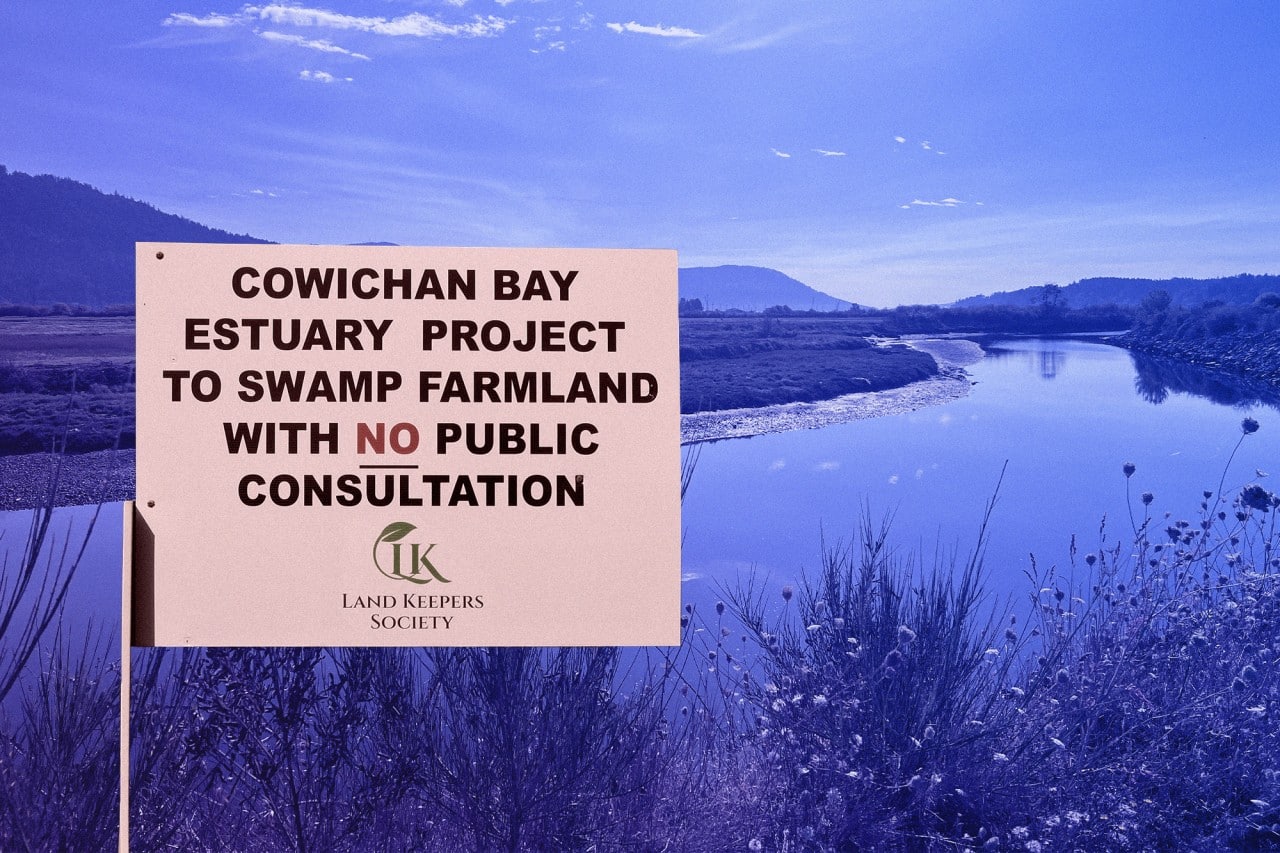
The town hall meeting was being hosted by a new non-profit organization called the Land Keepers Society. Its purpose? To stop the largest estuary restoration project to ever occur on Vancouver Island.
“Land Keepers is taking a stand against a destructive $3 million restoration project that threatens to obliterate our precious land,” the group’s website states.
Since the Land Keepers Society formed in July, it’s partnered with a group of local organizers and aspiring politicians who push far-right climate denial conspiracy theories. And they appear to be using the local estuary restoration project to create opposition to climate action.
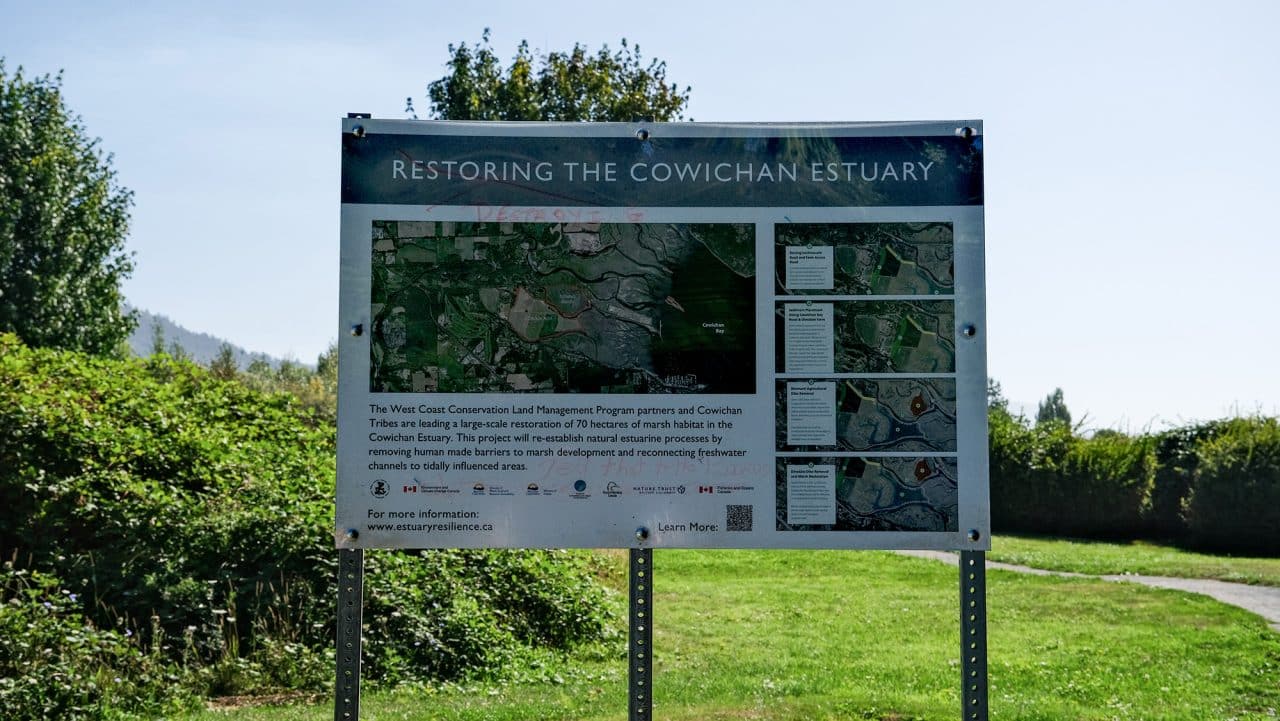
But the estuary restoration is a nature conservation project. Nature Trust of BC, Ducks Unlimited Canada, and partners in the Pacific Estuary Conservation Program say the purpose is to restore 70 acres of marsh habitat. The project is now underway, with berms and dikes that were built in the 1800s to create farmland being removed as a part of the restoration process.
According to Nature Trust of BC, modelling of the estuary shows that 60 per cent of the overall marsh area will be lost by 2100 if this work—which will increase resilience to climate change and sea level rise—is not done now.
‘The guise of climate change’
Questions from town hall attendees revealed a deep suspiciousness of the restoration project, influenced by unchecked misinformation. One attendee said they read about similar estuary restoration projects in other places, asking if the project is part of a wider agenda “under the guise of climate change.”
Municipal councillor Hilary Abbott, who was a guest at the town hall, began to answer the question. But every time he mentioned sea level rise and climate change, he was interrupted by boos and heckles.
One attendee asked about the benefits of the restoration project, but no one at the town hall could accurately answer that question.
Several of the town hall organizers and presenters—all of whom ran for political office in the 2022 municipal elections—have shared misinformation about climate change in their political platforms, long before the Land Keepers Society was formed.
Charles Borg, the event moderator, was a candidate for the North Cowichan municipal council. During the election, Borg appeared in a video with an organization called Veterans For Freedom where he discussed his reasons for getting into politics, including his desire to stop environmental and energy policies. He also compared COVID-19 restrictions to “the atrocities of communism and fascism.”
Veterans For Freedom, an organization that says on its website that it’s fighting back against a “cultural marxist attack on Canada,” was also featured on Borg’s choice of attire at the town hall: a black Veterans For Freedom T-shirt and a Tulips4Freedom pin.
In August, four days before the Land Keepers Society town hall, Borg announced on X that he is running to be a candidate for the federal Conservative party in the Cowichan-Malahat-Langford riding.
Borg said by email that he is not associated with the Land Keepers Society, even though he moderated the event, and did not provide additional comment.
Adrienne Richards and Joseph Enslow, both town hall volunteers and presenters, share similar views. Richards and Enslow ran in a political slate for the 2022 North Cowichan municipal council and their platforms were dominated by far-right dog whistles and conspiracy theories, such as worries about the United Nations and World Economic Forum meddling in local politics, opposition to municipal climate plans, and resistance to the urban planning concept of 15-minute cities.
After not securing seats as municipal councillors in the election, Richards and Enslow went on to create a new corporation called Citizens Oversight & Accountability Project (COAP). The group, which partnered with the Land Keepers Society to host the town hall, recently hosted its own series of town hall events to challenge the science of anthropogenic climate change, titled “Climate: Is the Science Settled?”
COAP is also a part of BC Rising’s “BC 15 Minute/Smart City Coalition” which distributes email newsletters with false conspiracy theories attributing the wildfires in British Columbia and Maui to direct energy weapons, and 15-minute cities to a nefarious global plot by the United Nations and the World Economic Forum to gain worldwide control of private property and humanity as a whole.
Richards and Enslow did not respond to requests for comment.

BC United MLA appeared at the town hall
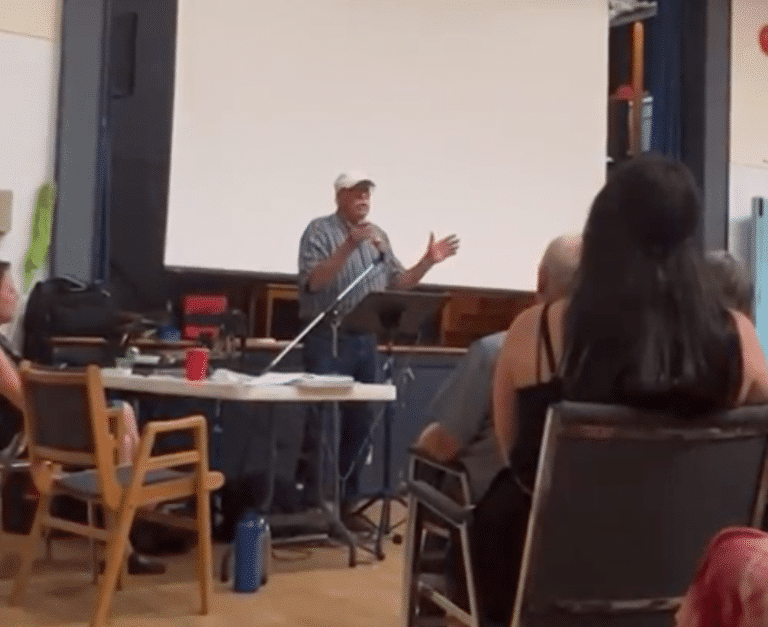
BC United MLA Ian Paton was also a guest and presenter at the town hall. In a passionate speech, he shared his disapproval of the estuary restoration project, stating that it will cause conflict between Quw’utsun Mustimuhw (the Cowichan Peoples) and non-Indigenous community members.
“There’s going to be a racial divide! Not just amongst farmers, but people are going to be ticked off about the fact that they lost this wonderful dog walking trail and bicycling that they’ve had for many, many years…It took a million years to make this farm and this soil, and they’re going to destroy it in 30 days or so by opening this dike up and flooding all that good farmland!” Paton said as the audience broke out with whistles, cheering and clapping.
In an emailed statement, a press secretary for BC United defended Paton’s comments. The MLA was referring to “the unfortunate sentiment that some in the area hold, incorrectly blaming the Cowichan Tribe for the destruction of the dike and walking trails,” Andrew Reeve said.
“Unfortunately, that reality is lost on some in the community which has resulted in blame for the loss of the land being assigned to First Nations,” Reeve’s statement read.
But Paton’s claim that the public will lose access to the estuary was incorrect. Visitors will still be able to access the estuary through a public park and nature trail on Westcan Terminal Road. However, because no one involved in the restoration project was in attendance at the event, Paton’s speech went uncontested.
Modern colonialism ‘at its worst’
At the same Aug. 14 meeting, the one Cowichan Tribes member in attendance, Gary Droulliard, approached the microphone.
“I have to say, I’m surprised to see no acknowledgement of my tribe at all,” Drouillard said as the gymnasium fell silent.
“I haven’t seen any sort of mention of working with us, what our thoughts are and concerns are in any of this…Have you reached out to Cowichan Tribes and what are you doing to work with them? Or, will you just work around us?”
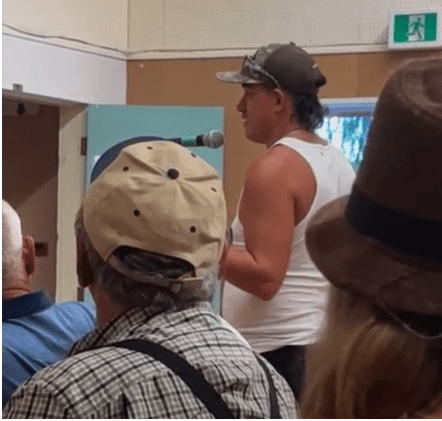
Land Keepers Society president Jack McLeod stood up to answer Drouillard as the audience clapped.
“We have been talking to the tribe and tribespeople. I have to admit that a lot of them won’t speak up because they’re perhaps nervous,” McLeod said. “They support what we’re doing, but find it very difficult to speak up.”
In an interview with The Breach after the event, Drouillard contested McLeod’s comments. “The feeling I got is they just went and talked to a couple people. And they’re playing that crowd and saying that they had talked to Cowichan Tribes. But they never actually went and talked to us officially,” he said.
He said some of the Land Keeper Society’s claims about the restoration project, such as that it will destroy wildlife habitats, are “complete BS.”
At the town hall, farmers involved with the Land Keepers Society raised concerns about the restoration project causing harm to migrating birds, flooding, loss of eco-tourism and food insecurity in the Cowichan Valley.
McLeod continued his response to Drouillard, stating that the Cowichan Tribes members he spoke to are more concerned about sewage in the river systems that feed into Cowichan Bay than restoring the estuary. Drouillard says that is a different issue altogether.
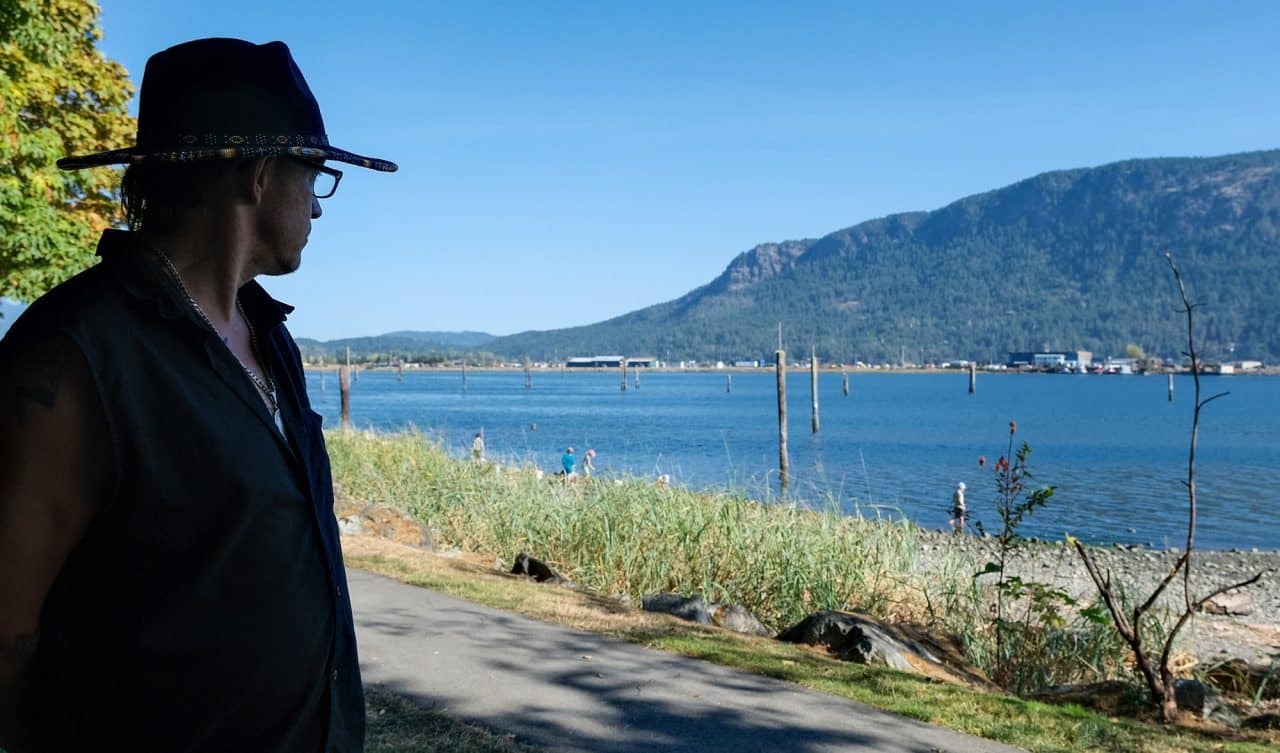
“He’s doubling up two problems on one that don’t correlate to each other,” Drouillard said, sitting on a bench that overlooks Cowichan Bay and the estuary.
Drouillard lives in an off-grid cabin along the water, accessible by a quick boat ride across the channel. He is a subsistence fisherman and a hunter involved in the community in many ways: he sits on the boards for the Cowichan Bay Fisherman’s Wharf and the Clear Seas Centre for Responsible Marine Shipping. He is also a part of the Cowichan Tribes Community Land Use Committee and is involved in the Hul’qumi’num Lands and Resource Society Seafood Garden Working Group.
He said the Land Keepers Society town hall meeting was a display of modern colonialism “at its worst.”
“It was pretty hard to watch,” he said. “You know, to see all those people there, claiming that they own everything and not even bat an eye at us, or even say a single word to us, or try and work with us is pretty disheartening.”
Cowichan Tribes declined an interview with The Breach due to staff unavailability and scheduling issues.
Area lands were taken by force
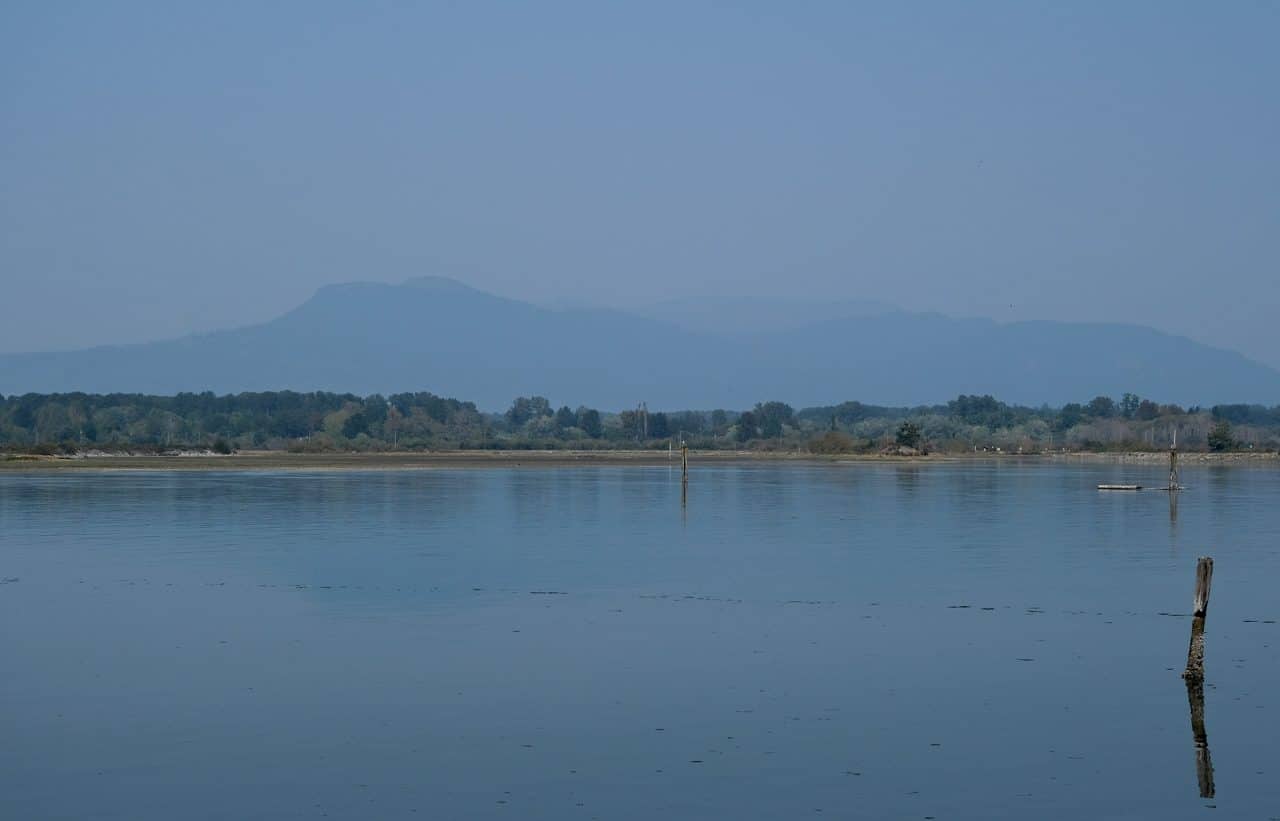
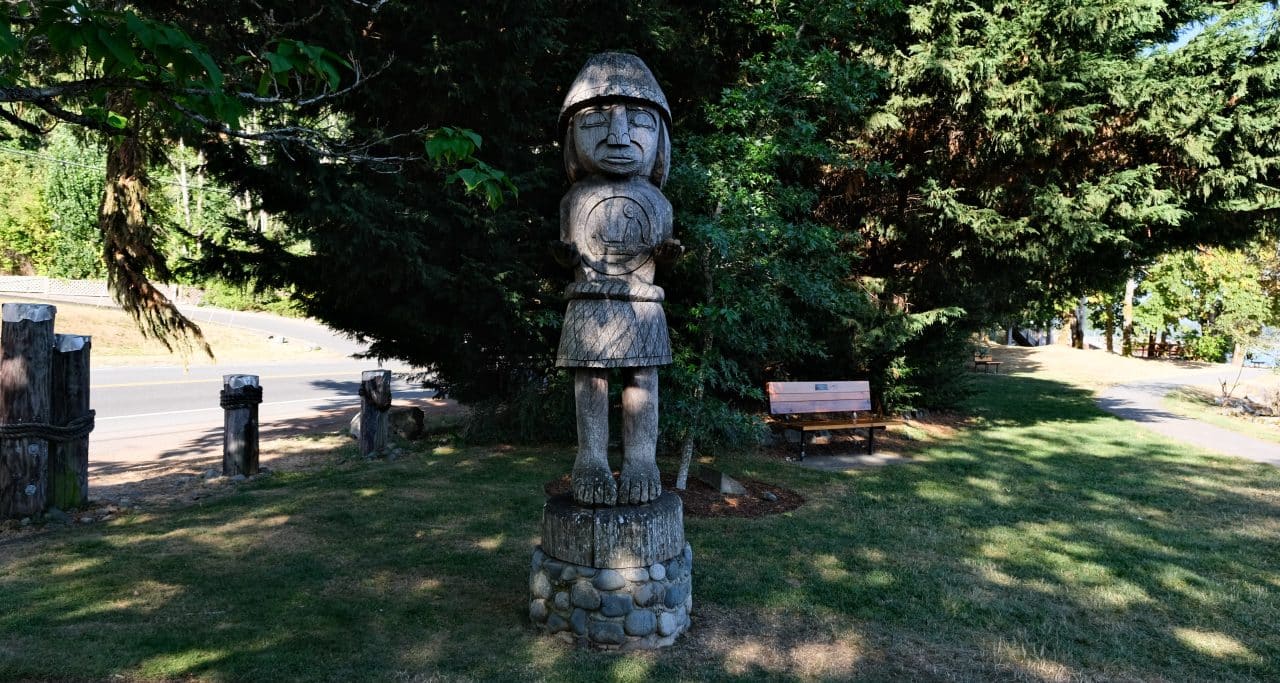
Located on southeast Vancouver Island, the Cowichan Estuary is adjacent to the seaside village of Cowichan Bay where the Koksilah and Cowichan rivers coalesce into the ocean. The area used to be home to three traditional Quw’utsun villages: Comiaken, Khenipsen and Clemclemuluts, with another village located across the bay called Tl’ulpahlus, according to a plaque on site.
Once a thriving ecosystem, rich with salmon gathered by the Quw’utsun Mustimuhw prior to contact, the estuary fell victim to big industries like logging, shipping and fishing, when settlers came to colonize the Cowichan Valley.
New diseases brought by settlers killed 90 per cent of Quw’utsun Mustimuhw, including during a devastating smallpox epidemic in 1862. That same year, settlers from the Victoria region came, backed up by the colonial government with a militarized gunboat, to claim property in the Cowichan Valley, according to a plaque on site.
It was then that Cowichan lands, which had been used for millennia by Quw’utsun Mustimuhw to gather food, were stolen to be transformed into privately owned farmland.
Claims made at town hall disputed by project partners
While “respecting Indigenous rights” is listed on its website as one of the Land Keepers Society’s interests, the town hall presentations did not talk about why the restoration project is important for Quw’utsun Mustimuhw.
Other presentations at the town hall included claims that the restoration project will cause flooding and harm to wildlife, both of which have been disputed by a representative of the Nature Trust of BC.
At the town hall, Nigel Dinsdale said the Dinsdale farmland was sold to Ducks Unlimited and the Nature Trust of BC under the stipulation that it would remain a farm forever. But Tom Reid, the West Coast Conservation Land Management program manager, told The Breach there was no stipulation when the farmland was purchased by the Nature Trust of BC and Ducks Unlimited Canada in 1990.
“We have completed a legal review of this property acquisition and there are no clauses in the purchase and sale agreements with the Dinsdale family that state that the land was to be farmed in perpetuity.”
The Land Keepers Society did not respond to a request for comment.
At the town hall, McLeod claimed that flooding was a “real problem” because the restoration project would flood nearby properties. However, Reid says that comprehensive environmental studies of the area showed the project would have the opposite effect.
“The development of this project included in-depth and extensive engineering and hydraulic reviews of flood conditions and scenarios utilizing up-to-date modelling, historic records and field observations.”
“The project was reviewed and approved by the Deputy Inspector of Dikes under the Dike Maintenance Act…The project was also presented to the Cowichan Flood Management Working Group,” Reid said. The environmental studies, assessments, and consultations found that the project will improve the estuary’s resilience to flooding caused by sea level rise.
Andrew Rushmere, the program director for the Farm Resilience Mentorship Program at Farmers for Climate Solutions, did not want to comment on the estuary specifically but said that misinformation can make life more difficult for farmers. Rushmere is local to the Cowichan Valley and was an organic farmer for 15 years.
“Conspiracy theories, misinformation and disinformation can very quickly exacerbate existing polarization on issues like climate change. Our current information landscape is a major factor in making my job of supporting farmers to build resilience in the face of climate change more difficult,” Rushmere said in an interview with The Breach.
Estuary restoration project is underway
Despite some pushback from the community and misinformation about the reasons for the project, the first phase of restoring the estuary in the Koksilah Marsh is officially complete.
Workers were able to remove 500 pounds of garbage from the marsh and open tidal exchanges, improving the habitat for the salmonid fish that utilize the estuary transition for feeding. The next phase will see the removal of the dike at the Dinsdale Farm property which is set to be complete by the summer of 2024.
For Drouillard, the Cowichan Estuary Restoration Project provides a glimmer of hope amidst the biodiversity crisis.
“There’s very little left of my territory here that is in its natural state…So I hope that this is the beginning of things turning back to the way they were. I only wish we could do more.”

‘We need an outlet, a source of information that is credible, that is progressive, that we can cling to and believe in’
David Suzuki
Want to support journalism you can believe in? Become a sustainer today.
Climate Crisis | A group of B.C. towns want to sue Big Oil over the climate crisis
Climate Crisis | First Nations say they’re not wildfire evacuees, but climate refugees
Environment | Muskoka residents take on giant of Ontario’s ‘grey gold’ gravel industry

2 comments
Comments are closed.
Ironic that the Land Keepers worry about the United Nations and World Economic Forum meddling in local politics, when the only real meddler is Alberta and its so-called “war room” that’s been organizing opposition to Nanaimo city council’s plan to phase out natural gas hook-ups.
Thank you for this. I am truly sick to death of misinformation and fear mongers twisting the truth to suit their agendas. It feels like constantly going backwards with so many red herrings holding up progress. I appreciate your coverage on this important matter.