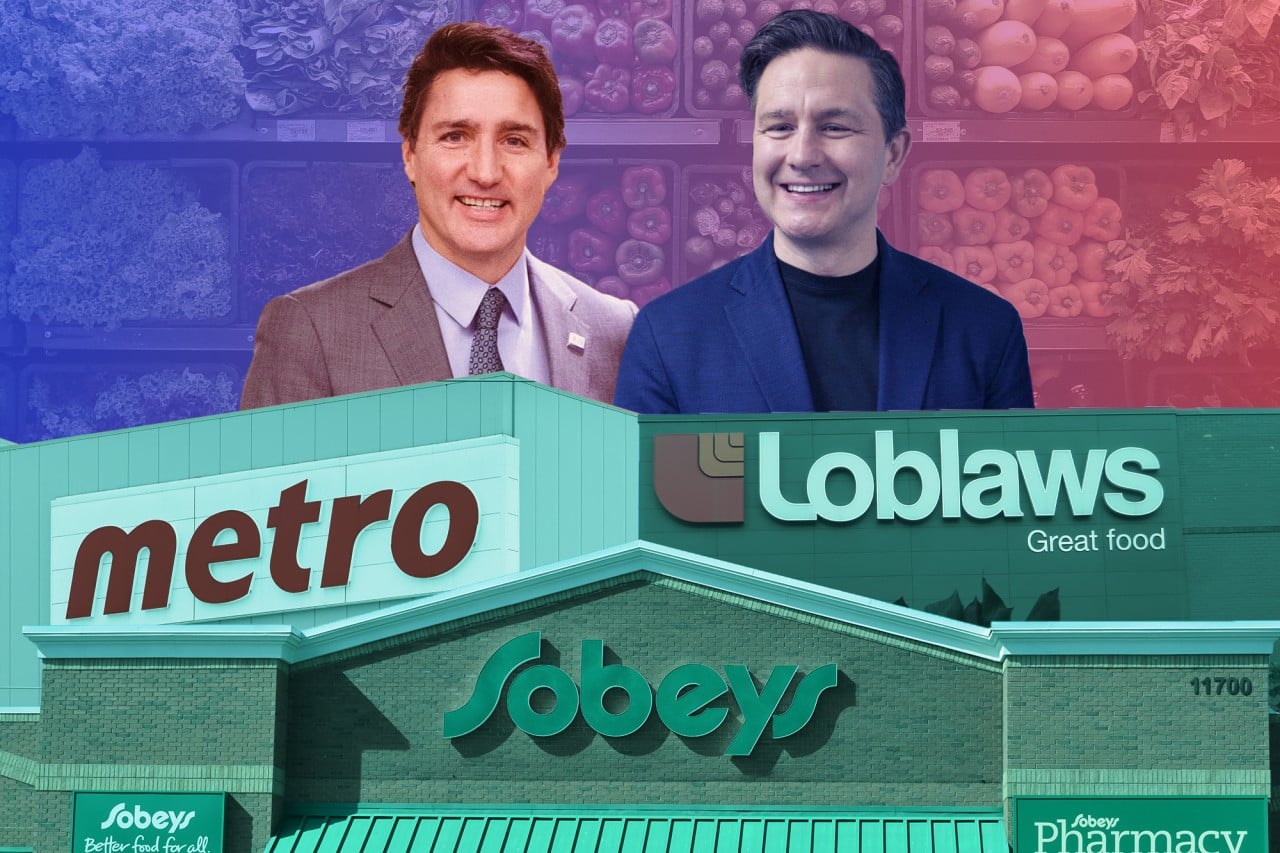
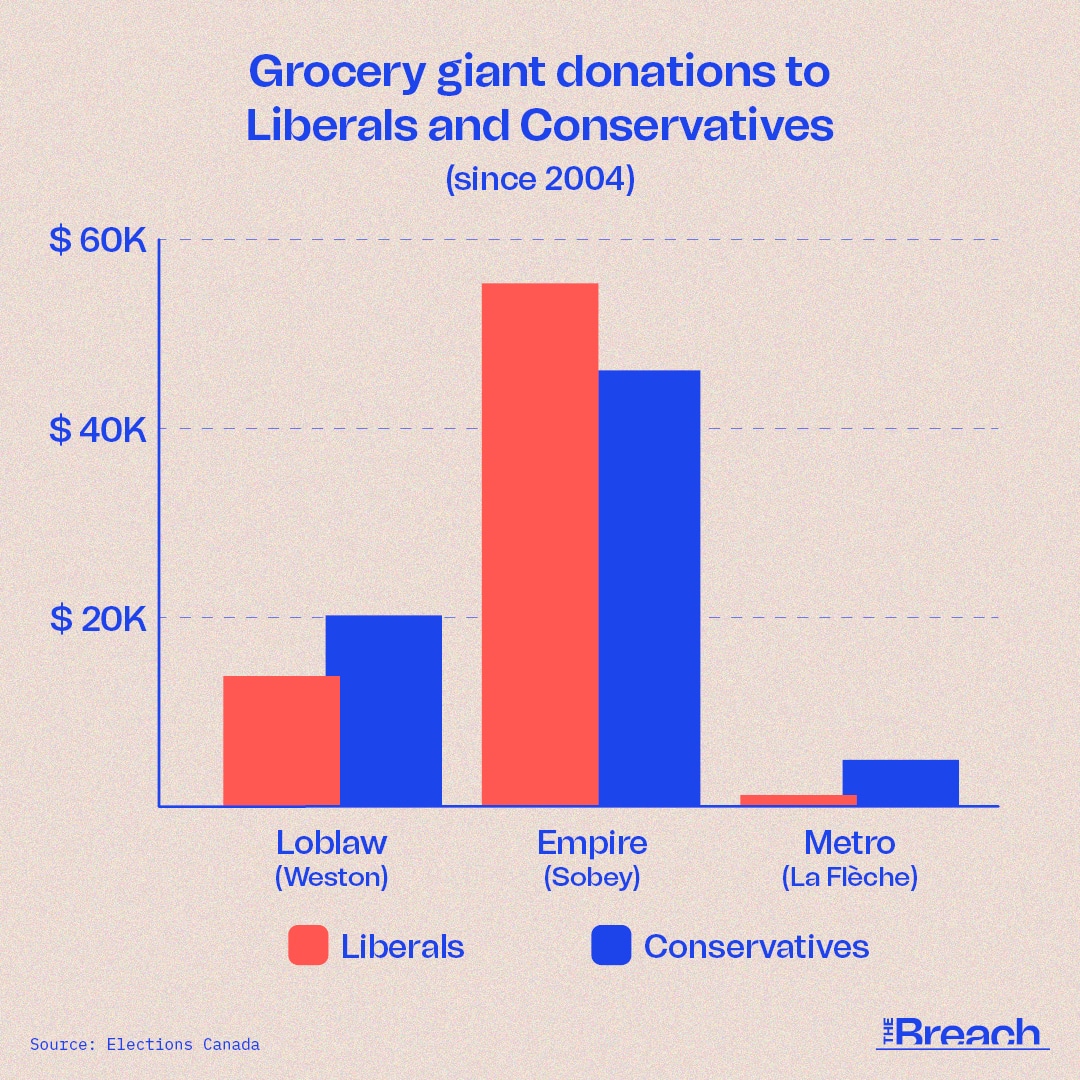
The families and CEOs behind Canada’s largest grocery retailers have donated more than $150,000 to the Liberal and Conservative Party over the last two decades, data from Elections Canada shows.
That puts the owners of Loblaw and Empire among the top political donors in the country, according to a political financing expert.
Corporations have been banned from giving to federal parties since 2004, but that hasn’t stopped billionaire families like the Westons (owners of Loblaw) and Sobeys (owners of Empire) from frequently giving the maximum annual amount allowed.
These families split the spoils fairly evenly between the Conservative and Liberals, indicating they think of donations as a down payment to ensure corporate-friendly policies from both parties.
“Donations buy influence with politicians,” Duff Connacher of Ottawa-based Democracy Watch said. “Psychologists have shown the best way to influence people is to give them a gift or do them a favour. Even small gifts create an unconscious sense of obligation.”
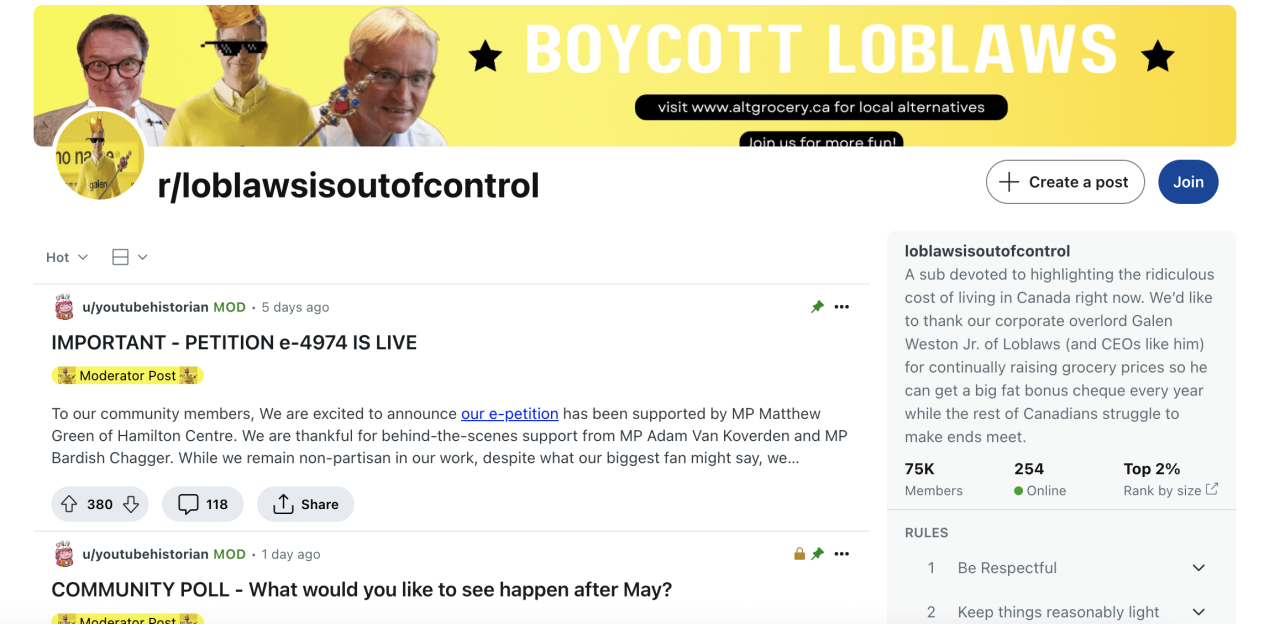
In the midst of a cost-of-living crisis—with historic visits to food banks and one in four children suffering from food insecurity—the practices of the grocery giants have come under intensified public scrutiny, sparking a boycott movement against Loblaw this month.
Loblaw, Empire, and Metro control nearly two thirds of the entire retail food market in Canada, which pulled in record profits topping $6 billion in 2023, aided by widespread price-gouging.
While Prime Minister Justin Trudeau and opposition leader Pierre Poilievre have taken turns accusing each other of cozying up to the corporate elite, Conservatives and Liberals have both consistently obliged their grocery donors.
The Liberal government forked over $26 million to Loblaw and Costco for new fridges and appliances. Under the former Conservative government of Stephen Harper, grocery retailers started pocketing tens of millions of dollars in subsidies intended to make food more affordable in Canada’s north.
Neither party has advocated for stricter rules to ensure Loblaw can’t repeat its tax evasion scheme of the 2000s, when it deprived the federal government of nearly $400 million in revenue by stashing money in Barbados.
For the past few years, the New Democrats have pushed for a windfall tax on the record profits of grocery giants. Justin Trudeau initially rejected the idea, calling it “simplistic,” then shifted to vaguely threatening to implement it, without following through. Meanwhile, the Conservatives have expressed constant opposition.
Donations can buy “inaction” on regulation
Alongside their history of donations, the corporate grocers have recently turned to a PR blitz, claiming they are innocent of the accusations of profiteering and putting the blame instead on higher costs of supplies.
But a study last year by economist Jim Stanford found clear evidence that they have used the cover of inflation to raise food prices well beyond their costs.
According to StatsCan data, grocery retail profits in 2023 doubled from what they were pre-pandemic, and their profit margins massively increased too. And it wasn’t because Canadians were buying more food. “Canadians are actually buying fewer groceries than before the pandemic,” Stanford concluded, “but paying much more for them.”
Yet neither the Liberals or Conservatives have advocated for restraining the ability of corporate retailers to squeeze huge profits from the most basic essentials of life. Committed to a shared neoliberal political consensus, both parties pretend the state can’t use its enormous power to intervene in the marketplace to alter profiteering behaviour.
According to Conacher, donations often buy inaction from governments, but it can be harder to track that.
“Most of the battle is over whether these companies will be strongly regulated,” he said. “If voters or citizen groups are clamouring for reforms, what big business is looking for is inaction—and politicians can do them a favour by simply not doing anything.”
That may be one reason why we’ve seen the Liberal government resort exclusively to coaxing and cajoling.
They gathered grocery CEOs for a gabfest in Ottawa where they elicited a promise to “stabilize” prices. They’ve made tweaks to the country’s competition law that lawyers have described as “window dressing.” They’ve pushed for a toothless, voluntary, industry-developed grocery code. And they’re courting foreign multinational companies to enter the Canadian market to bring down prices (though Walmart’s entry in the 1990s didn’t particularly help do that).
“I have faith that they will come to the table with solutions,” Industry Minister François-Philippe Champagne said of the grocery giants in the fall without any plausible reason. As of the first quarter of 2024, Champagne has his definite answer: their record profits have only kept rising.
Poilievre has released no details about what his grocery reforms would look like. Instead, he’s claimed incorrectly that higher prices and food bank use are entirely a result of the government’s carbon tax. (Economist Trevor Tombe has estimated that the tax is responsible for a fraction of an one per cent increase).
Meanwhile, the PR firm of Poilievre’s chief advisor, Jenni Byrne, has been exposed for lobbying on behalf of Loblaw in Ontario.
Neither party has ever suggested the kind of policies that would make a genuine impact: price controls to prevent companies from jacking up prices, regulations that would bar them oligopolistic price-fixing and vertical domination, or a publicly-run, non-profit grocer that could provide affordable alternatives and genuine competition.
Giving to both Tories and Liberals a ‘corporate insurance policy’
Records on federal political donors have only been kept since 2004, when Liberal Prime Minister Jean Chretien brought in a ban on corporate donations in the wake of the sponsorship scandal.
Since then, members of the Weston family have given $34,036, the Sobey family $110,262, and Metro’s CEO’s Eric La Flèche $6,179.08, relatively evenly split between the two main parties.
Instead of stopping “big money” from flowing to the main political parties, the ban on corporate donations has only “obscured” it, according to Conacher.
“The pattern has been clear,” he said. “When business donations have been banned, suddenly executives, their spouses, and sometimes their kids are giving, substituting for what the business used to give. The only way to stop that is to dramatically lower the donation limit to what an ordinary voter can afford, no more than 100 dollars.”
Individuals are currently allowed to give a maximum of $1,700 yearly to a federal party, along with another $1,700 to local riding associations, nomination contestants, and leadership candidates.
Giving to both Liberals and Conservatives isn’t just a feature of these family food empires—typically all of Canada’s wealthiest have given to both political parties.
The last time Canadian Business published its list of the top 100 richest families, 56 donated to the Liberal Party and 61 donated to the Conservative Party (with many giving to both).
It’s a long-standing corporate insurance policy that appears to be continuing: a way to guarantee pro-corporate government regardless of which party is in power.

‘The first video I ever made with The Breach was on why we need to support the movement for Land Back. Today, it’s being used in educational settings everywhere—in universities and colleges and children’s classrooms too. When I give talks, people will say, ‘I saw your video and it helped me understand the issue.’
That’s what we do at The Breach—reach people where they are at, with bold ideas, principled analysis, and critical investigations.” – Pam Palmater, scholar and author
Become a sustaining member of our work today.
Corporate Power | High food prices don’t have to be the ‘new normal’
Corporate Power | Grocery giants are screwing Canadians—and farmers have proof
Cooperatives | In a pandemic downturn, worker co-ops are on the rise
6 comments
Comments are closed.

I agree that big grocers are making too much, and I agree that gov’t is not taking effective steps, BUT looking at Loblaws only,, approx 80K, over 20 years, that’s 4K per year, surely that’s not enough to influence a party. Nice argument but does not work for me.
As always, I love your journalism and integrity. The recent article about the grocery chain families donating to Canada’s political parties is a welcome exposé. I wonder if you could examine other sources of large corporate-related donations to political parties in relation to the grocery-chain family funding? Specifically, I’m thinking that $150k over 20 years isn’t a lot of money to these grocery corporations, so why do they have so much sway? What is their relationship to other large conglomerates who fund Canada’s political parties? What is the connection between fossil fuel donations and the grocery store families?
Obviously we know these are all connected, as they are part of the 1% or 0.1% of Canada’s wealthiest, but I’d be curious about further digging into these corporate ties in the hope that greater public awareness and discourse can bring about new regulations.
Thanks again for all your great work! Keep it up!
Loblaws is owned by One family. Filling their pockets. They should publicize what they do with it all. Reason why they get criticism. Others are corporations.
$150,000 in donations is a drop in the bucket as to the amount that is raised nationally.
One candidate in one riding would need that amount. Should have dug deeper to find out who the top executives gave their donations to.
In fact the establishments in both parties are probably laughing at this article!
So it only takes about $10k a year to ensure you make $billions annually? That’s good business!
Thank you so much for sharing this information – no other news outlet has shared this, even CBC to my knowledge. I am appalled by the greed that leaves lower income families, and families in general, struggling to put decent food on the table. Shame on both the Liberals and Conservatives for allowing this to happen.