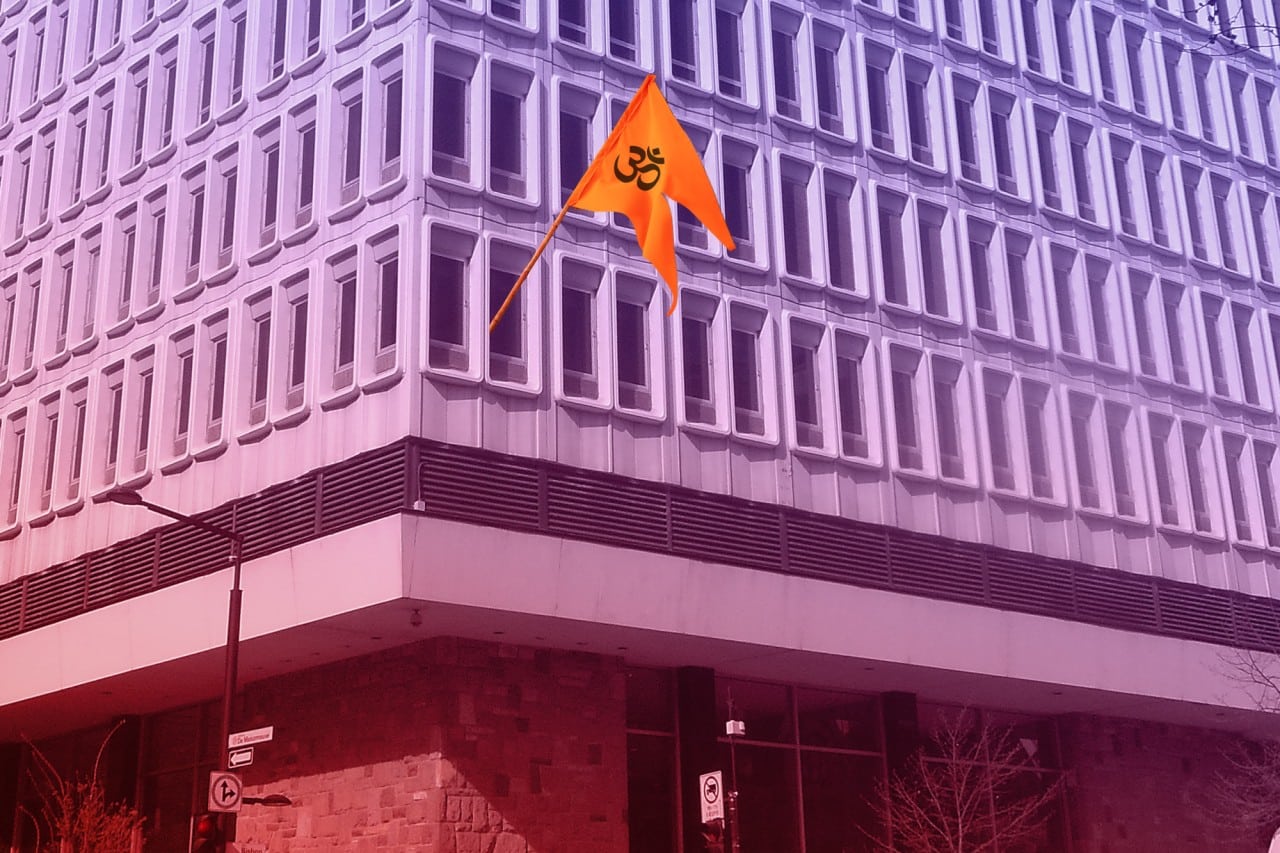
Concordia University’s campus was set for a sleepy late summer public lecture, but that’s not how commentary online made it seem.
“Blatantly Hinduphobic,” one post on X blared. “Baseless #propaganda,“ said another. “DISGUSTING behaviour from Concordia.”
Objecting to a panel discussion on rising fascism in India and its diaspora in August, the statements were put out by groups with innocuous names like Coalition of Hindus of North America and Canadian Organization for Hindu Heritage Education.
Calling for the event to be shut down, some posts gathered thousands of reposts and likes, building up momentum over the next day.
The only wrinkle?
The event was put on by a coalition of progressive groups, with the speakers including a journalist, a professor from Toronto Metropolitan University, and a young Muslim activist whose family’s home was bulldozed by Indian government officials.
And those innocuous-sounding organizations? They were far-right ultra-nationalist Hindu groups tied to the right wing Indian government.
But by the next day, Concordia University had caved to the online pressure campaign, cancelling the groups’ auditorium booking.
It wasn’t the end of the story. The event’s organizers, the South Asian Diaspora Action Collective and the Centre sur l’asie du sud, moved the event to the offices of the Quebec Public Interest Research Group-Concordia, a nearby community activism hub. The evening of the event, dozens of men blocked the entrances to the event, chanting, and tried to force their way into the room.
Titas Banerjee, an organizer with the South Asian Diaspora Action Collective, said he heard them chant “terrorist, terrorist, terrorist,” make homophobic and sexist comments, and repeatedly pull the fire alarm.
“Concordia University should not have succumbed to such intimidation tactics,” he said.
While the Hindu organizations celebrated Concordia’s cancellation as a “victory,” the university administration has stuck to its story that it was merely an administrative decision.
The night before the event, the organizers received an email from Concordia’s security that the university did “not have sufficient time to assess your event” and so it “cannot proceed tomorrow.”’
But other emails from Concordia that The Breach reviewed showed the university had granted the auditorium booking three weeks earlier and provided technicians for the night.
A spokesperson for Concordia repeated to The Breach that they did not have “sufficient time to assess the event, an assessment which is part of the approval of such events on Concordia premises.”
The campaign to shut down the event is only the latest in a series of escalating attacks in Canada on critics of right-wing Hindu nationalism—also known as Hindutva—that have ranged from harassment of academic researchers to the assassination of a Sikh activist.
Organizers of the Montreal event released a statement saying it was a “real time example of the dangers of Hindutva ideologies in practice.”
From social media pile-ons and false claims of racism, to celebrations of supremacism in a multicultural guise, it’s emblematic of how these far-right Hindu groups are disguising their politics and making inroads into Canadian political life.
“They’ve become more emboldened and are making incursions here,” Banerjee said. “They have money, non-profit and charitable organizations, are advocating legislation, and are way more present than they were five or ten years ago.”
Raising the Indian far right’s flag in Ottawa
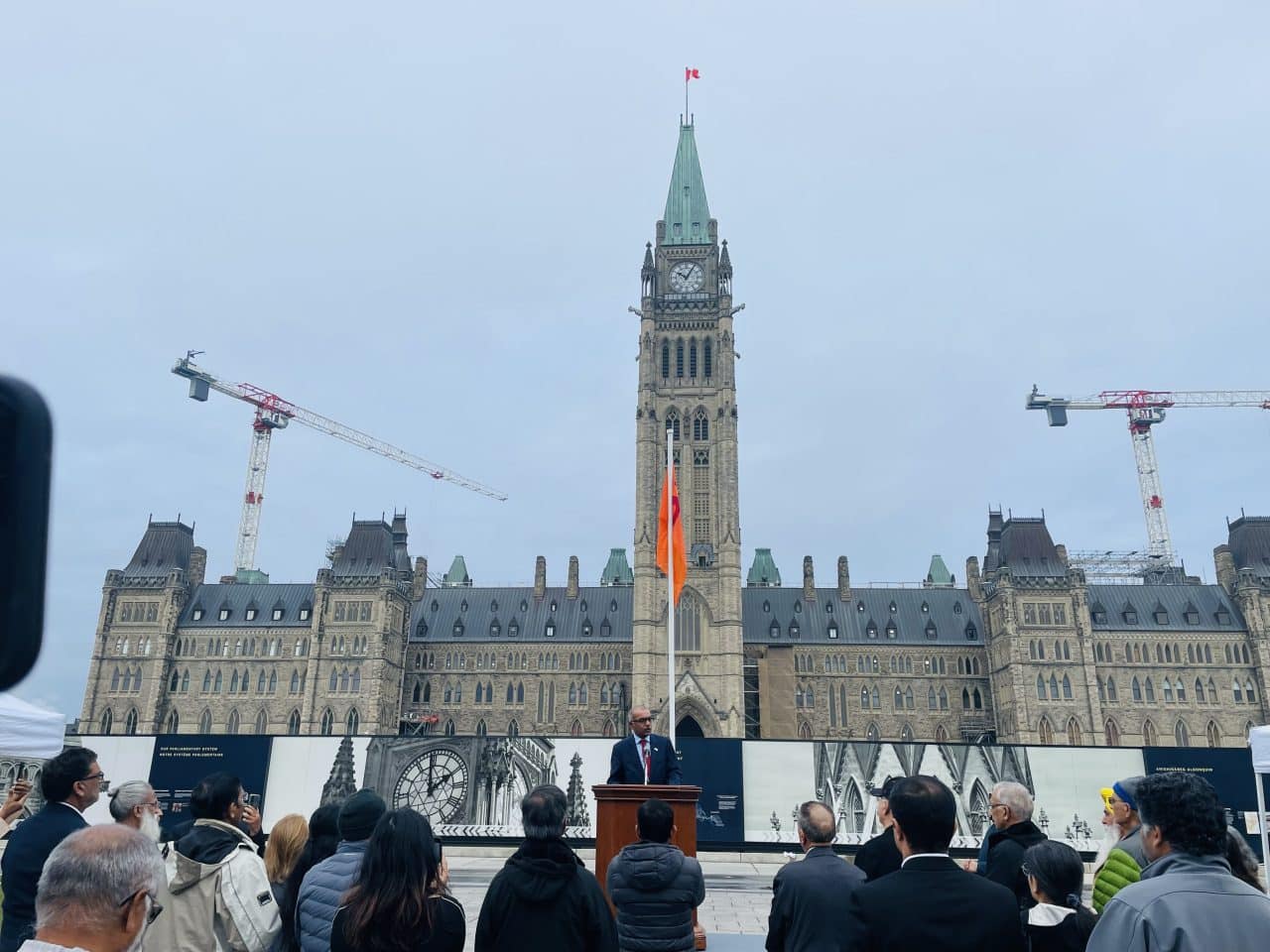
In November 2022, Ottawa-area MP Chandra Arya marked the start of Hindu Heritage Month by getting the flag of the Indian far right raised on Parliament Hill.
The saffron flag—an orange, swallow-tailed flag bearing the religiously significant “om” symbol—is the official emblem of the powerful Hindu-nationalist paramilitary organization that counts among its members current Indian Prime Minister Narendra Modi.
The Rashtriya Swayamsevak Sangh (RSS) aims to transform India into a Hindu ethnostate, with religious minorities such as Muslims and Sikhs and lower-caste Hindus as second-class citizens. Its early adherents were staunch admirers of Adolf Hitler and Nazism, and it is widely believed to be the world’s largest far-right group.
The National Canadian Council of Muslims describes it as “the centre of a network of groups” advancing this Hindu-supremacist ideology. Affiliated groups are known as the “family of the RSS,” including the Bharatiya Janata Party (BJP)—the political party to which Modi belongs and which has governed India since 2014.
This consolidated power has allowed this Hindu far-right movement to target opposition politicians, attack journalists, and foment mob violence against religious and caste minorities in India.
In Canada, the public-facing tactic of these Hindu supremacists has been to operate within multicultural politics.
By using the language of anti-racism and cultural promotion, they have been able to inject Hindu-nationalist ideas and reference points into a political scene that is largely unfamiliar with their far-right ideology, but very committed to appearing anti-racist and multicultural.
To that end, Arya, who has spent his career as a Liberal MP advocating for causes near and dear to the Hindu far right, moved a private member’s bill in 2022 to declare November “Hindu Heritage Month.”
The seemingly inoffensive bill was passed unanimously by parliament.
In a similar vein, the diasporic arm of the RSS frequently organizes public events across Canada. While these events are sometimes uncontroversial, such as International Yoga Day, other celebrations are much more closely linked to the Hindu-nationalist agenda.
In January, another RSS-associated group that has been implicated in destroying a 16th-century mosque in India in 1992 organized over 100 events across Canada celebrating the consecration of the Hindu temple built atop the mosque’s ruins.
In effect, these events were a celebration of the anti-Muslim violence that the group is alleged to have perpetrated.
The spectre of ‘Hinduphobia’
The crowning jewel of the Hindu far-right movement would be to have Canada recognize Hinduphobia as a legal category of discrimination. That would allow Hindu nationalists to lob the charge of Hinduphobia at anyone who criticizes the reigning Indian government.
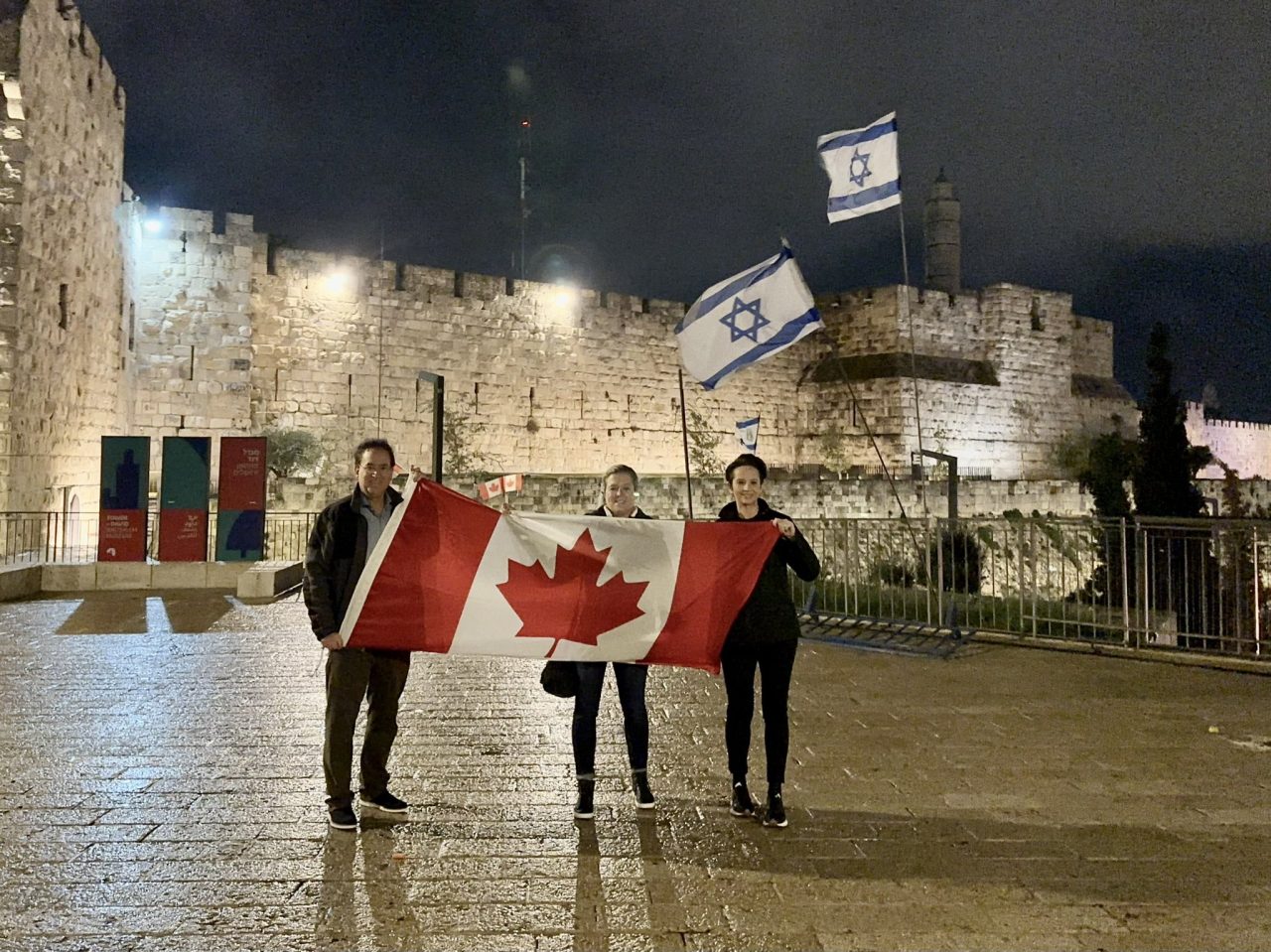
Such tactics have borrowed heavily from the pro-Israel playbook, according to an investigation in Jewish Currents, with Israel lobby groups actively providing counsel and political support to right-wing Hindu organizations.
“We shared with them the Jewish approach to political activism,” Ann Schaffer, an AJC leader, told the Forward in 2002.
This has included learning from the pro-Israel campaign to win government recognition of the International Holocaust Remembrance Alliance (IHRA) definition of antisemitism, which equates certain criticism of the state of Israel with bigotry toward Jewish people.
This seemingly shared political project is not a coincidence, but part of a deeper and growing alliance between right wing governments in Israel and India and elsewhere.
Last November, a petition to recognize Hinduphobia in the House of Parliament was tabled by Melissa Lantsman, a Conservative MP famous for her staunch support of Israel.
The concern about discrimination against Hindus is selective. Those advocating for more attention to Hinduphobia in Canada tend to focus on events that critically discuss Hindu nationalism, such as academic conferences, or on moves to recognize the caste-based oppression that is closely linked to Hinduism in India.
The Toronto District School Board’s 2023 decision to recognize the presence of caste-based discrimination and to ask the Ontario Human Rights Commission to do the same attracted charges of Hinduphobia from the Canadian Organization for Hindu Heritage Education.
Proponents of the concept of Hinduphobia focus on distinguishing a specific kind of anti-Hindu discrimination that does not speak to the racism and harassment faced by South Asians in Canada regardless of religion, nationality or caste.
In the case of the Concordia event, participants in the social media harassment campaign frequently lobbed the charge of Hinduphobia, which the event’s organizers say was “baseless.”
In a statement, the South Asian Diaspora Action Collective and Centre sur l’asie du sud underlined that they are “staunch defenders of minority rights and have routinely held events focusing on minorities across South Asia. The event’s aim was to address the concern of Hindutva fascism and Hindu right-wing supremacy. It was not an attack on the Hindu religion or observant Hindus.”
Despite considerable efforts, Hinduphobia has not yet found its way into the lexicon of the Canadian Human Rights Code.
Lantsman brought a petition to Parliament in November 2023 that presented Hindus as the “Indigenous people of the Indian subcontinent” and decried Hinduism’s “misrepresentation” in the media and academia. It was quietly rejected.
Canadian politicians’ love affair with the BJP
Since Modi and the BJP took power in 2014, they have steadily worked to implant Hindu nationalism as the dominant ideology of the Indian state.
They have rewritten textbooks to shape how coming generations understand India’s history and undertaken significant legal efforts including reforming the Citizenship Act and updating the National Register of Citizens—closely-related projects that chip away at the secular foundation of the Indian state by enshrining citizenship rights for adherents of some religions while excluding Muslims.
During the Modi regime’s reign, there has also been a sharp increase in the extrajudicial murder of critics—including the 2023 assassination of a Canadian Sikh activist in British Columbia.
Prior to Hardeep Singh Nijjar’s killing in Surrey and the resulting diplomatic crisis, Modi and the BJP had always enjoyed allies in Canada’s political class.
Politicians supporting the BJP include Liberal MP Arya, who deflected from Prime Minister Justin Trudeau’s statement on the Indian government’s role in the assassination to raise concerns about an alleged rise in “Hinduphobia”; Calgary MP Shuvaloy Majumdar; and former prime minister Stephen Harper, who has called Modi a “friend” and “the most significant leader of India since independence.”
Perhaps the most notable onetime Modi ally in Canada, though, is former Ontario Progressive Conservative leader and current Brampton Mayor Patrick Brown.
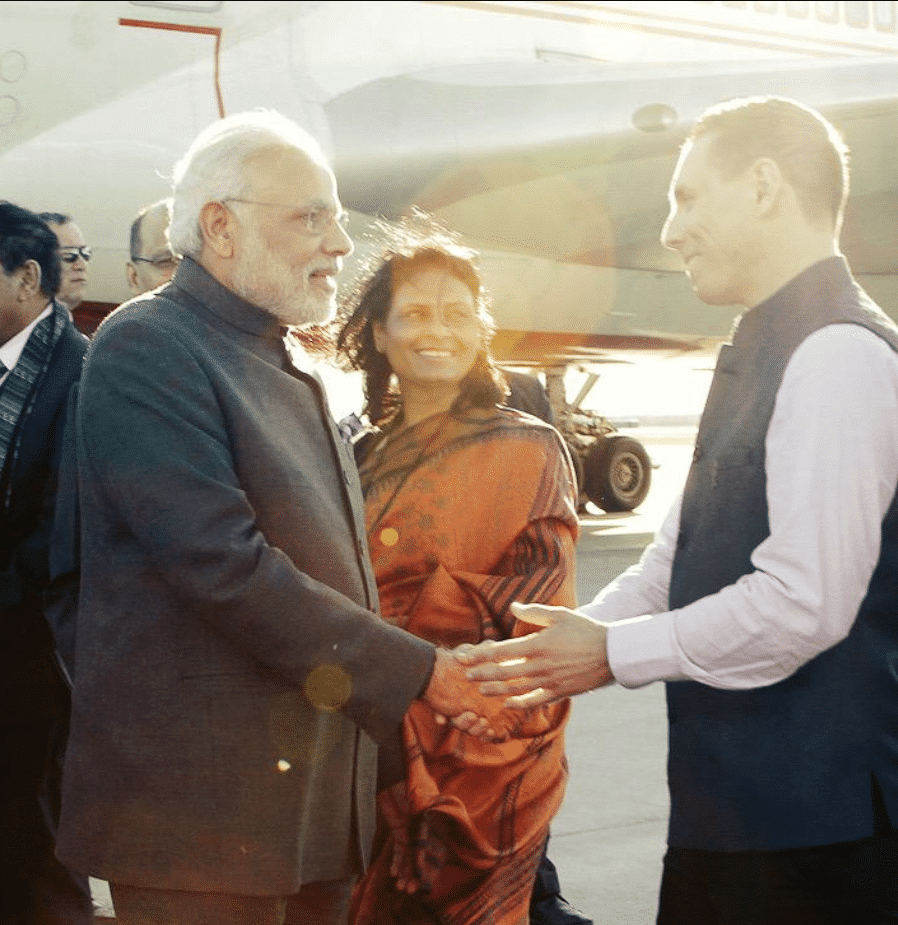
In 2009, Patrick Brown, then a young Conservative MP, flew to India on the first of more than a dozen trips he would make as co-chair of the Canada-India Parliamentary Friendship Group. On this first trip, Brown attended a trade summit in Gujarat against the advice of foreign affairs officials, who noted that the host, the then-chief minister of the western Indian state, had been banned from travelling to the United States due to his prominent role in abetting the 2002 Gujarat riots that saw over 1,000 people, mostly Muslims, killed.
During that summit, future Indian Prime Minister Narendra Modi and Brown cemented a friendship that would last over a decade. According to a 2015 article from The Globe and Mail, Modi affectionately referred to Brown as “Patrick Bhai” (brother Patrick).
This close alliance came to an abrupt end in 2020 when Brown criticized India’s Citizenship Act as Islamophobic, incurring the wrath of the Hindu far-right and earning a cold shoulder from the Indian Consulate in Canada.
Hate directed at critics
Despite some setbacks, such as the diplomatic dispute that arose after Trudeau credibly accused the Indian government of assassinating Nijjar on Canadian soil, Hindutva activists have continued to make inroads into Canadian politics.
And aside from some notable exceptions, such as Nijjar’s killing, western democracies—including Canada—have been loathe to explicitly address this movement’s impact. That reluctance has left critics open to harassment and, increasingly, restrictions on travel into India.
In a 2022 report, the CBC found that at least 18 Canadian academics who study Hindu nationalism felt they had been targeted for harassment, ranging from abusive emails to death and rape threats. The threats allegedly originated from Hindu nationalist networks both in India and in the diaspora.
Travel to India is also being restricted for these critics. An investigation found that the Modi regime has cancelled more than 100 Overseas Citizen of India (OCI) cards over the past decade.
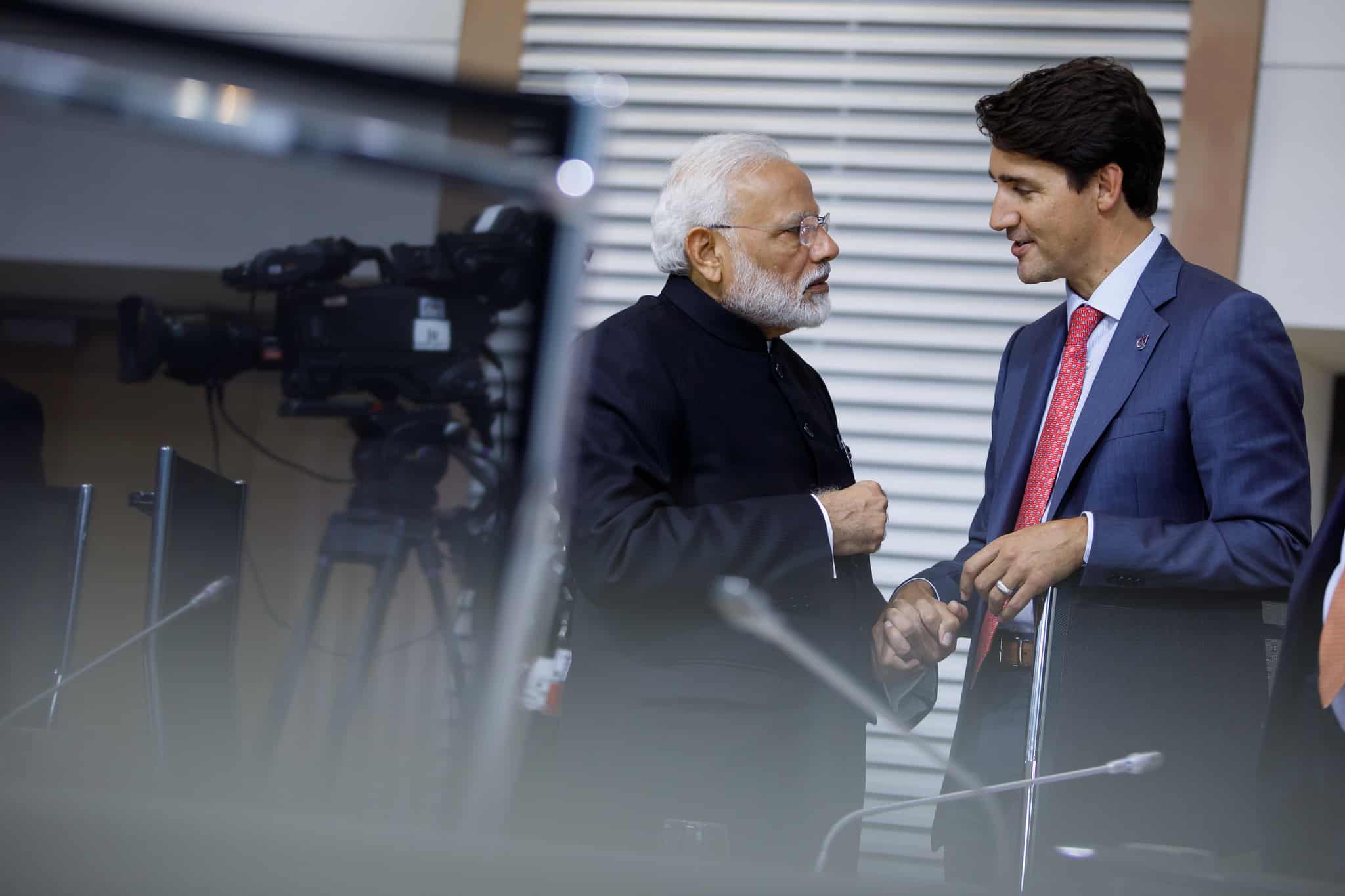
With an ongoing diplomatic crisis and allegations from the foreign interference inquiry that India attempted to influence the results of the past two Canadian federal elections, Canada’s reluctance to challenge the Modi regime may be coming to a close.
In India, however, Modi and the BJP won in June yet another general election. While they did not win an outright majority—a first for the Modi-led BJP—their continued dominance will further cement their hard-right political ideology into the institutions of the world’s largest democracy.
And that will likely have an impact on its critics abroad.
For their part, the groups who put on the Montreal event don’t plan to let up.
They wrote a letter to the Concordia University president, demanding a public apology and resources for teach-ins on the human rights violations of the Indian government
“It’s a reminder that Hindu supremacist fascists are organizing in Montreal to silence opposing narratives,” they said. “The struggle for justice and dignity must continue against the ideology of hate.”

“It’s about getting to the bottom of things. It’s about unveiling who has the power and what they’re doing with that power.”
Linda McQuaig, journalist and author
As a non-profit, free from powerful corporate interests, we invest in investigations and uncover the cover-ups. Sustain our journalism for transformation.
Gaza | Globe and Mail censored criticism of Israel by award-winning Indian author

Hindutva | Hindu far-right lobbied Canadian cities to celebrate a mosque’s destruction
Hindutva | Canada has ignored India’s targeting of Sikh activists for too long
1 comment
Comments are closed.
I have recently read “Caste” by Isabel Wilkerson and her analysis and comparison of the Hindu caste and American (also Canadian) caste. I believe that any adoption or acceptance of this system is to be denounced. Thank you for doing so.