Dr. Thaer Ahmad, Al Nasser hospital, Gaza: You can hear the F-35 overhead and it felt literally like they were about to land on top of the hospital.
Then you’d hear a whistling noise and you knew that a missile was flying down and getting ready to hit.
Text on screen: In Gaza, Israel has used F-35 jets to rain destruction on Palestinians.
The jets are made in the United States, with Canadian companies supplying key components.
Since the 1990s, more than 100 Canadian companies have been awarded F-35 contracts worth billions:
Asco, Delta B.C. – Wing bulkhead
Magellan, Winnipeg MB – Horizontal tail
FTG, Curtiss-Wright, Ottawa ON – Circuit cards
Gastops, Dartmouth N.S. – Engine monitoring sensors
Héroux-Devtek, Laval QC – Landing gear, collaborative door uplock
Stelia, Lunenberg N.S. – Weapons bay door inserts, wing parts
Honeywell, Mississauga ON – Power and thermal management system controller
Magellan Aerospace, PCC-Dorval, Apex; Kitchener ON, Dorval QC, Moncton N.B. – Machined parts
ITL Circuits, Letar; Markham ON, Concord ON – External lightning printed circuit board
Centra, Cambridge ON – Keel beem
Acroturn, Brampton ON – Landing gear components
Ben Machine, Vaughan ON – Electro-hydraulic actuation system components
Anita Anand, Canadian Defence Minister: Canada’s participation in the Joint Strike Fighter program over the past number of years has already allowed companies in Canada to secure almost $3 billion U.S. in contracts, and this number will grow.
Rob Wittman, Republican chair of the Armed Services Subcommittee: The F-35 joint program office has moved at a breakneck speed to support our closest partner and ally in the Middle East: Israel.
Text on screen: Israel is arming the F-35 jets with 2,000 pound bombs
Newscaster: The bomb that caused this damage is a 2,000 pound bomb, likely made in the U.S.A., dropped by the Israeli Air Force, at least four times as powerful as the vast majority of the bombs used by the U.S. in its fight against ISIS.
Text on screen: A Palestine solidarity movement has begun forcing a shift in Canadian policy.
Amy Goodman, Democracy Now!: Canada’s government has announced it will halt weapons shipments to Israel after the Canadian Parliament approved a non-binding resolution on the issue.
Text on screen: But Canadian companies continue shipping F-35 parts to the U.S—a loophole the Liberal government has kept open.
Activists are now focusing on a F-35 vulnerability—their dependence on a “just-in-time supply chain.”
U.S. Lt General Michael Schmidt, Director of the F-35 Lightning II Program: When you take a just-in-time mentality, it introduces a lot of risks.
You get a hiccup in the supply chain, whether it be a strike or a quality issue, and then that becomes your single point of failure.
Text on screen: Canadian activists are introducing another “hiccup”—blockades.
Rachel Small, World Beyond War Canada: When we find out, “Oh wait, these are weapons and parts that are traveling on our highways, like on the 401 right near my house,” or are being made, in some cases, nearly in your backyard.
These are points of intervention. Direct actions to interrupt the flow of weapons to Israel have been happening en masse from coast-to-coast.

“We need media that enlarges the sense of what’s possible.”
Naomi Klein, journalist and author
Want to support hope-fuelled journalism? Become a sustaining member.
Israeli Apartheid | Stephen Harper’s firm pours $350M into developing military tech for Israel

Canadian company’s Israeli subsidiary sold more deadly weapons than advertised

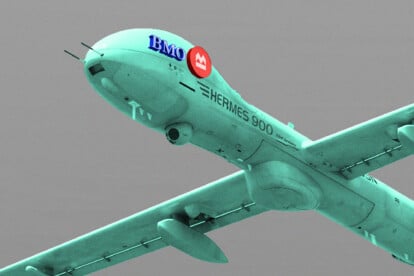
Banks | Revealed: BMO bankrolled Israeli weapons maker with a $90M loan
1 comment
Comments are closed.
Why Canadian air force don’t have any F35 jet if we secure that much money and we still flying F18, which is a great plane but is time has expired