Standing in front of a field in a village in southern Quebec, a farmer turns to the camera and issues a threat to gas companies.
“If they come,” she explains, “I am willing to open the doors of my house to demonstrators. There are four bedrooms and two large living rooms.”
“If they decide to come to Saint Marc sur Richelieu,” says another resident of the town, “I will make all the little sandwiches the activists need.”
Later on in the video, a different woman proudly holding a “diploma” in civil disobedience announces that she is ready to be arrested.
A man points on a map to the roads in town where company trucks will arrive, detailing their blockade plans.
The trucks never came.
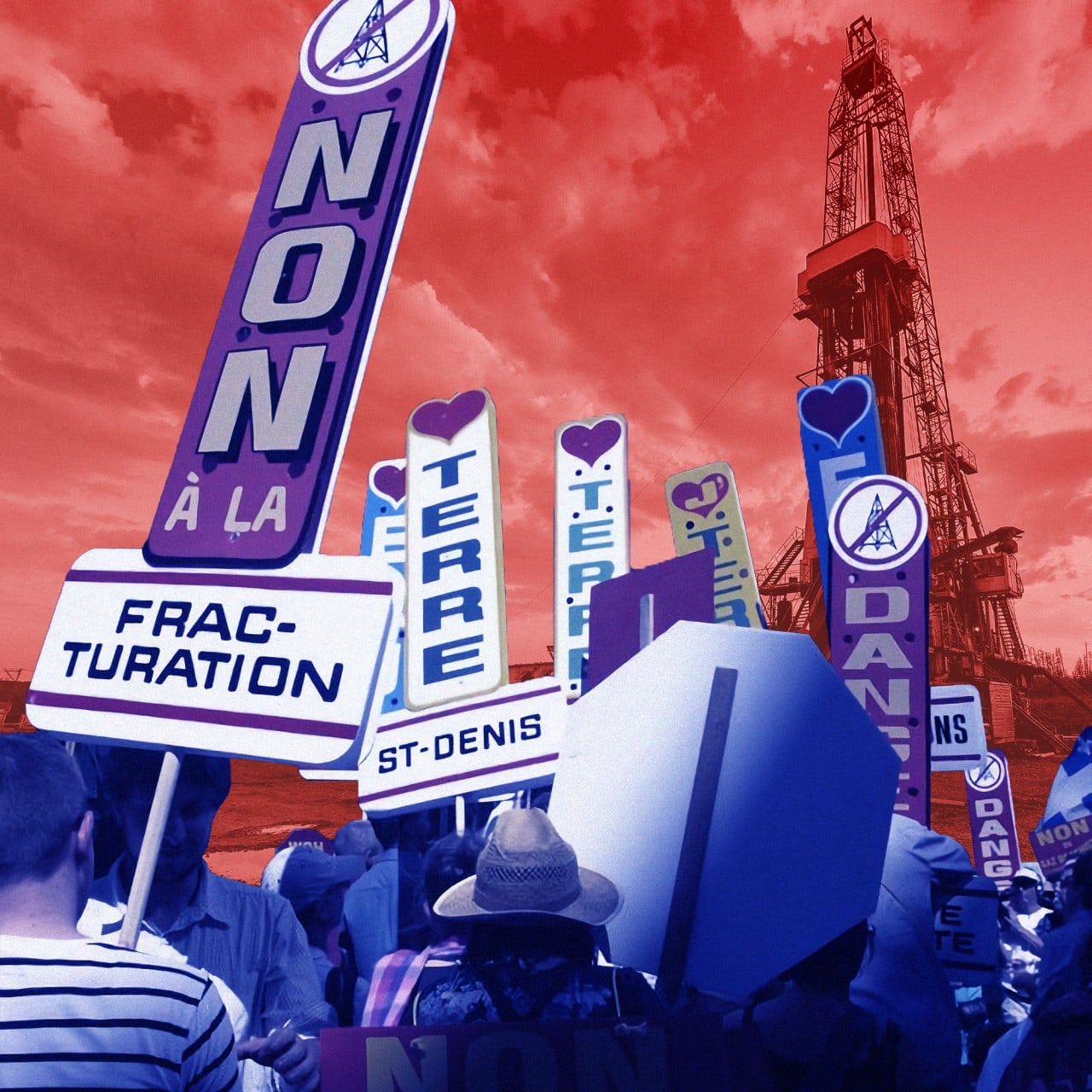
Between 2010 and 2013, these activists promised escalating action as part of a network of citizen committees in Quebec. They would stop multiple gas companies from opening 20,000 fracking wells in the Saint Lawrence Valley, and embolden a movement to fight for even greater victories.
Soon, this movement bringing together environmentalists, farmers, hunters, labour activists, Indigenous nations, and progressive politicians would manage to stop oil drilling in the same valley as well as on Anticosti Island, Madeleine Islands, and Gaspé. They would block the Energy East crude oil pipeline and a liquified-natural-gas megaproject in the Saguenay. Finally, in 2022, they would force a conservative provincial government to agree to keep all oil and gas in the ground—the first state in the world to do it.
Today, Quebec’s ban on hydrocarbon exploration represents a massive social movement victory, but the story of it has never been fully told.
The Breach conducted more than a dozen interviews with key leaders to distill its lessons. Developed over two decades, the movement won by building coalitions and using decentralized organizing, deploying tactics ranging from legal advocacy to direct action, sometimes in tension.
“Leonard Cohen says there’s a crack in everything,” said Angela Carter, an associate professor of political science at the University of Waterloo who has studied the victory. “There’s something about what Quebec has done that, if we take advantage of it, will allow us to change how we think about climate policy in this country.”
In the path of exploding oil trains
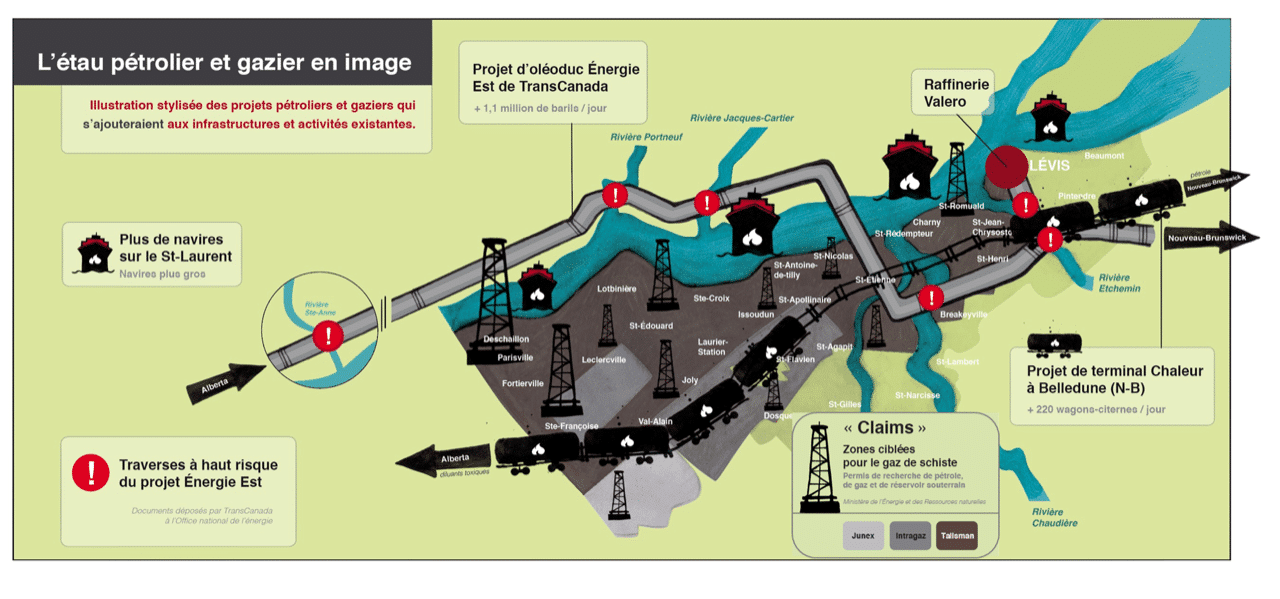
In 2013, Carole Dupuis watched as trains carried petrol through her town of Saint Entoine de Tilly in southern Quebec.
Only months before, a train like this had derailed and exploded a few hours drive away in Lac Megantic, killing 47 people.
“I was surprised,” recalled the former municipal politician, “I thought all of this was far from me.”
Dupuis began researching, trying to understand how much oil was being transported through Quebec, the impacts on her region, and the risks. What she discovered was shocking.
“If the various proposed projects were to occur,” Dupuis wrote in a report she produced, the volume of crude oil transported through Quebec “would go up 324 per cent, attaining roughly 2,000,000 barrels a day as compared to today’s 600,000 barrels a day.”
Dupuis’s research was the first comprehensive survey of oil and gas projects in Quebec. “According to the Quebec petrol and gas association,” the report added, “‘recent developments suggest that 20,000 billion cubic feet of natural gas are available [in the Saint Lawrence Valley], representing a hundred years of domestic consumption.’”
Quebec’s oil consumption stood at 350,000 barrels per day, but the province was set to become a transit hub for more than four times this amount. Her investigation echoed and enlarged the worries of scientists, Indigenous leaders, and Quebecois activists, underlining that a fossil fuel boom was set to completely transform their lives for the dramatically worse, and with very little democratic supervision.
Industry’s designs represented a direct threat. “The Saint Lawrence, the sea, it’s a part of our lives,” Innu Chief Jean-Charles Piétacho said as he remembered what had driven his part in the fight against oil extraction in the Saint Lawrence Estuary. “All that comes from the sea was essential to our livelihood. We do this because our grandparents did.”
Piétacho and Dupuis, and many others, resolved to fight back.
Piétacho’s campaigning would lead him to face down the Quebec police’s riot squad on Anticosti Island to protect the marine habitats of the Saint Lawrence Gulf.
Dupuis would come to lead a major network of groups attempting to beat back gas companies in the Saint Lawrence Valley.
Citizen groups pop up in every corner of the province
In the spring of 2011, Andre Belisle took a reporter from TVA to visit one of Quebec’s supposed model fracking wells.
With snow melting around the well, the reporter pointed at bubbles coming up in the water in the well. “What the hell is that?” he asked.
“Need I say more?” Belisle replied.
Industry insisted there were no leaks from the fracked gas, or anything to be feared in their plans. But activists set out to prove them wrong and persuade the public of the dangers.
This method of using public education to establish self-organized citizen committees had been honed by Belisle’s Association Quebecoise pour la Lutte contre la Pollution Atmosphérique (AQLPA) over decades. It proved an effective method of identifying and nurturing potential activist leaders.
Starting in the 1980s, the AQLPA had successfully fought acid rain, leading to a North America-wide treaty. That victory, as well broader coalition victories against gas-fired power plants and import terminals through the 2000s, would be an important buoy for this new movement.
A straight-talking ex-construction worker often described as one of the first Quebecois environmentalists, Belisle stands by this approach. “Other groups were activist,” he said. “I felt that to change things people needed to understand, that we needed to ensure a continuous popular education campaign.”
Some of Quebec’s most empowered environmentalists were activated through this method.
One of them was Serge Fortier, a farmer by trade who was cultivating his garden when a neighbor invited him to a meeting in Fortier Ville near Quebec City.
“We didn’t know much about fracking,” Fortier remembered. But after the meeting, a man stood up, worried and angry, and volunteered to launch a citizen committee. Fortier followed, beginning a four-year adventure as a full-time volunteer organizer.
He and his team soon came across other citizen groups popping up everywhere, meeting them in demonstrations.
Piecing knowledge from various sources, with no prior campaigning know-how, they organized the committees into a network, inaugurating the Réseau Interrégional Gaz de Schiste Vallée du Saint-Laurent (RIGSV). They coordinated through large-scale, union-style regional assemblies.
“We went village by village,” recalled Fortier, “finding 65,000 people who publicly stated that the gas companies were not welcome on their land. In some villages, 75 per cent of the map was red!”
The network pushed municipality after municipality to use their power to protect their water, effectively denying access to fracking companies. Working upwards through the halls of power, they made a robust case for the gas companies’ lack of social license.
The powerful threat of civil disobedience
Industry was quick to express their concerns about mounting resistance. “A fracking operation costs about half a million dollars a day,” warned the CEO of Questerre Energy in 2011. “That’s why I won’t pay this kind of money if the risk is too high that protesters will chain themselves to installations, or stop my teams from working.”
Quebecois activist Philippe Duhamel, a student of Gandhi and Gene Sharp’s doctrine of strategic nonviolence, took all this as an encouragement.
Looking back now, the movement seems to have marshalled a quasi-mystical capacity to develop winning strategies. But success was far from a guarantee from the standpoint of the activists.
Characteristically, people fulfilling different roles in typical “social movement ecologies” clashed. Those involved in public persuasion, campaigning and lobbying such as Belisle, whom social movement theorist Bill Moyer describes as “change agents,” viewed with suspicion the “rebels” who championed civil disobedience.
It was without approval from the less confrontational parts of the movement that Duhamel, a long-time strategist with a track record of success dating back to the nuclear and anti-globalization movement, decided to take the fracking companies at their word.
With a team of young volunteers, his group planned two ambitious campaigns that would eventually earn the begrudging praise of the global fracking lobby, which would dub the activists “sophisticated.”
First, in 2011, the group marched from Rimouski to Montreal, training citizens in civil disobedience in every town they stopped at. They were intentional and innovative, treating each training as its own action, a warning shot to the companies that fracking would come at a high cost. They generated buzz. When they arrived in Montreal, they were met by one of the largest environmental demonstrations in Quebec’s history.
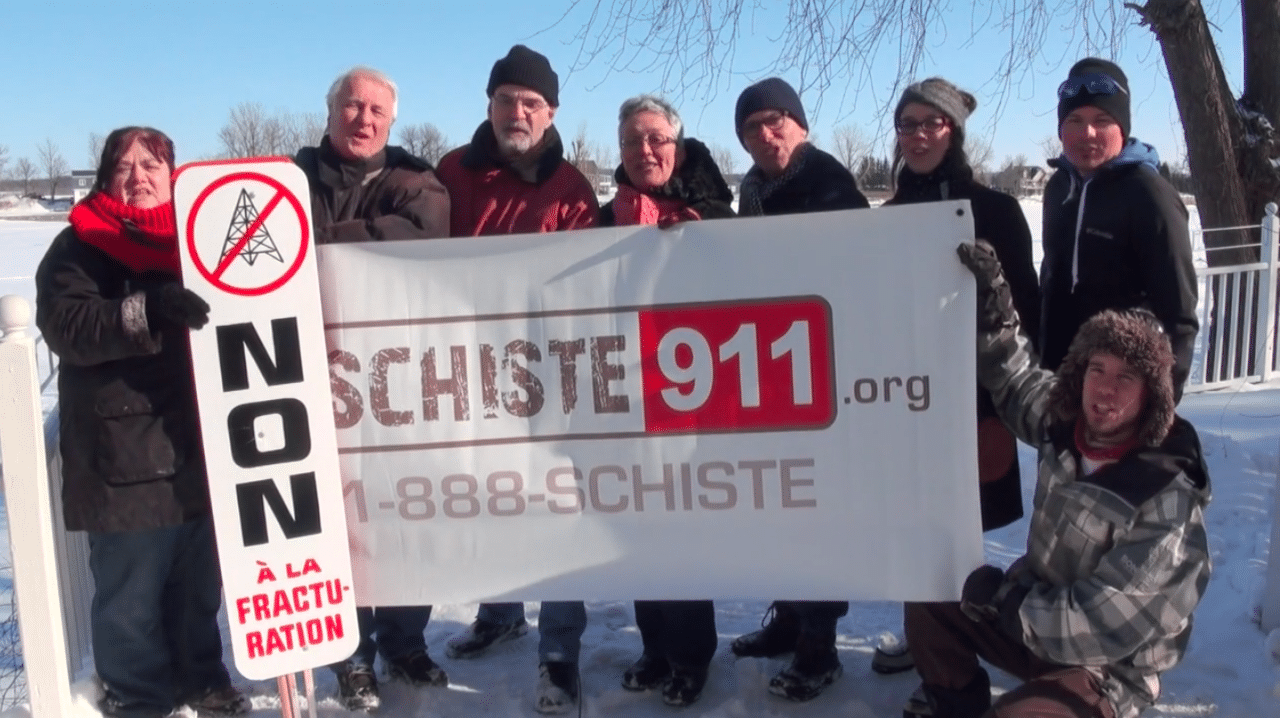
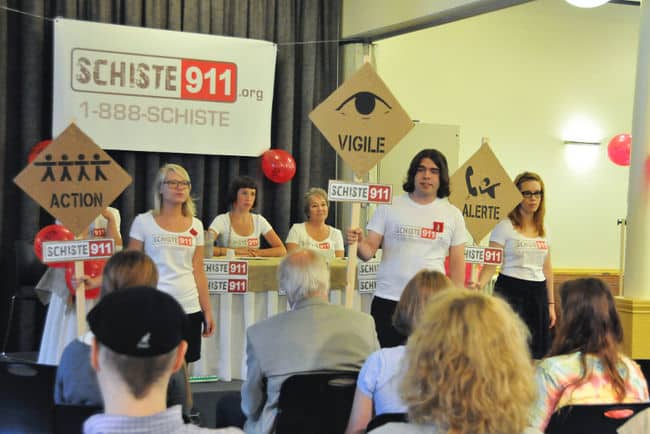
Not content with significant progress on the gas file, they set out to create a warning system—“Schiste 911”—for citizens to spot any early signs of fracking and train in civil disobedience.
But in the end, they never needed to swing into action. The mere threat of it, combined with the wider public advocacy campaign, ultimately stopped industry, and pushed the government to institute a long-term moratorium on fracking.
Whatever the tensions in the movement may have been, Duhamel’s marching tactic was replicated twice, and innovated on. In Gaspe, activists set up a year-long occupation at the Camp de la Riviere, and ultimately scared industry away. They took a more confrontational stance, disrupting politicians. They acted with faces covered at times. But they remained effective.
In all forms, radical groups fulfilled a core social movement role, complementing the massive public engagement campaigns that delivered municipal wins. They turned the efforts of their change agent comrades, which had stripped the companies of social license, into a direct material threat to the fracking industry. Together, they won.
From opposition to proposition
Anne-Céline Guyon was the apolitical coordinator of an anthropology research centre when she showed up at a drab community centre in Portneuf, along the Saint Lawrence river in 2013.
But after what she heard that day about the threats of oil expansion through Quebec, she volunteered to coordinate the local Stop Oleoduc citizen committee, following hundreds of others before her.
A campaigning powerhouse, Guyon would go on to first coordinate the campaign against the Energy East pipeline, then the campaign against the LNG project, and then the push for a transition away from oil and gas.
One of Quebec’s best known environmental campaigners today, Guyon’s journey exemplifies how thousands of activists were recruited into the movement.
They began anxious about watching their immediate environment and quality of life threatened. But they would soon follow a road of widening political consciousness: saying “no” to shale gas (or pipelines) in their backyard, to saying “no” to those projects anywhere, to saying no to all fossil fuels, to saying “yes” to the transition, and then saying “yes” to a just transition, a process that continues to this day.
“We recognized the need to formalize our coordination [in the fight against Energy East], to facilitate the coordination of NGOs and grassroots,” Guyon said. “This is the moment when the Front Commun pour la Transition Energetique was created. We wanted to formalize coordination against fossil fuels at large.”
Building on its victories, the movement became a proposing force as well as an opposing one.
Buoyed by the Common Front, a new chapter opened with a push for a transition to a low carbon economy in Quebec. Waves of mobilizing and action between 2018 and 2019, including massive highschool strikes and a climate march that brought out half a million Montrealers, would breathe new urgency into this demand.
The movement had been at it for 20 years. It beat the final major proposed project in 2021, the largest private sector investment in Quebec history—a LNG gas export terminal, in the treasured beluga habitat of the Saguenay Fjord.
It had become adept at mobilizing key contributions—civil disobedience, advocacy, and insiders and middle-ground “respectable” citizens protecting it against charges of radicalism. It knew how to lobby. And boosted by the wave of interest in climate action, it successfully showed a conservative government that it could be a popular decision to leave oil and gas in the ground.
‘What’s the Quebec factor?’
In June 2015, environmental activist Martin Poirier joined a group of anti-tar sands campaigners in British Columbia for a strategic retreat. It was not long after he and fellow Quebecers had defeated the Energy East pipeline, adding another victory to their growing list. Soon, someone asked the inevitable: “what is the Quebec factor?”
Any strategist understands that social movement victories are highly contextual. Quebec’s is no exception.
They caught industry early. They tapped into a rich social democratic tradition. Hydro-electricity’s availability in the province constituted a ready energy alternative, and meant the province had never significantly developed fossil fuels. The extraction potential was not entirely clear anyways.
And yet there is little doubt on anyone’s mind. A conservative, pro-business Quebec government with a penchant for anti-woke populism was compelled to keep oil and gas in the ground.
The industry had originally benefited from unqualified political support, particularly at the federal level. Were it not for the movement, the trucks heading for Saint Marc de Richelieu and everywhere else would have gone straight through, as would the pipelines, ships, and drills.
The movement created a complete, textbook “ecology,” mobilizing diverse capacities from the bottom up. They had rebels threatening civil disobedience, highly skilled and committed journalists, and cultural actors on side. They generated deep public engagement, turning up at every consultation, as well as massive petition drives. They built unlikely alliances between farmers, Indigenous nations, hunters, NGOs, labour unions, and many others. They published books and research, had an inside game, excellent legal activism, and allies within political parties.
“We won without realizing it,” said Dupuis. “We did everything all the time. We were always on their case. We wrote to the media, wrote newsletters, followed the news, wrote reports that constantly exposed it all. Everyone did all kinds of things. The painters painted, the singers sang. We had to fight on all fronts, in a way that was organic and organized.”
A victory obscured
And yet when the extraction ban was finally written into law, few in the grassroots felt inclined to celebrate. A victory decades in the making often dismissed as insignificant, obscured by broader hopelessness in the face of an escalating climate crisis.
Your average Quebecer still emits roughly 11.2 tons of Co2 equivalent per year. That is less than most North Americans, but more than almost everyone else globally. In May of 2023, the Quebec government proudly announced it would achieve only 60 percent of its already inadequate target of 37.5 per cent reductions by 2030, relative to 1990 levels. By mid-summer, a forested area bigger than Costa Rica has been consumed by flames in the country.
There is presently no organizing on the scale that the province saw in the past 10 years, only remnants of the 2019 mobilizing waves fighting to find their footing. This fact and the wider situation looms large for those in the movement.
But activists often focus on their immediate predicament, without taking notice of their larger historical situation. Those attempting to kick off organizing stand on the shoulders of victorious campaigns and social movement traditions. Public opinion is sympathetic. The Quebec state is not highly exposed to fossil fuel lobbying.
If they were to take a step back, they would see much room for hope.
The organizers who made the victory possible gave years of their lives to full time volunteer campaigning. Most are heartened to see new generations pick up the fight. And some are not yet done.
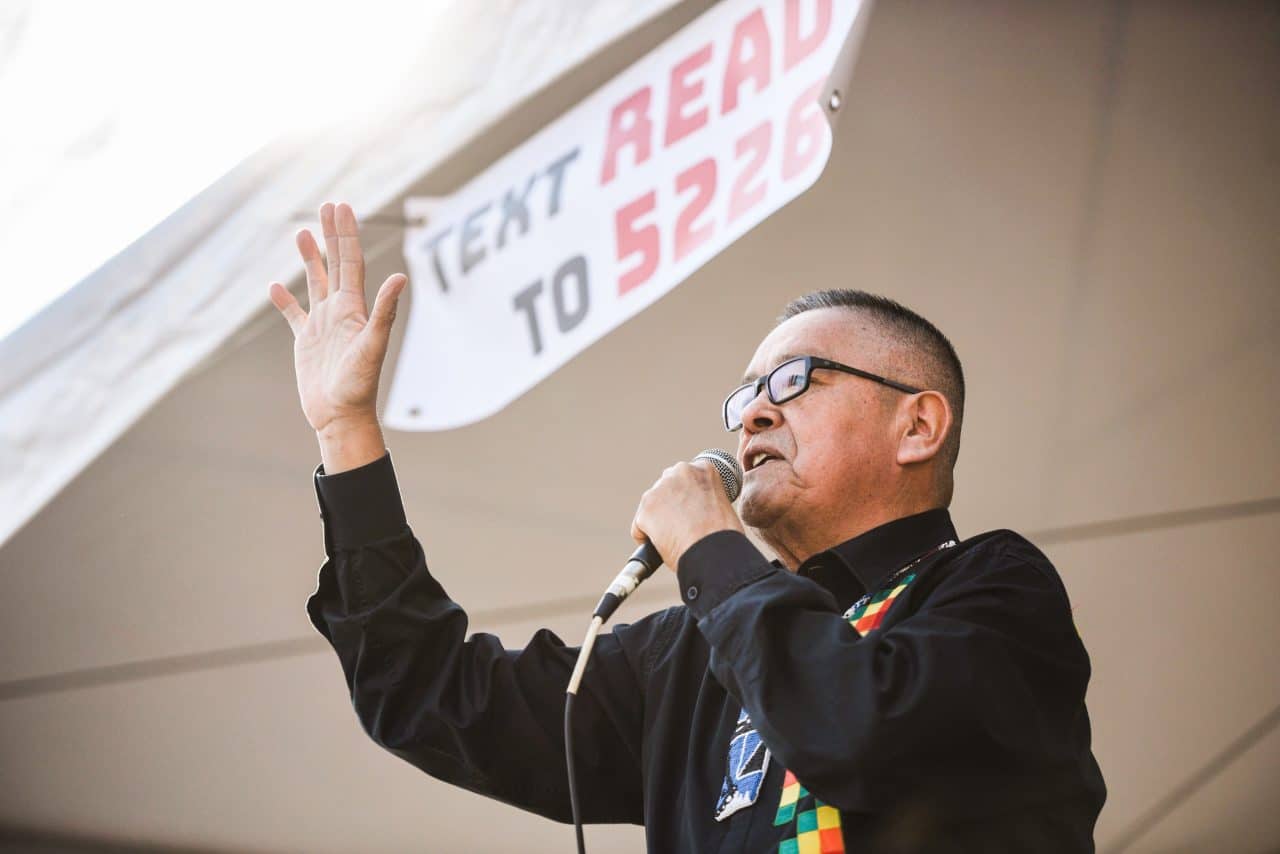
Innu Chief Jean–Charles Piétacho helped a successful drive to get UNESCO world heritage status for Anticosti Island. He is now campaigning to give the Magpie River personhood status.
Anne-Celine Guyon is still a relatively young campaigner with many more fights ahead.
As for Philippe Duhamel, after his interview with The Breach, he sent a document via email. It’s a new direct action campaign plan.

“We need media that enlarges the sense of what’s possible.”
Naomi Klein, journalist and author
Want to support hope-fuelled journalism? Become a sustaining member.