
The chant rumbled through Hamilton’s city hall: “Fuck AI.” Packing the council chambers in early June, residents shouted their anger at a massive data centre suddenly planned in their city by a private equity firm.
Hundreds held up a sea of placards expressing concern over the project’s impacts: “You can’t drink data,” “No tripled electrical bills,” “Hands off Hamilton.”
The city is by no means alone. Hamilton is part of a broader Canadian movement rising up against a spate of hyperscale data centres being fast-tracked across the country.
Planned with few guardrails to protect the environment and nearby residents, these data centres threaten to hoover up water and energy, expelling pollution while multiplying local electricity rates. And since AI centres are being planned with little warning and transparency, under a hasty federal AI strategy that will enrich tech companies, the movement is increasingly seeing the fight against data centres as a fight for democracy and against Canada’s burgeoning tech oligarchy.
And remarkably, in places like Hamilton, their campaigns are already starting to win.
The ‘Wild West’ of AI expansion
The scale of what’s coming is hard to overstate. A recent paper from York University—the first comprehensive mapping of Canada’s data centre landscape—puts numbers to the behemoths Canadians have started to see proposed in their backyards.
There are 194 currently-active data centres across Canada. These are buildings stacked with computer servers: the hardware that stores and processes the information that supports the cloud, social media, and the global finance system. At present, just five of those are “hyperscalers.” The threshold for a hyperscaler is debated, but the York paper defines them as data centres that draw over 50 megawatts (MW) of power, making them large enough to train and deploy artificial intelligence (AI) models.
The expansion that’s happening now would bring an additional 159 hyperscalers to Canada, in places like Olds, Alberta; Mississauga, Ontario; and Vancouver, B.C. These planned hyperscalers need, on average, over ten times more power than the currently-operational facilities.
And as they grow in size, they become more disruptive. Larger data centres emit noise, water, and air pollution, and use enormous amounts of energy—which, in Canada, will largely come from burning fossil fuels—while likely raising the cost of electricity for local residents.
“The scope and scale and the power that is used by some of the largest data centre facilities is really unlike anything we’ve seen before,“ said Mairin Loewen, the associate program director at Urban Climate Leadership and a policy researcher tracking gaps in AI regulation.
She pointed to one hyperscaler proposed in Sherwood, a rural municipality of Saskatchewan, that would ”use more power than all of the homes in Regina.”
But the data centre boom is zeroing in on one province: Alberta. The prairie province accounts for 93 per cent of all planned data centre capacity in Canada, in large part because of its cheap natural gas-powered electricity. Plus, Alberta’s UCP government has been courting the AI industry, offering corporate tax incentives to data centre builders and exempting them from otherwise routine environmental impact assessments.
It’s all happening “very, very quickly and with almost no rules,” said Loewen. “It’s a bit of a Wild West.”
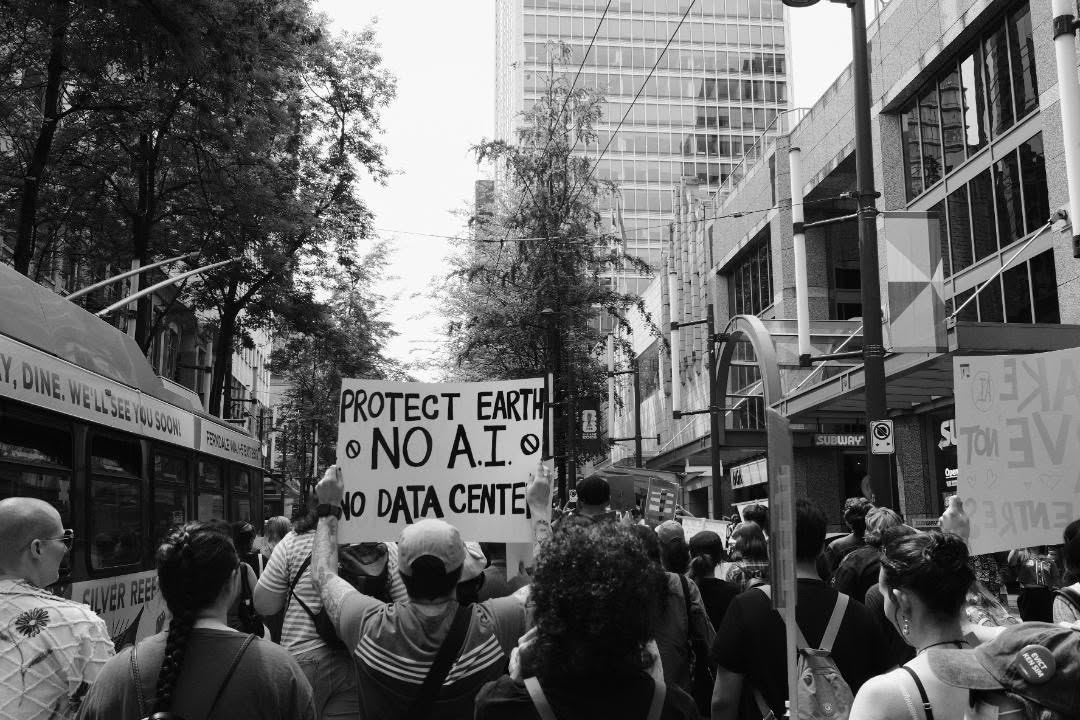
Record-breaking resistance
For Nick Tsergas, a health journalist and organizer, the campaign against Hamilton’s three proposed data centres began with a blog post that someone shared on the Hamilton subreddit. Blogger Dan Shannon had written about Slate Asset Management’s pitch to investors for what Tsergas called a “giant mega monster data centre.”
After reading the post, Tsergas messaged his city councillor, and within two weeks was helping to organise a campaign that packed council chambers. 1,688 residents submitted public comments about the data centre project—possibly setting a record for the small city.
Tsergas listed off his concerns about the data centres: “noise, water pollution, increased electricity costs, hit to affordability, cost of living, brownouts, [and] air pollution.” Hyperscalers also emit low frequency hums that can be constant and unrelenting for locals.
As a health journalist, Tsergas knows more than most about the impacts of huge industrial projects. Not long ago, he was reporting on the infrastructural strain of data centres in the U.S. Now, “it’s all happening right here in my backyard,“ he said.
In the U.S., the data centre boom came earlier. But so did the resistance.
In the first quarter of 2026, a wave of campaigns across the U.S. blocked or delayed at least 75 projects worth roughly $130 billion USD. Legislation has been proposed across more than a dozen states to place moratoriums on new data centres.
The U.S. resistance has grown to include celebrities like Erin Brokovich, who built a community-informed map of U.S. data centres to help shine light on shadowy developments.
Tsergas watched and took notes. Then, he built his own website that provides real-time information on the Hamilton campaign.
His first order of business was to print a thousand stickers with QR codes linking to the website and posting them all over town. “The sticker shop gave me a discount,” he recalled. “They charged me 15 bucks because everyone I’ve spoken to on the ground is onside. Any time I saw a business owner, they’d say, ‘Oh, can I take a stack?’”
The website transformed the fight in Hamilton. It features a municipal “election tracker” that lists every candidate’s position on data centre regulations. “I have had many candidates coming to us saying, ‘Please update my tracker entry to reflect that my thinking on this has evolved as I’ve learned more,'” said Tsergas.
A dozen cities are now running campaigns on Tsergas’ Stop The Datacentre website, porting the model used in Hamilton. This month, councillors in Vancouver and Mississauga are expected to bring forward motions asking their cities to place a moratorium on new data centres.
“We actually have a group chat with all of those communities together,” said Cameron Caughlin, who’s been organizing against AI data centres in Alberta. “We talk very often, and we try to help each other to the best of our abilities when we can.“
In Vancouver, Torin LaRocque was also watching what was unfolding south of the border, before he decided to found No AI Vancouver as a one-man organizing team. Now, hundreds of people are joining protests and over 15,000 have signed a petition to stop a data centre from being built in Vancouver.
In Winnipeg, Christie Little had never heard of data centres before stumbling upon a social media post about one being proposed near her home. Then, she started an online petition which garnered over 13,500 signatures. As a result, NDP Premier Wab Kinew rejected the proposed 500 MW hyperscaler. “I find that the more people know and the quicker we know it, the better,” Little told CBC.
And in Alberta, the eye of the storm, Indigenous communities have been at the forefront of fighting back, arguing that data centres could violate their rights. Sturgeon Lake Cree Nation took legal action against the Alberta government after it issued a license for Wonder Valley—billionaire Kevin O’Leary’s pet project to build the world’s largest data centre—allowing the project to draw water that will presumably come from the Smoky River without consulting the nearby First Nation.
Wonder Valley was also what galvanized Flora Mejia of Red Deer, Alberta, to petition the House of Commons for a federal moratorium on fossil fuel-powered hyperscalers in Alberta. That includes the Synapse hyperscale project in Olds, which would be built along with the second-largest natural gas power plant in the province. Meija’s petition now has over 12,000 signatures.
The general feeling is that AI data centres are being built too fast, and too big. According to an Angus Reid poll, 68 per cent of Canadians would oppose a large AI data centre near their home.

Boon or burden?
Given the dour public sentiment and sharp backlash, why are local governments approving these projects?
For a cash-strapped municipality, a hyperscale data centre can look like a windfall.
“When you get a large commercial project, that’s going to pay a lot of property tax,” explained Loewen. And that calculation is “taking place in a context of really resource-constrained local governments trying to deliver a huge number of services, often in rural communities across a massive land base with very few financial tools.”
So municipalities often assume that the benefits of having a data centre outweigh the negatives.
But Lyndsey Rolheiser, the urban economist who co-authored the York University paper, said that this assumption isn’t backed by data. She explains that in places like the U.S. where a little more data about the medium-term impacts of data centres is available, it shows that when states offered tax incentives for data centres, the public purse was being drained, not filled.
For example in Virginia, for every dollar the state gave up by offering tax breaks to data centres, it generated only 48 cents in new state revenue.
As Tsergas puts it, “Sure, there’s a big injection of cash—but that doesn’t necessarily go to you and me. It goes to private equity firms, to big construction developers, and to tech companies.”
The misconception about data centres’ upsides is being nurtured by the AI industry. Lobbying records show the developers behind two of Hamilton’s proposed data centres have met repeatedly with federal and provincial officials in recent months.
The CEO of the American Petroleum Institute recently advised tech companies to get ahead of public opposition by stressing the industry’s “benefits,” the way the oil industry learned to do during the fracking battles of the 2000s and 2010s.
The fossil fuel industry has an incentive to hand out pages from its PR playbook: it stands to become a profitable supplier of energy to a boom of power-hungry data centres. The federal government quietly got on board: despite claiming that Canada will become a leader in building AI data centres “sustainably,” in internal documents the government wrote that one of the top “public policy benefits to Canada” of building data centres is the creation of new markets for Canadian natural gas.

‘Avatars’ for AI distrust
“There are all kinds of different fronts on which people are concerned about or fighting AI,” explained Dru Oja Jay.
Jay is the executive director of the Council of Canadians (and a board member of The Breach). His non-profit is writing a resource manual for the burgeoning AI resistance in Canada—from transparency requirements to Treaty rights—and held a summit on AI in May that brought together organizers.
He explained that data centres represent the upstream impacts of AI—the harms that happen before AI is even used. But people are concerned about the downstream effects of AI too: workers losing jobs, an expansion of surveillance, and the spread of mis- and disinformation.
It was these downstream impacts that led Cameron Caughlin to join the fight. As a student at the Alberta University of the Arts, she feels AI threatens her livelihood. “It’s making it harder for us [artists] to get taken seriously,” she said, “[and to] be paid a living wage.”
After attending an anti-AI meeting last year, she helped found Alberta Anti AI, a Discord server split by city, where members now exchange information and coordinate locally against Alberta’s rash of proposed hyperscalers.
For Caughlin, the harms of AI and data centres are inextricable. “When you use generative AI, you’re making the excuse of, ‘Oh, yeah, let’s make more data centres,’” she said. As a result, AI data centres have become “an avatar for Canadians’ distrust of AI broadly,” said Loewen.
The federal government’s narrative is that AI is “a key element of productivity growth across the broader economy, particularly [for] small and medium-sized enterprises,” and a necessary investment to help Canada stay competitive amid a global technology arms race. But that’s not the full story, said Jay.
The federal government “is not trying to create publicly-owned AI,” he said. “They’re not trying to create AI that actually is useful immediately for problems.”
Instead, he said that the framing of AI as a national imperative “is being weaponized as an excuse to create domestically what we already have in the U.S., which is a billionaire-driven tech oligarchy that is enabled by the government.” Here, he points to the world’s first trillionaire, Elon Musk, whose fortune was built with the help of U.S. government subsidies. In Canada, the Carney Liberals’ AI approach appears to be taking notes from Build Canada, a consortium of Canada’s wealthiest tech bros.
As a result, the fight against AI has become a David-and-Goliath story. As LaRoque put it, “It’s the people versus these giant corporations: the few that actually run these companies versus the thousands of us who are protesting.”

Reining in the AI rush
“I don’t have a problem with AI,” said Tsergas. “I just don’t think that data centres should be completely unregulated.”
Tsergas’ main concern is the undemocratic process through which data centres are being planned. In Hamilton, for example, there are no guardrails stopping the data centre from “being privatized a year from now or massively scaled up,” explained Tsergas. That is, even a data centre approved today under the auspices of supporting a government research program—as is the case with one of the smaller projects proposed for Hamilton—has nothing legally binding it to that purpose tomorrow.
In fact, municipal regulations were written for a completely different technological era. As Hamilton City Councillor Nrinder Nann told The Breach, Hamilton’s industrial zoning framework, which was developed over a decade ago, “never even imagined this kind of scale of land use could ever potentially come down the pipe.”
So to Tsergas, the fight in Hamilton is about “the right for people to be actually consulted when the federal government decides it wants to put a big giant thing into a neighborhood that we know is going to harm people.” And crucially, that fight begins before the approval of a new project.
On June 24, City Council in Hamilton advanced a motion to place a one-year moratorium on data centre developments, with no loopholes and with the possibility of a year-long extension. A final bylaw is expected at the July 15 council meeting. That means all three proposed data centres in Hamilton—including Slate’s hyperscaler—are on hold.
This is a major and possibly unprecedented win in Canada, and it came directly as a response to the growing backlash from local residents.
Following the decision, Hamilton council also asked staff to develop a municipal framework to evaluate future data centre proposals based on their social and environmental impact. Nann said it will be the first of its kind in Canada.
“I think that every single municipality across the country should be asking for this framework,” she said, “where our provincial and federal governments haven’t done their due diligence of putting forward the regulatory requirements for this new industry boom in our country.”
This local win is set to snowball. Nann and her colleagues have already shared copies of Hamilton’s framework with 21 different city councillors across Canada who are looking to erect their own city’s guardrails.
“Industry and investment interests have been pandered to and, quite frankly, co-opted inside of government,” said Nann. “It is truly time to re-democratize our government and make sure that the people’s will is represented.”
When asked if the dust has settled, Tsergas responded that there’s still work to be done. “I don’t think it’s over,” he said.
“Yeah, it’s far from over,” Nann agreed. “It’s just the beginning.”

‘The first video I ever made with The Breach was on why we need to support the movement for Land Back. Today, it’s being used in educational settings everywhere—in universities and colleges and children’s classrooms too. When I give talks, people will say, ‘I saw your video and it helped me understand the issue.’
That’s what we do at The Breach—reach people where they are at, with bold ideas, principled analysis, and critical investigations.” – Pam Palmater, scholar and author
Become a sustaining member of our work today.