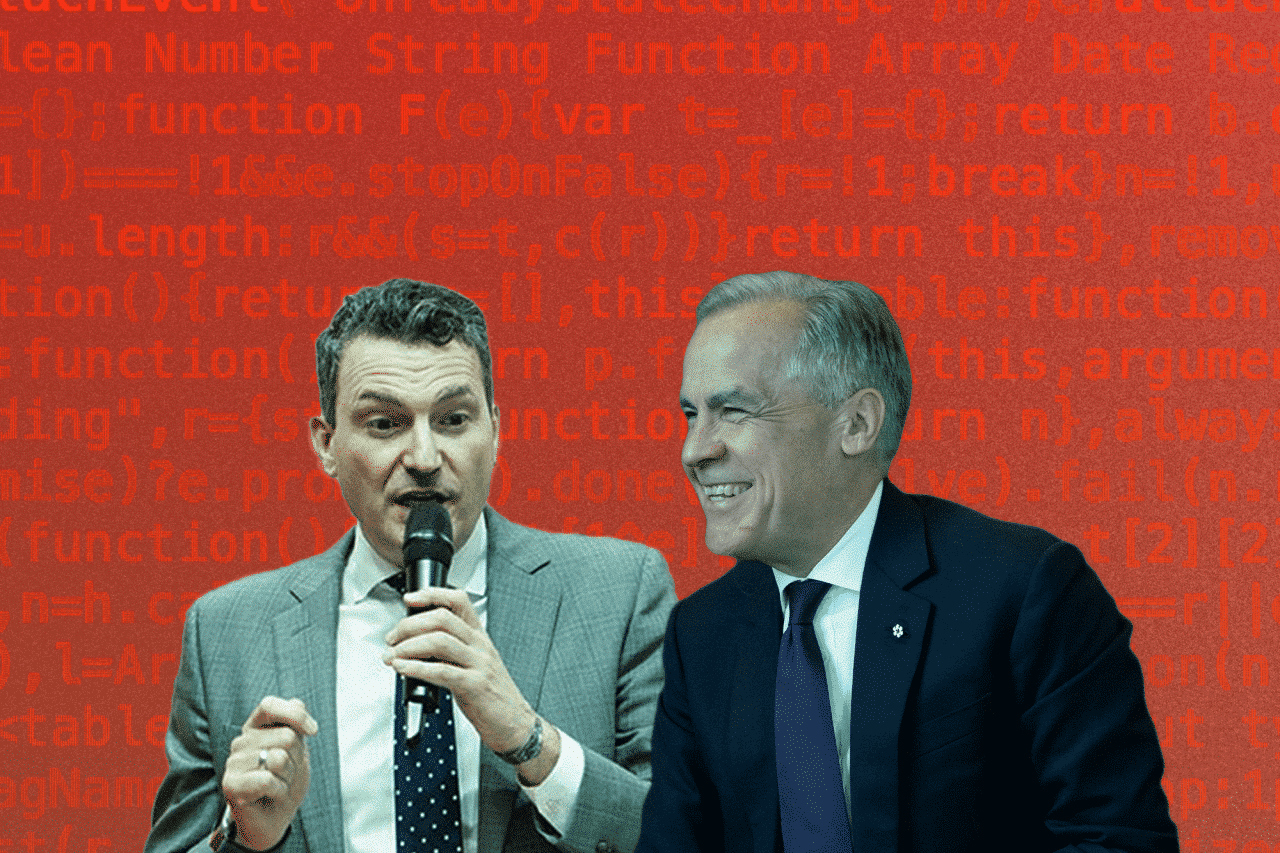
When Evan Solomon took the stage in Ottawa last month to give his inaugural speech as Canada’s first-ever Minister of Artificial Intelligence and Digital Innovation, he was quick to reassure tech leaders that regulating their industry would not be his top priority.
Rather than dwelling on AI’s pitfalls and “over-indexing on warnings and regulation,” his focus would be on unlocking the technology’s economic potential, he said. The regulatory legislation that had been in the works under Justin Trudeau was now fully off the table.
For Canada’s tech elites, this was cause for celebration. After spending much of the past year cozying up to Pierre Poilievre and the Conservatives in search of less regulation and lower taxes, these CEOs could now breathe a sigh of relief.
But for everyone else—from public service workers to artists, gig workers, refugees, and the broader public—Solomon’s message should cause alarm. The government appears poised to speed ahead with adopting AI without considering its proven drawbacks and harms.
Since Mark Carney arrived on the political scene, he’s made AI adoption a cornerstone of his policy program, based on the view that the technology can serve as an essential tool in boosting productivity and addressing the government’s budget deficit. His federal election platform contained plans to increase funding for AI projects, create incentives for workers and businesses to adopt it, and cut “red tape” around the construction of infrastructure like data centres.
Carney’s excitement about AI isn’t new. In his 2021 book Values(s), he outlined his belief that AI, big data, and increases in computing power meant that “smarter machines are already replacing a broader range of human activities than before.” Now, when asked tough questions about government finances, military procurement, and the state of the economy, he often throws out AI as an obvious solution that doesn’t require further detail.
But there’s ample reason to be worried about the consequences of the government’s optimistic embrace of AI at any cost.
The last AI hype cycle
Claims that artificial intelligence is on the cusp of transforming society are nothing new. In the 2010s, it was common to argue that advances in robotics and AI would wipe out as many as half the jobs in the entire economy, leading progressives to debate whether it was time for a universal basic income. But those narratives were little more than a distraction from how AI was really being used in many parts of society.
AI didn’t bring about mass unemployment. Instead, it gave employers new tools to exploit workers.
Companies like Amazon and Uber pioneered the rollout of algorithmic management techniques, which used automated systems to increase control over workers, crush their attempts to unionize, push down wages, and worsen working conditions. Gig work expanded, turning employees into contractors while offering the illusion of freedom and empowerment. In the years since, those technologies have proliferated into workplaces well beyond the major tech companies.
Governments also got in on the hype, just as they are today. Around the world, agencies rolled out AI systems designed to increase efficiency and reduce costs, often with harmful consequences for the most vulnerable groups. Unsurprisingly, the welfare system became a key target of those initiatives.
From Sweden and Denmark to the Netherlands and Australia, AI-powered systems used to detect fraud have been found to falsely flag people from marginalized groups and throw hundreds of thousands of people off benefits—destroying lives in the process and even pushing some to commit suicide out of desperation.
In 2021, a class action lawsuit successfully forced the Australian government to pay $1.8 billion AUD in compensation to 443,000 people affected by its “robodebt” system. A recent report found public servants in Australia are hesitant to adopt future AI systems because they’ve seen how harmful they can be when not done properly.
Scandals have also accompanied the rollout of AI systems in policing, health care, and immigration systems. Canada hasn’t been immune either. Human rights experts have signalled concerns about the government’s use of automated decision-making in visa processing and risk assessment.
The UK Labour playbook
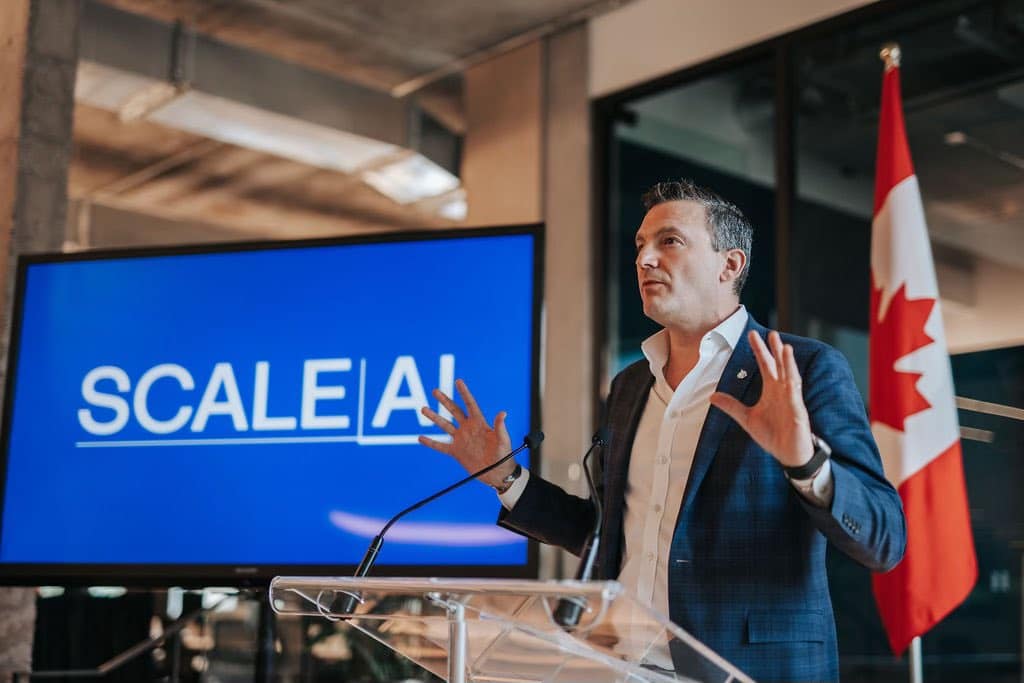
Solomon seems eager to ignore these lessons in the hopes of chasing short-term investments, amid a flood of money pouring into the AI space. It’s a recipe for disaster.
He has described building large AI companies in Canada as an “urgent issue” and even suggested that Canada could cozy up to Saudi Arabia to secure capital for major AI projects. He’s also signalled an openness to allowing AI companies to train on the copyrighted works of artists, writers, and other creatives, without their consent or compensation—a legal proposal already put forth by the UK government that has been met with widespread outrage in the arts community.
The UK Labour Party under Prime Minister Keir Starmer is already months ahead of Canada. It has moved quickly to appease the tech industry, overturning local roadblocks to data centre construction, pushing AI on schools, and announcing plans to roll it out throughout the public service.
The public backlash in the UK to this tech industry-aligned AI agenda has been swift, creating a public relations nightmare for the Labour government. Still, Carney appears determined to follow in the footsteps of his friend Starmer. Last month, he signed an agreement with the UK and the Canadian AI firm Cohere to “deepen” collaboration on AI deployment.
Specifically, Cohere has been tasked with accelerating the adoption of AI in the public service in Canada, though Carney has refused to offer any details about how this might impact public sector jobs or service delivery. The timing raises concerns: paired with the government’s recent announcement about radical cuts to public spending, the move suggests adopting AI could justify layoffs or service reductions under the banner of efficiency.

The AI productivity myth
Carney’s AI gamble is unlikely to deliver the productivity results he’s selling. Much like the last AI boom, its rollout in workplaces is likely to increase the power of management rather than lead to serious productivity improvements.
In a study conducted last year, 77 per cent of employees said generative AI created more work for them, not less. More recently, The Economist reported a growing number of companies are abandoning projects to implement generative AI while the BBC spoke to others that were having to hire people to fix the mistakes generative AI systems are making. Air Canada was even forced to compensate a customer for its chatbot’s mistake last year.
There is also growing evidence that the use of chatbots is reducing users’ cognitive abilities, leaving their critical thinking skills “atrophied and unprepared,” according to a study that involved Microsoft researchers. There are alarming stories about the rise of people getting hooked to chatbots, becoming severely delusional, and even having to be committed for mental health treatment. And the technology has led to a rise in non-consensual, AI-generated explicit images, which particularly victimize teenage girls.
At a time when regulators are still belatedly trying to get a handle on the consequences of social media, generative AI may negate those efforts and turbocharge the harms arising from digital platforms. Yet Justice Minister Sean Fraser says he will be taking “a fresh look” at the Online Harms Bill and may not reintroduce it at all, leaving those serious issues unaddressed.
Elbows down against Big Tech
Carney isn’t just overlooking AI’s pitfalls—he’s deliberately crafting a policy agenda that aligns with the interests of Big Tech.
While he boasted about taking an “elbows up” stance against Trump during the last federal election, his approach to the tech industry—whose leaders have cozied up to the MAGA movement—has been anything but adversarial. His government killed the planned capital gains tax increase that had angered domestic tech executives, rolled out a series of measures seeking to attract more tech investment, and, most recently, killed the digital services tax that had drawn the ire of tech CEOs south of the border.
His gamble is that being friendly to the tech industry will drive economic growth in Canada—the only metric that seems to matter to the former central banker.
In the process, he appears ready to hand over the country’s research agenda to an industry that fuels financial bubbles for its own benefit, expands the scope of surveillance, and is incentivized to hook the public in order to maximize engagement and profits.
Technology can indeed serve the public good, but only if it is developed with that purpose.
Carney’s agenda will allow existing tech harms to fester while new ones are birthed, forcing all of us to pay the price of the industry’s reckless efforts to maximize power and profit at all costs. We can take a different path, but it’s clear the government will not do that unless it faces pressure to change course.

‘The first video I ever made with The Breach was on why we need to support the movement for Land Back. Today, it’s being used in educational settings everywhere—in universities and colleges and children’s classrooms too. When I give talks, people will say, ‘I saw your video and it helped me understand the issue.’
That’s what we do at The Breach—reach people where they are at, with bold ideas, principled analysis, and critical investigations.” – Pam Palmater, scholar and author
Become a sustaining member of our work today.
Liberal Party | Mark Carney says he’s a pragmatic outsider—but he’s a banker selling yesterday’s failed ideas

Tenant Rights | Competition Bureau investigating high tech price-fixing by Canadian landlords

Israeli Apartheid | Stephen Harper’s firm pours $350M into developing military tech for Israel

3 comments
Comments are closed.

The assumption is that Carney will permanently drop the DST. Dropping it was an easy decision if Trump walks and you feel that Trump isn’t willing to deal and is 100% in gouge mode. He can resurrect the tax later if Trump does indeed walk anyway. We shall see.
Mark Carney reminds me of when John Tory became mayor of Toronto. When a voter’s only choice is between the so-called “lesser of two evils”, it makes for just more of the same. In Tory’s case, the idiom quickly became “same Ford policies with a Rosedale accent”. For Carney, it’s actually worse because he is the “same neoconservative policies of the CPC with a Liberal logo”. He is making a grave mistake in judgement as there were a lot of NDP voters who voted for Carney(sorry to say I’m one) who won’t be fooled again. Our electoral system needs major reforms to get big money out of it and a ranked ballot that would be more representative of the majority of the electorate. With every news story from you guys & the CNO I truly believe our country is going to hell in a hand basket 😩
First I would like to ask Paris Marx and then the Prime Minister Carney, why would you agree or disagree with the idea that *the online media content access industry* should be and could be a public service?
*the online media content access industry — is the industry that gives patrons access to online content. It only provides access. It does not produce the majority of the content. In the current state of the internet this industry is dominated by a few very large firms including; Google, YouTube, Meta, Facebook, Instagram, TicToc, Twitter (now X), Telegram, Spotify, Netflix, Apple, MicroSoft, Substack and Amazon.