The timing was ironic.
The Breach’s production assistant logged into Instagram on Friday to share a graphic asking readers to subscribe to our newsletter and bookmark our homepage in case Meta and Google cut off other pathways to our work.
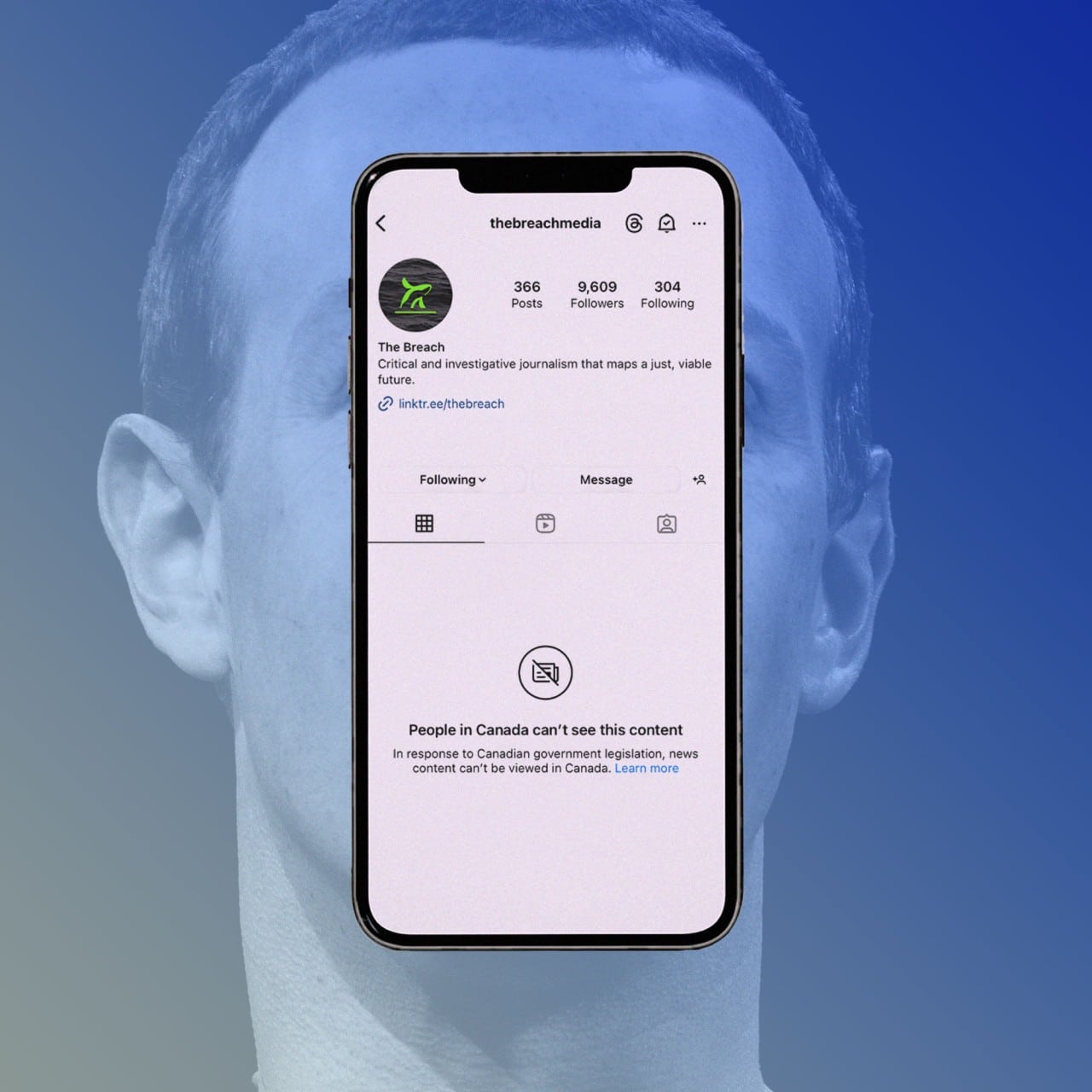
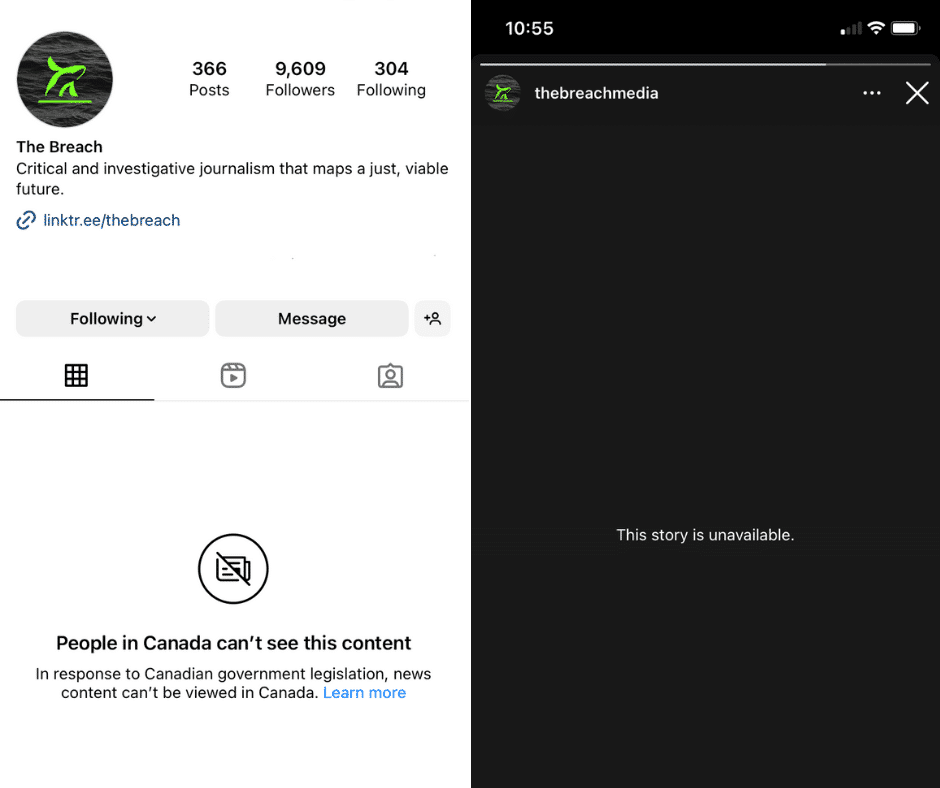
Instead, she saw an error message. She clicked on our Instagram profile and saw another error message, the one that has been popping up on the accounts of other media outlets. “People in Canada can’t see this content,” it said.
All of The Breach’s posts, including a recent infographic exposing the climate harms of Canada’s 2023 wildfire season and a story summary about Quebec tenants fighting back against bad policy, were gone.
The Breach is an independent news outlet, funded mostly by readers, that operates as a non-profit. We produce investigations, analysis and video content about the crises of racism, inequality, colonialism and climate breakdown. Thousands of new readers discover The Breach on Instagram, Facebook and Google every month, or use those platforms to share our work.
Instagram’s removal of The Breach’s posts is the latest escalation in Big Tech’s fight with the Canadian government over Bill C-18. Meta, billionaire Mark Zuckerberg’s company that owns Facebook and Instagram, announced on June 1 that it would conduct “randomised tests” of news-content removal for several weeks. The tech giant said that eventually, it will block all news content for all users in Canada.
Fellow non-profit news outlet The Tyee was blocked on some Meta platforms on Wednesday.
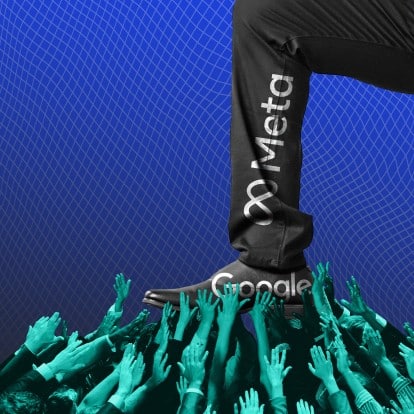
Google is also threatening to end news sharing in response to Bill C-18. The bill, which became law in June, will force these companies to share a small fraction of their profits with some Canadian media outlets. But the law was unlikely to ever benefit small, independent outlets like The Breach, and it was designed in a way that lets Meta and Google off the hook. And not just that—it gave them a multi-hundred-million-dollar incentive to remove all links to news from their platforms.
The policy throws the future of journalism—and especially the future of independent news outlets like The Breach—into uncertainty. It also demonstrates the dangers of allowing a handful of American multinationals to control vitally important platforms that communities rely on to share information.
‘Gut punch’ to independent media
“This is a gut punch,” The Breach’s publisher Dru Oja Jay said Friday. “One in four Canadians—and over a third of young people—get their news from sites like Facebook and Instagram. The reality is that the methods people use to discover new information are solidly under the control of two companies,” he said.
“This is existential for The Breach: the bulk of our new readers find us on social media.”
Readers who want to defy a dystopian future of corporate control—where important information about governments, corporations and the environment is inaccessible—should seek news outside of corporate platforms, Jay said.
The Breach’s email newsletter is one way to do that.
“From here on out, we’re going to be heavily dependent on word of mouth to build our audience,” he said.

‘The first video I ever made with The Breach was on why we need to support the movement for Land Back. Today, it’s being used in educational settings everywhere—in universities and colleges and children’s classrooms too. When I give talks, people will say, ‘I saw your video and it helped me understand the issue.’
That’s what we do at The Breach—reach people where they are at, with bold ideas, principled analysis, and critical investigations.” – Pam Palmater, scholar and author
Become a sustaining member of our work today.