
In the winter of 2020, at the outset of the pandemic, the Immigrant Workers Centre where I’m an organizer brought together a group of migrant workers for a Zoom meeting. It was a snapshot of the precarious lives of those who make Canada’s economy run.
There was Julius, a Nigerian refugee who had risked travelling from the United States as he feared being deported. He and his wife arrived on foot, walking over Roxham Road near the Lacolle border crossing in Quebec, like thousands of others. His first job was in a large distribution centre where he worked alongside thousands of other refugee claimants, all hired through temp agencies. Julius had worked less than a year before he was hit by machinery and severely injured.
There was Gaurav from India, who I’d met while handing out masks to workers at the same warehouse. Coming from Punjab as a refugee nearly three years before, he was part of a growing trend of Indian refugee claimants in Canada, whose numbers had nearly tripled over the past two years. Due to the gruelling pace of work at the Dollarama warehouse, he had gotten injured, and left to work for Uber Eats.
Ronnie, a truck driver from the Philippines, had come to Canada as a temporary foreign worker, propelled by a recruiter’s promise of permanent residency. But he had remained in limbo, without access to a path to permanent residency, working a minimum wage job nearly sixteen hours a day in the transportation industry. He longed for his family.
Then there was Nina, who lived without status, toiling with cleaning work in care homes after escaping poverty in Guatemala. She represented a group of undocumented women who faced constant threats and abuse from employers; two of their closest friends had become very ill from the anxiety and pressures of living without status. Without access to healthcare, they complied with deportation orders back to Mexico and subsequently passed away, their deaths a bitter reminder that they had become invisibilized to the point of death.
These stories are not an exception but the norm for temporary foreign workers. These racialized workers generate great wealth for the corporate class inside countries like Canada because they’ve been made exploitable through a restrictive immigration regime designed to ensure they remain vulnerable, docile, deportable and disposable.
Capitalists tend not to be fundamentally anti-migrant but rather seek to control and manage migration for the needs of business. They envision migration to be a kind of kitchen faucet that can be turned on and off according to labour market fluctuations. These include some of the largest corporations on the planet like Uber, Amazon, Walmart, and giants within the Canadian economy like Loblaws and Dollarama. Corporations in critical sectors like logistics, warehouses and distribution rely on the same strategies in the Global South as they do in the Global North: when the industries cannot be offshored, they rely on a precarious workforce of migrants.

Migrant workers from Mexico on six month visas working on a farm in Île d’Orléans, Quebec, Canada in May, 2021. Credit: Shutterstock
During the covid-19 lockdowns across North America, the migrant workers on that Zoom call were all labelled “essential,” or even “guardian angels.” When confinement measures were imposed and borders closed, employers issued desperate pleas for migrant workers to replace workers in the agricultural sector and meat-processing plants, healthcare workers such as patient attendants, delivery drivers, cleaners and behind-the-scenes workers in massive warehouses to ensure that goods flowed from overseas into stores or directly into our homes. The Liberal government complied.
But over the last two decades, both Liberal and Conservative governments had made this possible, constructing an immigration regime that prioritized temporary migrant labour. Increasingly restrictive for asylum seekers and those living with precarious status or without status, it ensures the disposability of certain categories of migrants, while opening the door to permanent migration for those deemed “deserving.” In the process, Canada’s model has drawn the attention of other governments and agencies around the world—in many ways, a model immigration regime to service global capitalism.
Borders serve not to deter migration but to control and discipline a global working class. Border regimes and immigration laws in core capitalist countries in the Global North function as filters, producing those who are deemed deserving as “legal” and those who are rendered vulnerable as “illegal.” The illegality of migrant workers has forced many of them—like the good folks I met at that Zoom meeting in 2020—to live in the shadows.
Canada’s bipartisan migration exploitation machine
Canada’s shift from an immigration system based on permanent settlement towards a system based on filling “labour shortage gaps” took place in 2006, when the Conservative government expanded temporary migrant worker programs beyond the existing Seasonal Agricultural Worker Program and the Live-In Caregiver Program.
Temporary work became a dominant pathway to entering the country. In response to corporate pressure to use foreign labour at an unprecedented level, the Conservative government created a new “low-skilled” worker program, which was based mainly in Alberta’s burgeoning tar sands.
Former Conservative immigration minister Monte Solberg, one of the architects of the program, asked in a speech: “Ladies and gentlemen, our economy is very strong—and very hungry. But as we face these shortfalls, we must ask the question, ‘Who is going to be doing all the work?’”

The tar sands oil boom in Alberta meant there was an acute shortage of workers in restaurants and hotels and otherwise servicing new oil and gas sector workers in the tar sands. Driven by the needs of employers, a new neoliberal immigration system was born without even a parliamentary vote.
The Conservative government opened up the temporary migrant worker system to nearly 200 occupations under pressure in high demand provinces, particularly Alberta and British Columbia. The government lauded how it had cut the red tape to bring in temporary foreign workers. In his speech, Solberg aptly described the aims of migration as a benefit to big business: “Before, it took five months to get permission to hire a foreign worker. Now it will take just five days. Ladies and gentlemen, that’s progress, and I think it’s a pretty clear sign that the federal government is listening to the concerns of employers.”
In fact, by 2023, the number of employed temporary foreign workers in Canada was at 240,000, up from 90,000 in 2016, this does not include the number of workers through the international mobility program which has reached 900,000 workers larger doubling the number of permanent residents admitted. Before the changes in Canada’s temporary foreign worker program, the most numerous temporary work entries were musicians, actors, engineers and media producers. By 2008, the largest categories now included food counter and kitchen helpers, cooks, construction trade labourers, and light-duty cleaners. It was part of a global trend, with the estimated number of international migrants more than doubling, from 81 million to 215 million between 1970 and 2010.
Good enough to work, not good enough to stay?
The Seasonal Agricultural Worker Program began in 1966 to bring in workers mainly from the Caribbean Commonwealth, particularly Jamaica and then Trinidad and Tobago. In 1974, Mexico negotiated a bilateral agreement with Canada to import workers from Mexico. According to scholar Mark Thomas, “The state was able to secure a labour force that accepts the physically demanding and low paying work that is subject to labour standards abuses.”
These workers are brought in seasonally to toil on farms for anywhere from two to nine months a year. Their work permits are tied to a single employer and contract. If they demand their rights or contest their conditions, their contracts can be terminated, which leads to deportation. Many workers face twelve- to fourteen-hour workdays seven days a week and are paid minimum wage.
In our organizing work, we habitually encounter workers who are overcharged for substandard housing, which is the responsibility of the employers. While there have been grassroots efforts to organize, workers have lost legal challenges in Quebec and Ontario for the right to do so. These workers are at the whim of their employers, while their families, thousands of kilometres away, rely on their wages. Migrant workers are also structurally excluded from accessing necessary labour and social rights such as employment insurance. Justicia for Migrant Workers organizer Chris Ramsaroop contends that the denial of employment insurance and social entitlements are rooted in “the historic role that racism has played in Canada’s Immigration system.”
The Live-in Care Worker Program was another example of unfree labour. Each year 12,000 workers—mainly racialized women from the Global South, primarily the Philippines—were forced to live with their employers until the program ended in 2014.

Now caregivers arrive through other programs and can negotiate whether to live with the employer or not. Previously, these workers arrived on closed work permits and were required to remain with their employer and work 1,950 hours before being able to apply for permanent residency. Living and working in their employer’s home, they were isolated, and the asymmetrical relationship gave employers carte blanche in terms of working conditions. Workers frequently talked about being required to work around the clock, to care, clean and cook for their employers with no days off.
In Quebec, the home is not considered a legal workplace, which denies care workers’ access to occupational health and safety regulations if they have a dangerous accident or become ill from the workplace. A campaign by self-organized live-in caregivers wanting to end such discrimination has been going on for nearly twenty years in Quebec; in Ontario and Alberta, workers have won health and safety coverage after similar campaigns.
A ‘model’ in exploiting migrants
Canada’s economic immigration system is increasingly viewed as a model for other advanced capitalist economies and is considered the “most carefully designed” among the OECD’s thirty-six member countries. The use of tiered migration management provides an exemplar for other countries looking to improve how they manage migration, says the Paris-based organization, which praises the “largest, longest-standing and most comprehensive and elaborate skilled labour migration system in the OECD.”
This apparently ideal migration system, where citizenship and pathways for permanent residence are based on economic categories, means workers deemed “unskilled” are denied citizenship. For many, the only open door is the Temporary Foreign Workers Program, which forces migrants to remain precarious with little access to fundamental rights.
Even the UN Global Forum on Migration and Development advanced the case for globalizing Canada’s model to ensure “orderly and regular” migration. The aim was to ensure the legitimacy and viability of global capitalism and the migration regimes it depends on without risking further political threat.
Former US President Donald Trump himself has praised Canada’s approach: “I think we should have merit-based immigration like they have in Canada, like they have in Australia, so we have people coming in that have a good track record.”
In this way, Trump’s cartoonish xenophobia is in complete alignment with what many perceive as the liberal, pro-migrant stance of Canada. Both are fundamentally about the stratification of a truly global working class through the transformation of immigration regimes.
For the capitalist class, Canada’s immigration regime is a model worth globablizing because it facilitates temporary or “circular” migration based on the needs of corporations and employers as opposed to humanitarian values. The racialization of Canada’s immigration system is clear yet invisible through the cloak of bureaucracy. The “merit” or “points” system favours permanent migration for certain people (mainly white Europeans) and temporary migration for the majority (who are mostly racialized migrants from the Global South).
The task for the left
However, a threat is appearing again now: right-wing movements are capitalizing on people’s fears of a loss of dignity and livelihoods that has resulted from three decades of neoliberalism, while protecting the interests of capital in the advanced capitalist economies that rely on migration.
As one migrant from Mexico once said to me, “The border always reads at the same time ‘sorry we’re closed’ and ‘we are looking for help.’” This is the paradox the political establishment must contend with as the needs of business are clashing with old ideas of nativism.
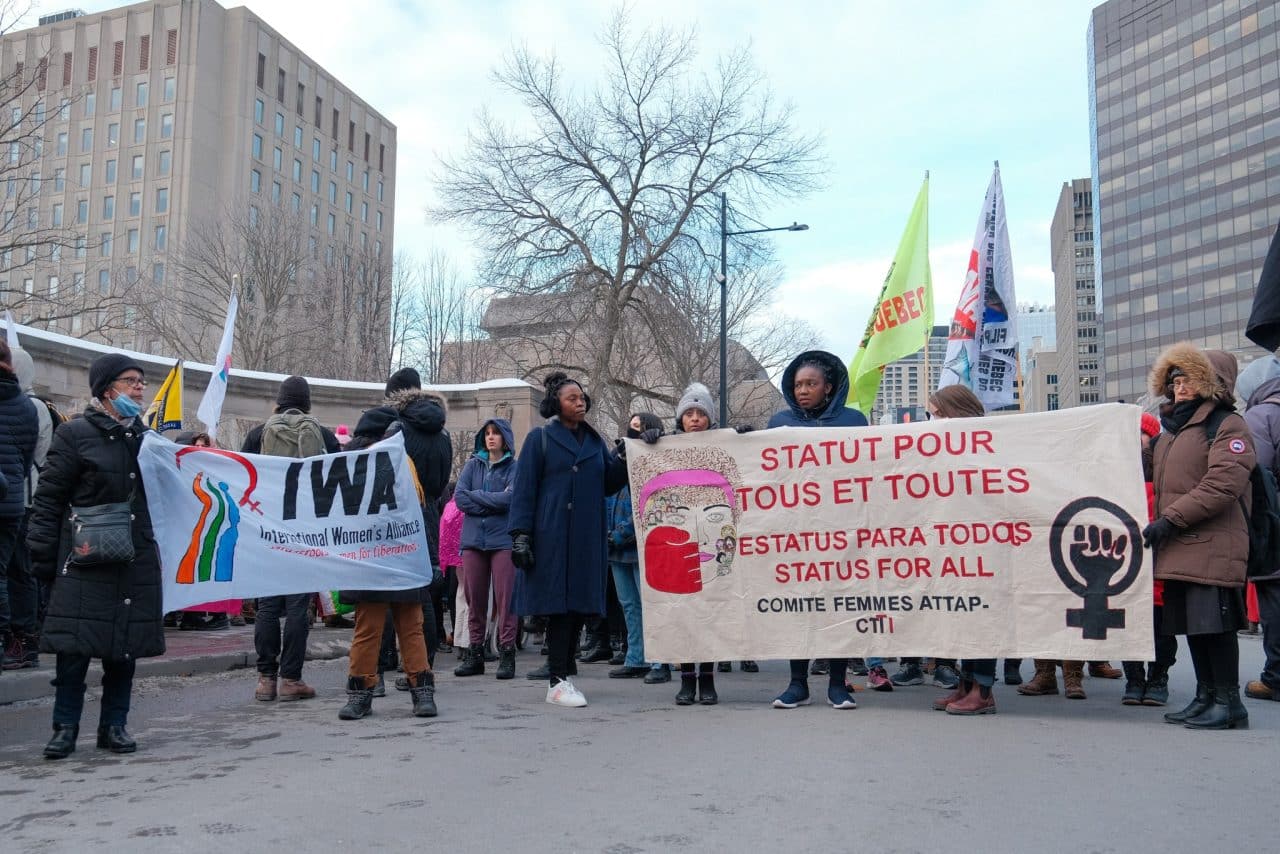
For the left, we must remember that all anti-racist struggles are class struggles—the struggles of migrant workers for status; the self-organized communities of precarious Palestinians, Guineans, undocumented women; and immigration detainees organizing hunger strikes against their incarceration; campaigns that too often have failed to stop the deportations of people.
These are fundamentally class struggles and must be taken up that way in an effort toward international solidarity. Migrant justice organizer and author Harsha Walia cuts to the heart of the matter when she says: “Simply put, borders manufacture divisions within the international working class.”
Race and status are wielded to both divide working and poor people by scapegoating migrants and divert attention from the effects of the global neoliberal economy upon this section of the working class. On the other hand, regularization—giving people status and citizenship—allows people to organize collectively to improve their conditions in the workplace and their lives, which fundamentally weakens the power of capital to divide workers.
At the same time, the struggles of working-class organizations like labour unions can at their core also be anti-racist. Campaigns for minimum wage and for housing most affect those who are left out of the right to a decent wage and decent work conditions. These people are most often without a union, and they are racialized.
For organizers, the question is whether to seek recognition for those who have the most to gain from campaigns about inclusion and diversity or to ensure that the majority of those who are racialized have full social and economic equality. If the latter is the priority, we must ensure that the jobs people work are decent jobs. They should not be low-paid temp jobs.
A growing section of the working class—migrants—has taken action despite the conditions they face, and they are continuing to organize on a day-to-day basis. To challenge neoliberal capitalism we must take up the struggle of migrant workers and their campaigns, whether for the minimum wage or status, or against precarious work, deportations or racism. These are central working-class demands. In this moment, “no borders” and “status for all” are working-class demands, not liberal or humanitarian ones. The broader left must acknowledge migration and its root causes as central to the movements of the working class. We need to learn and act in solidarity—not just for their dignity and freedom but for all of ours.
We must abandon the temptations of protectionist and nationalist conceptions of class struggle, which pit the global working class against itself. The challenge is to find common unity among a diverse and multi-racial working class. By making the connections between migration and capitalism, we can forge links on the ground, understanding that the forces that dispossess and compel people to migrate are the same ones that have robbed working people of their livelihoods. The struggles of migrant workers connect worker dispossession with broader struggles for freedom against colonialism. By building and creating new forms of organization and solidarity along class lines, not disconnected from the root causes of the conditions migrants face, we can transform society. The urgency of our moment demands it.
This is an adapted excerpt from Essential Workers, Disposable Workers, published in 2023 by Fernwood.

The Breach’s investigations don’t just inform our readers—they force the powerful to react.
An exposé on blood plasma privatization led to national headlines. Our revelations about the government’s cozy connections to Big Pharma sparked a parliamentary probe. A report on high-tech price-fixing by mega landlords resulted in a criminal investigation.
From activists to elected officials, people are using The Breach’s journalism to push for transformative change.
– Dru Oja Jay, Board President, The Breach
Immigration | Canada deporting highest level of migrants in a decade, despite promises to let more stay

Immigration | Deportation of frontline worker shows violence of Canada’s immigration state

Immigration | Canada’s racist model of migration control
2 comments
Comments are closed.

Some comments about the Live-In Caregiver Program.
The version with a closed work permit requiring that the caregiver live in the employer’s home did not end in 2014. I hired a caregiver at the beginning of 2016 under these terms. I believe it was a few years later when a pilot program was introduced that had an open work permit.
You failed to consider the consequences of an open work permit for the Canadian employer. For example, in my case, I am a quadriplegic and, to be able to stay in my house I need a guarantee of continuity of care. Local workers could not provide that, as I found out from experience. My foreign caregiver was found through an agency which I had to pay and her visa processing took about six months (pre-pandemic, after which processing times were vastly lengthened). The closed work permit provided me with a guarantee of continuity of care. When this switched to an open work permit, it left me with no such guarantee. I could pay an agency a fee to find me a replacement, but the caregiver could arrive and give notice at any time – something that could be tempting if she had friends or relatives living in some other part of the country or where she could work for higher wages. I would be left with no care. In the end, I was left with no option but to move into a nursing home, a worse outcome for me and also a socially undesirable outcome, because I am taking space that would be better used by someone who would be unable to stay in their own house under any circumstances.
In short, the new rules prioritize the temporary foreign workers and leave the Canadians who need care in a very vulnerable situation. I spoke to two Liberal MPs about this new pilot program and how it left people such as me in an unsatisfactory situation; they understood and were sympathetic, but were unable to do anything about it.
It is easy to imagine methods that could be put in place to monitor the situation faced by temporary foreign workers. Indeed, my initial caregiver, who had worked as a caregiver in Cyprus before coming to Canada, had been mistreated by one of her employers there. She had gone to a local police station to complain; she was allowed to quit her job and to find another, while the employers were penalized.
That is why you have to come legally to avoid all the mentioned hardship or abused. Some migrant is thinking that refugee is the fastest way to get status but they are just risking themselves to more problem. Everyone wanted a better chance in life but you need to do tge process legally like everyone else. Detouring the line up will just make life more harder than where you came from. For the TFW holder, know your visa type and make sure you understand the regulation if you have in fact a path to PR status, those information can be found on the IRCC website for Canada.
The problem with people now a days are lack of “Patience”.