Journalist and activist Naomi Klein’s new book is not like her others.
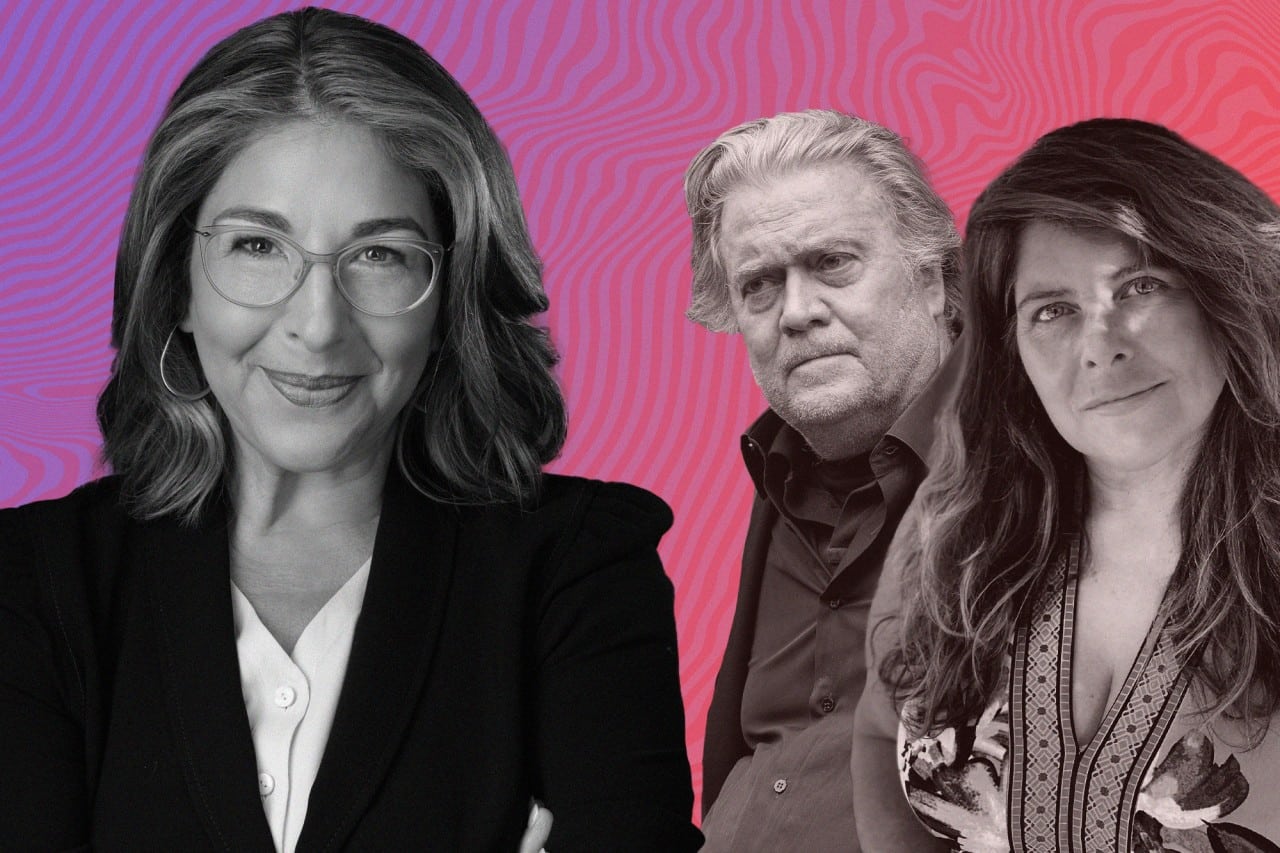
The Canadian author of The Shock Doctrine and This Changes Everything has just published Doppelganger: A Trip Into the Mirror World, which traces her journey being mistaken for Naomi Wolf, formerly a liberal feminist known for The Beauty Myth who has now joined forces with the likes of Steve Bannon as an anti-vax conspiracy theorist.
The book—a work of creative, very funny, personal non-fiction—opens out into a cultural and political dissection of an uncanny post-pandemic moment. It’s a moment in which a surging right—whether in the United States, Canada, or globally—has absorbed left-wing ideas and regurgitated them as something more dark and dangerous.
The Breach’s Martin Lukacs spoke with Klein about her “weird book, for a weird moment” while she was on her book tour. The interview has been edited for length and clarity.
Lukacs: Let me start by quoting this very funny tweet that was posted by a host of one of your book events recently:
At the risk of analyzing away the humour of a good joke, can you speak a little bit about how this gets to the genesis of your new book?
Klein: The book is not just about me having a doppelganger, but it does use it as a starting-off point. I have been confused and conflated with another writer, Naomi Wolf. It’s been happening on and off for about 15 years now—that I’m aware of. It could have been happening for even longer, but I didn’t know about it. It really went wild during the pandemic, in part because of Naomi Wolf, who people may remember from her early books, like The Beauty Myth. She advised Al Gore on how to reach women voters and was a face of third-wave feminism.
During the pandemic, she talked a lot about how the pandemic was being exploited to push through a Davos-Chinese-Communist-Party-plot-New-World-Order-thing. It did sound like The Shock Doctrine, which is a book that I wrote. I guess “the Naomis” situation grew more confusing, so the identity confusion events became more frequent.
The book uses my own experience of identity vertigo to think about other sorts of vertigo that many of us are experiencing where we don’t quite know who we can trust. There are a lot of people who we used to think of as progressive voices who have moved over to the conspiratorial right. The book is an attempt to map the moment, and the moment is weird.
One of the central dynamics of the doppelganger culture you write about is what you call “the mirror world.” This kind of strange ceding of territory to the right, where the right has been latching on to these legitimate fears and anxieties. As an example, you write about how Wolf and others on the right have spoken to and invalidated fears about the power of Big Tech, but then steered it in an entirely different direction.
I was struck by the fact that this is the place where she—my doppelganger—now lives, because she’s gone fully over to the right and she’s on Steve Bannon’s podcast, sometimes daily. They wrote a book together. When Tucker Carlson was still on Fox, she became a regular on his show.
What I was struck by was that when she was de-platformed from what was then called Twitter and other mainstream social media sites, many people on liberal Twitter sort of thought she had just disappeared from the planet. They were posting things like “R.I.P.” and “death recorded,” which is a reference to something else. Somebody actually posted, “dingdong, the witch is dead.”
Because I was following her I knew that she was very far from “deleted.” She actually had a platform that was much larger than anything she’d had in years, probably, since she was kind of a household name in the ‘90s.
This idea that people disappear just because we can’t see them is super bizarre, and I think very prevalent. I would listen to Steve Bannon and what seems to be his strategy for the next election and people would go, “Why are you listening to him?” And what I say is: “He’s listening to us.” He’s responding and building this mirror world. This weird warped mirror, as you say, where left-wing ideas get refracted and turned into doppelgangers of themselves.
But then it’s also a direct replica. You’re kicked off Twitter, go to Gettr, which markets itself as this Twitter killer. Or, if you can’t crowdfund on GoFundMe, go to GiveSendGo. People who remember the trucker convoy will remember that when people didn’t get their donations through GoFundMe, they went to GiveSendGo, which is a Christian crowdfunding site, which will send your donation, no questions asked, and also a prayer. There are all these like direct copies in the mirror world.
I think what’s more relevant and more interesting for us to pay attention to is the way in which ideas get co-opted and twisted. Everything from “I can’t breathe,” the slogan of the Black Lives Matter racial justice uprisings, becomes: “I can’t breathe, because of a mask.” The vaccines are cast as “Canada’s second genocide,” a direct reference to the genocide of First Nations. “My body, my choice,” is about not getting a vaccine.
Wolf, in particular, her star turn on the right was all about riling up fears about vaccine verification apps. She put out a video saying “Vaccine passports equals slavery forever,” and that was what got her on Bannon in the first place, and Tucker Carlson. What she was describing about these vaccine verification apps was surveillance capitalism, and she was projecting it all onto this app, which wasn’t true. The apps weren’t listening to our conversations and things like that. The only reason why I think it got the traction that it did is because surveillance has been so normalized in our culture, so they’re filling a vacuum.
You mentioned that she’s formed this dynamic duo with Steven Bannon. Let’s talk about Bannon, the former Trump advisor and guru to an emergent international far right. In this book, you take a deep dive into his world. It sounds like you listened to a lot of episodes of Bannon’s War Room—I feel like you really took one for the team! I found this to be one of the most valuable parts of the book. You write that not enough people on the left, as you mentioned earlier, have actually tried to understand the agenda he’s crafting, which he calls MAGA Plus.
If we think about what he did as Trump’s campaign manager and chief strategist in the run-up to Trump’s victory in 2016, I think Bannon played an absolutely critical role in turning Trump into a certain kind of working-class hero. Certainly not for everyone, but for particularly guys in the Rust Belt, who were really disaffected. They’d voted Democrat many times, back to Bill Clinton promising to renegotiate the trade deals, and just gotten more trade deals. Trump was not somebody who used to talk about free trade very much, but suddenly this became a centrepiece of his platform, that he was going to bring the jobs back, that he was going to renegotiate NAFTA, that he was going to get us a great deal, right?
This is an important dynamic to understand, because this is only available to Trump, because the Democrats have betrayed voters, ceded this territory. This used to be an issue for the left. I came up in the alter-globalization movement. It didn’t used to be reactionary to talk about these trade deals, but it does point to the fact that this has not been an issue on the left for a long time and it’s dangerous to create that kind of political vacuum.
I think the reason why Bannon and Wolf have teamed up—in what I call one of the strangest buddy movies of all time—is that Bannon can read an electoral map, and he knows why Republicans have lost the last elections, and a lot of it has to do with women voters.
He’s trying to figure out how to appeal to more women voters—mostly white women, but not exclusively white women. He saw a huge amount of potential and energy in—he calls them the “warrior moms”—the moms who were very upset about prolonged school closures, very upset about mask mandates in schools, very upset about vaccine mandates. The people wearing those “I can’t breathe” T-shirts about masks and so on.
This is what he means by MAGA Plus. It’s basically MAGA, plus all that my doppelganger represents to him. He says, “All these people out there listening to Naomi Wolf.” He says that she “should be nominated for woman of the year.” What’s interesting, too, and really chilling to watch, is how he pivots these COVID complaints to territory that we would see as more recognizable as a MAGA agenda. Transphobia, book banning, and obviously, what he calls the border war, all of it is cast as “grooming.” All of it is cast as attacks on our kids, and all of it is about controlling what you can control, which is the family, the child.
That’s where much of the COVID energy is pivoting. It’s pivoting to transphobia. It’s also pivoting to opposing climate action—that’s something else we need to pay attention to. It’s been interesting to watch, since the mandates have been lifted, like where is this energy going to go? We’ve just seen these huge protests in Canada attacking LGBTIQA+ rights.
It’s also going into these weird sort of paranoid narratives around like the 15-minute city. Really bureaucratic, benign urban planning around parking suddenly becomes a fulcrum of paranoia and this idea that it’s going to be used to lock you in your house and never let you go anywhere that isn’t 15 minutes away. That’s important to be aware of if we hope to get sane climate policies through.
You’ve pointed out that this kind of warped mirror agenda is being picked up elsewhere outside of the United States. I see elements of it surfacing in Canada, in Conservative leader Pierre Poilievere’s agenda. He has expressions of sympathy for the “left behind,” people who are struggling thanks to decades of neoliberalism with the cost of housing, cost of living. He has attacks on the elite, including the global Davos elite, and then mixes in the transphobia and opposition to climate action.
It also shows what a disadvantage liberals and leftists, pseudo-leftists are, who are aligned with neoliberalism. Because if you’re out there saying everything is broken, and you’re speaking to the fact that people can’t afford their grocery bill, and they can’t imagine being able to afford a home—you may have an agenda that’s actually going to make it worse, which I think is true of Poilievre—but at least you are saying something that feels a little bit close to reality for a lot of people.
All the promises of capitalism: work hard, meritocracy, you’ll have a better life than your parents. It’s all crashing. It’s not working. It’s broken. You have all these figures who are selling a counterfeit response. They’re speaking to the rage, the disappointment, the pain. They’re not offering anything real, but if the people running against them are running on, “Everything’s great, the economy is booming, haven’t you noticed?” Then, that is its own kind of lie, its own kind of counterfeit.
I think that the centre-right and centre-left parties that have traded power over the last half century have set the table for a situation in which it’s going to be one kind of radicalism or another. I’m not “both sides-ing” it. I’m not saying “Oh, we’re twinsies! We’re the same! Horseshoe theory!” No—I believe that only a robust left that is actually offering tangible improvements to people’s lives and taking on elite power in a real way has any chance of standing up to this right.
Since I’ve been on tour, I get questions like, “What should we do about the conspiracy theorists? Do we need more fact-checkers? Do we need more content moderators? Do we de-platform them?” I don’t think we can fact-check our way out of it. But when I heard Shawn Fain, the new president of the United Auto Workers, pounding the table about the greedy bosses not sharing their record profits with working people and leading this very innovative strike action, I thought, “You know, he’s probably doing more to counter this conspiracy culture then an army of fact-checkers, because he’s showing what actual left populism looks like.” When you have that in the public domain, this Poilievre nonsense looks like the counterfeit that it is.
In Doppelganger you return to some of the themes of one of your earlier books, No Logo, in describing how our hyper-curated social media personas have become brands that in their own way are a kind of doppelganger, part of avoiding something we need to face.
This is partly why I wanted to write this book: to come back to some material that actually first got me into writing, which had to do with branding and marketing culture.
My first book, No Logo, was about the rise of the first lifestyle brands and the first human brands—the first people who saw themselves proudly as being brands. But those people when I wrote No Logo, in the ‘90s, were all celebrities. The idea that a non-celebrity person who didn’t have their own marketing firm could be a brand was like a laughable concept to our 1990s brains. So after No Logo, I swore off writing anything about marketing for a while, because I felt trapped in my own brand, and I’m like, “Okay, I’m moving on.”
I wrote The Shock Doctrine, and This Changes Everything. But, nagging away at me, has been how much that idea had come to colonize so many of our inner lives or interpersonal relationships, and even our social movements, so to bring it back around to the ways our movements have hurt themselves, and not just been crushed by outside forces.
I think this is part of the triumph of neoliberalism: we have all been conditioned to think of ourselves as you know, as performing product versions of us, individually and also collectively. The logic of marketing has infiltrated social movements, and many people have written about this and theorized about it.
What I’m describing is a branding crisis with my doppelganger. The brand that I’ve spent my life building, or my reputation, or whatever you want to call it, is certainly in crisis. If large numbers of people cannot distinguish me from somebody who thinks a temporary health measure is a coup d’etat, I’ve clearly managed my brand very poorly. It just struck me right as a funny way into a pretty prickly subject.
Towards the end of the book, you argue that so much of this doppelganger culture is an attempt not to see what you describe as “shadow lands,” the kind of ugly understory of our economy and our society. You write about how in Canada, there have been moments recently, first with COVID, then with the resurgence of Black Lives Matter, and then the confirmation of unmarked graves at the site of residential schools, where it seemed like people would finally look closely at this understory of our society. You wrote about what you call “the tale of two convoys,” one convoy that everyone knows about in Canada, when truckers descended on Ottawa, but the other one that I don’t think most have heard of, the We Stand in Solidarity Convoy. Can you talk a bit about what that was about?
I believe it was seven months earlier and it was shortly after the unmarked graves were confirmed at the site of the former Kamloops Indian Residential School. At the time, maybe people will remember, COVID was still coursing through all of our communities and the Tkʼemlúps te Secwépemc nation had asked not to have people coming and expressing condolences in person because they were afraid of spreading COVID.
There was a trucker named Mike Otto, who I believe lives in Kelowna, who had an idea for a way to express solidarity with the community and with his Indigenous neighbours, which was to organize a convoy of 215 trucks to drive past the site of the former school, and just do exactly that: express solidarity. In the end, they had more than 400 vehicles.
It was a very simple act. I watched the footage from it, and people were very moved. Many Secwépemc folks had tears streaming down their faces, and there were offerings made. The message of it was: this burden is not only yours to bear, this is a collective crisis for every Canadian, and the burden of seeking justice and reparations should not be borne solely by Indigenous people in Canada. Everybody should be in solidarity.
What was striking about that, to me, is that I mentioned it to some friends in Kamloops, and they said, “You know, some people went to both convoys.” They went to the We Stand in Solidarity Convoy in the spring, and they went to the trucker convoy in Ottawa in the winter. The moods of these two events were completely different. Obviously, one was very humble and really about respect, and the other one was pretty aggressive towards anybody who might disagree and there were all kinds of racist harassment, the presence of noted white supremacist groups there, and wild appropriations like calling vaccines genocide and using like orange shirts, and “Every Child Matters” as a slogan for the anti-vax movement.
I found it really interesting to think about the fact that a lot of us have the capacity to be both kinds of people, right? It’s too easy to say one protest is progress, the other one is backlash. I think that is true, but if some of the same people could be at both, it points to the fact that different moments and different systems can light up different parts of ourselves.
Coming back to what you were saying about my understanding of what is going on with this surging conspiracy culture, but also the performance culture more generally—where we’re all performing our brand versions of ourselves—all of it is a way of not looking at the things that are hardest to look at. I think the reason why we don’t look is because it’s too much to bear on our own.
We live in a culture that sort of trains us to imagine that we can respond to collective crises individually, including the revelations of the racial justice reckonings of 2020 and 2021. It becomes about going to an EDI training and confronting your own white fragility, which I’m not saying is a bad thing to do, but it isn’t going to dismantle white supremacy. It isn’t going to bring land back to Indigenous peoples and stealing land was the reason for those residential schools.
It brings me back to the importance of collective action, and maybe a little bit more empathy for some of the people who have chosen to take these flights into fantasy. Our culture puts so much on the self. The performance of the self is our income, it’s our retirement plan, it’s our kids’ tuition. I don’t think we should be surprised that selves are breaking under the pressure of all that has been placed on them by neoliberal capitalism. That’s why I take hope from these examples of collective organizing that are starting to win some real victories.

“It’s about getting to the bottom of things. It’s about unveiling who has the power and what they’re doing with that power.”
Linda McQuaig, journalist and author
As a non-profit, free from powerful corporate interests, we invest in investigations and uncover the cover-ups. Sustain our journalism for transformation.