
A dramatic increase in casual paramedic jobs is contributing to a crisis in Alberta’s emergency response system, new data reveals.
The decision not to hire qualified and available medics into full-time, permanent positions by Alberta’s governing United Conservative Party (UCP) appears to be laying the groundwork for privatizing the province’s emergency services.
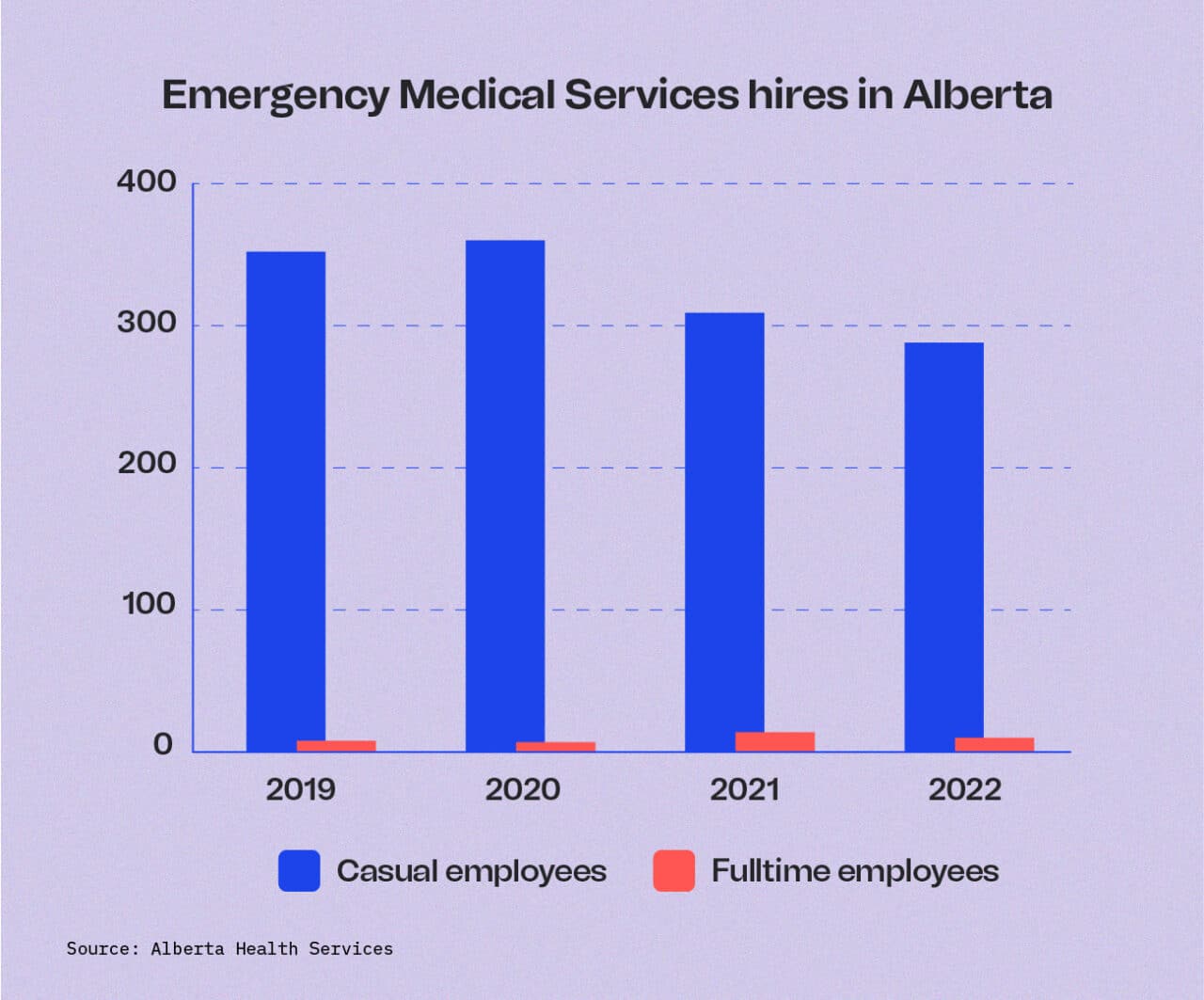
Since 2018, the number of casual Emergency Medical Service (EMS) employees working for Alberta Health Services (AHS) jumped up by half, compared to just a tiny increase in full-time employees, according to documents obtained by The Breach through the freedom of information process.
It’s a revelation of the province’s over-reliance on precarious emergency workers, which has contributed to wide-spread reports of staff burnout, chronic under-staffing, longer ambulance response times, and a ten-fold increase in “red alerts” in parts of Alberta—instances when there are no ambulances to respond to a call for help.
One of those red alerts occurred in Calgary last year, when 86-year-old Betty Ann Williams was attacked by three dogs and died after waiting over 30 minutes for an ambulance to arrive.
Of the more than 300 paramedics hired last year, nearly three quarters are casual workers who don’t receive paid sick days and work on-call or on short contracts with no guarantee of consistent shifts.
Other data released by the Alberta NDP two weeks ago shows that there were almost 19,000 unfilled ambulance shifts in Edmonton alone from January to October of last year.
“When hundreds of shifts are going unfilled each week, to then say, we’re not going to hire people into full-time jobs with job security and benefits, it’s counterintuitive,” said Chris Gallaway, Executive Director of Friends of Medicare, who was shown the data by The Breach.
Gallaway said this “casualization” of essential front-line workers is part of a broader strategy by the UCP to undermine and ultimately privatize the public system, instead of creating a long-term stable public workforce.

A system in crisis by design
“It’s the government’s attempt to kind of fragment the workforce and reduce their costs, to make the jobs less appealing and to spend less money,” said Gallaway. “It’s a strategy that’s rooted in austerity and privatization.”
Last month, the province announced plans to privatize one aspect of the EMS system, by contracting private companies to transfer non-emergency patients between facilities in Calgary and Edmonton.
It’s a move that Gallaway said won’t resolve capacity issues and threatens to pull trained professionals from the public sector to private companies.
Under premier Jason Kenney and now Danielle Smith, the Alberta government has made for-profit healthcare a core part of their agenda.
The province has partnered with for-profit clinics to outsource surgeries, which followed on Kenney selling off public labs, home care, and laundry services.
With a provincial election looming in May, Alberta NDP leader Rachel Notley has promised to “stop treating paramedics as disposable workers” and launch the “largest health-care recruitment campaign Alberta has ever seen.”
During the pandemic, the UCP government has responded to hundreds of code red incidents by announcing funding for new ambulances and more paramedics.
However, the newly released data shows that they maintained a multi-year trend where an overwhelming majority—over 90 per cent—of new EMS hires have been casuals.
The government’s recent announcements have also failed to keep up with the rate of turnover in staff, with an overall decrease in the number of full-time employees last year.
Workers want stability, government offers precarity
The Health Sciences Association of Alberta (HSAA), the union representing paramedics, has repeatedly called for casual workers to be given full-time employment to fill the thousands of shifts going unfilled in major centres.
Currently, a third of Alberta’s three thousand paramedics are casuals. They receive no benefits and work on-call or on 89-day contracts with no guarantee of contract renewal—all reasons the union says AHS has favoured hiring casual workers over full-time staff.
In an emailed statement, an AHS spokesperson said “EMS is doing all it can to find and hire paramedics.”
“Many of our staff prefer the flexibility of casual employment, as it offers the ability to choose shifts, and contributes to work-life balance,” they said.
But paramedics have widely reported raising concerns over their working conditions and contracts, and have spoken about the toll it has taken on their mental health.
“Given how important this issue is, it’s amazing to me that they’re going to play these sorts of classic twenty-first century employer tactics at a time when it’s about Albertans’ health and well-being and lives,” said Jason Foster, Associate Professor of Human Resources and Labour Relations at Athabasca University.
“The government keeps talking about hiring and you would think that if they actually wanted to try and fix the crisis in health care, they would be hiring as many EMS and other healthcare professionals as they can and offering them job security because they’re going to need them in the long term.”
This trend of more precarious work accelerated after the United Conservative Party was elected.
Since 2019, there was a 41 per cent increase in the number of casuals and a 56 per cent increase in part time employees, compared to just a 6 per cent increase in full-time employees, based on a yearly headcount provided by AHS.

“Just-in-time” staffing has failed elsewhere
Alberta isn’t the first jurisdiction where this strategy has been tried.
To cope with austerity measures and unpredictable funding in the 1990s, Ontario’s health care organizations adopted a similar “just-in-time” staffing policy that employed fewer full-time workers and relied instead on more casuals and agency nurses.
According to an article published in the Canadian Journal of Public Health, these policies introduced vulnerabilities in the entire healthcare system, and jeopardized nurse and patient health during the SARS outbreak of 2003.
Fewer staff resulted in reduced surge capacity and more overtime. Workers took more stress-related leaves. And ultimately costs increased as employers struggled to keep up with elevated demand.
In Alberta, a similar pattern is emerging, as paramedics report they are forced to work overtime and have their requests for time off denied.
Precarity weakens worker solidarity
Replacing full-time employees with more precarious labour is still generally cheaper, said Foster, but there are other dimensions of “casualization” that make it desirable to employers.
“It all comes down to power,” Foster said. “Making workers precarious, uncertain, and unsure about what happens next gives the employer more capacity to control the circumstances in the workplace. And that lack of security, that precarity that the worker experiences, results in them being less willing and able to stand up for their own rights.”
Casual employees also generally undermine the strength and effectiveness of unions, Foster explained, because their uncertain position makes them less likely to become active in the union, to take part in a job action, or even file a grievance for fear of not getting enough shifts or being looked over for a permanent position.
“Therefore, they’ll do exactly what the employer wants them to do, which means it allows the employer to breach the collective agreement, even if it’s just in spirit,” Foster said.
“Employers found an opportunity in the last 20 to 30 years to be able to break the social contract with workers in terms of sharing part of the prosperity of economic growth with workers. And they’re taking full advantage of it,” Foster noted.
‘We have people in Alberta’
The Alberta government has also launched a paramedic recruitment drive in Australia to help fill the gaps created by its employment strategy. It’s a plan that Friends of Medicare’s Gallaway says ignores how many trained and qualified medics are already in the province willing to work and waiting for permanent positions.
“We have people right now in Alberta, who we’re churning through as casuals. We’re burning them out. We’re not giving them a real job or job security, and we could do that immediately to start shifting the trend. We don’t need to be going to places like Australia,” said Gallaway.
“We should have a workforce plan for health care, which includes a plan for EMS, and further casualization and further privatization aren’t the answers if we want ambulances for Albertans when they need them.”
Alberta NDP critic for Health David Shephard told The Breach that “there are specific steps that paramedics themselves have been calling for and the UCP have ignored for years.”
“The work of a paramedic is both highly skilled and incredibly difficult,” he said. “Paramedics attend traumatic events several times a day saving the lives and protecting the health of Albertans. They deserve the respect and dignity of being offered a full-time contract with benefits for this essential work.”

When I went to journalism school 10 years ago, my parents thought that they would eventually read my articles in The Montreal Gazette. Today, that newspaper is a husk of its former self. But I get to explain that I’m working towards critical, independent, and sustainable journalism.
Want to be a part of the future of journalism? Support our work with a monthly contribution. Sign up here.
– Amanda Siino, Development Director, The Breach