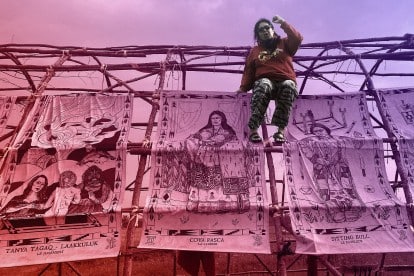
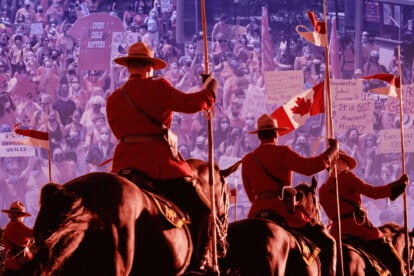
A recent court ruling found the RCMP breached land defender Molly Wickham’s Charter rights—but still upheld her criminal conviction for blocking the CGL pipeline.
Wickham sits down with Desmond Cole to discuss Canada’s colonial courts, police violence, and what she’s learned from a decade of land defence. Full transcript is included below.
The Breach Show is our podcast featuring sharp analysis on politics and social movements in Canada. Subscribe to the podcast on Apple, Spotify, Iheartradio, Google or your favourite service.
Desmond Cole: Welcome to The Breach Show, featuring sharp analysis on politics and social movements in Canada. I’m your host, Desmond Cole.
Sometime this year, and perhaps any day now, natural gas is set to start flowing through the Coastal GasLink pipeline, a 670-kilometer project in British Columbia.
It’s been one of the most contested energy projects in modern Canadian history—with years of delays, blockades, and resistance from Indigenous land defenders, who point out they hold title to the land and never consented to the pipeline.
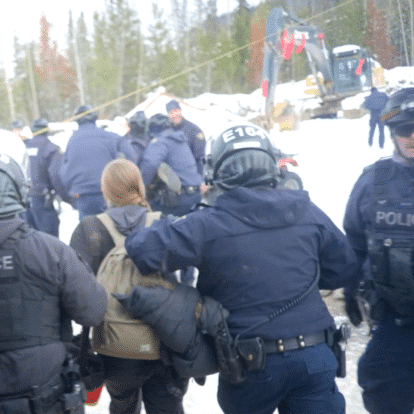
After two court injunctions, the RCMP arrested dozens of people who blocked the path of pipeline workers.
In February of 2025, a judge found that police violated the rights of three of the people they arrested by racially mocking them and by entering their structures without a warrant.
Nevertheless, the judge found that those arrested were guilty of violating the injunctions that barred them from the land. He ruled that their sentences should be reduced because of the violations of their rights.
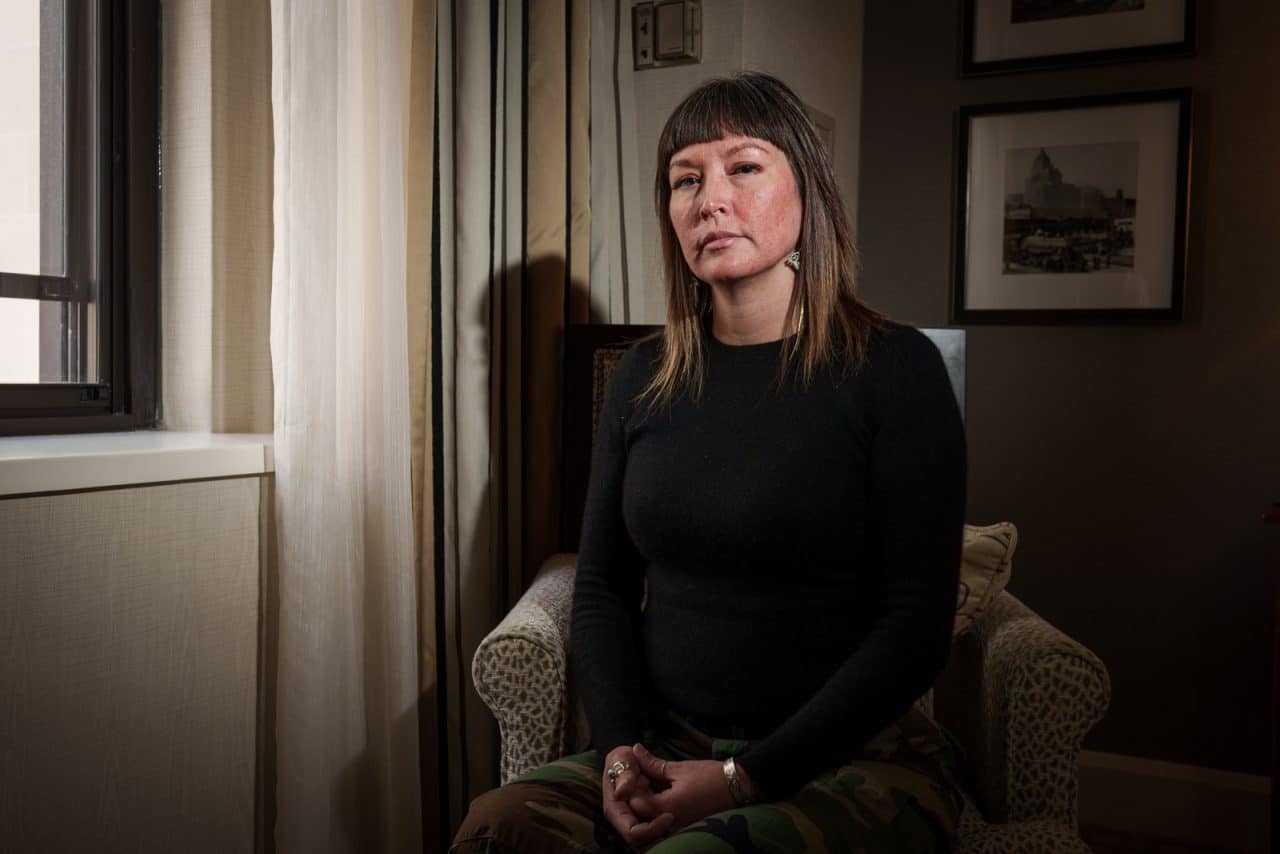
One of the three people convicted of defying the injunction is Molly Wickham, also known as Sleydo’.
She is a wing chief of the Cas Yikh, a house group of the Gidimt’en Clan of the Wet’suwet’en nation, and a spokesperson for the resistance to pipeline development.
We caught up with Wickham recently as she passed through Toronto while promoting the documentary film Yintah, which chronicles the over decade long struggle of the Wet’suwet’en hereditary chiefs against the pipeline.
Molly, thank you so much for joining us today.
Molly Wickham: Thanks for having me.
Cole: We’re here to talk about a battle, a very long battle, between a group of private energy interests in British Columbia and the Wet’suwet’en hereditary chiefs over a pipeline, the Coastal GasLink pipeline, which spans over 670 kilometers and has been contested by your people for well over a decade now.
I just want to start by asking you who are the Wet’suwet’en and what is their connection to the land that you call the Yintah.
Wickham: The Wet’suwet’en are the original people of 22,000 square kilometers of land in northern so-called British Columbia.
We have never ceded, surrendered, treated or lost in war any of those territories, and they’re governed by our traditional clan governance system, which is comprised of five clans of the Wet’suwet’en, and each clan has several house groups—smaller familial ties within each clan—and are represented by our house chiefs.
And that’s the governance system that was recognized by the Delgamuukw and Gitksan court case in 1997, where the Supreme Court ruled that the House groups, within the clans of the Wet’suwet’en nation, hold title to 22,000 square kilometers of land.
Cole: Coastal GasLink wanted to develop this natural gas pipeline through this large area, including through Wet’suwet’en territory.
The hereditary chiefs did not consent, and this began this very long struggle where the owners of Coastal GasLink went to the courts, they sought an injunction, meaning that they were allowed to control who was allowed to go onto this land and who wasn’t.
After they got a couple of injunctions in 2018 and 2019, people started getting arrested. Dozens of people, including yourself, were arrested through this injunction process, and we know that you were just in court, and a judge decided that you and two other Indigenous women were guilty of violating this injunction.
I wonder what you think it says, given that you hold the title to this land and never gave it up.
What does it say that a court decided to side with the Coastal GasLink ownership, and to say that you actually didn’t have the right to be on your territory?
Wickham: Well, the thing with the injunctions is that the test for them is very narrow, and so it doesn’t include title to the land. Our title to the land was never considered in the injunction case. It was determined that that was an outside process.
Within the colonial court system, they work within silos, so the Supreme Court of Canada decision is not being taken into account in this injunction case. That makes injunctions really dangerous to Indigenous people and all people, because the test for it is very narrow. They only look at the economic impact and harm that could be done to a company.
They don’t look at our access to our land, our culture, our way of life, the risk of police violence or state violence to Indigenous people, if there is an injunction in place.
Through all of our court processes, we’re in this foreign system that doesn’t even acknowledge that Wet’suwet’en law exists—that Wet’suwet’en law has existed for thousands of years before Canada existed. It’s inherently racist in excluding us, and in dehumanizing us as if we don’t have our own rule of law, and that the only legitimate rule of law is Canadian law.
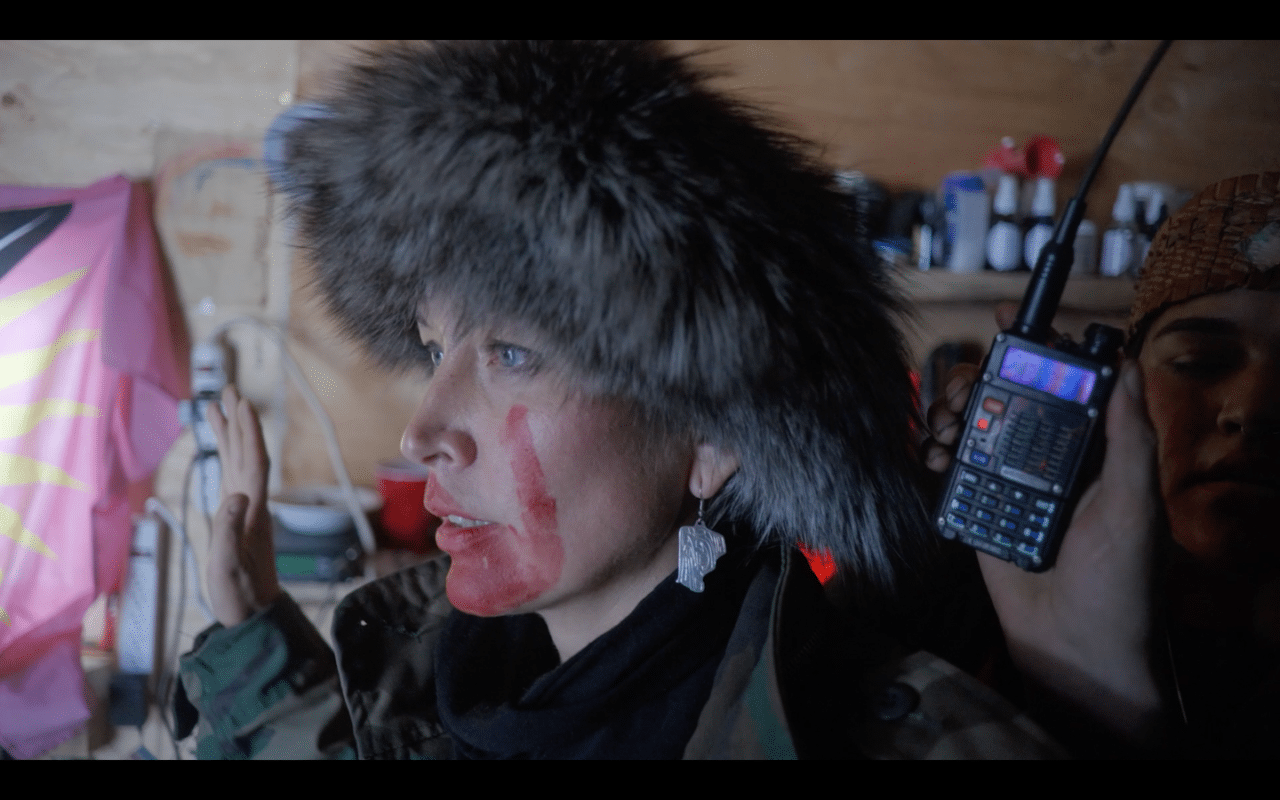
Cole: Now, speaking of racism, despite the fact that this judge found you and others guilty of violating the injunction, he also found that your Charter rights were discriminated against by the RCMP when they arrested you.
The RCMP came into structures that you were in, on the land, without warrant.
We also heard, of course, that the RCMP officers, many of them, during and after your arrest, used some really disgusting, racist mockery of you and the other women.
They made fun of you, calling you “ogres.” They made fun of the red paint that you wore on your faces to commemorate murdered and missing Indigenous women and girls and Two-Spirit people.
The judge said that that was a violation of your Charter rights. But what do you make of the fact that nothing happened to the police as a result of that decision?
Wickham: I just want to correct you that there was myself and another Gitxsan woman that was wearing the red paint hand print. The other person who was arrested with us was a Haudenosaunee man. So, we were wearing the red hand prints.
There were a lot of other racist comments as well by the police about other Indigenous people.
For me, it’s not surprising at all. We’ve been in this relationship with the RCMP for, you know, since contact as Indigenous people, as Indigenous women, but also since this whole conflict started. We just know that the police don’t care about Indigenous women.
If the police cared about Indigenous women, if society at large cared about Indigenous women, if there weren’t state actors being racist, modeling racism and getting away with it and showing that it’s okay, we wouldn’t have murdered and missing Indigenous women to begin with.
I know how inherently racist the whole system is, and that the police don’t care about our wellbeing. They don’t care about our lives. We’re not even human to them. They talked about us like monsters, like animals, and that’s the way that they talk about us. That’s how they see us.
I think the fact that nothing is happening to them is just indicative of the situation that we find ourselves in. That’s why there’s so many murdered and missing Indigenous women.
Even within the court, when I was on the stand, I talked about how the state has treated Indigenous women, how it was strategic to undermine the Wet’suwet’en and women’s authority.
We’re a matrilineal society. Our Indigenous women are highly regarded and upheld in our traditional society. Through colonialism and colonization, they had to undermine the authority of the women.
They had to dehumanize us so that they would only deal with the men, and they did that in really violent ways. Through the priests, through the RCMP, throughout our whole history.
This is no different. This is the state making a show of their power and their racism so that everybody else knows that it’s okay to treat Indigenous women this way because we aren’t as human, and our bodies aren’t worth as much as white women or white people and the power of the state. That’s the reality that we’re facing, and that’s why nothing is happening to them.
Cole: Now the judge did say that you and your co-arrestees were entitled to a reduced sentence as a result of your rights being violated in this way. So, he wasn’t going to throw out the charges or anything, but he did say that when you’re sentenced, the sentence will be reduced.
Some are saying that that’s a victory fighting against racism, because it was acknowledged in that way in court. What do you think about that?
Wickham: The only victory that I feel about this whole situation is the fact that it cost Coastal GasLink 10 extra billion dollars and multiple years to complete their project.
I really thought about how I would feel about whatever decision was going to come out, and I think even in the best case scenario, if the charges had been dropped, it would still be frustrating, infuriating to have our laws be dismissed. We believe in our laws so strongly, in our way of life, that it’s part of who we are.
So, just not being acknowledged as a human being with their own sovereignty and laws is really infuriating to be in that kind of system, and to be in that kind of process.
I shouldn’t go to jail. None of us should go to jail. In fact, they should go to jail if anyone’s going to go to jail. I don’t believe in the whole prison system in the first place, but we shouldn’t even be facing that kind of consequence for upholding our law and following our rule of law.
That’s always been the big debate. Justin Trudeau said it, the police have said it: “We have to uphold the rule of law.”
Well, the rule of law also has committed genocide and caused genocides. The rule of law has put our children in residential schools. The rule of law continues to take our children from us. The rule of law in this case is completely wrong, and we shouldn’t have to go to jail for that.
I’m glad that in that narrow of a framework that there’s some movement, because I know it’s not easy within the colonial legal framework to make change. So I accept that, yes, this is a victory in that realm. It’s not a victory to me. My goals and our goals and our victories are much broader.
Cole: There’s a strong military connection to the land that has been disputed all this time. For example, we know that KKR, the company that owns the majority stake in this pipeline, one of its leaders is former U.S. general David Petraeus, who oversaw a lot of conflict in Afghanistan.
He’s now spearheading strategies about how to get access to lands in British Columbia and other parts of Canada through KKR. We also know that one of the senior members of the RCMP, who was part of this unit that was surveilling and ultimately moving in on Wet’suwet’en folks, was a former strategist for the police in Afghanistan through NATO.
I wonder what it says to you that all of these people with former military experience are now the people strategizing about how to get access to land and to resources in interior British Columbia and elsewhere in North America.
Wickham: I think it indicates the fear that they have of our jurisdiction and the threat of Indigenous jurisdiction to land.
[John] Brewer, who is the gold commander of C-IRG, which is now—they’ve changed their name to the Critical Response Unit—he’s the gold commander of that special industry unit of police, and he trained directly under David Petraeus.
There’s a strong relationship there. I think it really shows society what we’re up against, this militarized police.
The fact that they have to use that kind of force, the fact that they’re using that kind of force against civilians in so-called Canada, I think this should be alarming to people, and it is alarming to a lot of people.
But I think that people have become complacent in the fact that this is happening in their own backyards and in our territories against unarmed Indigenous people who have jurisdiction to the land according to their own colonial courts.
I think that it indicates that, one, we’re a real threat, but also that we are a police state, and that nobody’s going to be free from the kinds of violence and repression that are coming if we don’t fall in line with the status quo and extract every little last resource on this planet.
Cole: When this RCMP unit first started interacting with you, it was called C-IRG, the Community Industry Response Group, which, in and of itself is a quite interesting title for a police division.
They’ve since rebranded and changed their name. Well before you were all arrested, this surveillance through the RCMP was [already] happening. Can you talk a little bit about what that surveillance was like?
Wickham: Since the police have started coming around, they’ve really honed in on a few individuals, and really looked at and followed what the hereditary chiefs are doing.
We’ve even had spies in our feast halls, police officers who’ve worked in the community that have been actually spying for the government on our people. That came out in freedom of information requests by reporters, that committees were saying, “Who’s putting in money? How much money do they have? What are they doing? What are the clans doing in the feast hall? What kind of decisions are being made?”
We know that that’s been an ongoing thing for years, and then with C-IRG coming into play, it’s just been exponential, to the point where it’s actually just a tactic to try to drive us off the land completely.
I think that we all know that it’s been happening for years, but in the past several years, it’s been very, very intense to the point that we can’t even live our lives.
We can’t practice our culture. We can’t access our territories. We’re threatened, followed around everywhere, threatened with arrest all of the time.
We have stories of our house chiefs—the highest ranking chiefs in our territories—being followed to their children and grandchildren’s activities, sports games and all over the town. It’s a small town. You know when you’re being followed.
It again indicates that the state sees and the industry sees the Wet’suwet’en as a real threat.
Cole: Right now there are a lot of conversations happening across Canada about resource development because of this trade war with the United States, and it’s becoming very fashionable for politicians to be like, “What we need to do? We need to develop more pipeline capacity within Canada, and that’s going to protect us from the United States.”
What is your message for other communities who are wondering right now if their community is going to be next, if they’re going to face a similar struggle for a development that they may not want because it’s being prioritized by the Canadian government for the sake of the economy right now?
Wickham: I think that Trump and the U.S. government and the Canadian government are taking advantage of this fear mongering, and we need to take advantage of this fear mongering as well.
This is an opportunity to seek the alternative. If we’re not happy with the way things are going—which we aren’t currently, obviously—this is the opportunity to actually start implementing what a different way of life looks like.
We know from the climate crisis, we know from our own communities, that we cannot continue to extract resources the way that Canada has been and industry has been.
We know that we have to start relying on each other, uplifting mutual aid, working locally to create those relationships and those agreements within our nations and between our nations and allies and accomplices, to be able to start being more self-sufficient.
The more reliant we are on the state, the weaker we are. We have to become more reliant on each other. In our movement, we really learned that.
Look at what happened in Shut Down Canada. That shows and proves the power that we have when we work together, and that we do have real power. To jump on the bandwagon of what might seem like the easiest route is really just missing this opportunity to strengthen our own self-sufficiency.
Cole: You and other people have given so much personally to this struggle. You’ve paid a heavy price. And yet, as we’re sitting here right now, in early 2025. The Coastal GasLink pipeline is completed. It’s set to start flowing sometime this year, any day now potentially.
I wonder how you kind of step back from everything you’ve been a part of in this struggle, and how you understand your struggle and its toll?
Wickham: I think that we’ve learned a lot of lessons. I think that it has absolutely taken a toll, and what I’ve learned from that is how we need to be more sustainable within our movement.
This has never been about this one project. This has been about Indigenous sovereignty, the whole time. This has been a threat to our ability to live as Wet’suwet’en people and to follow our own laws—but it’s always been about more than that.
The lesson that I’ve learned is that we have to learn how to continue and be stronger and be more sustainable in that, because it does take a toll.
So many people have been caught up in the criminal justice system for several years. There were a lot of people who weren’t even allowed back on the territory, at all. I still have conditions that I can’t even go on the territory—my own territory—unless I’m engaged in a cultural practice, or I could be arrested.
These are all real things that we have to contend with, but we have learned so much. We need to share those teachings, and we need to grow from them. I think that it’s an opportunity.
When we first started, we didn’t know anything about anything. We knew our laws and we knew we were doing the right thing, but we didn’t even know how to have a blockade, or how to be in a movement and work with other nations and all those kinds of things.
I think there’s a lot to be gained from it, and the sacrifices are sacrifices that we don’t have to pass on to our children. That’s been the whole goal of this: we want to make sure that our children have a future. We don’t want to pass on these problems to them. We have to do, and sacrifice whatever we have to do, so that that happens.
Cole: Molly Wickham. Thank you for your time this morning. I appreciate you so much.
Wickham: Thank you so much.
Cole: That’s our show for today. If you like what you’ve heard on The Breach Show, please subscribe to the podcast. And if you want to support our work, please become a sustaining member to help us produce more journalism for transformation. You can do that by going to breachmedia.ca/support.
Thanks for listening.
“We need media that enlarges the sense of what’s possible.”
Naomi Klein, journalist and author
Want to support hope-fuelled journalism? Become a sustaining member.