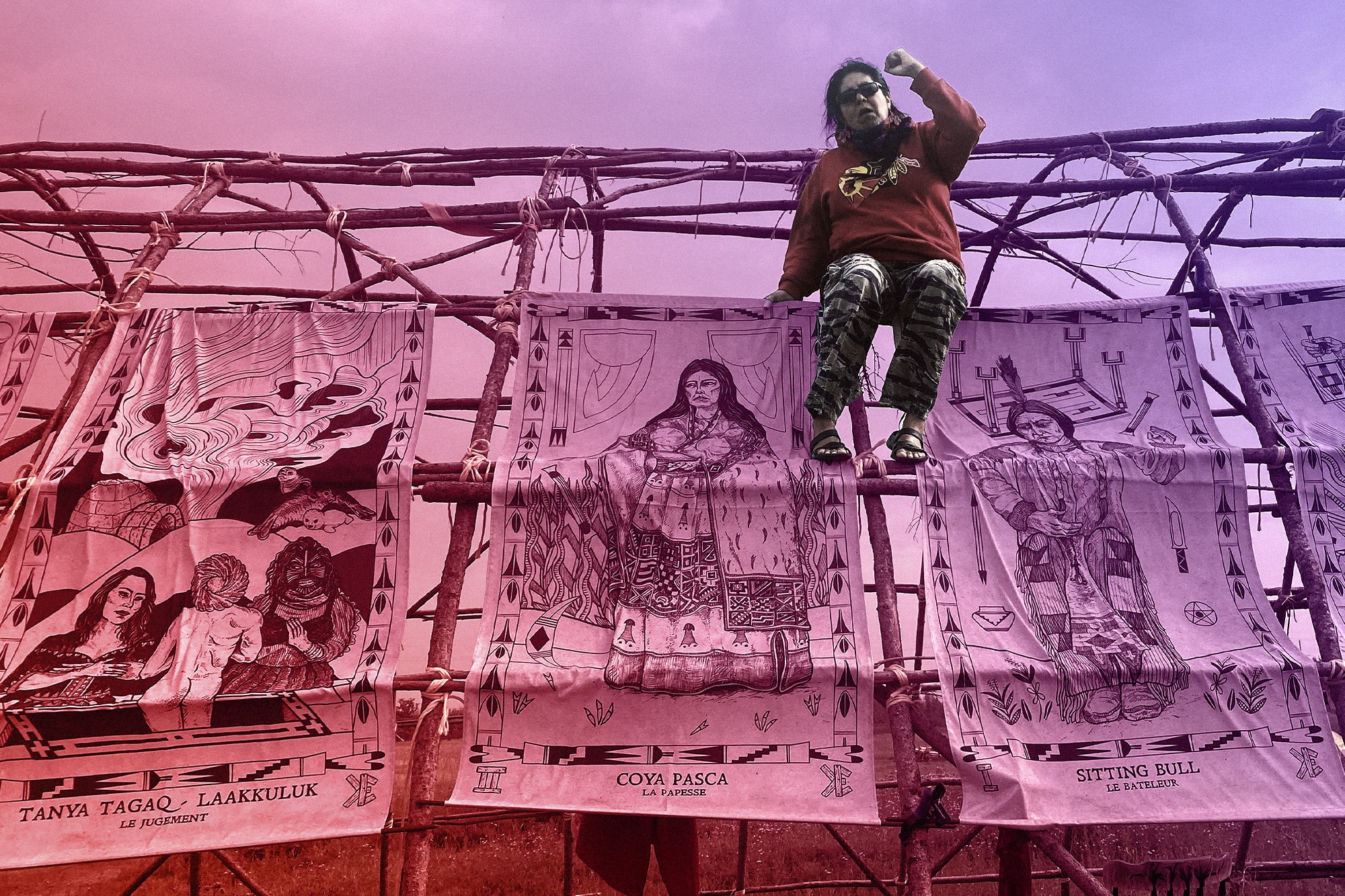
“It’s so peaceful up here,” Jo tells me. “I don’t even want to get down. You can smell the land.”
It’s Monday evening and Jo is sitting high up on the wiigwaam at Camp Morgan at the Brady landfill in Winnipeg. Members of the camp have just finished putting up banners with portraits honouring great Indigenous leaders, artists and activists.
Out of the violence and horror of the murders of Morgan Harris, Marcedes Myran, Rebecca Contois and a fourth unidentified woman known as Mashkode Bizhiki’ikwe (Buffalo Woman) and the compounded trauma of the government’s refusal to search for their remains, residents of the camp have worked to bring life and healing back to the land. A ceremonial fire burns behind us; as I climb to join the wiigwaam, I can see across the camp: to the women’s tent where elders and children rest, to the tipis erected, to the artwork created. All in the shadow of death and violence.
Back home in Kjipuktuk, Halifax, I am missing the North American Indigenous Games. In the airport in Toronto on my way to Winnipeg, I see dozens of young athletes wearing Manitoba hoodies headed to the games. In Winnipeg, the World Police and Fire Games, bringing 8,500 police, border guards, correctional officers and firefighters (one of these things is not like the other one) open at the end of the month. Winnipeg has committed nearly $1 million dollars to the games, offered free transit to participants and volunteers, and recently gave police another $10 million dollars to patrol the downtown core. As usual, the money for police is unlimited. They get to take over the city for games while the bodies of Indigenous women can’t even return home.
A week ago, on July 9, a man named Kyle Klochko dumped trash on the MMIWG mural painted on the road at the site. Members of the camp integrated the waste into the mural, creating a border stretching around the memorial. This camp was established not only to demand action on searching the landfill, not only to pay respect and remember, but to transform pain and grief in the face of ongoing genocide into community, love and support.
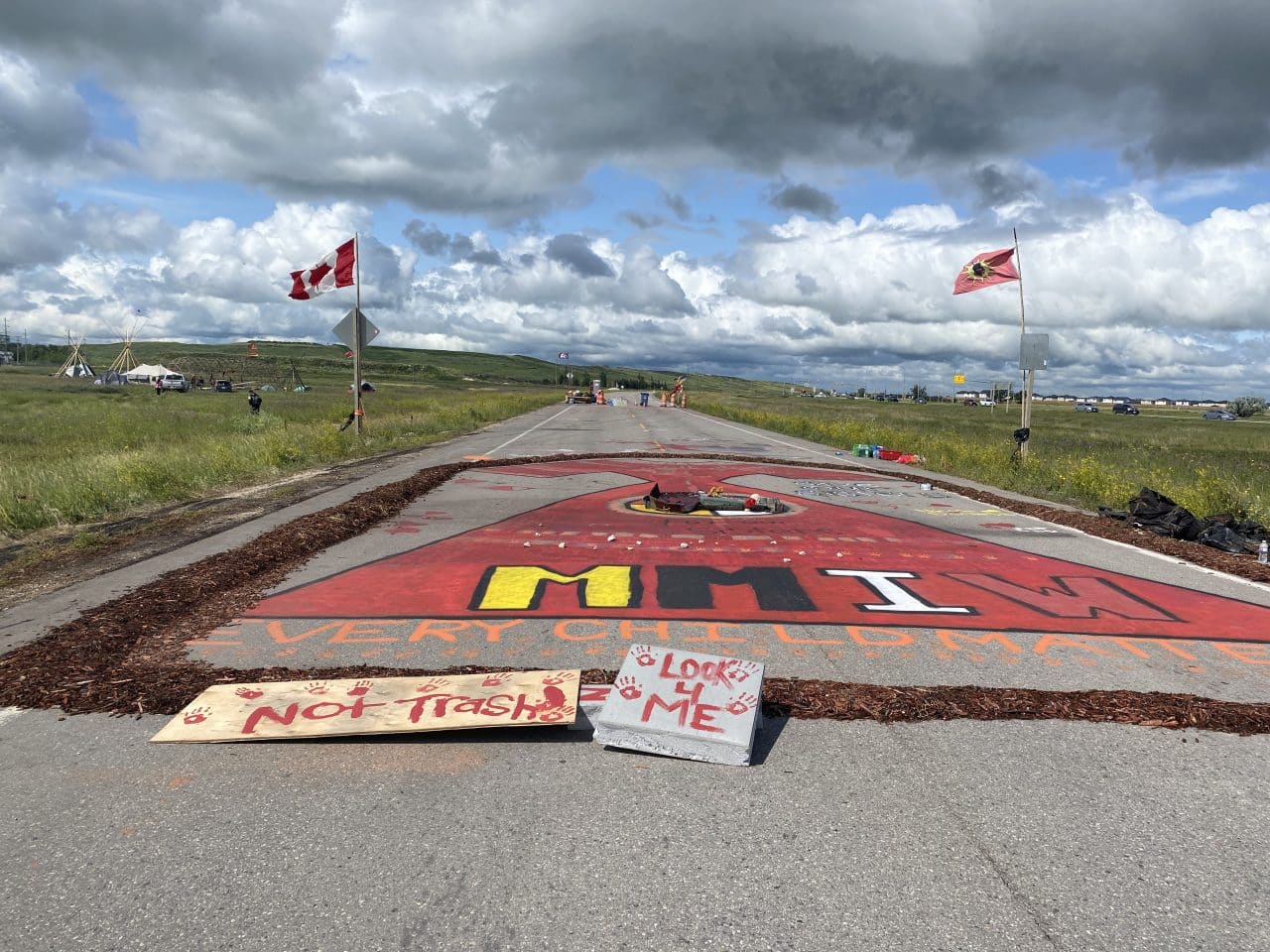
One of many works of art at Camp Morgan, a mural for missing and murdered Indigenous women and girls centres a red dress. Originally part of the REDress project, the red dress is now a symbol of the widespread violence facing Indigenous women and girls. Credit: El Jones
“Fires of War,” blared the Winnipeg Sun headline on July 13, the day before an injunction ordered the protesters to remove the blockade on the road to the landfill. The media is working hard to portray the protest as violent when it is violence that surrounds us, from the women horrifically murdered, to the desecration of dumping their bodies, to the weighing of their lives against claims of “safety” and costs that make up the refusal to even search the landfill.
But here, among women warriors, builders, elders and mothers, what I have found is a fierce love. The love that moves women to jump on trains overnight to come and sit beside their murdered sisters. The love that stays up all night to tend the fires. The love of the male warriors and elders who have come to protect and speak out for women. The love that welcomes visitors and offers teachings.
As Jo tells me, “What is over there in the landfill is terrible, but we can bring something peaceful to them and to our community.”
One woman who has travelled from Alberta where she lives and attends school is Sîpihko-kamâmak (Blue Butterfly). Three of her grandparents were residential school survivors. The elders at the Aboriginal Centre in Winnipeg “put the Indian back in me,” she says. Like many of the women I talk to, she’s been working as a protector across the country. Many of the women were present supporting Unist’ot’en, the site built to protest the incursion of the Coastal GasLink Pipeline through Wetʼsuwetʼen land in northern British Columbia. They’ve faced the full weight of the police brought down against them again and again, and yet they are unshaken.
“I was living here in Winnipeg when they first started Camp Morgan, but I had some healing and work to do so I was called out there,” Sîpihko-kamâmak said. “But I knew I had to be here, so I saved my money and got a bus ticket. Twenty-seven hours [later], here I am.”
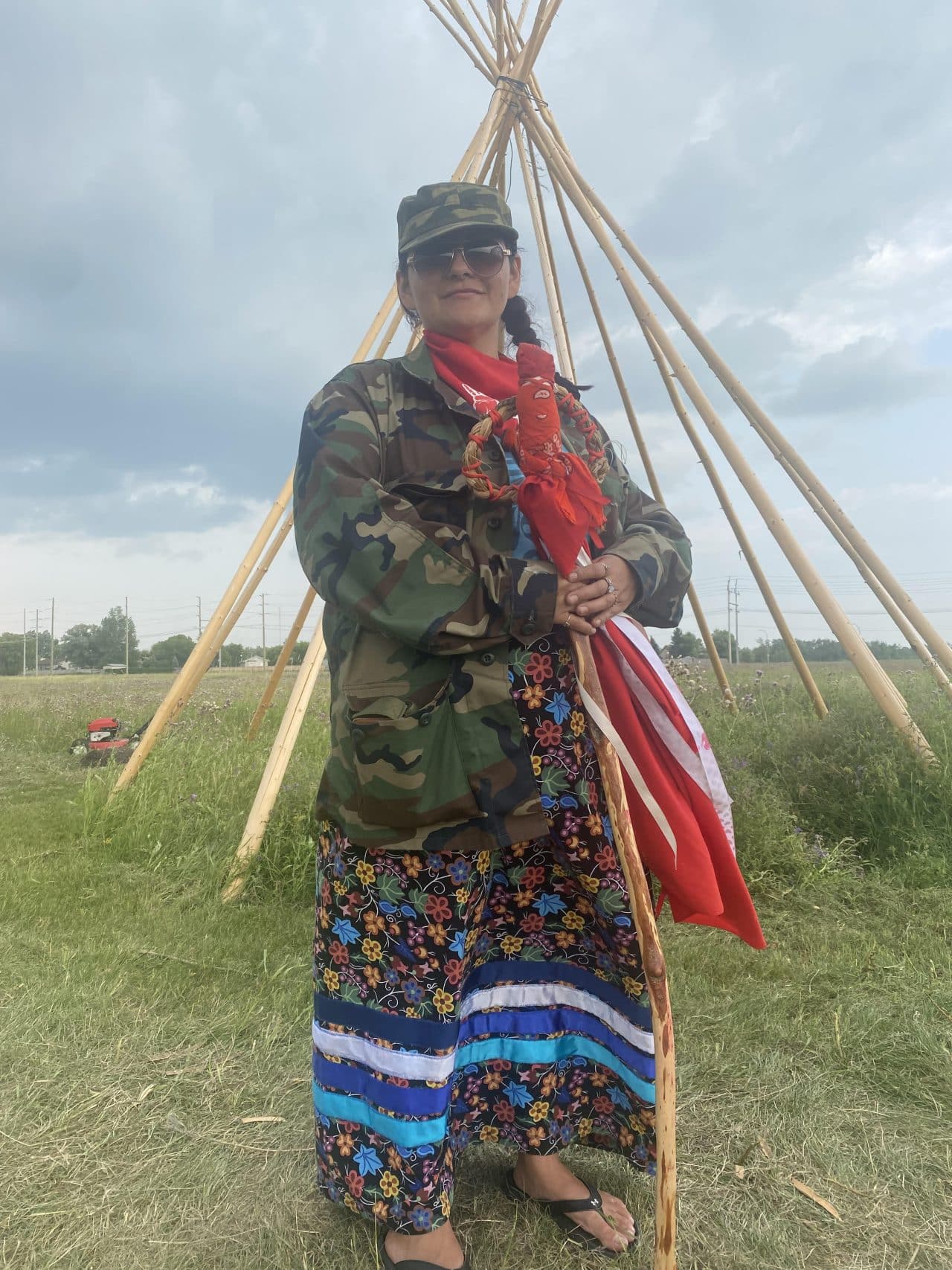
Sîpihko-kamâmak stands in front of a tipi at Camp Morgan. Credit: El Jones
“My main goal is the ceremonial part,” Sîpihko-kamâmak says. She tells me how women put up the moon lodge. “That’s our safe space for women to make sure the children are fed. There’s lots of smudging and song. We have some real gifted sisters who remind us how to do things in a proper way, keeping the hostility and negativity out. Out there it’s politics and government, so we come back here and do some prayers for everyone.”
Sîpihko-kamâmak takes me back to the women’s tipi. The camp was thinking of having a pow wow, but there aren’t enough drummers yet, and everyone’s waiting to see where the spirit takes them. Women change out of their jingle dresses. I’m offered tea. The grandmothers are relaxing and laughing.
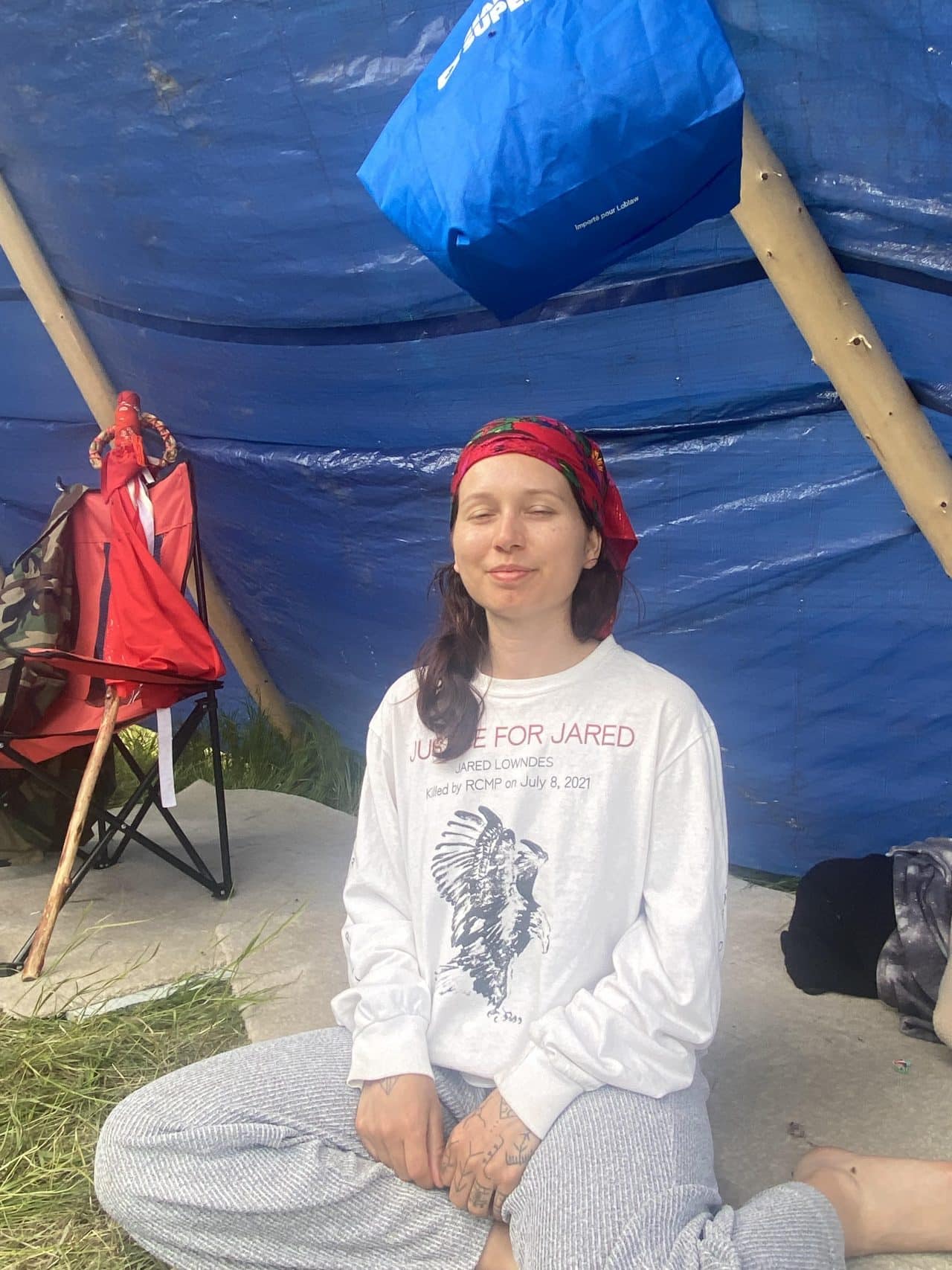
A protester named Link sits in the moon lodge. Credit: El Jones
One of the grandmothers tells me her legs were beaten in the residential school so she is triggered by wearing skirts. Her daughter shows her pants with long ribbons and she thinks she can wear those instead. They teach me about the fire and about medicine. Outside, the men are laying out a tarp to cover the tipi, and stripping poles for the wiigwaam.
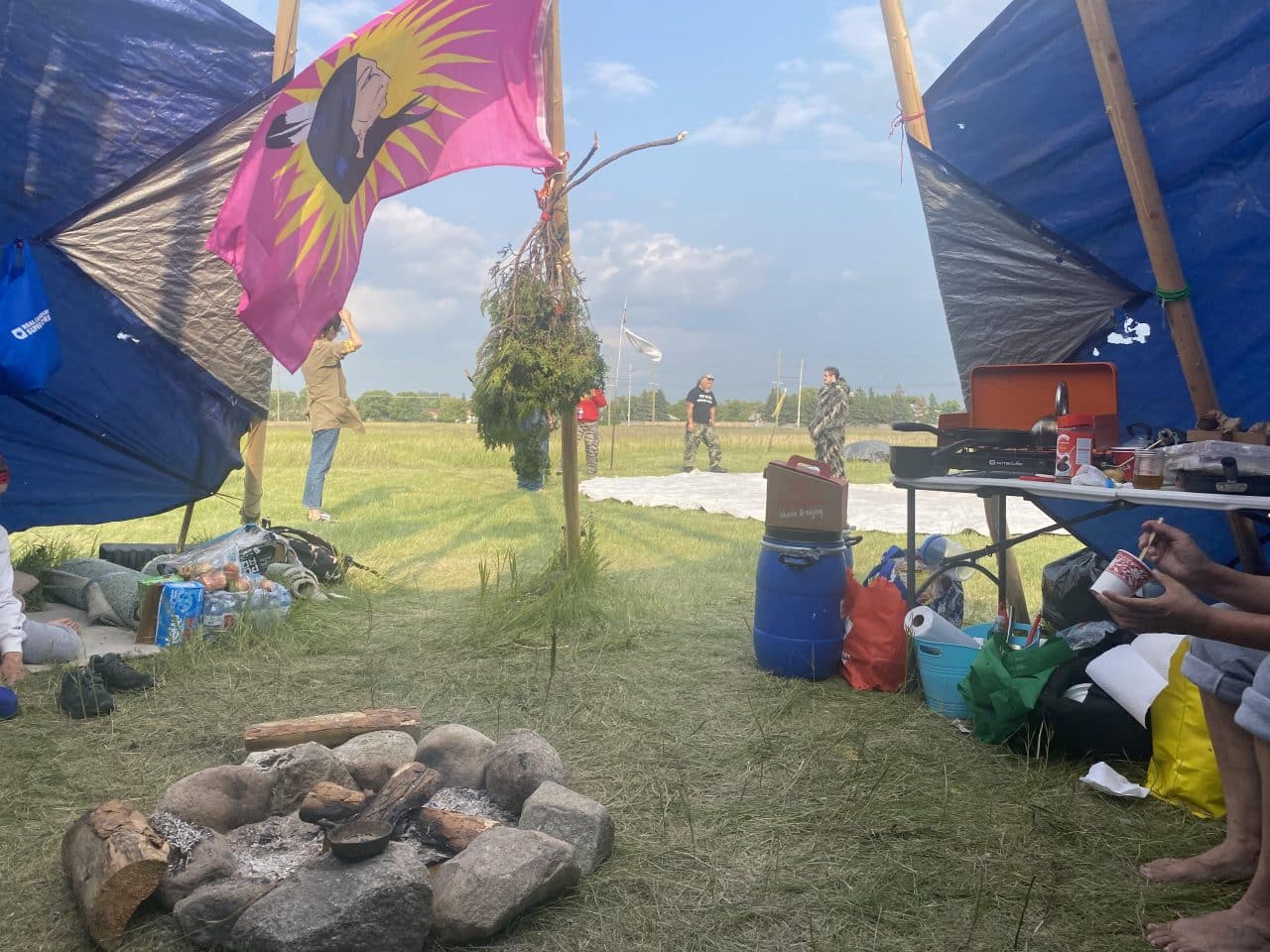
A view from inside the moon lodge shows men at the camp preparing tarp to cover a tipi. Credit: El Jones
Later, Joseph Munro tells me that one of the tipis burned down over the winter with everything inside. They believe that the tipi and the supplies and ceremonial items are now with the women on the other side. The burned tipi still stands: they call it the ghost tipi, another marker of bringing healing from destruction. On the road painted with the names of missing and murdered women, children colour with chalk. Everything built here will be left here, after the police come and remove people. Everyone knows that they cannot stop the police, but they also know that what they have built here cannot be dismantled, displaced or destroyed.
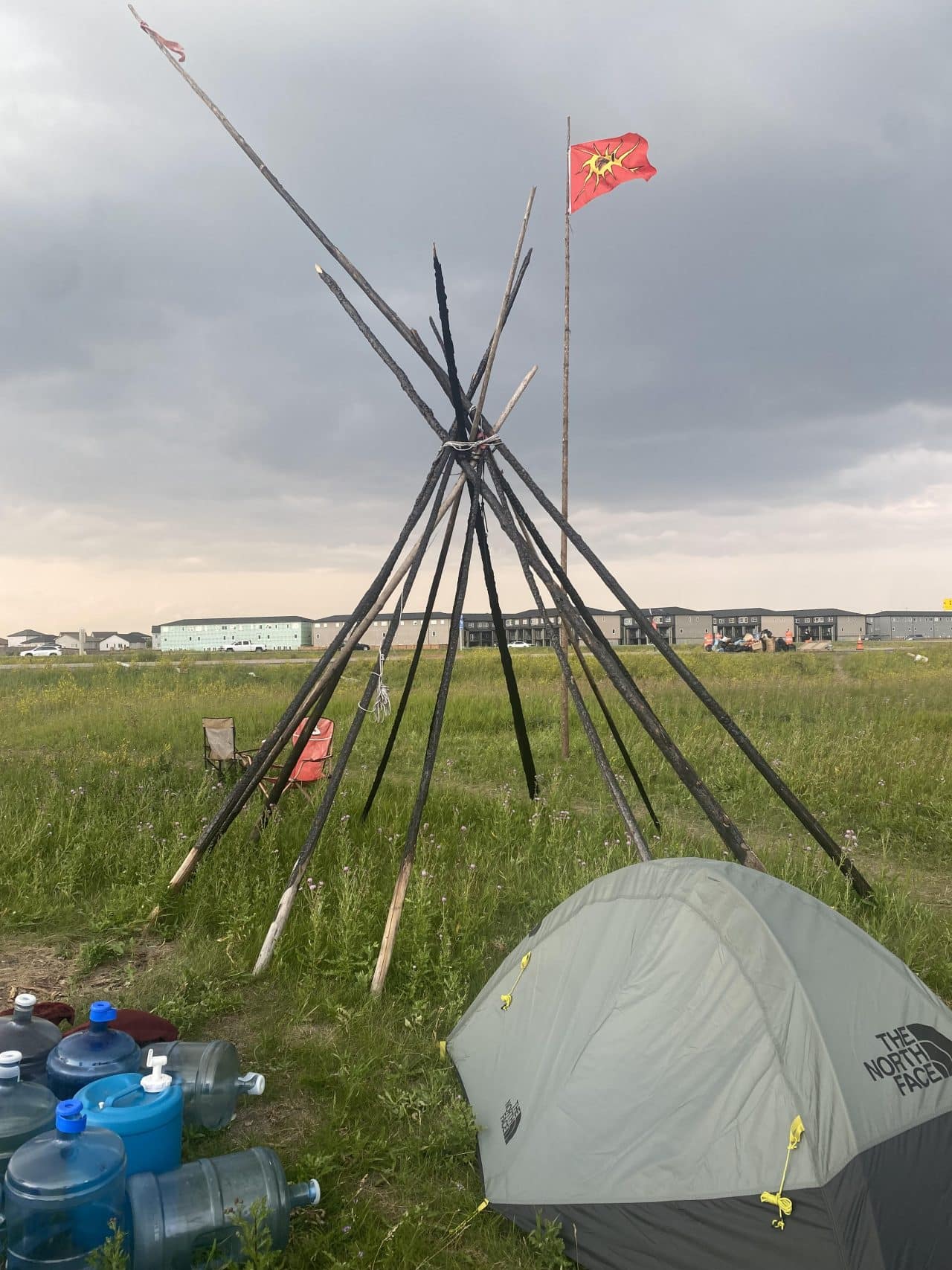
The ghost tipi, as it is known at Camp Morgan, still stands. Credit: El Jones
The next morning, Tuesday, when the camp is quiet and only three women are sitting at the blockade, the police move in. A callout comes for bodies to get to the camp but many people have had to go back to work, to tend to their families, to rest. It’s a familiar story: police watching the site, wearing people down and then moving in when resistance looks the weakest. They’re just doing their jobs, they say, the job authorized by the judge and egged on by the heartless government, and cheered by cruel segments of the public. But the police cannot win, precisely because this is only one site of violence and memory. Moving people out cannot silence the voices of centuries, of untold loved ones, of solidarity.
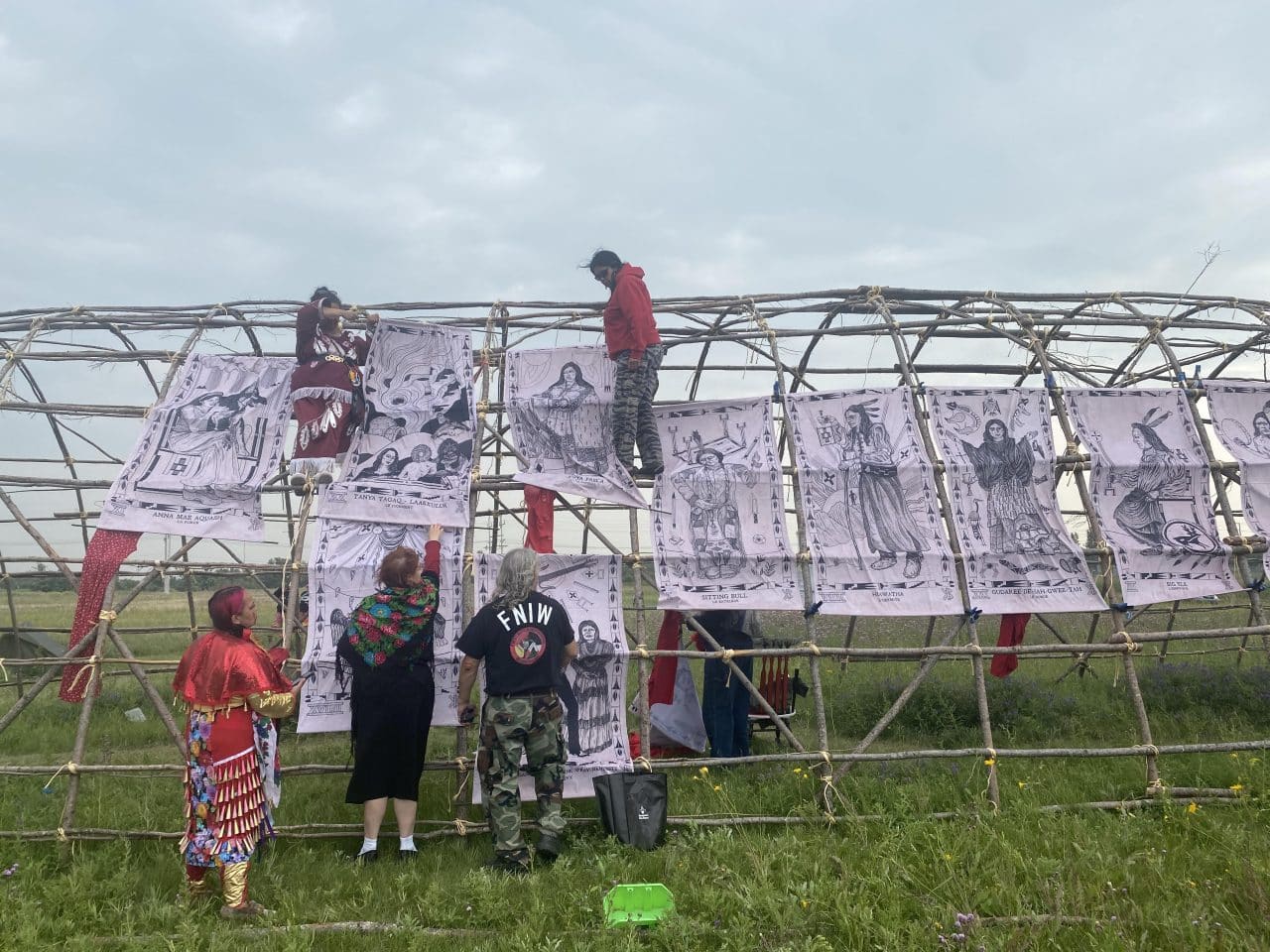
Protesters attatch portraits to the wiigwaam. Art which seeks to give a face and voice to silenced Indigenous women and girls is central to the resistance at the Brady landfill camp. Credit: El Jones
This is what life looks like, and resistance. In my days at the camp, I have been welcomed, taught, and nurtured by people taking the time for this love while fighting simply to not have the bodies of their families and community members dumped like trash. Amid all the racist discourse fired up, the callous calculations, the lies and smears and attacks, the daily debate about whether Indigenous womens’ lives are worth more than garbage, they have still made beautiful spaces to honour and remember them by.
That evening, I go over to the Canadian Museum for Human Rights, where a new camp called Camp Marcedes, is already being built. The fire has been brought over from Camp Morgan. A barbeque is going. Rudolph, who I met the night before, introduces me to his daughter. People smudge the food.
It starts to rain, and they hold a tarp over the fire and continue on.

‘We need an outlet, a source of information that is credible, that is progressive, that we can cling to and believe in’
David Suzuki
Want to support journalism you can believe in? Become a sustainer today.
Defund the Police | Torontonians imagine a police-free city, while Tory defends status quo

Indigenous Sovereignty | Behind a facade of Inuit self-determination, profits flow south

Indigenous Rights | Canada, it’s time for Land Back

1 comment
Comments are closed.
Beautiful story. Doing a good job, Breach. Keep up the good work. Much appreciated. SQ