
Over a month ago, Avi Lewis became the leader of the federal NDP.
Managing editor Martin Lukacs and Spring Socialist Network organizer Deena Newaz debate how Lewis’ win raises new, interesting questions: how should the Canadian left relate to the party now? Can the NDP become a vehicle for mass socialist politics?
The discussion took place in early April and was hosted by professor, author, and activist David Camfield on his podcast Victor’s Children.
The Breach Show is our podcast featuring sharp analysis on politics and social movements in Canada. Subscribe to the podcast on Apple, Spotify, Iheartradio, Youtube Music or your favourite service.

“It’s about getting to the bottom of things. It’s about unveiling who has the power and what they’re doing with that power.”
Linda McQuaig, journalist and author
As a non-profit, free from powerful corporate interests, we invest in investigations and uncover the cover-ups. Sustain our journalism for transformation.
Socialism | Opportunity or distraction? 5 organizers debate how to work with a Lewis-led NDP
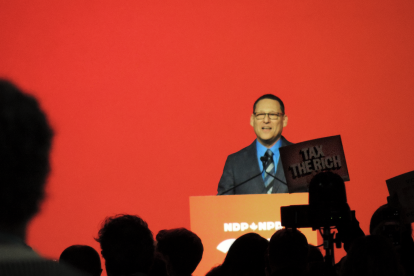
Manitoba | This NDP MP believes ‘unapologetic socialism’ can revive the party
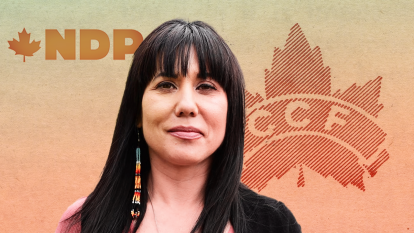
History | The NDP’s untapped radical potential

5 comments
Comments are closed.
Not sure we can expand our seats in the House of Commons
I joined briefly, the federal Liberal party in order to vote for the leader and voted for Mark Carney. In the actual election later in the spring, I voted for the NDP incumbent because I suspected the Libs would win under Carney and we would need an NDP presence to hold back the investment banker view of how to run Canada and I suspected he would just hob nob with the corporate group, which of course he did. I didn’t realize it’d be as bad as it’s turned out to be and the Liberal that won in my riding is doing a pretty good job and has abstained, not voted against, several egregious bills Carney was bulldozing through. I’ve been a frequent critic of the government through my MPs constituency office and I’m on a first-name basis with his office staff, sending them articles from The Breach, the Narwhal and The Tyee too. A week ago, on the phone, I jokingly suggested that Will Greaves should consider joining the floor-crossing extravaganza and cross over to the NDP caucus, and I got a little chuckle from his office employee for that, so I’m gonna write a letter to the local newspaper with some of the same criticisms of Carney and the Liberal government. But mostly I’m focused on the health care issue as well as climate and environment. Whatever helps, and includes some humour.
This is a genuinely important debate, and the Lewis leadership moment opens questions that go well beyond electoral tactics. Let me engage with it through the analytical framework I find most useful — and most clarifying about why the NDP’s dilemma is so structurally deep.
The Adlerian diagnosis
Alfred Adler’s central concept, Gemeinschaftsgefühl, social interest, or community feeling, holds that psychological and social health depends on genuine identification with the wellbeing of the whole community, not merely one’s own advancement or that of one’s immediate tribe. Its opposite is what Adler called the striving for personal superiority, the compensatory drive to dominate, accumulate, and distinguish oneself from others, rooted in a felt sense of inadequacy.
C.B. Macpherson’s possessive individualism is essentially the political-economic institutionalization of exactly that Adlerian pathology. The possessive individual is one who understands themselves as proprietor of their own person and capacities, owing nothing to society, relating to others primarily through market exchange. Liberal democratic theory, Macpherson argued, was built on this anthropological assumption, and Canadian political culture has been saturated by it, increasingly so since the neoliberal turn of the 1980s.
The NDP’s core problem is that it has spent forty years trying to win elections within a political culture organized by possessive individualism, and in doing so has progressively hollowed out its own alternative vision. The party that once offered a genuinely different account of what human beings are to one another: rooted in solidarity, mutual obligation, collective capacity, gradually repackaged itself as a more competent and compassionate manager of the existing order.
What Lewis represents and what he doesn’t yet answer
Avi Lewis’s leadership signals a genuine appetite within the party for recovering that lost vision. His public profile, his associations with the climate justice movement, and his rhetorical willingness to name capitalism as the problem rather than merely its excesses, all suggest someone who understands that the NDP needs a different kind of politics, not just a different leader.
But the Lukacs-Newaz debate, as framed, circles around a tension that Adlerian analysis makes very clear: you cannot build Gemeinschaftsgefühl through vertical strategy alone. Social interest is not a policy platform delivered from above; it is a living practice of horizontal solidarity that has to be cultivated in communities, workplaces, and neighbourhoods before it can be expressed electorally. The NDP’s historic mistake was to invert this relationship, treating electoral success as the precondition for social change, rather than as one possible expression of social change already underway.
The McGill faculty unions I was reading about earlier this week are, in this sense, doing more foundational work for democratic socialism than any leadership campaign. They are building exactly the kind of collective identity, rooted in shared conditions, mutual recognition, and the experience of acting together, that Adler would recognize as genuine social interest in formation.
The possessive individualism trap:
The deepest challenge Lewis faces is not the Conservatives or even the Liberals. It is that forty years of neoliberalism have genuinely reorganized how many working Canadians understand themselves, as individual consumers, homeowners, credential-holders, and taxpayers rather than as members of a class with shared interests. Macpherson saw this coming: possessive individualism isn’t merely an ideology imposed from above, it becomes internalized as common sense, as the natural description of what human beings are.
Democratic socialism cannot win by simply asserting a better ideology against this common sense. It has to demonstrate, in concrete and lived experience, that the Adlerian alternative is real, that people are genuinely more free, more capable, and more fulfilled when they act collectively than when they compete individually. That demonstration happens in union halls, tenant organizations, community health centres, and mutual aid networks, not primarily on debate stages or in Parliament.
The question Lewis must answer:
Can the NDP become a vehicle for mass socialist politics? Possibly, but only if Lewis understands that the party’s role is to amplify and connect social movements that are already doing the work of building Gemeinschaftsgefühl, rather than to substitute for them. The moment the NDP treats itself as the primary agent of change, the expert organization that will deliver socialism to a waiting public; it reproduces the very vertical logic that possessive individualism depends on.
The healthiest thing a Lewis-led NDP could do is make itself, in some genuine sense, less important than the movements around it. That would be the most authentically Adlerian, and most authentically socialist, thing it could possibly do.
The ndp screwed up two ways, 1: going woke, 2: not defending the socalled antivaxxers, who opposed mandates for socalled
Covid19 vaccines.The former, in my opinion, was an ultraleftist
Infantile disorder.
If true to the tenets of democratic socialism, avi could work miracles for the ndp.Especially now.Carneys liberalism is finding criticism. Militarism is on the rise.