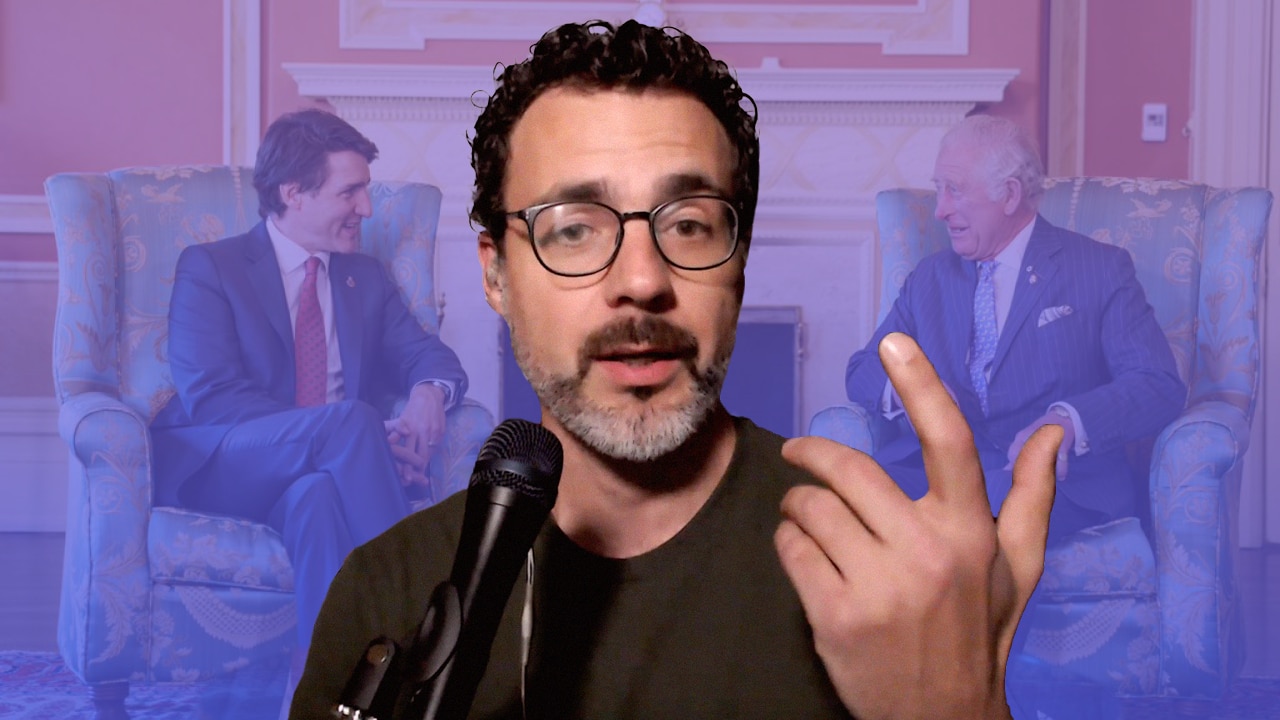
Martin Lukacs: Welcome to The Breach Show, featuring sharp analysis on politics and social movements in Canada. I’m your host Martin Lukacs. Today, we have with us Dan Freeman-Maloy to dissect the historical roots of Canada’s support for Israel’s ongoing destruction of Gaza, and its status as a junior partner to the United States.
Dan is the director of strategic operations for the Canadians for Justice and Peace in the Middle East, and a longtime activist involved in Palestinian solidarity. He’s also a mythbusting scholar, and in my view, Canada’s most astute analyst of the country’s foreign policy toward Israel and Palestine. He received his PhD from the University of Exeter, working under Israeli historian Ilan Pappé, and recently completed a postdoctoral fellowship with the Canada Research Chair on Québec and Canadian Studies.
Dan, thanks for joining us.
Dan Freeman-Maloy: Thanks for having me.
Lukacs: We’re starting to see some cracks in the Canadian establishment with unlikely people speaking out about Canada’s defence for this devastation. But simultaneously, I’ve been struck by how some of these same figures are trying to suggest that this is an exceptional moment rather than being something rooted in several decades of policy.
Let me give you an example. When Canada voted against the UN General Assembly a few days ago, repeating that Israeli settlements in the occupied territories are illegal and an impediment to peace, Canada’s former UN ambassador Louise Blais tweeted her outrage. She said:
“Canadians need to ask our government the rationale behind this devastating decision for Canada’s standing in the world. From my experience, the U.S. did not ask us to side with them. We did this on our own. But why? Because the cost is enormous, and we should be told the reason.”
I was struck that she’s seemingly forgetting that Canada, under her own tenure, also voted “no” on these resolutions, and that’s not to mention an entire multi-decade record at the UN of support for Israel.
I’m curious, from your work and your scholarship, how did these self-flattering notions of Canadian fair-mindedness and honest brokership take root?
Freeman-Maloy: Canadian history forms part of the worst racial imperial alliance in the history of the species—the alliance of the English-speaking races, so-called—which is also famously the most self-righteous and distorting and self-flattering in its depiction of the horrors that it wrought on the world. So, Canada really punched above its weight. Canada, to the extent that was distinct from other parts of the British Empire, was a propagandistic contributor to the British Empire.
That history of lies is unbroken, from the early development of Canada, especially post-Confederation in a period of triumphant Anglo-Saxonism, through to the present. So, the short story is, they’re a bunch of liars.
The slightly longer story is they’re a bunch of liars whose system is in profound crisis, so that there are cracks. There should be. They’re going to wear what Israel is doing. Israel is the emanation of their alliance’s presence in the Middle East.
The rather flimsy anti-racist branding of the Canadian government—as it’s tried to pursue in recent years—it’s just coming apart at the seams, as you have a technologically sophisticated lynch mob massacring in Gaza with the support of the government.
It’s a long-standing pattern, and I think those who are involved in its core can’t be trusted, and it’s against them that we need to think with some clarity and act.
Lukacs: Let’s get into that history. I’m curious for you to, in broad strokes, tell us how Canadian foreign policy toward Palestine started back when—as you mentioned—it was still determined by the British Empire.
Freeman-Maloy: The Anglo settler states—Canada, New Zealand, Australia, to which was added South Africa, alongside Britain—formed part of the racial governing core of the British Empire for a long while. Conquering forces across the world have always looked to this English, Anglo-Saxon alliance, as the pathbreaker.
Let’s just talk about what Zionism is. The European colonial model is when people in Europe face hardship, we have a welfare program for them. It’s called “attack Black and Indigenous peoples and steal their stuff. Right? There’s a famine in Ireland, the English poor have a problem, what is the territory in South Africa, in North America, elsewhere in the world that we can pillage on the moral pretext of helping those in Europe in need?”
That was just cookie-cutter applied to what was genuinely a very hard-off European population group: the Jews. The idea of Jewish colonial settlement abroad was then very explicitly modelled on Anglo-Saxon models of settler colonialism. Canada was the foreign policy of the British Empire, right? It was this model of settler colonial state expansion, where the settlers are themselves the self-propelling motor of imperial expansion. You pretend from the centre that you don’t mean for that to happen, but whether it’s in Palestine, whether it’s in North America, whether it’s in South Africa, it’s the organization from the imperial core of settlers in circumstances where they will feel in alliance with Empire: both that they need Empire, and then they need to expand on its behalf.
That model of attack dog settler colonialism—that general world of which Canada formed a part—provided the template for what the Zionists did. And, not only provided the template, like, [it] put it in Palestine. There wouldn’t be Zionism, if, as one of the latest phases of European overseas expansion during World War One, coming out of the scramble for Africa, which was ongoing. You have the extension of European colonialism to the Middle East, and then a variety of neocolonial systems set up to the League of Nations mandate system. But then, in one case, Palestine, the implantation—at the barrels of British guns—of a Jewish settler colony.
Without the support that they subsequently got from the United States, this wouldn’t be a thing. This isn’t an Israeli massacre. Things go down in early October, and the U.S. is just pumping in weapons. Time after time, even Jewish-Israeli domestic politics have been flipped, where people are saying, “No, no, we can’t get away with this.” And the U.S. just steps in and pours in weaponry and makes it happen. This is not an Israeli problem. This is a regional outrage, being committed by an imperial system of which Canada is an interwoven part.
Lukacs: Let’s talk about that shift toward U.S. power, which is a big focus of your thesis, that kind of awkward period for Canada when the power of the British Empire is starting to ebb and U.S. power is coming to the fore. You quote this very evocative line from historian David Bercuson, that in that interwar period, that Canada was, “tailor-made to play ‘honest broker’ over Palestine, but not between Arab and Jew, but between the United States and the United Kingdom.”
Tell us how this shook out in those years.
Freeman-Maloy: Canadians like to talk about the North Atlantic triangle as being Canada, the U.S. and Britain because it gives them the sense of being part of the ruling group in the world. There’s actually a quote from old Lester B. Pearson, from I think it was the ‘40s, where he’s just like, “There’s this problem between the States and the British Empire, and when these are out of alignment, Canada loses its capacity to play the triangle in the North Atlantic symphony,” or something to that effect.
The whole project of creating things like Canada had to do with a period of British imperial decline back in the 19th century, where recasting the whole project as one of English racial expansion globally meant that you could not only count on the hopeful loyalty of settler states like Canada, Australia, New Zealand, etc., but you could also reframe the whole British world imperial project as centrally including the United States.
When the United States starts becoming an overseas imperial power, with the Philippines War, with the Spanish-American War, this is the high point of a global racism entangling all these people. By say, World War One, when Britain seizes Palestine by the force of arms, Britain is the senior partner, everyone gets it, the U.S. defers to Britain, that’s sort of the situation.
Things become more complicated because in the middle of the 20th century, the British Empire is getting beaten back. What the U.S. is basically doing is riding to the rescue of all the European colonies, which in the absence of U.S. counter-revolutionary intervention in the Third World would have decolonized in some more meaningful way.
Now, Palestine was one of these rare cases where there was a split between the British and the Americans. The Americans mostly look at the Middle East, they’re like, “Okay, we’re gonna have to fill in where the British were. And that literally means we’ll take over British military facilities, we’ll take over British client relationships.”
It was a very collaborative relationship, in the context of a racial, political, economic and cultural alliance that goes back a long time. The problem was the British.
There’s colonialism and there’s being foolhardy, and the British were too interested in maintaining their neocolonial relationships in the Arab world to be fully on board with the fullscale expulsion of people in the 1940s. The Zionist game was the old Puritan game: “We are taking the land over as settlers.”
This is the 1940s. You’re beginning to have decolonization. You’re having to relinquish India. The British Empire is trying to decolonize and maintain what it can, and the Zionists are saying, “No, we are seizing the land for ourselves.” The United States is more supportive of that. The Canadian game is trying to be polite, but maintain that harmony at the core of this imperial system, which corresponds to awful violence for those at its periphery.
What passes for Canadian internationalism is in fact the tinkering within the core of a racial imperial system to which it feels attached. Now, that extends through the 1940s, in ways you’ve alluded to, and we can describe. I think the more famous case comes in the late 1950s, in terms of that part of the world, one of the great last efforts is mounted by the old colonial powers to maintain their position, namely, in the Suez Crisis of 1956 to 1957, featuring, by the way, the first Israeli occupation of the Gaza Strip.
Israel had expelled hundreds of thousands of Palestinians in 1948. Then, the colonial powers, France and Britain, worked with Israel to create a pretext for another war trying to break anti-colonial nationalism in the region. It was just going to lose. A lot of the independent trade unions across the Middle East owe their history to the backlash to what’s called the Tripartite Aggression of 1956. Huge actions by oil sector workers in the Arabian Peninsula. The Soviet Union threatened to get involved, the population of Egypt was armed for a guerrilla war, the likes of which would have just shaken any empire that tried to take Egypt.
In this context, Canada did not speak for international law at all. The Canadian government, in this context, said, “We will try to get these imperialists to get along a little bit better.” What that largely meant was trying to convince the United States that its limited gestures to Third World nationalism, in that context, should be abandoned and that the French and the British not only should not be punished but should be given maximum wartime gains.
In the course of the first Israeli occupation of this Gaza Strip—created by Israel as an enclave densely populated by refugees—Israel carried out lots of extrajudicial assassinations, some significant massacres, and as a condition of leaving, they’re like, “Okay, we’ll leave, but we want then a multinational Western force to come in and pacify the population where we were trying to fulfill that role.” That was effectively the rule that Pearsonian diplomacy tried to play, as of 1957.
We talk about the international community, but when they talk about the international community among like, polite Canadian circles, they mean London and Washington. They mean London and Washington, and maybe let’s try not to irritate the French too much. Let’s try to bring some Europeans in.
Lukacs: You’ve taken us to 1967, up to the Six-Day War, when Israel smashes anti-colonial Arab nationalism. At that point, you know, U.S. dominance in the region is unchallenged, and there really isn’t much brokering of any this kind you’ve described left to do for Canada. At that point, what does Canada’s role become in the region?
Freeman-Maloy: A lot of what has underpinned United States policy since 1967, is an attempt through its alliance with Israel to have a very unilateral form of Western power in the Middle East, where, in this critical region, the U.S. and the U.S. alone paces the security environment for all of its allies. In the 1970s, within the Western alliance, one of the principal points of tension was precisely U.S. unilateral support for Israel.
You have again, the Nixon shocks of 1971, extreme unilateral U.S. monetary moves designed to undercut France and Germany and European rivals. But you also have the extraordinary U.S. support for Israel’s expanded occupation in the West Bank, Gaza, and the Egyptian Sinai and the Syrian Golan Heights. In 1973, Egypt and Syria try to take back their territory.
The U.S. just ships billions of dollars of weapons on a scale that the world has never seen. All the NATO members in Europe say, “No, we’re not participating in this rearmament.” That’s a big moment. What that means, is that the Third World in its entirety is outraged and supporting the Palestinians, and even the Western Allies are saying “No, this is just too far.”
What happens though, to go through it quickly, is that with the fall of the Soviet Union and the unipolar moment of the early 1990s, the Palestinian movement is fairly weakened, and the U.S. is able to impose its unilateralism in a way that doesn’t really have opposition. What happened in the 1990s is that European strategic challenges to the United States as the leader of who decides everything strategically collapsed, but the old moderating policy on Canada, which is like, “Let’s try to mediate, as you said, not between Arabs and Israelis, but between, first the U.S. and Britain, and later, the U.S. and Western European powers.”
An independent Western European strategic policy no longer exists. You still have Palestinian refugees organizing and getting world support, and Israel does deal a real blow to the Palestinian national movement in 1982 by going in and smashing at southern Lebanon and destroying a lot of the P.L.O. infrastructure there.
What happens in the late 1980s, is that Palestinians in the occupied West Bank and Gaza Strip rise up in the First Intifada. You have doves of peace, like Yitzhak Rabin, famously saying that soldiers should break the bones of Palestinian demonstrators and videos of that being done circulating internationally. But more than that, an army that’s breaking the bones of Palestinian demonstrators, young and old alike, is not a fighting force.
What happens in the 1990s, is that the Israeli strategic command finds it expedient to try to outsource the tasks of occupation to Palestinians.
Benjamin Netanyahu gets elected as prime minister on a platform of opposition to the Oslo process, of opposition to this limited peace process. He gets overturned by the Israeli army effectively.
It’s the Israeli army who’s like, “No, no, our boy is a guy [named] Ehud Barak and Barak actually knows what the fighting circumstances are and he will be our prime minister. Netanyahu, you will go back to the fringe and we will try to manage things.”
What happens is that with the uprising, with the Al-Aqsa Intifada, from 2000 on, the renewed escalation of things, Israel might have been in a more vulnerable position. But then September 11 happens and the United States launches an extraordinary outburst of anti-Arab racism and assaults across the region.
There’s this period from 2001, through 2005 to 2006, when Israel’s part of this massive attack across the region, and you know, Afghanistan and Iraq and all of this stuff. But, by the time that Israel invades Lebanon, in 2006, it’s already out of step with the times, as the U.S. has tried to step back a little bit from the overt warfare across the Middle East.
The result is that since then, Israel is increasingly conspicuous as a source of Western-backed atrocities in the region.
Lukacs: I think the latest rightward turn happens in the “War on Terror” under Paul Martin, and then is consolidated and taken even further to the right by Stephen Harper. Do you want to talk a bit about that?
Freeman-Maloy: Totally. We need to have enough historical sense of it, in the sense that it’s often been the case. That is to say, Jean Chrétien was less right-wing on imperial questions than Martin, but in 1998, when they tried to do Operation, what was it, Desert Fox and invade Iraq, it was basically blocked by Western European opposition, and Canada supported the attack on Iraq in 1998. That sort of support for Anglo-American narrowness is pretty standard. It was, I think, Canada and Britain, I bet the Australians were in, I don’t know exactly the voting figures.
What that meant then, is that after the decision to sit out the 2003 invasion of Iraq—Canada participated in Afghanistan, Canada, still had its personnel in CENTCOM, Canadian weapons still went to the invasion, but there was a withholding of certain forms of both diplomatic and logistical assistance from Canada for the American invasion of Iraq in 2003. Then what happens is from 2004, with Allan Rock’s speech at the UN, but especially with Martin’s replacement of Chrétien in 2005, you have a real reassertion of Canadian support for the American Empire as something that we need to make a point of.
In some ways, the Canadian participation in the U.S.-French Haiti intervention—the coup against Aristide—was one of the most conspicuous contributions, alongside then the escalation of Canadian combat operations in Afghanistan.
Support the coup in Haiti, participate in the Afghanistan war, support Israel—these are all gestures of deference to American strategic leadership, such that it was, literally, on the eve of Bush’s visit to Canada in 2004 or 2005, my dates are getting a bit off, where one of the major policy decisions to increase the rejection of Palestinian human rights at the UN came from Canada.
That was Martin. Then you just have Harper. Harper makes life simple. I mean, Poilievre maybe simpler still. But Harper is like a British racialist. Harper goes to the Canada-U.K. Chamber of Commerce in London in 2006, and is like, “Okay, Hezbollah are barbarians, the British race of which Churchill spoke is our people,” he quotes Kipling—
Lukacs: —And God bless the queen—
Freeman-Maloy: —but totally. He’s literally quoting Churchill, quoting Kipling, he’s just mentioning British racialism as the history that is his stock as he would have.
Remember in 2015, his distinction between new and old stock Canadians. That model of organicist British racialism is a big deal, but that’s a slightly different discussion.
The only weird thing about this, is at least the British loyalists, back in the day, didn’t want to kiss the American ring, I’ll say to be more polite. At least, the old model of Diefenbaker was wishing that the British Empire was still more of a force and not wanting to capitulate to U.S. strategic leadership.
That was sort of the model. The betrayal of that model came with the merger of the Reform and Progressive Conservative parties, and that model of Canadian conservatism, federally, that is not totally subject to American leadership died. You had a model of British Canadian Tory politics that were very suspicious of U.S. leadership, and in fact that were more supportive of the Palestinians than the Liberal Party, actually, through the 1980s and 1990s. But that just died.
We have hard-line, imperial, Britishist politics in the politics of Harper. We know what that involves ideologically and we can get into it, with an escalation of a racist rhetoric. Describing Hezbollah as a cancer on Lebanon—this sort of language that really went out of fashion in the 1960s, but if applied against Muslims and Arabs came back in, and the peacekeeping that you and I have been talking about not being all that, the peacekeeping that used to involve the mediation is gone. This is just like, “No, we stand with the hardline war pole.”
There’s an attempt to be very polite about it on the part of the Liberal Party of Canada right now, and simultaneously navigate both. There’s the big pro-imperial bloodlust, and there’s the anti-racist branding of inclusivity, and right now, there’s some sort of attempt to square those, but I think people across the country are really confused.
I don’t think that there’s a cohesive cultural leadership from anybody right now. These are real times of social crisis, where I think the stories that are being told from above about politics not only are false but just aren’t commanding that much credulity.
There’s a real vacuum that people can fill if we can regain a sense of social groundedness and historical memory and start speaking in ways that address people’s lives because the leadership in this country isn’t doing it.
Support for Israel has been very unilateral on the part of the United States. So the hopeful piece is that there is, within the Canadian establishment, a history as was pursued under Trudeau Senior of saying, “We need what they call the ‘third option.’ We need not to so surrender to American unilateral power in this way, because it’s in none of our interests.”
That attempt to not wholeheartedly and solely accept U.S. strategic guidance is just sensible. The U.S. isn’t that powerful anymore. The U.S. cannot impose its will in the way that it used to, and the U.S. political system is in a profound crisis.
We’re probably about to be treated to the spectacle of a Biden-Trump election, that no one wants, that no one can credibly say represents the interests or the opinions of the American population.
It’s not even that ruthlessly sophisticated and efficient from their point of view. They’re sort of losing it. There are parts of the Canadian establishment that are just saying, “What are we doing? Is our plan just to go along with the U.S., with whatever it’s doing?”
I think we’re seeing the cracks you’ve described, and I think what we need to figure out is how we address a situation in which the propaganda system and the foreign policy community in Canada, as in the United States, are pursuing policies that even strategic thinkers who just want North Atlantic power—even setting aside morality—think this is madness. They do not have the power they used to have to impose their will by force. What we’re seeing in Gaza is a tragedy, but it’s not a strategic triumph for Israel. This is catastrophic for Israel, too.
Lukacs: Let me finish by asking you, what will it take the Canadian government now to defy the U.S. again, and become a voice for a ceasefire and reining in the violence that Israel is delivering on Palestinians in Gaza?
Freeman-Maloy: I think there are a lot of different approaches. I think there are people who are trying to appeal to people’s sense of humanity, I think there are people who are trying to—within the system, on strategic grounds—get people in power to take more humane positions.
I think there are also people who are trying to stress the point that this is a moment that is really discrediting the Canadian social system, and on those grounds, force [it] to retreat.
The key point to me is that we’re talking about multi-century and multi-decade developments, and we just need to approach it with a clear head.
There is a pace of politics that’s imposed on us, where even the old American media model now in social media times has given away to this really manic sense of—I don’t mean to say urgency, because things are urgent. But, the world changes slowly. What we’re seeing from our adversaries, in this context, is not as a display of strength, but a display of weakness.
I think that there are all sorts of options, that all should be pursued to try to get a more sensible Canadian policy in place, immediately.
But, to the extent that that’s not forthcoming, I think it’s a matter of—these issues are going to continue for days, and for weeks, and for months, and for years, and for decades—I think what we need to be doing is looking at that long-term trajectory. The fundamental point, I think, is that the rule by people who have more money in this country, the rule by people who come from the right ethnic backgrounds, is not eternal.
There were the days when it was the old stock establishment that ruled—it’s a more complicated situation now. We need to be developing the social strength of the population at large. We need to be insisting that the fact that it used to be the case that in most of the world, these ethnic groups dominated—like the British—but now other people get to speak. There’s a real push right now to shut that down and to use anti-Palestinian racism as a spearhead to attack the whole assertion of an anti-racist politics in recent years.
I think there are then two things we have to do. One is to say that no one, thinking for a second, can pretend that there’s a credible anti-racism at this stage that does not address anti-Palestinian racism. Therefore, in alliance, we need a multi-issue, anti-racist movement, from which none of us will back down.
I think, what sort of policy changes that provokes [and] when, we need to be strategic about. But we also need to approach it with a sense of the long-term and a sense of follow-through, because things are going to be depressing in this period of genocide in Gaza.
“Don’t mourn, organize,” they say. One needs also to be thinking about what energies we have and what we can do. The fact that the hard, heart-wrenching truth is that we don’t have immediate capacities to stop this because we don’t, should not lead to despair but needs to lead to a realistic appraisal of what energies and social resources we do have and how they can be strategically applied.
Lukacs: Dan, thanks for that and for your historical perspective.
Freeman-Maloy: Thanks, Martin.

‘The first video I ever made with The Breach was on why we need to support the movement for Land Back. Today, it’s being used in educational settings everywhere—in universities and colleges and children’s classrooms too. When I give talks, people will say, ‘I saw your video and it helped me understand the issue.’
That’s what we do at The Breach—reach people where they are at, with bold ideas, principled analysis, and critical investigations.” – Pam Palmater, scholar and author
Become a sustaining member of our work today.
Settler Colonialism | Why Canada is one of Israel’s most extreme defenders
Gaza | Canada’s hand in the war on Gaza
Canadian company’s Israeli subsidiary sold more deadly weapons than advertised
2 comments
Comments are closed.
It is simple, the rich and powerful in Canada do a lot of business with America so they support America when needed. Our government regardless of party does what the powerful tell them t do. It has nothing to do with being a settler or colonizer society whatever that means since we keep bringing in new settler colonizers as immigrants. I suspect most Canadians and even Americans support what Israel is doing and it can be seen in the confusion coming from the politicians and some media. Being on the opposite side is not always being right
“Freeman-Maloy: Canadian history forms part of the worst racial imperial alliance in the history of the species—the alliance of the English-speaking races…”
Not sure I’ll read past this point. There’s only one race of H o m o sapiens. If you don’t understand that, the rest of interview is questionable.