
Canada’s newspapers lately have featured a new type of financial advice: encouragement to their elite readers to invest in profit-gouging oligopolies.
Two airlines. Three grocers. Three telecom providers. Six big banks.
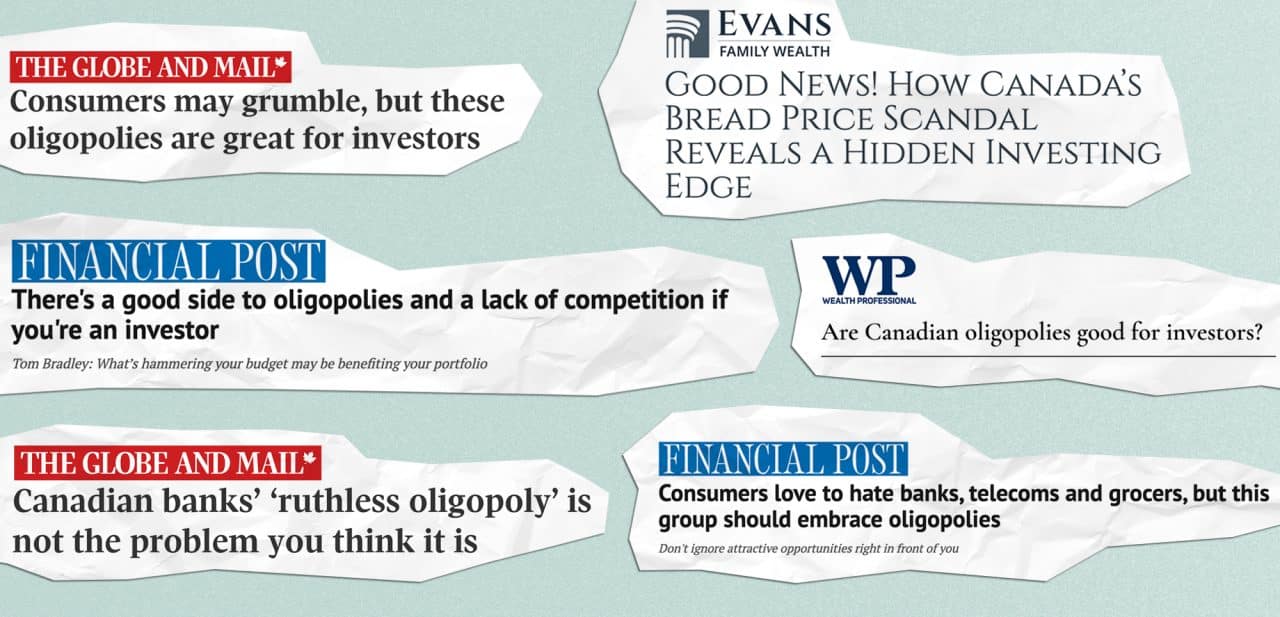
According to elite media, investors should park their money with these corporations that dominate their industries and are driving a cost-of-living crisis—and maybe even have a laugh at the expense of those struggling to buy groceries or pay their bills.
Buying shares in Telus, one of just three companies that control 90 per cent of its market? “You won’t be enraged over service fees when they go into your pocket,” The Globe and Mail suggests.
Investing in Loblaws, the most profitable Canadian stock in the past decade? “Rising food prices might not sting so much,” the article says.
And then there’s Canadian Pacific Kansas City Ltd, a rail line operating in a sector where it is extremely costly to build new infrastructure. “Worried about a new, low-cost railway undercutting the established players? Exactly.”
By now, the joke that Canada is a few monopolies in a trenchcoat has become familiar.
“Consumers love to hate banks, telecoms and grocers,” the Financial Post acknowledges in an article, but “they offer stability, impressive profitability and relatively notable stock performance when left to operate without notable regulatory intervention”—in other words, without the government reining in their predatory behaviour.
Another Financial Post article, entitled “There’s a good side to oligopolies and a lack of competition if you’re an investor,” is honest that such firms are great because they are “in a position to control pricing and pound down new competitors or buy them out.”
One Canadian business analysis site has even created a basket of recommended oligopoly stocks.
The pitch these outlets are making is consistent: sure, Canada doesn’t have Silicon Valley unicorns or a constellation of hundreds of competing firms in key sectors, but who needs innovation when you’ve got grocery cartels, telecom duopolies, and banks that charge you huge amounts for the bare essentials?
What’s hurting working peoples’ pocketbooks is actually juicing your portfolio. And that’s a good thing, actually.
Crushing the competition
While the defiant endorsement of oligopolies is new, establishment business pages have long praised corporate concentration as a win for investors.
Back in the late 1990s, waves of mergers and acquisitions were reported in glowing terms—“bigger is better” was the mantra—even as jobs were cut and consumer choice shrank.
The stock market rewarded consolidation with surging share prices, but for workers and households it meant layoffs, higher prices, and less control over their economic future.
It’s no different today. Trade outlets like Wealth Professional point out that “from an investment standpoint, the relative lack of competition in many Canadian sectors means that investors don’t run the risk of ‘picking the loser.’”
Another Globe and Mail column acknowledges that Royal Bank CEO Dave McKay has described Canadian banking as a “ruthless oligopoly,” but quickly reassures readers that this was not a problem but a positive.
Canadian banks, he argued, are “more cutthroat than we would expect” supposedly because the threat of new companies in their industry keeps them acting like they face real competition.
That’s one way to put it. Another is: competition in Canada has been crushed, prices are soaring, and if you own enough stock in the country’s biggest players, you get to skim profits from the very crisis hammering the rest of us.

The beneficiaries of oligopolies: the 1%
Corporate oligopolies are a very Canadian story.
Banks, airlines, telecoms, insurance companies and grocers have each carved up their industries. Canadians pay some of the highest cell phone and internet bills in the world as a result, while grocery prices have outpaced inflation for nearly three years and Loblaw’s profits have ballooned.
Yet the CEOs of these companies routinely insist that their industries are in fact “vigorously” or even “ruthlessly” competitive.
The benefits stemming from the growth in oligopolies are wildly unequal. Only a minority of Canadians own significant stock holdings outside their pensions.
Wealth is heavily concentrated among billionaires and the richest one per cent, who alone hold nearly 30 per cent of all wealth.
Meanwhile, the bottom 60 per cent had virtually no stake in Canadian corporate wealth, according to the Canadian Centre for Policy Alternatives.
So while media columns pretend everyone can get in on the game, the reality is most people are just paying the bills that generate these “safe returns” for the already wealthy.
Defenders sometimes argue that oligopolies are simply “necessary because of our low population and geographic dispersion,” as Wellington-Altus manager Martin Pelletier told The Globe and Mail.
But this reasoning collapses on closer inspection.
Saskatchewan’s crown-owned SaskTel, for instance, delivers some of the lowest wireless prices in the country, despite operating in one of the smallest provincial markets.
And abroad, foreign telecoms companies in Argentina have thrived in markets far smaller than Canada’s, proving that concentrated ownership is not a demographic inevitability.

What harms households enriches wealthy shareholders
When the establishment media promotes investment in oligopolies, it is asking readers to accept concentrated corporate power as natural, even beneficial.
This glosses over the reality that workers are being asked to hop on the bandwagon for an economic system that delivers meagre wage gains, soaring consumer costs, and record corporate profits, all so they can cling to the hope that their modest savings might keep pace with the rising cost of living.
The very criticisms of oligopolies—high prices, poor service, anti-competitive practices—are not inconveniences to be explained away, but the precise reasons they’re such profitable investments.
What harms households is exactly what enriches shareholders. For investors, this is presented as hard, actionable truth; for everyone else, it’s a reminder of how tilted the system has become.
Even the Globe acknowledges that Loblaw “carries some baggage”—namely, a bread price-fixing scandal that made it a national symbol for food-price inflation. But in the same breath, it reassures investors that the stock is still a winner, seeing double-digit gains in two years.
In a 2022 analysis for the Financial Post, as the cost-of-living crisis was gaining steam, one financial advisor exulted over the fact that Loblaw was posting “such strong profits that it’s now taking heat for gouging customers who are struggling with food inflation.”
This was “encouraging news” for investors, because it indicated that Loblaw and kindred oligopolists would be able to maintain their profit margins in the face of rising input costs. ”So next time you’re grumbling about the price of toothpaste, or the cost of internet access, keep in mind that what’s hammering your budget may be benefiting your portfolio.”
Similarly, an article published by Evans Family Wealth—a financial advisory arm of Wellington-Altus—reassures investors that Loblaw’s price fixing scandal exposes a “hidden investing edge.” Consumers, they write, got the short end of the stick in a deception that generated more than $4 billion in excess revenues for the mega-retailer.
For investors, though, “it is a stark reminder of how lucrative market concentration can be.”
Cynically, the blog post states, “If you live in Canada you already pay oligopoly prices for food, data plans, and bank fees. Owning a slice of the profits can help offset that cost.”
Is a post-oligopoly Canada possible?
Breaking this cycle won’t come from “ethical shopping” campaigns or individual investment choices. It requires political will. Competition law reform, stronger antitrust enforcement, and even outright breakups of mega-firms are all on the table in other jurisdictions.
In New York, mayoral nominee Zohran Mamdani surged to victory with a proposal to open public grocery stores across the city’s five boroughs. The idea is based on a public alternative stepping in where private markets fail.
Canadian policy thinkers like Vass Bednar have argued the same policies could work here. After all, governments already run utilities, transit, and even telecoms in some provinces. She argues that a municipally-run grocery wouldn’t eliminate competition, it would expand it, giving consumers at least one non-profit option in a system rigged for corporate greed.
Canada’s Competition Bureau has warned that concentration in groceries and telecom is harming consumers, but it has virtually no enforcement power and Ottawa has been timid about acting.
Meanwhile, Canada’s establishment media pitches corporate concentration as stability and prosperity, and tells us oligopolies are one of our greatest assets.
If you can afford to invest, they say, you can ride the wave. If you can’t, you’re left to shoulder the bill.
Until meaningful intervention happens, this will remain the Canadian story: oligopoly profits for the few, struggle for the rest.

The Breach’s investigations don’t just inform our readers—they force the powerful to react.
An exposé on blood plasma privatization led to national headlines. Our revelations about the government’s cozy connections to Big Pharma sparked a parliamentary probe. A report on high-tech price-fixing by mega landlords resulted in a criminal investigation.
From activists to elected officials, people are using The Breach’s journalism to push for transformative change.
– Dru Oja Jay, Board President, The Breach
Foreign Policy | Canada shifts its tone on Gaza but not its complicity

Media Criticism | How Canadian media provide cover for racist acts

Corporate Power | Pundits regularly attacked pharmacare without disclosing Big Pharma ties

3 comments
Comments are closed.


What an apalling display of greed!
Why is the answer for the left always more government? Taxpayer funded grocery stores and more people on the government payroll with their higher than average pensions and wages does not sound like something that will benefit anyone, except the government.
https://www.investopedia.com/terms/n/neoliberalism.asp
Neoliberalism for 45 years gas destroyed governments ability to deal with big ignorance business. Look world wide to see the control. In Canada 2000 lobbyists make sure big businesses get their way. The Teck Mineral Corp is to be purchased by ? ANGLIO We have allowed this and as productivity depends on business investments, there are no businesses left in Canada . Neoliberalism is a compact between business and governments to increase profits as Milton Friedman and James Buchanan visualized. BIG OIL, PHARMA, FOOD, AGRO, MEDIA AND TELEPHONE. ALL oligopolies. And God help us Libertarian Poilievre ever gets elected as he has promised to eliminate all social benefits. THE STAR, LINDA MCQUAIG APRIL 3 2025, CARNEY IS DIFFERENT THAN POILIEVRE