Loblaw chairman Galen Weston Jr, the creaseless face of inherited Canadian wealth, smiled serenely at parliamentarians as he explained why, when it came to rising food prices, his company was blameless.
Speaking to an agri-food committee in the spring of 2023, he told them that Loblaw’s profit “goes back into the country.”
“The profit we do generate, we reinvest back in this country to create more stores, more services, and more jobs,” Weston said in the same dulcet tones he uses to sell President’s Choice products on television.
While Weston didn’t back up his claims with any numbers, nor did his critics have any with which to dispute him.
Now we do.
Two new reports, one by Canadians for Tax Fairness and the other by CLC economist D.T. Cochrane, reveal that Loblaw—and many of Canada’s major corporations—are primarily using their profits to enrich their already wealthy owners, instead of using them to the benefit of Canadians.
The data shows that since the 1980s, Canadian corporations have reinvested dramatically less and less into new equipment or products, even as corporate profits steadily increased.
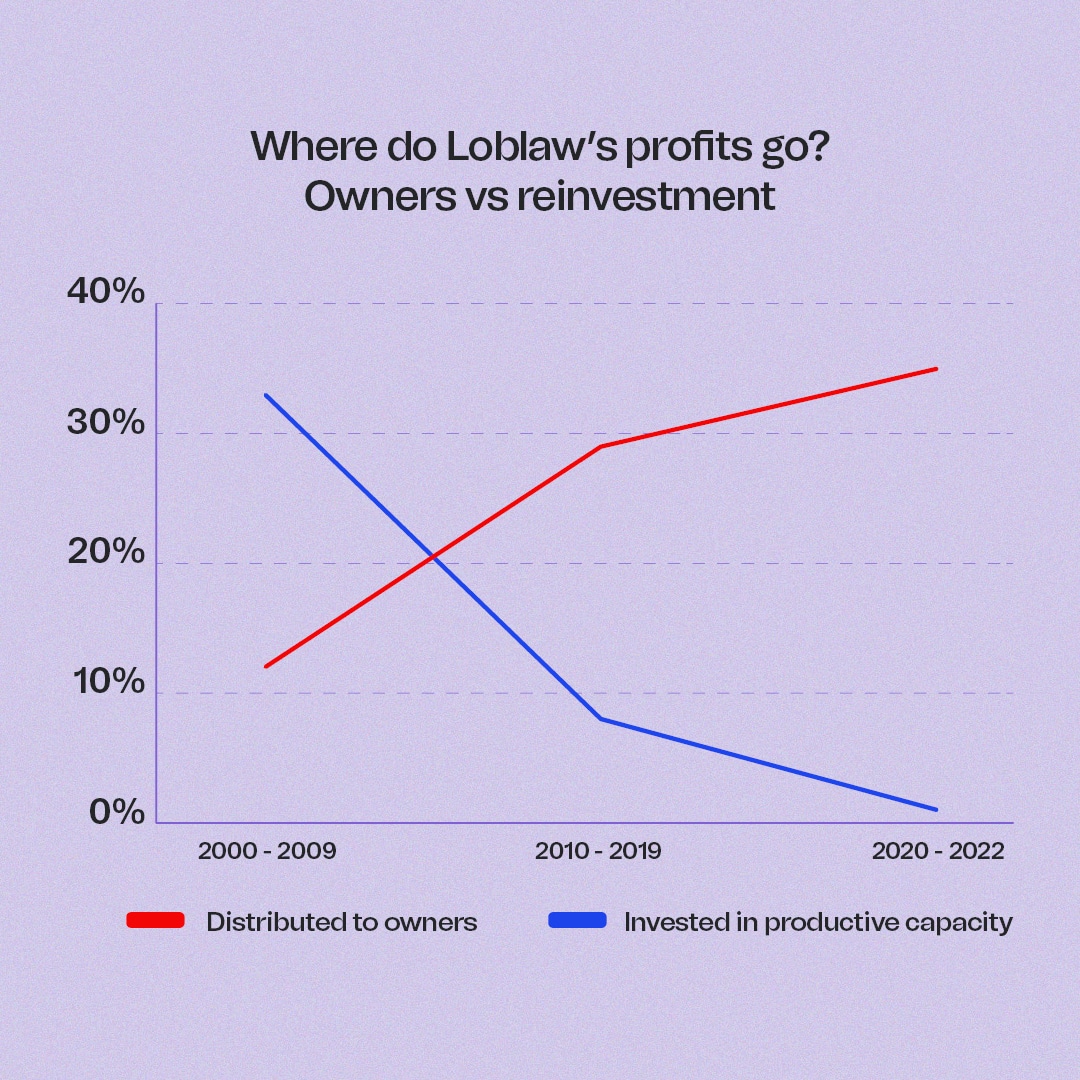
Decades ago, they devoted as much as a third of their profits to reinvestment. Today that number has shrunk to a piddly ten per cent.
In the case of Loblaw, the decrease in reinvestment is even more extreme: from 2020 to 2022, it was a mere one percent.
So where is the money going?
According to the number-crunching by Canadians for Tax Fairness, Canadian corporations are using more than two-thirds of their profits to pay out dividends to their shareholders and buy back their shares.
The latter maneuver drives up the price of their share (not to mention the bonuses of executives like Galen Weston Jr, which are often tied to share prices) and plows even more money into the pockets of their investors.
What it doesn’t do is contribute to productive investment.
In other words, and flatly contradicting Weston, not more stores, not more services, and not more jobs.
So much for the ‘trickle down’ of corporate profits
For decades, we’ve been told we shouldn’t worry about the slash-and-burning of regulations and corporate taxes.
Higher profits for companies and their wealthy owners would supposedly “trickle down” to the rest of us in the form of investment, which would spark more jobs and better incomes.
But the numbers betray this essential dogma of the neoliberal era.
Despite a friendly business environment—basically, unheralded power and freedom—Canadian corporations are investing their profits less than ever before.

Economist Jim Stanford writes that this is a “sure sign companies literally have more money than they know what to do with.”
He points out that the grocery giants Loblaw, Empire and Metro “spent twice as much last year on share buybacks as it would have cost the entire food retail sector to raise wages for all grocery store workers by $2 per hour.” (Remember when the grocers offered workers $2 “hero pay” during the initial COVID lockdowns, then clawed it back?)
Investors may understand that any major growth that comes from investment will make workers hungry for a bigger piece of the pie. Instead, by curtailing growth, they can keep workers permanently insecure and more compliant.
But whatever the cause of the hoarding, the connection between higher profits and greater investment has been resoundingly shattered.
And despite the sweet promises of Weston Jr, the time for small fixes is over.
Both reports advocate significant increases to corporate and windfall taxes. That would ensure that massive corporate gains truly, in Weston’s words, “goes back into the country.”

When I went to journalism school 10 years ago, my parents thought that they would eventually read my articles in The Montreal Gazette. Today, that newspaper is a husk of its former self. But I get to explain that I’m working towards critical, independent, and sustainable journalism.
Want to be a part of the future of journalism? Support our work with a monthly contribution. Sign up here.
– Amanda Siino, Development Director, The Breach
Corporate Power | Grocery giants paid for friendly Liberal, Tory policy with decades of donations

Corporate Power | Grocery giants are screwing Canadians—and farmers have proof

Capitalism | How Canada’s grocery ‘cartel’ doubled its profits while food bank lines grew

15 comments
Comments are closed.

Hi, there’s a spelling error in your chart caption, should be distributed not “destributed”
https://breachmedia.ca/canadas-soaring-corporate-profits-reinvestment/
I worked for all the major food company’s and none of there money is invested in canada it is invested in China and other country’s people just has to wake up and see that over ninety five percent of the foods are processed in these country’s and people beware of your meat you buy to if you can buy local buy it because you don’t know what your eating now that stores are selling Un expected meat
Buy from your local farmers
A spade is a SPADE… not a Manure Redistribution Implement.
Let’s wake up, people.
Torches and Pitchforks… anyone?
Really the type of completely uniformed opinion I expect from the “media”. Nobody is investing in Canaduh. Our productivity has been falling for decades along with our per capital gap. If a company manages to make a nickle, the politicians want a dime. All the while the media and uniformed claim corporate greed ignoring the reality that their pensions are tied to corporate profitability. The bray on demanding companies underperformed then wonder why nobody else wants to bring competition to a place money goes to die.
If the writer and most media only took an economics course…
This report will surprise no one, Canadians unfortunately have become inured to such corporate greed. For the super wealthy, there is never enough profit for them, the last thing on their mind is giving anything to employees or their communities. Until some meaningful legislation is passed this type of robbery will continue
This report will surprise no one, Canadians unfortunately have become inured to such corporate greed. For the super wealthy, there is never enough profit for them, the last thing on their mind is giving anything to employees or their communities. Until some meaningful legislation is passed this type of robbery will continue
This is why the whole argument to hand out corporate wealth fair in order to create jobs is BS
Facts matter .. and you have facts!
Brian mulroney told us that he woud never vote for free trade that woud betray canada. He destroyed canada.
Corporate greed needs to be addressed.
Great article thanks
This is essential……but perhaps also, old news.
We understood 3-4 years ago that companies that buy back their own shares and reward share holders……are doing so to keep the profits in house.
The long term effect of this kind of economic hoarding is companies that become shell entities. They keep recirculating the profits…..but not investing in a real future.
Our governments continue to support them at all of our peril.
Enjoyed Martin Lucas’s piece on Corporate profits. While I am familiar with the argument I would like him to explain how/why owners/investors of big corps investing in their own companies increases their comp. share value. It’s logical but appreicate more on it. Is it simply that my monopolizing a company’s stock shares increases their value insofar as fewer are available on the ‘open’ market?
Buybacks benefit insiders doubly b/c their bonus compensation on price “rise” of shares (however artificially that “rise” is generated) is tantamount to a matching contribution by the company for the executives alone. The public only sees the buyback. The insiders get the buyback AND bonus matching contribution!