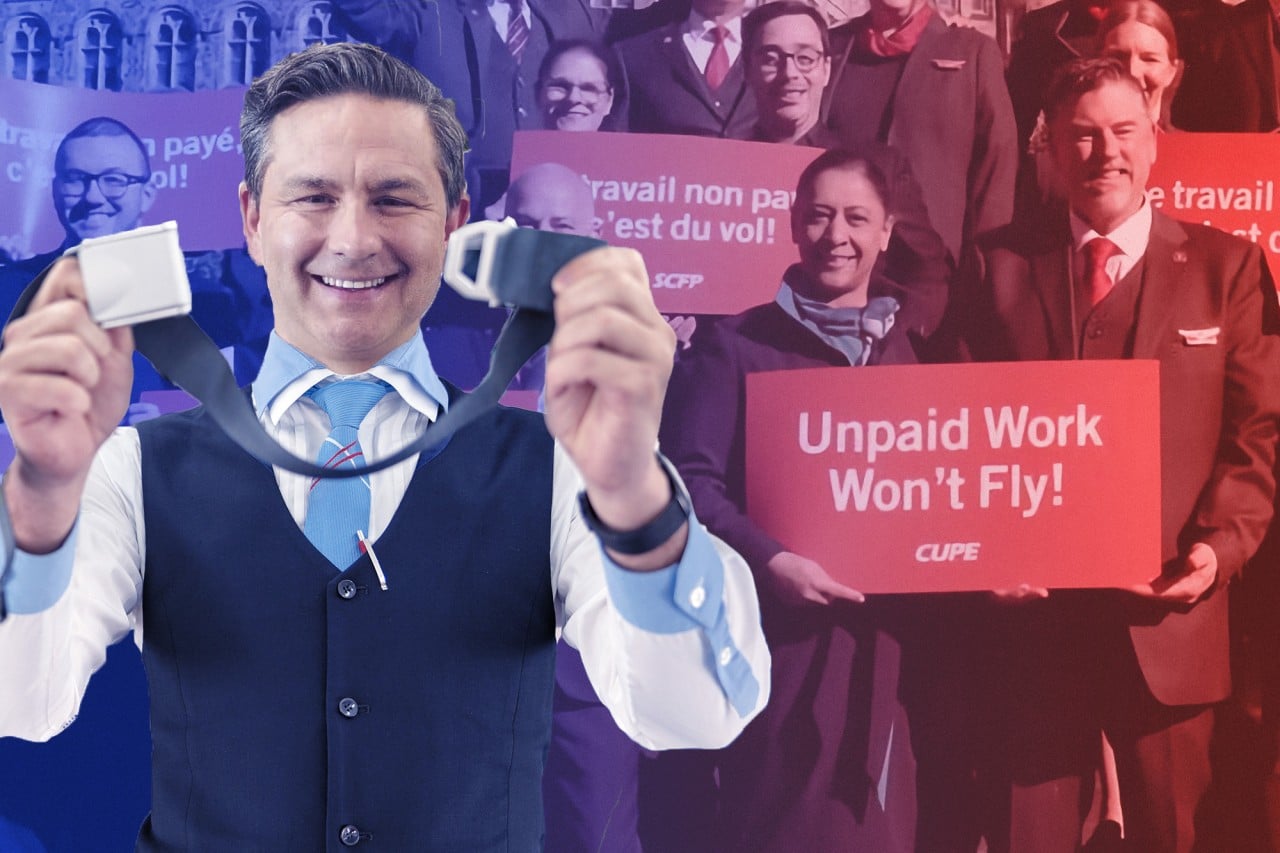
When legislation was introduced in the House of Commons this summer to ensure that flight attendants are fairly paid, the person standing up for their rights was an unlikely ally: a Conservative parliamentarian with a history of doing anything but supporting workers.
“We’ve heard for years from flight attendants that they are not paid until their aircraft is in motion,” Ontario MP Lianne Rood announced while introducing a private members bill in mid-June, presenting herself as a champion of the female workers who make up a large percentage of flight attendants.
The Conservatives soon followed up with an online petition and social media videos drawing attention to how airline workers are not compensated for any hours worked before or after flights—including all the stressful moments dealing with frustrated travellers.
Rood was a surprising sponsor of the Fairness for Flight Attendants Act. Elected to her Southwestern Ontario seat in 2019, she has already racked up an impressively anti-worker record.
She opposed paid sick days for workers in the summer of 2020—saying it would be a “huge strain on businesses that are already desperate right now”—and supported legislation a year later that forced Montreal port workers back to work rather than allowing them to strike over attempts to make their shifts 30 per cent longer.
Far from amplifying the concerns she’d supposedly been hearing about for years from flight attendants, she’s appeared more preoccupied with what she called “woke” plastic bans in grocery stores and Tim Hortons. Before sponsoring the private members’ bill, she’d never once tweeted about airline workers.

Such bills, while rarely ever becoming law, do serve well as political theatre. Alongside rhetorical shots at corporate leaders, a shift in some anti-worker parliamentary votes, a makeover for Poilievre, and a blitz of visits to shop floors across the country, Rood’s bill is part of the Conservative Party’s bid to woo working-class voters ahead of the next federal election—and it appears to be paying off.
The bill itself falls short, according to Wesley Lesosky, the president of the Canadian Union of Public Employees (CUPE) Airline Division—which represents about 19,000 flight attendants at several airlines, including Air Canada, WestJet, and a number of smaller outfits. Blindsiding the union with their initial announcement, the party did not consult or meet with the worker’s elected representatives, indicating zero interest in what workers themselves have to say.
In fact, the last time Conservatives addressed the issues of airline workers a decade ago, while in government, they made workers’ lives even more difficult by increasing the number of passengers flight attendants have to deal with.
Conservative bill ‘a grab for attention’
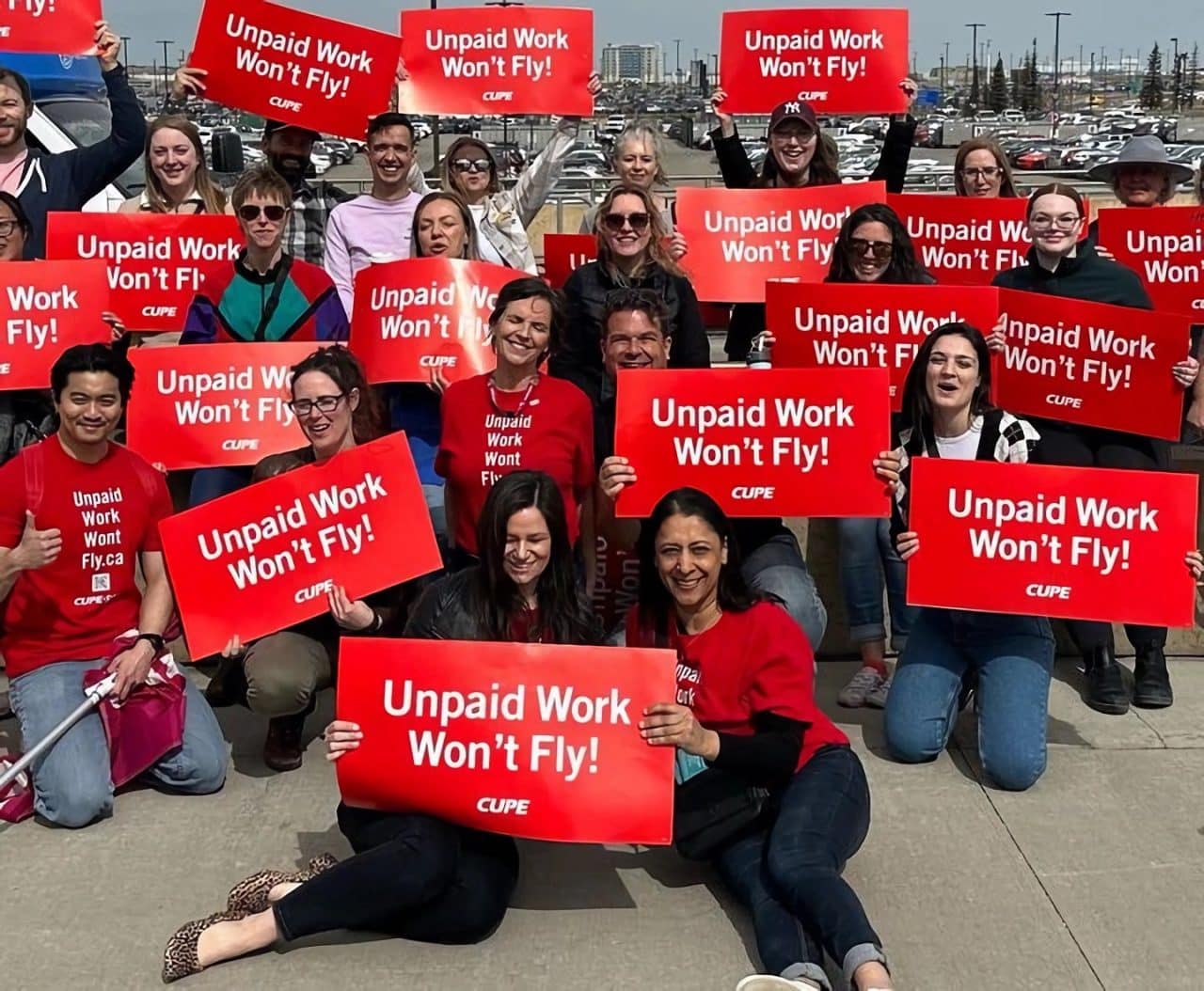
The bill was a complete surprise to Lesosky. The Conservative Party never approached him before introducing their bill, even though CUPE has been running their “Unpaid Work Won’t Fly” campaign since the spring of 2023.
Involving member-to-member as well as public education, the campaign has tried to bring wider attention to how flight attendants are paid only when they are in the air.
That means that they must get passengers on and off planes safely, deal with lost luggage, handle briefings on hazardous or precious cargo on board, without compensation—and all with a smile on their face.
If a flight gets cancelled, they’re out of luck—even if they’ve boarded everyone.
They also receive no guaranteed pay rate for their six to eight weeks of initial training. For any subsequent training once they are on the job, they are typically paid only 50 per cent of their wage, or the provincial minimum.
Ironically, the Conservatives have previously had a hand in increasing the pressure on airline workers. In 2015, under Stephen Harper’s Conservative government, Transport Canada allowed airline companies to increase the ratio of allowable passengers per flight attendants from 40 passengers for every attendant to 50.
Lesosky said that workers starting their careers as flight attendants earn less per hour, once their unpaid work is factored in, than working full-time in fast food or at Walmart.
The Conservative bill, while it would mandate attendants be paid for work pre- and post- flights, would not alter the issues with training pay that Lesosky says are key.
But the Conservatives have not responded to requests to improve the bill.
“As soon as we saw that the bill dropped we reached out to them to work on changes, to work on tightening the language, and have not heard back from them,” Lesosky said.
A better bill would specify that workers will be paid for all hours at their contractual pay rate and guarantee that workers will be paid for at least four hours when they come into work, like other federally regulated employees.
MP Rood’s office did not return a request for comment from The Breach.
Lesosky contrasted the Conservatives’ stand-offish approach with that of the New Democrats, who had been working on a separate bill. Lesosky said that the NDP not only consulted with the labour union, but took their lead, and is still currently in talks with flight attendant unions on how to address workers’ issues. As far back as February, NDP MP Bonita Zarrillo raised the issue of mandatory training pay in parliament—in contrast to the Conservative’s newfound interest in their cause.
When the Conservative bill was announced, Lesosky and the union swung into action, explaining to members that they viewed it as a stunt and releasing bulletins to stay ahead of the Conservatives’ messaging.
“It seemed like it was more of a grab for attention, to get people on board with the Conservative platform,” Lesosky said.
“I think through hard discussion our members understand what it is that the Conservatives are doing. This is just somebody trying to come and take a bit of the limelight away.”
A Conservative working class charm offensive
While the Conservative strategy may not be making inroads with CUPE’s airline attendants, it is clearly having success with other working class voters.
Polling from the spring of 2023 showed Poilievre’s Conservatives had opened up a lead among unionized workers—including both public and private sector workers.
The successful approach has involved Poilievre cultivating the persona of an anti-establishment crusader against profiteering corporate giants and out-of-touch elites. Poilievre was an early and fierce critic of the Liberal government’s pandemic-era wage subsidy program, which several corporations received and then paid out dividends to shareholders.
He’s also blasted the government for handing giant consulting contracts to multinational management firm McKinsey, promised to sue Big Pharma, and upped his attacks on “corporate lobbyists.”
Alongside this has come a personal makeover. As of last summer, gone were the glasses, ties and staid Bay Street-style suits that had been Poilievre’s uniform for nearly twenty years on Parliament Hill. The new Poilievre wears more relaxed blazers, shirts and jeans, in an attempt to make him seem more ordinary and relatable.

The change hasn’t been limited to just rhetoric and optics. The Conservatives have also shifted some of their voting in parliament. They supported legislation from the Liberals and NDP earlier this year that bans employers in federally regulated workplaces from hiring replacement workers—scabs—during strikes and lockouts.
It’s hard to imagine this being a genuine change of heart: Poilievre himself voted no less than eight times against previous such legislation.
The Conservatives have been helped along by an uncritical press, which has largely let Poilievre position himself as an ally of workers in spite of plenty of contradictory evidence: nearly half his governing council are lobbyists, every other week he is hobnobbing and fundraising in their presence, and his main advisor owns not one but two lobby firms. The Conservatives have also continued voting against the interests of workers in other ways, including opposing an NDP motion to put a price cap on grocery staples.
Within the Harper government, Poilievre was a leading opponent of worker’s rights. He opposed card-check legislation that aimed to make it easier for workers to unionize, and championed a law that would have forced unions to reveal their internal finances, a standard not applied to corporations.
In 2012, he notoriously boasted about being the “first federal politician to make a dedicated push” to bring in so-called “right-to-work” laws that would make it harder for unions to collect their dues and collectively bargain for better wages and working conditions.
Over the past summer, Poilievre has doubled down on his PR-heavy outreach to workers. He’s done a flurry of stops in factories around the country, visiting at least 42 shop floors.
While Poilievre is busy traipsing from one factory to another, and MPs like Rood are burnishing their working class credentials by sponsoring pseudo-effective legislation, flight attendants continue to be mistreated and subjected to low pay.

“It’s about getting to the bottom of things. It’s about unveiling who has the power and what they’re doing with that power.”
Linda McQuaig, journalist and author
As a non-profit, free from powerful corporate interests, we invest in investigations and uncover the cover-ups. Sustain our journalism for transformation.
Social Movements | 15 movement victories in 2023 you may not have heard about

The movement that’s won back $650K in stolen wages for international students
Despite exorbitant cost of flying, crews say their pay is unlivable
2 comments
Comments are closed.


This story reminds me of the state of college professors who are on contract (part-time, or partial load status). They are paid for “teaching contact hours” meaning the time they are delivering classes to students. They are not compensated for the time spent preparing for the classes, marking (which in some courses could be 20 hours a week), or meeting with students outside of class time. While the pay grids may look attractive, when amortized out with all the unpaid work, they too are earning barely minimum wage. It’s been an issue forever that colleges avoid. Ironically, there are more of this classification of professors now in colleges than full-time roles.
When I was a working Airline Transport Pilot, it was the same for us and I’m certain it’s still the same. We got paid for only the hours we were behind the flight controls of the airplane and it was moving! That was the only time we were given credit for. In other words if we were behind the controls while under way and that amounted to 70 hours for that month, we would have worked anywhere from 110 to 150 hours on the job but were paid for 70 hours. This is not new. You will often hear that pilots hardly work at all and get paid big money but that’s a lie generated by the airline carrier’s owners.