Martin Lukacs: Welcome to The Breach Show, featuring sharp analysis on politics and social movements in Canada. I’m your host, Martin Lukacs.
On this episode, we’ll be hearing a dispatch from Indigenous activist Eriel Deranger from the United Nations climate negotiations. At the conclusion of the two-week long negotiations, known by their shorthand COP (Conference of Parties), mainstream media headlines are describing it as ‘historic.’ But the agreement that’s been reached is loophole ridden, without teeth, and without any explicit commitment to phase out the fossil fuels that are driving the climate crisis.
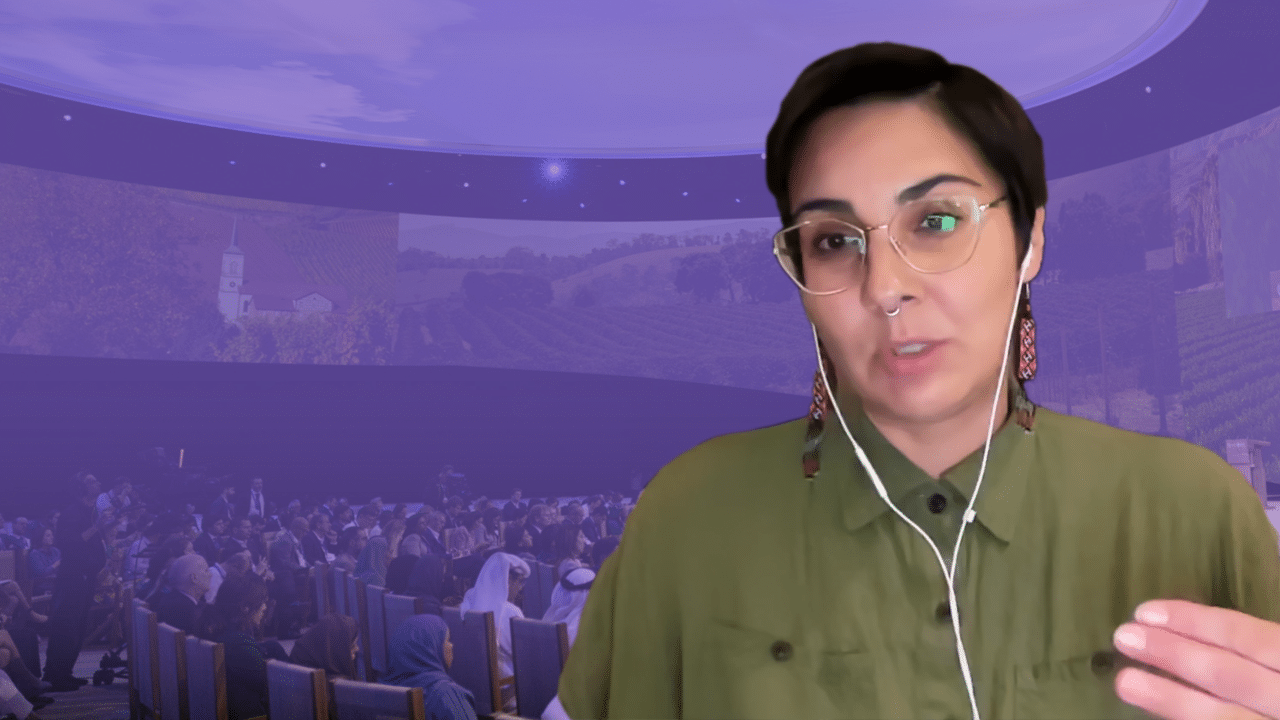
Eriel Deranger is from the Athabasca Chipewyan First Nation and the executive director and co-founder of Indigenous Climate Action, an Indigenous led climate justice organization in Canada. She’s joining us at the tail end of COP28 in Dubai, United Arab Emirates. Eriel, thanks for taking time to speak with us even though you must be exhausted.
Eriel Deranger: Thanks for having me.
I’ve been here since the 24th because I came for preparatory meetings. There was a week of Indigenous preparatory meetings that I was part of. Yeah. People are just like, “Oh, when are you going home?” It’s like, “Oh, no, I live here now.” There’s this big dome in the COP venue, and I’m just like, “The dome is my home. I live here.”
Lukacs: So Indigenous Climate Action, alongside other frontline organizations, has been pushing to improve whatever agreement comes out of this COP. Can you tell us about what you have been there trying to push for?
Deranger: I think that Indigenous Climate Action, along with a lot of civil society organizations and other Indigenous groups from across the world, have been trying to push for a climate justice framework within the negotiations.
This looks like uplifting both human rights and the rights of Indigenous peoples to be implemented and upheld through all of the mechanisms, negotiations, processes, and ultimately outcomes. A part of that is demanding no false solutions and a phase out of fossil fuels and ensuring that whatever climate finance mechanisms come out of this, that there is direct access to Indigenous and frontline communities.
We don’t come to COP thinking that this is where we’re going to find the solutions to the problem. This is where we find out what states are going to do to block our capacities to have real action and the actions that we need to do back home to ensure that they don’t enact these false solutions and false promises, hold them accountable to the minutiae of actual progress they’ve made to ensure that they don’t try to sidestep it when we get home. So for us, this is the place where we find the intel so that we can make sure that real action gets done at home and demand more.
Lukacs: So it’s like a reconnaissance mission.
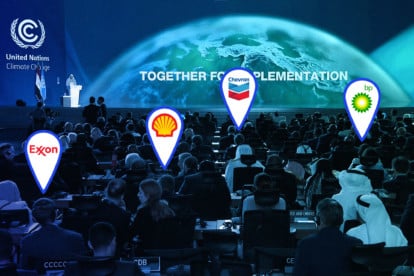
A lot of people are talking about how this is the COP of the oil lobbyists. I think by one count, there are nearly 2,500 fossil fuel lobbyists registered for this year’s event. That’s compared to 636 last year and this includes at least 35 people with ties to the fossil fuel sector who are part of Canada’s official delegation. Last year, there were only eight. That’s not to mention that the COP President himself, Sultan Al-Jabbar is the chief executive of UAE’s state oil company. How has this influx of lobbyists impacted this COP?
Deranger: Well, earlier this week—I mean, I guess two days ago—there was a leak of the have a letter from OPEC, that urged all state leaders to not accept the outcomes of this COP, that included a phase out of fossil fuels, and that fossil fuels absolutely needs to be a part of our climate transition. It’s absolutely absurd to see that.
We’ve also seen the same oil and gas lobbyists trying to push a series of false solutions like carbon capture and storage, with no real commitment to actually phase out fossil fuels. They want to talk about abatement of emissions rather than a phase out of fossil fuels. This is a real, real problem. This comes very heavily from the fact that there is this huge sector of oil and gas lobbyists. In fact, when it comes to Indigenous delegation, they outnumber us seven to one.
I also want to note, though, what’s really, really interesting—that someone pointed out to me—is that this is the highest civil society attended COP in history. This is also the largest attended COP in history as well. While the oil and gas lobbyists are coming out in numbers we’ve never seen before, so was civil society, because just like the oil and gas lobbyists are scared about their bottom line, humanity and civil society is afraid of losing the entire planet. It’s a really interesting dynamic that is starting to really pop off in these spaces.
Lukacs: Talk a bit more about this fight that’s been unfolding over the inclusion of fossil fuel phase-out in this agreement, and where does Canada fit in all of this?
Deranger: I think what’s really interesting is a couple of days ago, there was like this huddle of like state leaders to discuss the phase out of fossil fuels. It was tabled originally through some of the work that was done by the fossil fuel treaty group that tried to push forward this. They really wanted to table this and discussions.
It started last year when we talked about a phase out of coal, but we wanted to talk about a phase out of all fossil fuels. There’s a lot of debate on this, some countries are like, “Yes, we absolutely must reduce emissions created by fossil fuels,” but do not want to say the words “phase out of fossil fuels.” They’re talking about abated emissions, as opposed to actual reduction of fossil fuels themselves.
As far as Canada, they were absent from this global discussionon the phase out of fossil fuel language to be included. What they’ve done instead is they’ve made these announcements of their paltry commitments to a framework, which isn’t even an actual commitment, but to develop a framework on a cap on emissions in the country. This is absolutely absurd, because when we look at what’s happening in the country, Alberta, and Saskatchewan are like, “Actually, we’re sovereign, we don’t have to do what you tell us.” So their cap on emissions, with two provinces that carry some of the largest emissions profiles in the country, saying “We’re not going to abide by it,” is really, really flat.
In addition, they’ve come out saying that carbon pricing is going to be a big part of their platform, again, no actual language to support a phase out of fossil fuels. They’re talking about just transition, they’re talking about energy profiles that we need to be looking at, but absolutely sidestepping any opportunity to actually join the course in calling for a phase out of fossil fuels.
Lukacs: One thing I found just striking, at least how it’s playing out today, is all the colonial settler states like Canada and the U.S. are trying to like beat their chests righteously about how, you know, “We can sign a death warrant for the island states,” and then the OPEC nations are like, “How dare you? You’re hypocritical.” It’s very Spider Man versus Spider Man.
Deranger: Yeah. I feel like it is. Canada, honestly, it’s just like, “we came as a climate champion, and we’re doing so much.” And I’m like, “Are you though?”
It’s a lot of really weak, watered down language and lip service to some of the commitments that they’ve made. Guilbeault was on a stage and I said, “How are you actually going to talk about a real just transition in this country with a weak emissions cap that does nothing to substantively change the lives of Indigenous peoples in this country, and allow provinces to declare sovereignty over federal legislation, when historically Canada has denied Indigenous peoples rights to have a veto, even though our treaty rights were created long before provinces were created in this country. It seems like such a double standard, and a slap in the face to so-called Truth and Reconciliation in Canada.”
Lukacs: What did he say in response?
Deranger: Oh, my God, he didn’t answer. He just sidestepped, and he said this and that. Because I know him personally, he was like, “Eriel, you know, I was on the other side, and we’re doing all we can and Truth and Reconciliation is important.” He didn’t answer the question. He just kind of danced around the question for a few minutes.
He just said that he appreciates all the work we do, and they’re working in partnership with Indigenous peoples everywhere they can, but didn’t answer the question on the specificity of like, “Why does a province get a veto and Indigenous communities don’t?” That was not answered at all.
Lukacs: Speaking of dancing, I recall dancing next to him on the beach at COP15, in Durban in 2011 when he when, as you put it still on the quote unquote, “other side,” though, I think even when he was vquiterre, he was playing a very elite role, hardly put pushing root cause solutions.
Deranger: Yeah, I remember definitely getting into it a couple of times with him being like, “Well, this is what we’re doing, and we’re not going to block what you’re doing, and we’d appreciate it if you didn’t block what we’re doing.”
And I’m like, “But when you push forward solutions that don’t take into consideration Indigenous rights, you’re actually blocking what we’re trying to do.” And he said, “I just think we have different tactics and strategies.”
Lukacs: That’s definitely one way of putting his liberal sell-out.
Deranger: Yeah, it’s been very challenging because I also know that: what are you even going to do when you work in a colonial system and structure?
Canada has done a really good job at Indigenizing itself, but they have zero interest in moving towards true decolonial processes and policies in the country, because that would mean that they would have to relinquish power and resources to Indigenous communities, and create spaces for sovereignty and self-determination, and allow communities to have the same sort of sovereignty power, that provinces are being granted right now. Frankly, I don’t think they want to do that.
Lukacs: No, that seems like a step way too far for their corporate masters.
You mentioned earlier how fossil fuel companies are shopping around false solutions at this COP. Talk a bit more about, in detail, what that looks like.
Deranger: It is such a scary time. We are seeing the fossil fuel industry not take this very lightly, when we’re talking about even tabling the conversation of the phase out of fossil fuels. They’re looking for every loophole. We’re talking about really upholding things under implements of Article Six, which is part of the negotiations here that looks at reduction of emissions and countries meeting their NDCs.
It’s all about carbon markets. This is not about stopping emissions at the source. This is about simply shopping around looking for ways for us to sell and trade carbon, instead of actually reducing it at the source. We’re also talking about CCS technology. So, trying to scrub the carbon out of the atmosphere, largely from the power plants and the refineries, and not actually from burning the fossil fuels. We’re seeing companies look at conservation offsets or nature-based solutions. Again, just plant a couple trees over here so you can continue business as usual over here. And, they’re also hedging their bets on technology that doesn’t even exist.
Geoengineering technologies that, in the future, might actually amount to something, because what we’ve found out so far withcarbon markets and CCS technology, carbon capture and storage technology, is that it actually only reduces emissions at 0.1% of what they are claiming or trying to achieve.
What’s really scary is they’re saying that 90% of emissions will be reduced by carbon markets and CCS technology in the next 10 years, for technology that doesn’t even exist. This puts human rights and the rights of Indigenous communities at further risk through allowing these projects to continue business as usual, but also for our lands to be threatened for land grabs for these conservation offsets and these nature based solutions to find ways to allow companies to just continue polluting.
Lukacs: Depressing, but that’s what we’re up against.
Another part of the negotiations that’s loomed large at Dubai COP is discussions about climate finance: whether countries in the Global North will actually provide the adequate funding for countries in the Global South to adapt and mitigate climate change. How has that played out?
Deranger: I have been so disappointed by the discussions, the pledges and the commitments within the climate finance negotiations and discussions.
What we’re seeing is yes, absolutely Global North countries, G7 countries, G20 countries being like, “Yes, we pledged to commit.” But the United States is the first number one offender to GHG and the climate crisis, and they committed like, 17 and a half million dollars to the climate fund for loss and damages, when they should be paying the most.
We’re seeing other countries paying even more than this bringing better commitments in the United States. Canada committed—if we take it to the American dollar, I think it’s like $11 million, I think it’s $16 million Canadian dollars—but it’s about $11 million U.S. dollars. This is so shameful that our countries are doing this.
But what’s really dangerous within the conversations on loss and damages. This is just about states paying other states. This is a dangerous situation for frontline communities and Indigenous peoples where there are no guarantees that these funds are going to go to our communities who are the ones that are experiencing the loss and damages.
In fact, there’s some real fears around how states might utilize these funds to further develop false solutions rather than actually address the damages that are felt by frontline communities and Indigenous peoples that are experiencing these things. There’s a lot of work trying to push to have more accountability mechanisms.
As it stands now, Indigenous peoples in the Global North—we’re never going to see loss and damages. Even though my community, which is downstream from the Alberta tar sands, has experienced massive amounts of loss and damages from the industry that has been exacerbated by the climate crisis. We’re never going to see it. The communities in the Northwest Territories that have experienced out of control forest fires—never going to see those funds, because Canada is going to give their small little tiny commitments to someone else to another state, that’s probably never gonna give it to their Indigenous communities either.
Lukacs: I read somewhere that there were so many video cameras surveilling people at the COP. It was outsourced, [a] very shady company that had thousands of cameras around and so basically everyone was assuming that anything they say is being monitored.
Deranger: Oh, yeah. 100%. I’m just kind of like, “We’re living in 1984.”
I spoke at a pro-Palestinian rally that they had. It was the biggest protest the UAE has ever seen.
Lukacs: Oh I was going to ask about that. I read that it may have been the first Palestine rally in the UAE, just because protest is criminalized.
Deranger: Yeah, so there was two. They had one smaller one, and they really tried to contain it. Then they had a very big one.
But very last minute, they were like, “Hey, can you speak on the stage?” And I was like, “Ah! Yeah, sure, I’ll speak.” I definitely am, like, “I wonder what it’s gonna be leaving this country,” because I essentially said that what’s happening in Palestine is taking from the playbook of Canada. Some of the dark history of the colonization of North America and the Americas is ones that we tried to erase from our history.
I talked about how the term ‘Redskins’ that we hear, you know, sports teams named ‘Redskins,’ but we don’t even understand where that terminology comes from. It’s not because we’re red-skinned people. It was because when they came to colonize, and they sent the first wave to get rid of the Indians, there was nothing left but fields have red bloody skins. They started to refer to Indigenous peoples as ‘redskins,’ because that was all that was left of them.
And I’m like, “This is what the colonizers are doing in Palestine. They’re trying to tell you that they want to broker peace deals just like they did in the Americas. But what they’ll do is they’ll continue to take your land until there’s nothing left. We’re in colonial Canada, we were promised treaties, and yet what’s happened is 99.8% of the land is under the Crown and colonial rule, and we only have control over 0.2%, they’ve stolen our children.”
I went on and was like, “Peace and and treaties are not the answer. You need to continue to resist.” I got off the stage and I was just like, “Oh damn, what did I just say?”
Lukacs: Where’s where’s next year’s COP? I think it’s also an another pretty repressive place.
Deranger: Oh my God, Azerbaijan. Azerbaijan! Literally the only way the UN would accept their bid is if they agreed to free 150 political prisoners.
Lukacs: Oh God. What a self-parody for where the COP process has come to.
Deranger: Just like the UAE, [they’re] very embedded in oil and gas. Highly oppressive governments and regimes that are running things. A lot of people are just like, “Dang man, two cops.”
I’ve talked to dozens of people that were like, “I’m just not gonna go.” The COP after Azerbaijan for COP30 is going to be in Brazil and it’s going to have a huge Indigenous component. People are really excited about what Brazil COP30 is going to look like. It’s also COP30, so it’s a monumental COP.
Lukacs: Let me ask you about a very ambitious report that Indigenous Climate Action has been working on.
I understand you just released the second part of it. It’s called Decolonizing Climate Policy. In it you write, “settler led climate policies are failing to serve our community’s needs, and they are failing to address the root causes of the climate crisis.” Tell us more about what you’re hoping to accomplish with this report.
Deranger: I think, first off, sometimes people ask “If you’re focusing on decolonizing climate policy, why show up in these spaces?”
I think it’s really important for Indigenous peoples and frontline folks to understand what’s happening in these spaces, so they know how to create their own structures to counter these systems that again have never served our communities. They were not created to benefit our communities. They were created to benefit the colonial state governments and allow them to continue oppressing and appropriating lands and territories for financial gain.
When we talk about decolonization and decolonial policies, this is about creating structures that have a different centered value point that is about interrelationships with the natural world. It’s about collective liberation, and equity and equality for all.
These are not the tenants that colonial policies and structures were created on. When we’re talking about Indigenous climate actions and policies, we need decolonial frameworks. This report looks at like, what what does policy even mean for Indigenous peoples? How do we get to that place where we can start building our own sovereign decolonial policies to counter the colonial structures that again—as you stated, and is in the report—have failed our communities for the last 150 plus years in colonial Canada, and even longer in many other countries all across the across the world?
Lukacs: In the report it mentions that the last part, part three, will look to Indigenous led climate relationships and solutions. Sketch out for us how Indigenous rights are such a key part to fighting the climate crisis.
Deranger: I think that this has been such an interesting journey as someone who’s come into the space as a young person and didn’t really understand that either. But the reality is, within the Paris Accords, we saw the recognition not just of Indigenous rights, but of Indigenous knowledge systems as critical to finding the solutions and pathways forward.
Indigenous peoples model some of the best low carbon lifestyles of any other demographic and population in the world. We have some of the best knowledges and understandings of the ecosystems and the ecologies in which we reside in. This comes from intergenerational knowledge. We become some of the best scientists, the best ecologists, the best hydrologists, the best conservationists. Yet, our knowledge has been excluded from these processes for hundreds of years because of a colonial imposition and degradation and devaluing of our rights.
When we talk about the structures and systems, this looks like: how do we start from revitalizing Indigenous cultures and lifeways? How do we look to start to map out what future solutions look like? We’re seeing some of these things come into place. Even in my own community, we have developed the largest off-grid solar farm. We’re building vertical garden systems. This is all to address energy insecurity, food insecurity.
We’re doing a huge amount of work on cultural revitalization, language revitalization. Some folks don’t understand how important Indigenous languages are.
Indigenous languages are not like English, they’re verb based. So they’re more around describing relationships with the natural world. They paint part of that story of understanding those relationships. They also allow us to understand the human interactions with those ecosystems that provide the blueprint for how we can not only manage those lands and territories, but how we can live in a more symbiotic relationship and understand the resources and the balances that is necessary to sustain not only our communities, but the ecosystems that we rely on.
These are Indigenous solutions. These are the foundations that colonial policies have lacked, because they see our lands and territories as as something to be extracted, as something to be commodified, as opposed to something to be in relationship with.
I really think that this is part of the key that’s missing to the negotiations that so much of civil society has been trying to advocate for the last 28 COPs across the globe. We really, really desperately need to reframe of what climate policy looks like, where the foundations and those roots are, and really be guided by practices that are in relationship with the ecosystems that we claim to be trying to save.
Lukacs: Well, it sounds like if we can’t find hope in Dubai, we can find it back at home on the land. Thanks so much Eriel.
Deranger: Thanks so much for having me.
Lukacs: If you like what you’ve heard on The Breach Show, please subscribe to the podcast or our YouTube channel. If you want to support our work, please become a sustaining member to help us produce more journalism for transformation. You can do that at breachmedia.ca/support. Thanks for listening.
The Breach’s investigations don’t just inform our readers—they force the powerful to react.
An exposé on blood plasma privatization led to national headlines. Our revelations about the government’s cozy connections to Big Pharma sparked a parliamentary probe. A report on high-tech price-fixing by mega landlords resulted in a criminal investigation.
From activists to elected officials, people are using The Breach’s journalism to push for transformative change.
– Dru Oja Jay, Board President, The Breach
Climate Crisis | First Nations say they’re not wildfire evacuees, but climate refugees
Climate Crisis | While Canadians choke on toxins, Big Oil hides behind smoke and mirrors
Climate Crisis | Corporate power casts a long shadow at UN climate negotiations
1 comment
Comments are closed.
Regarding the Deranger’s interview by Martin. It is interesting except for the part about Palestine. Unfortunatly, she does not understand what is going on there. Dommage.