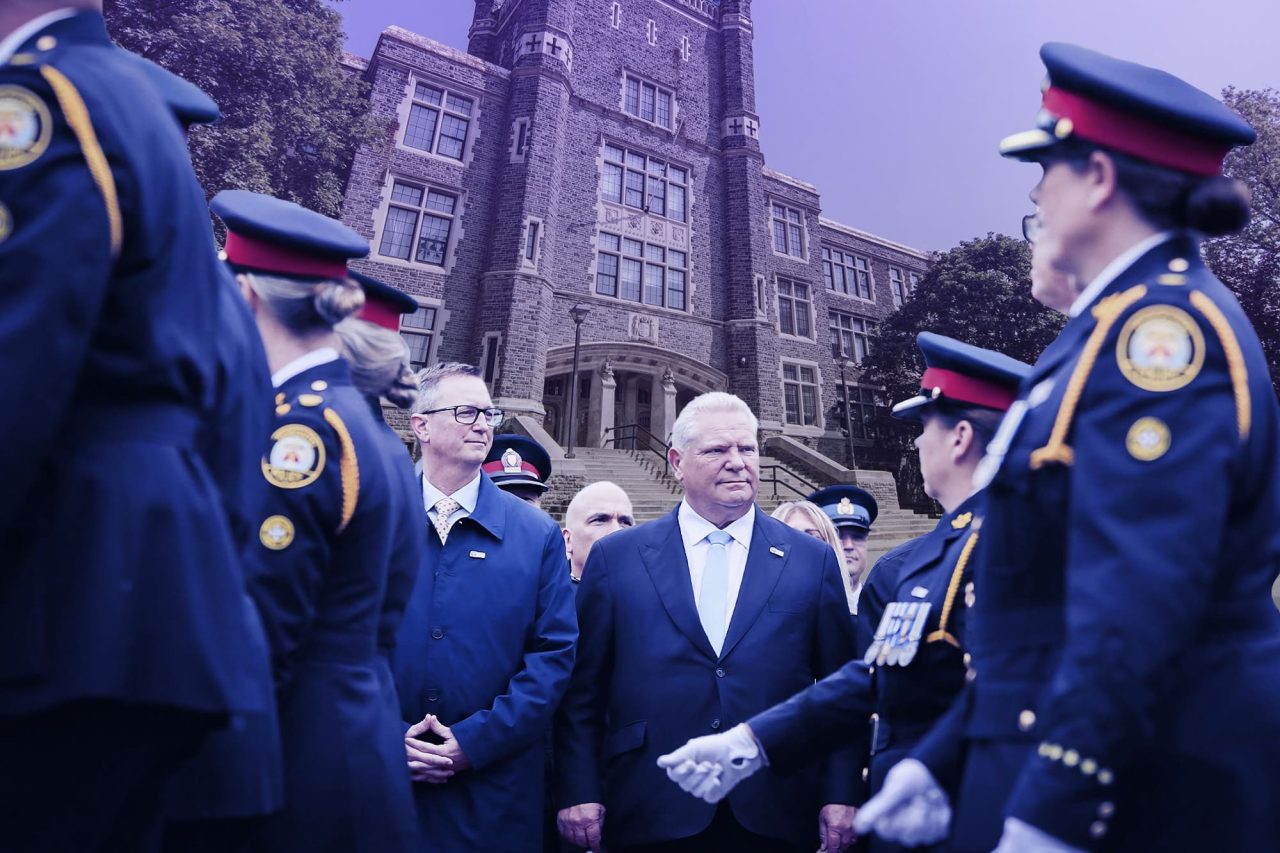
After starving Ontario public education of funding, Premier Doug Ford wants to send police into schools to oversee the dysfunction he’s enabling.
A bill put forward by his provincial government would enable cops to conduct programs in schools, reversing years of organizing that had removed them.
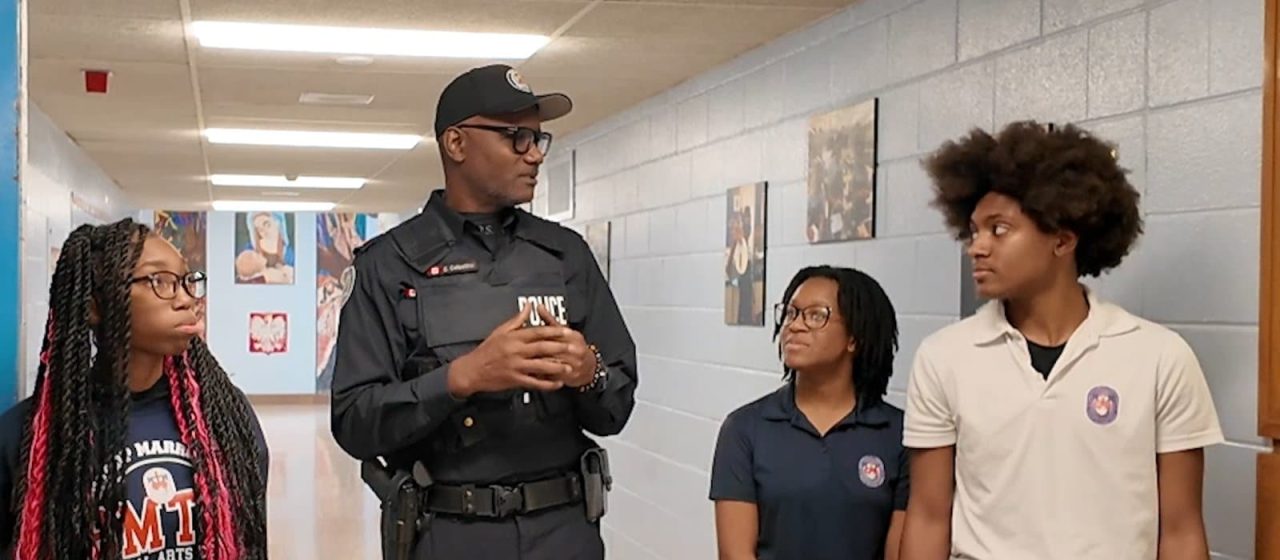
Students, parents, educators, and advocates had protested the police’s many harms: surveillance of students in hallways and classrooms, arrests of students for talking back to cops, and collaboration between police and the Canada Border Services Agency that threatened undocumented kids and their families.
All these things happened under so-called School Resource Officer programs that assigned or placed police in schools. We should expect this harm to happen again, especially since police have never acknowledged or addressed the student testimonies that led to the program cancellations.
A decade-long struggle in Toronto culminated in the city’s school board cancelling the program in 2017. School boards in many other districts, including Ottawa, Hamilton, Durham, York, Peel, Dufferin-Peel, Guelph, and Waterloo also paused or cancelled their programs—and Waterloo officials even issued an apology to students for harms they may have experienced.
But Ford now wants to reverse that. Bill 33, which is set to continue moving through the legislature when it resumes in the fall, would give his government more control over local school boards, including decisions they make about policing on school property.
The premier is a longtime supporter of putting cops in schools. He leans on intimidation and punishment to address social issues, even when other interventions like support staff, after-school programs, and hall monitors are safer, more effective, and less costly.
Many are susceptible to Ford’s position because they are worried about growing violence in schools, and believe police are a natural solution to situations that teachers can’t handle. But when organized parents, educators, and students previously showed people what police actually do beyond handling violent incidents, people become a lot less comfortable with the programs.
When police are granted authority within schools, issues that ought to be solved with a conversation between students and educators are often pushed onto police. Teachers and administrators who fear certain kids—or have a bias against them—can appeal to the cop on duty for discipline and criminalization.
We defeated this practice last time by demonstrating the excessive and unjustified scope of police activity, much of which the public had little idea about. Now we need to defeat it again.
Money for police but not education
Ontario’s education system has been here before. After the 2007 murder of Jordan Manners, who was shot and killed in his Toronto high school, police moved to install officers in the public school board through the introduction of the School Resource Officer program. In Toronto and many other regions, school boards introduced cops without even putting the programs to a vote.
But cops weren’t stationed at all schools within a given board: without explaining their rationale, school boards put police predominantly in schools with significant populations of Black, Indigenous, racialized, poor, and immigrant students.
There were no requirements for school boards or police to document the impacts of these programs on marginalized students, and they generally didn’t bother. However, they did sometimes conduct surveys which showed the majority of kids liked or didn’t mind police in their schools, and they used these findings to undermine the voices of the minority of students their programs were harming.
Most people involved in public education agree that violence in schools is a concern, especially since the COVID-19 pandemic forced school closures and changed the way students learn and engage with one another. But almost no one who studies the healthy development of students believes they now need to be policed into compliance, or removed entirely through the suspensions, expulsions, arrests, and humiliations associated with police-in-school programs.
Rather, teachers’ unions, researchers, and advocates say Ford’s systemic underfunding of our schools has led to increases in violence and dysfunction. As we see so often, Ford has found money for education in the form of policing, but consistently comes up empty regarding money to reduce class sizes, hire and retain teachers and support staff, and equip schools with basic infrastructure like air conditioners and proper ventilation systems.
The damage done by cops in schools, and by disciplinary measures like suspensions and expulsions, mirrors the general destruction policing visits on our communities: Black and other racialized students are harassed just for existing in school hallways; students with disabilities are singled out for behaviours viewed as non-normative or oppositional; families who lack full immigration status in Canada stop sending their kids to school, even though the Education Act guarantees them an education regardless of status, because they fear being reported to immigration officials and deported.
Re-energizing the fight against the school-to-prison pipeline
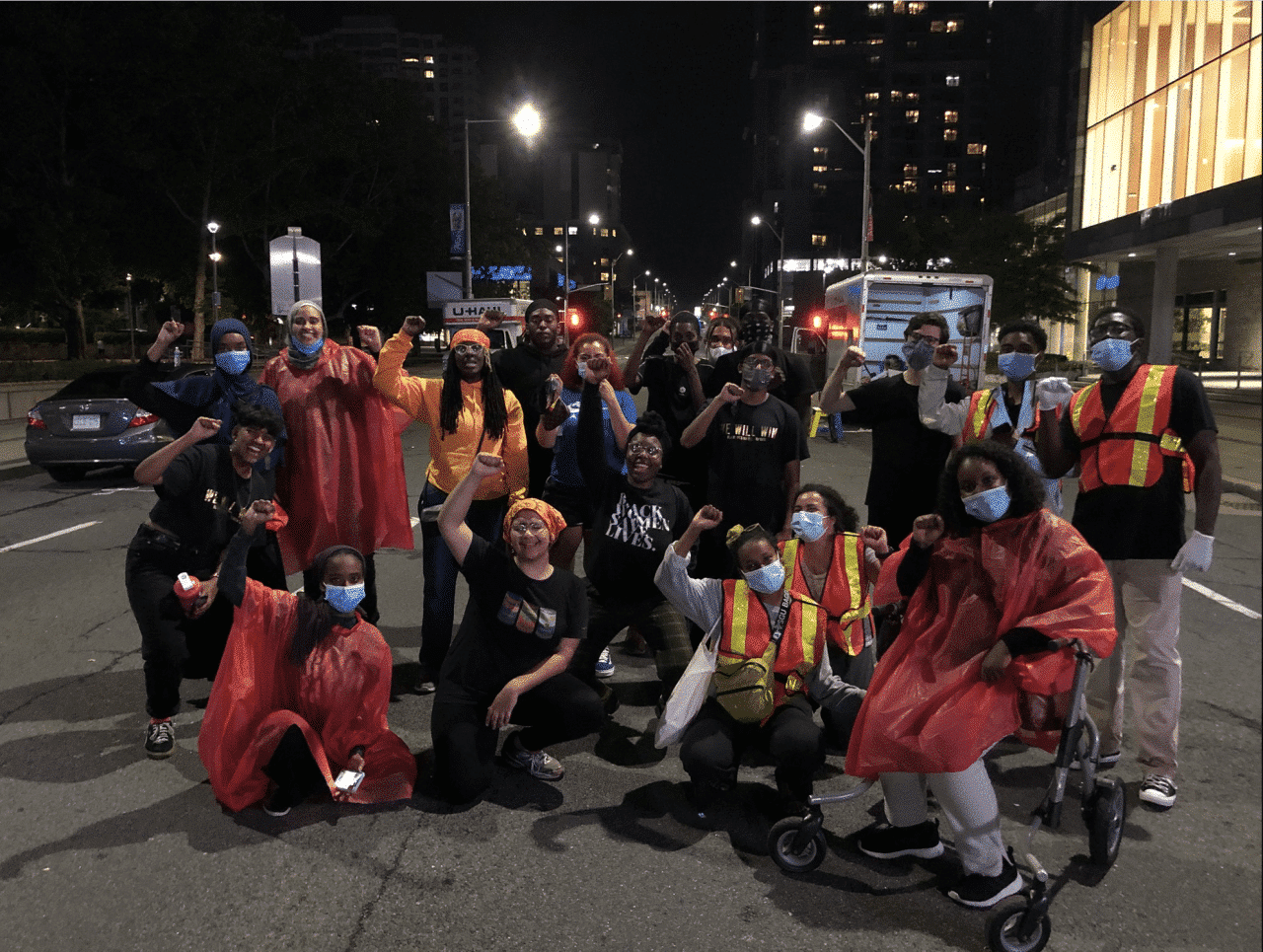
Local groups fought tirelessly to protect students and get cops out of schools a decade ago, and now many of the same actors are mobilizing again to confront the reckless proposals contained in Bill 33.
And while Ford’s majority government can easily pass any bill it proposes, the prospect of armed officers patrolling schools—particularly in areas that recently cancelled such programs—will spur communities who understand the risks to take action.
While Ford and his supporters may equate school safety with the criminalization of certain kids, many within the general public find it hard to repeatedly justify the worst excesses of policing against young people.
For decades, people who study education have warned about a school-to-prison pipeline: a set of policies in schools that criminalize children as early as kindergarten, and ultimately push them out of education systems and into the clutches of police, jails, and prisons.
Reinvesting in cops at schools, instead of giving students the support they need, will guarantee that fewer students get a good education, and that more of them are pushed out of society before they reach adulthood.
The next round of struggle against the school-to-prison pipeline in Ontario depends on a renewed and fierce opposition to Bill 33 by communities who value student care and connection over policing. While this new battle is a catastrophic waste of time and energy that could otherwise be used to improve public education across the province, Ford’s desire to expand police power makes the fight necessary.

When I went to journalism school 10 years ago, my parents thought that they would eventually read my articles in The Montreal Gazette. Today, that newspaper is a husk of its former self. But I get to explain that I’m working towards critical, independent, and sustainable journalism.
Want to be a part of the future of journalism? Support our work with a monthly contribution. Sign up here.
– Amanda Siino, Development Director, The Breach
Municipal Politics | ‘Out of control’: Mississauga mayor criticizes local police budget

Press Freedom | Police spied on Albertan journalist accused of vandalizing Nazi monuments
Palestine | Inside the ‘shocking’ police operation targeting pro-Palestine activists in Toronto

4 comments
Comments are closed.

As always, lot’s of opposition to ideas you disagree with but no solutions offered. Unions always want smaller class sizes and more teachers but not for the benefit of the students but for the benefit of the union. When I was in public school in the late 60’s and early 70’s we often had class sizes of 40 or 50 students for one teacher, without an EA. Probably half of those students were from families where English wasn’t their first language. I’ don’t agree with having police full time in schools either but I do feel it’s important to have at least weekly visits and talks with students to show they don’t need to fear the police.
Hey Randy! The CCPA (Canadian Center for Policy Alternatives) has more data-backed findings on this, but the solution is overwhelmingly ‘Put funding into schools, so they can hire Special Education and Mental Health staff to work with students in crisis.’ Currently the school boards have been underfunded by $6.35 billion.
https://www.policyalternatives.ca/news-research/ontario-has-underfunded-schools-by-6-3-billion-since-2018/
Hey Randy! The CCPA (Canadian Center for Policy Alternatives) has more data-backed findings on this, but the solution is overwhelmingly ‘Put funding into schools, so they can hire Special Education and Mental Health staff to work with students in crisis.’ Currently the school boards have been underfunded by $6.35 billion.
https://www.policyalternatives.ca/news-research/ontario-has-underfunded-schools-by-6-3-billion-since-2018/
I read this paragraph completely on the topic of the comparison of newest and previous technologies, it’s amazing article.
Feel free to surf to my web blog … Ботокс в Москве недорого