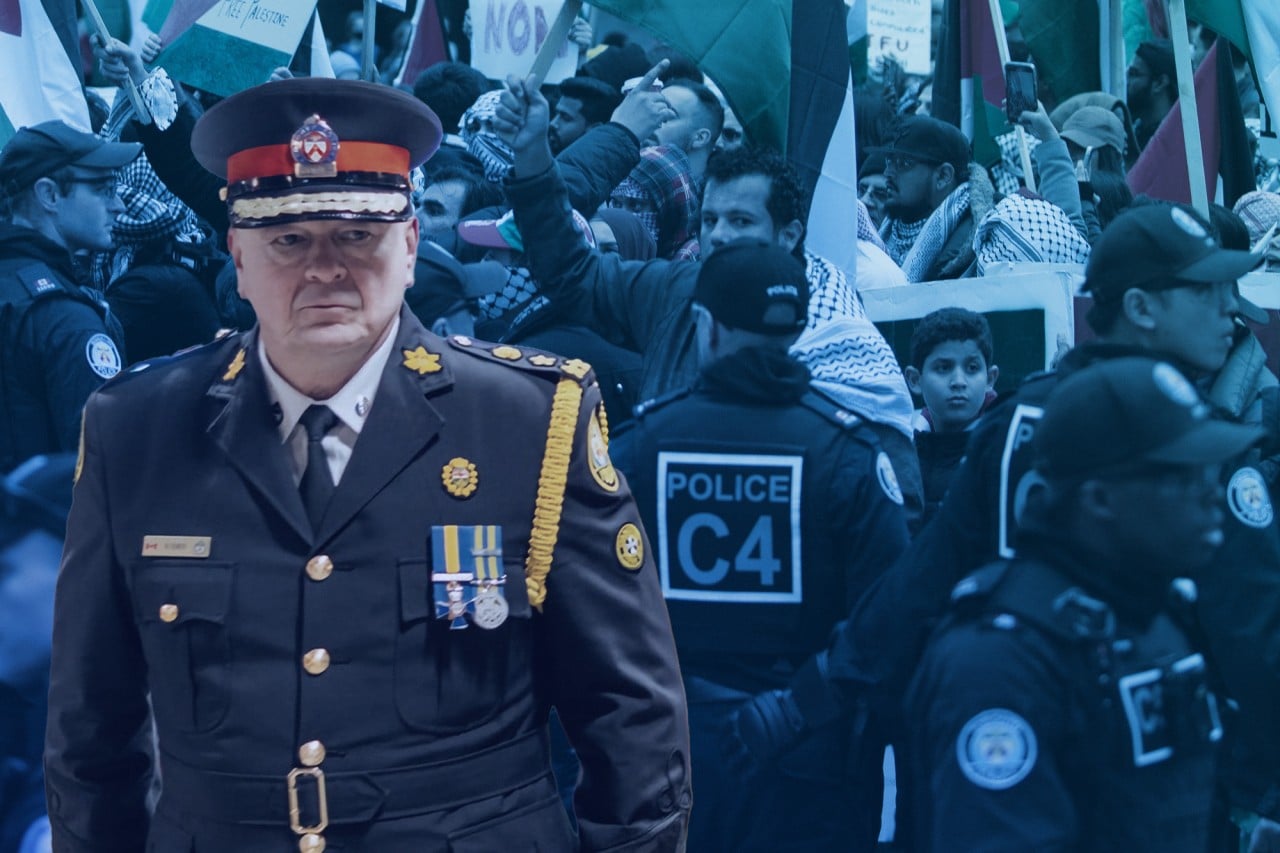
The banging at the front door started at 5:30 a.m.
It was so heavy that, on the second floor of the Mississauga, Ont. home of the Islaih family, a bed began to shake.
The Palestinian-Canadian family of five opened the door in late January to find several Toronto police officers with a warrant to arrest their eldest son.
“We were in shock,” Suha Islaih told The Breach in an interview. “Did my son hurt someone? Did he kill someone? Those were thoughts that crossed my mind.”
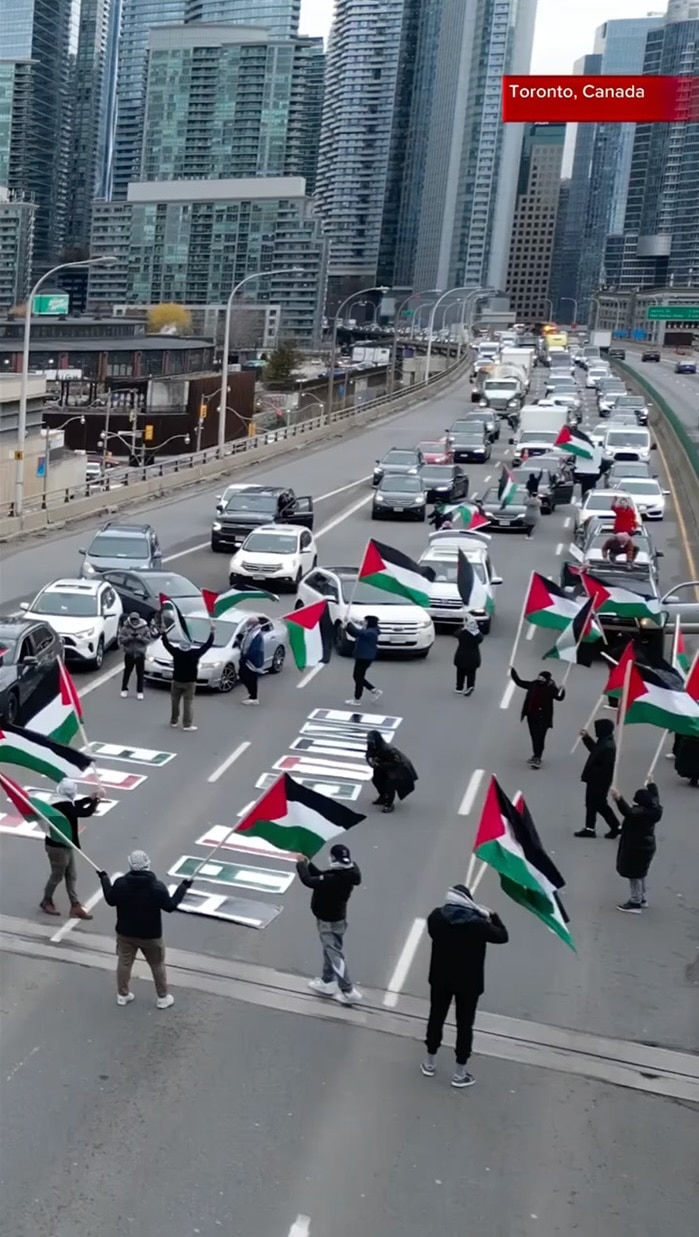
Ahmad Islaih, a 26 year old elementary school teacher, was accused of participating in a demonstration that briefly halted traffic on Toronto’s Gardiner Expressway in November. The protest against Israel’s assault on Gaza had lasted for only five minutes.
After waking up Ahmed, handcuffing him and charging him with “mischief,” eight police officers sat the family, still in their pajamas, at their dining room table. While they searched their home, the front door stayed open, despite freezing winter weather and the family’s pleas to police to close it.
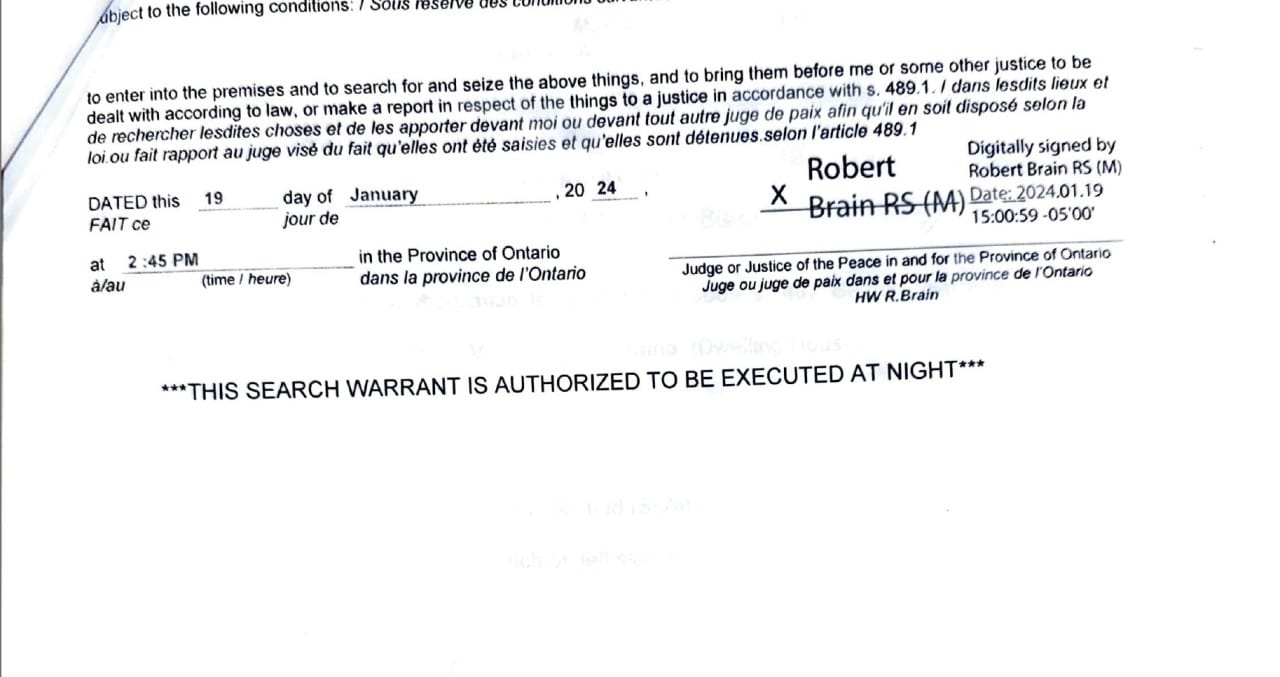
According to the warrant—marked “AUTHORIZED TO BE EXECUTED AT NIGHT”—the items police were looking for included black pants, white Nike running shoes, and a keffiyeh.
“Our house is full of keffiyehs, we’re Palestinian,” Suha recalled telling the police. The family, who immigrated to Canada in 2005 from Ramallah, maintains strong connections to their homeland. “I have a poster of a Palestine map. I asked them if they wanted that too?”
After the police left with Ahmad’s computers, electronics, and clothes, the family discovered his room “turned upside down.” Drawers had been emptied on the floor, his mattress was thrown off the bed, a vase was broken, and several boxes had been rifled through.
“It took us back to our life in the West Bank,” Suha said, “when Israeli soldiers raided our home.”
Their family is not alone. Since Oct. 7, both Palestinians and non-Palestinians involved in non-violent and common protest tactics have been targeted in a sweeping, heavily-resourced Toronto police operation that experts say has engaged in extreme overreach.
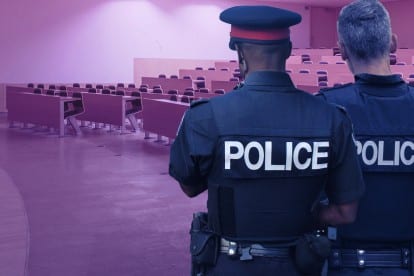
Led by an expanded Hate Crimes Unit and operating under the name “Project Resolute,” the police’s tactics have included pre-dawn raids, snatching people on the street, trying to turn arrested individuals into informants, showing up unannounced at university lectures, and capitalizing on years of surveillance of activist movements.
Policing scholars and lawyers say the Toronto police have undermined Charter-protected rights of protest and expression by missapplying “hate crime” charges, with some saying the aim is “strategic incapacitation” of a growing Palestinian solidarity movement.
Yet in several instances, months after the arrests and showy police press conferences, the cases are falling apart and charges are being withdrawn.
But in the time it has taken for the Crown to acknowledge that charges lacked a prospect of conviction, media headlines have caused significant damage to the livelihoods and reputations of those targetted.
Kevin Walby, an associate professor of criminal justice at the University of Winnipeg and an expert on police tactics, called it the “height of political policing.”
“The police aren’t acting to target everyone consistently,” Walby said. “It’s driven by pervasive anti-Palestinian sentiment among government officials. And it undermines the very idea of hate speech law when police apply the charges so selectively to serve political interests.”
Shane Martínez, a Toronto defense lawyer representing multiple people charged in the protests, said the operation “raises questions about the anti-Palestinian bias” of the Toronto Police Service.
“The public should be outraged that millions of taxpayer dollars are being used not to combat hate crimes, but to surveil and repress one of the largest mass organizing movements seen in decades,” Martínez said.
Hate Crimes Unit zones in on Palestine protests
On October 7, not long after news broke of Hamas’s cross-border attacks on Israeli civilians and military bases, Toronto’s Chief of Police Myron Demkiw posted a message on X:
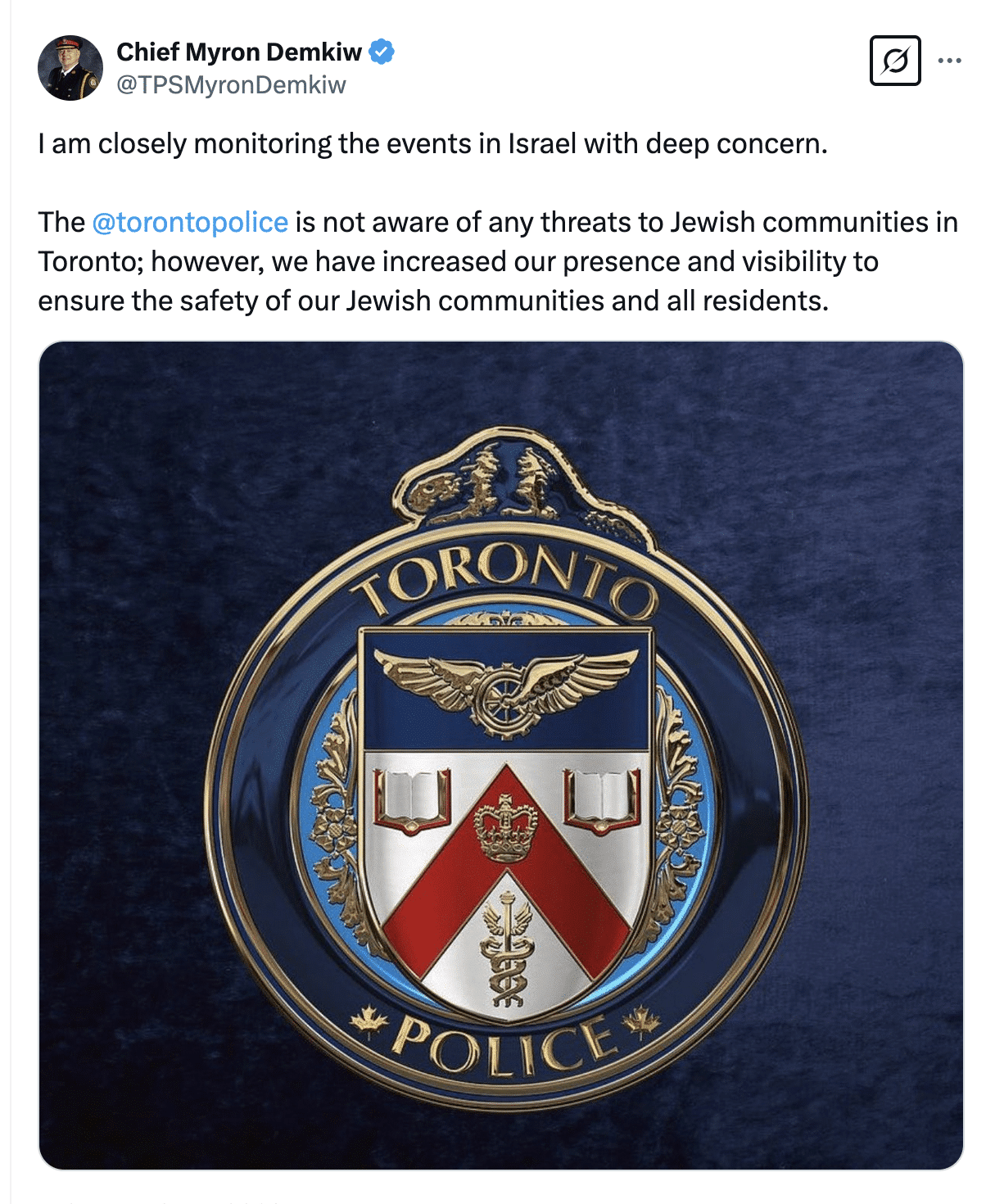
No such message of concern would ever be forthcoming for Toronto’s Palestinian community, even as Israel launched its bombardment and invasion of Gaza, which to date has killed more than 37,000 Palestinians.
It was an early sign of a one-sided policing approach.
Several days later, Mayor Olivia Chow put forward a motion that would give police a central role in “Keeping Toronto Safe from Hate.”
A small meeting followed between the Toronto Police’s Hate Crimes Unit—part of its Intelligence Services—and Chow’s top staff and the deputy mayor. Also in attendance was councilor James Pasternak, an aggressive defender of Israel who had previously tried to ban the group Queers Against Israeli Apartheid from the city’s Pride Parade.
A week later, Chief Demkiw and the unit’s senior officials participated in a major town hall organized by the United Jewish Appeal. Police promised a similar event with the Muslim community, but did not respond to The Breach’s questions about whether it ever happened.
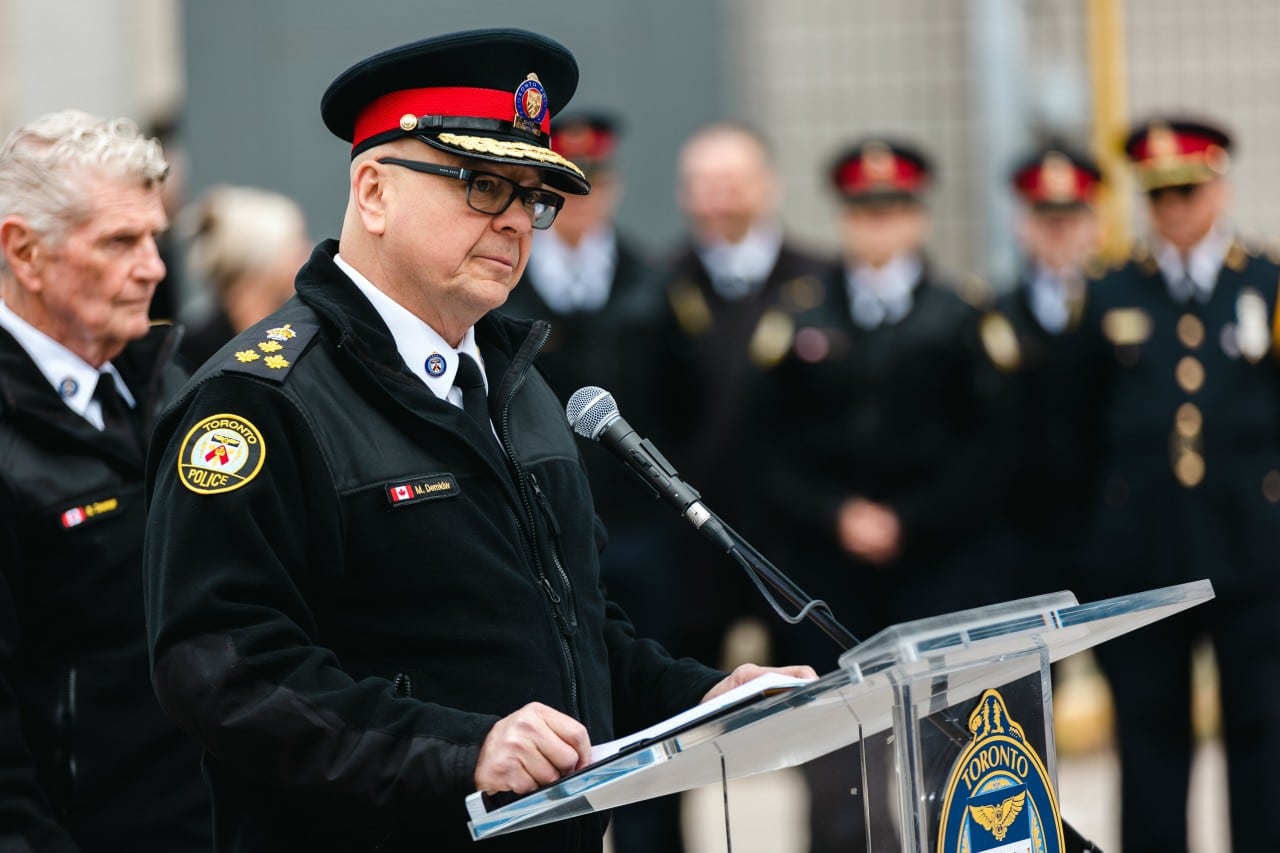
Meanwhile, several other pieces fell into place that would reinforce one-sided policing.
The Toronto Police made a decision to empower the Hate Crimes Unit, giving it leadership of Project Resolute.
The unit grew from six officers to 32, according to a verbal report Chief Demkiw gave the Police Services Board in November. Officers from other specialized units were drawn into the operation.
In late Oct. 2023, the mandate of the unit was also quietly expanded to include the “investigation of any occurrence generated as a result of protests and/or demonstrations related to the Middle East conflict.”
This stood out as a red flag to defense lawyer Martínez.
“The fact that the police expanded its mandate to investigate ‘Middle East’ protest activity that is not considered hateful or even criminal makes it evident that this movement was targeted because it is connected to Palestine,” he said. “They likely saw this as a major surveillance opportunity.”
The Toronto Police refused several requests for an interview and did not respond to questions from The Breach.
But one officer who The Breach is not naming because they were not authorized to speak to the media said police had set up a “fully-integrated intelligence sharing model,” getting fed information by RCMP’s Integrated National Security Enforcement Team and CSIS, Canada’s spy agency.
Dozens of other officers were soon deployed to fulfill the city motion’s request to create “community safety zones,” monitoring and protecting Jewish and Muslim places of worship.
“Will not allow the people of our city to be intimidated,” Demkiw pledged in front of city councilors at a Police Services Board meeting in November, while explaining the meaning of “Project Resolute.”
“Lest anyone try to misconstrue the meaning of the term, let me be clear: we are resolute in our mission to ensure public safety and security, while also ensuring that the constitutionally-protected right to free speech and assembly is maintained.”
But in the months to come, those rights would come under the crosshairs of the Hate Crimes Unit.
‘Strategic incapacitation’ of a growing movement
A socialist flag, a university lecture, a peaceful protest on a highway overpass, a non-violent office sit-in, and posters and washable paint splashed on a bookstore—all have drawn Project Resolute’s attention and resources. In many cases, this attention has led to charges of “hate-motivated” crime or severe restrictions on subsequent protest.
In mid-April, Samantha was walking along College Street after attending a protest at Union Station, when a stranger suddenly grabbed her wrist. She shook him off and kept walking, taking her phone out of her pocket.
He followed behind and grabbed her once again, slapping the phone out of her hand.
“You can’t do that, that’s assault,” Samantha shouted, recalling the encounter in an interview with The Breach.
That’s when the stranger and several others surrounded her, announced themselves to be plainclothes police officers, and declared that she was under arrest.
The arrest, she was informed, was for a peaceful sit-in she had attended at the Toronto office of Awz Ventures three months earlier, in January.
Samantha is not the protester’s real name, and The Breach has agreed to keep her anonymous for fear of professional retribution.
Awz, an investment fund led by former Conservative Prime Minister Stephen Harper, is behind a facial recognition tech being used by the Israeli military to conduct mass surveillance of Palestinians in Gaza.
High profile activists Desmond Cole and Anna Lippman were also arrested for participating in the same sit-in, and released on conditions that prevent them from using devices to amplify their voice when attending demonstrations.
To professor Walby, picking off lead organizers is a classic tactic in the playbook police use against social movements.
“It’s what we call ‘strategic incapacitation’ of groups that threaten the political order,” Walby said. “The tactics also include bogus or trumped up charges, early morning raids, and surveillance and strategic intelligence to know as much as possible about activist communications.
“I think we are seeing all these techniques, amplified by anti-Palestinian racism, brought to bear on this transformative movement.”
Earlier in January, Toronto Police as part of Project Resolute took the extraordinary step of banning protests on the Avenue Road bridge over Highway 401.
Some Jewish organizations claimed the location had been chosen because of the large Jewish population in the area, but for the protesters, it was a convenient and highly visible spot.
Hesham Aly, a 36 year old operations manager who lives a five minute drive from the overpass, was roughly arrested by police and charged with “obstruction.”
The Canadian Civil Liberties Association blasted the police ban as setting a “dangerous precedent.”
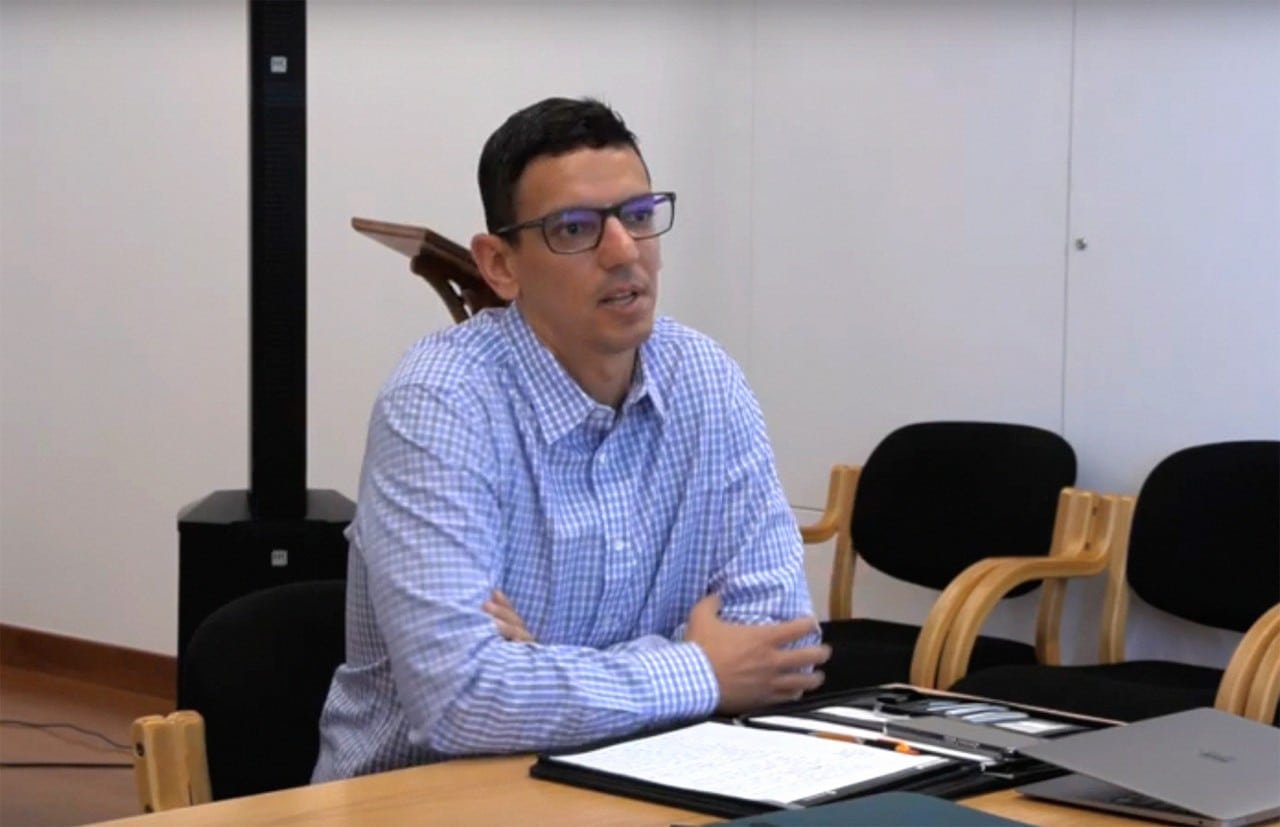
In February, Project Resolute even made itself felt in a university lecture hall.
Palestinian scholar Muhannad Ayyash was preparing to deliver a presentation at York University when two uniformed police officers entered the room. After being challenged about their presence, officers said that they had been called by the university to address a “possible protest.”
But according to The Breach’s investigation, this wasn’t true. York administrators revealed to a select group of professors that the police were acting on an alert from a “special intelligence unit.”
The crown jewel of Project Resolute’s operations, however, was its sustained focus on a protest against Indigo CEO Heather Reisman.
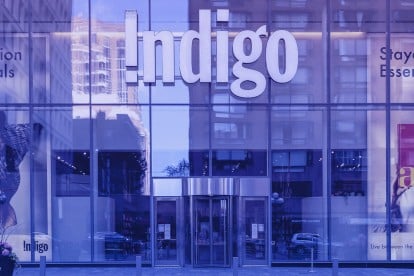
In early November, Indigo’s flagship Bloor store in Toronto was plastered with posters and red paint to protest Reisman’s involvement in a foundation that provides millions of dollars every year to people who volunteered to join the Israeli military.
For two weeks, nearly ten officers from the Hate Crimes Unit worked full time on the case, scouring social media and canvassing neighbourhoods where the protesters lived, for camera footage.
Night raids followed, involving more than 50 officers and a canine unit. They used tactics usually reserved for violent criminal offenses: arresting people in bed, handcuffing family members of those accused, and leaving doors knocked off their hinges.
Toronto police announced that the postering was being treated as a “hate-motivated offence,” and said it was carried out because Reisman is Jewish—even though one of the accused, a professor at York university, is Jewish herself. When protests first started against Reisman’s funding of Israeli military volunteers in 2006, the Jewish Women’s Committee to End the Occupation were centrally involved.
At least four of the people who used paint and posters to protest Reisman last year were suspended from their jobs, others lost contracts, and others still were subjected to harassment on social media.
As of early April, the costs of Project Resolute reached $12 million—though additional legal costs associated with the operations would likely increase that tally by millions more.
Indigo CEO’s ‘instant access’ to Police Chief
Claims of political pressure have swirled around the Toronto police’s operations, with experts stressing that police are not the only ones driving its politicized nature.
“The police are leveraging significant public resources and personnel,” said Walby. “That’s only possible because everyone from Olivia Chow, to Doug Ford, and Justin Trudeau have been pretty supportive. There is a broader formation of elites whose views are animating what police are doing.”
In January, the day before Toronto’s Police Chief declared a ban on the Avenue Road protests, he met with Prime Minister Justin Trudeau.
When Trudeau was pressed by the media about what he had said to Chief Demkiw, he only said “the federal government doesn’t have any line of command over the decisions taken by the Ontario and Toronto police.”

It’s not just political figures who are suspected of giving prompts to Toronto police.
The same day that Indigo was plastered with posters protesting her support for Israel’s military, CEO Heather Reisman made a phone call to Toronto’s Chief of Police, according to a police source.
To Walby, the example is telling.
“It shows some elites have instant access to the upper echelons of the police,” Walby said. “The police aren’t being directed and they’re not taking marching orders. But clearly they are taking cues, they’re taking advice that reflects a certain set of political interests. This is access and power that any other Canadians do not have.”
Reisman spoke to police again in late November. The next day, Toronto police added a new charge to the accused: “criminal harassment,” which is behaviour that causes a victim to “fear for their safety or the safety of anyone known to them.”
It carries the potential sentence of ten years in jail.
‘We were watching you’
The day after the eleven accused in the Indigo case were arrested, one of the individuals was interrogated in detention by a Hate Crimes Unit officer.
The officer revealed that police had been monitoring No One Is Illegal, the migrant justice organization that some of the arrested were members of.
“We were watching you,” the officer told the individual.
While police have relied on long-standing surveillance of movements, newcomers to activism have also been caught in Project Resolute’s web of attempted surveillance.
Cyrus Reynolds, a 34 year old construction worker attending protests for the first time in his life, was arrested on Avenue Road the day after protests were banned.
After being released from the police station, Reynolds said he was approached by a detective who asked to speak to him in a side room.
The detective, who told Reynolds he was with the intelligence unit, urged him to join a confidential informant program, and to share upcoming dates and locations of any Palestinian solidarity actions.
He told Reynolds that he couldn’t make any promises, but in return, he would try to help him out with his charges.
“Make sure you don’t tell your wife about this—I’m married too, but I don’t tell my wife everything,” Reynolds recalled the detective saying.
Reynolds told him there was “no way” he would be an informant.
Months on, police’s charges are falling apart
In the middle of the proceeding, the Justice of the Peace delivered a stern rebuke to the Crown prosecutor.
It was late April, and the Crown had agreed to drop charges against Maged Sameh Hilal Al Khalaf, a 41 year old sports instructor.
Back in January, he had been charged with “publicly inciting hatred” for flying the flag of the Popular Front for the Liberation of Palestine, a Marxist-Leninist party with a military wing and several legislators in the Palestinian parliament.
But three months later the Crown was withdrawing the charge because there was “no reasonable prospect of conviction.”
Yet the Assistant Crown Attorney had made a statement at the hearing that the police “had legitimate concerns [the flag] could incite hatred toward Jews” and that Torontonians should be “put on notice” that flying it may “very well be met with further arrests.”
Justice of the Peace Robert Shawyer looked taken aback. “I must say that’s an extremely concerning statement to put on the record while withdrawing a charge,” he said.
Police were clearly scrambling to save face.
At the time of Al Khalaf’s arrest in January, Chief Demkiw had confidently declared the flag “illegal” and called the charge “unprecedented.” He told CBC that “police have never laid a charge of this nature.”
To Martínez, who was Al Khalaf’s lawyer, this smacked of “political opportunism,” with “bias clearly at play.”
“It’s not like the police have been laying charges against people flying the Confederate flag, which is often associated with hate groups and white supremacy,” he said. “But suddenly they were motivated to charge someone for flying the flag of a Palestinian organization without first doing any research.”
Left and right, the police’s arrests were falling apart. Charges against all the individuals arrested in the Avenue Road protests were withdrawn almost immediately.
A defense lawyer told The Breach that someone within the Crown’s office said the collapse of one case had “Demkiw pulling his hair out.”
The Indigo case was going no better. After making a media splash during the arrests, the Crown’s case was disorganized, languishing under several delays.
As of early June, they had not yet provided key documents to the defendants’ lawyers to explain the basis for the police’s search warrants and night raids.
Four of the eleven accused had their charges dropped—yet again because of “no reasonable prospect of conviction.”
At the court hearing, a lawyer for one of the defendants, Mike Leitold, said there was “not a scintilla of evidence to support the allegations of hate motivation.”
At a press conference the following week, Leitold added that he believed all the rest of the charges in the Indigo case should be dropped.
“Police came into homes across the GTA and invaded their sanctity in ways that were highly traumatizing. All for what? For paint and posters,” Leitold said.
“The use of paint and posters to freely express our dissent is a time-honoured tradition—one we see as part of the cut and thrust of urban life and the vibrancy of the city’s fabric. And it is all the more important to protect when criticism of Israel’s war in Gaza is being suppressed. To criminalize this sends a very chilling message.”
As for the Islaih family, they told The Breach they are still shaken by their encounter with the police.
For weeks after their home was raided, they found it difficult to sleep.
In May, the Crown finally dropped its charge against Ahmad Islaih, saying pursuing it would not be in the “public interest.”
But that doesn’t change the damage done to the family. Ahmad’s arrest, covered across the media, was broadcast on the large television at the local YMCA where he used to teach kids to swim. Colleagues at the school where he works heard about the arrest, too.
“How did my son deserve something like this? They treated him like a criminal,” his mother Suha said. “We immigrated to Canada so that our kids would not suffer here like we did in Palestine.”
The Toronto Police still haven’t returned several of Ahmad’s things, including his phone, jacket, keffiyeh, as well his prized possession, a drone.
He used it to shoot videos in the community and to build a fledgling freelance business when not teaching. He’s waiting to get it back so he can again start documenting the Palestinian solidarity movement.
Despite the efforts of Project Resolute, the protest movement is not letting up.
“There’s a genocide happening,” Ahmad said. “I want to film the vast numbers coming out to show support for Gaza. I want to get the word out.”
-Files from Kunal Chaudhary
“We need media that enlarges the sense of what’s possible.”
Naomi Klein, journalist and author
Want to support hope-fuelled journalism? Become a sustaining member.
Palestine | CBC has whitewashed Israel’s crimes in Gaza. I saw it firsthand
Palestine | Cops crashed my talk on Palestine (and proved my point about colonialism)
Heather Reisman | In stunning pre-dawn raids, Toronto police ‘terrorize’ Palestine activists
6 comments
Comments are closed.

Thank you for your work on this issue. Much appreciated.
I used to work for Indigo. It was always entertaining when every year or so, some new employee would hear about Heather Reisman’s “charity” and post on the internal discussion board like “wow, is it true that Heather has a charity for people who want to join the IDF?? That’s alarming….” and things would get locked down so fast. I remember one time Heather posted defending herself and it was the most out-of-touch thing I’ve ever laid eyes on. There’s been minor backlash and boycotts for years but nothing stuck really, glad people are finally catching up. The fact that she has a direct line to the Chief of Police is messed up, unsurprising however.
If you liked the actions taken against the Trucker convoy, THIS is what it lead to. This genie will not easily go back into the box. Expect these tactics to be used against whoever holds view out of favor with the political elitists, and statists.
I am eager to follow any legal suites launched to address these massive official assaults against civil society and basic democratic freedoms. I would expect heavy weight lawyers gleefully wading into the limelight to pursue thorough accountability from those responsible for these abuses of authority.
Our democracy is at stake.
Is it time to re-invigourate the “Defund the Police ” Campaign!
Excellent piece. But at a 13-page Word doc of text you may want to consider presenting lengthy pieces like this in at least 3 parts.