“Recovery from addiction isn’t only possible,” a panelist told an Alberta tech industry audience last May, “it’s expected. It’s contagious. You can get near it. You can catch it. You can spread it.”
The panelist, Marshall Smith, outgoing chief of staff to Alberta Premier Danielle Smith and architect of the United Conservative Party’s (UCP) abstinence-first drug strategy, continued: “We need to ensure the recovery capital that we build into communities is more significant so as to extinguish the disease burden in the community, and then we will win.”
With communities struggling under the weight of interconnected crises of housing, health care and deteriorating public services, governments are racing to cast blame on “diseased” individuals rather than own up to their own policy failures.
The Alberta government defines “recovery capital” as “the internal and external resources a person can draw on to begin and maintain their pursuit of recovery”—employment, housing, family, skills, cultural support and so on—with an unstated requirement of “recovery” being complete abstinence from drugs.
This abstinence-only model is known as a “recovery-oriented system of care” and has been steadily working its way across the western provinces, propelled by conservative governments in Alberta and Saskatchewan.
These policies might seem innocuous on their surface, but the consequences for people who use drugs have been deadly.

Rates of opioid use disorder were essentially stable across Canada between 2012 and 2022. In Alberta, however, there were 85 reported deaths from opioids in 2012 and 1,526 in 2022– an 18-fold increase in just ten years.
Public health experts largely attribute this increase to an unregulated illicit drug supply whose users can’t know exactly what they’re getting or its potency. In Alberta, up to 94 per cent of opioid toxicity deaths involved fentanyl from 2021 to 2024, a direct consequence of government refusal to regulate this drug supply.
Rejecting the available data and choosing instead to view the problem as one of rampant addiction, the core response to this pressing issue by the Alberta and Saskatchewan governments is to expand capacity to institutionalize people who use drugs in privately run treatment facilities, with the ultimate aim of improving “recovery capital” in individuals and communities.
Other provinces have followed Alberta and Saskatchewan’s lead. In August, Ontario Premier Doug Ford announced the closure of some of the province’s supervised consumption sites along with new restrictions on the location of any new sites. His Progressive Conservative government has promised to open a number of homelessness and addiction recovery treatment centres, colloquially dubbed HART hubs.
Here, too, “recovery” and abstinence are being prioritized over all else.
With a Pierre Poilievre-led Conservative government looming on the federal horizon, this abstinence-only approach could be the future of drug policy across the country—with potentially disastrous results.
The war on drugs, back with a vengeance
The “recovery-oriented” system is a convenient way to wage an updated war on drugs, this time softened and obscured by pseudo-medical rhetoric.
Focusing on addressing addiction to the exclusion of all else, including the toxicity of an unregulated drug supply, maintains a racially and politically arbitrary legal standing of different drug classes for which the original war on drugs became known.
This moral inconsistency became particularly visible when Alberta’s Minister of Mental Health and Addiction Dan Williams chugged a beer on the legislature floor without consequence, while people who use illicit drugs face criminalization and soaring death rates.
The war on drugs in the 1980s leaned on expanding police power. Now, we see the same police powers used against people who use drugs in brutality toward tent encampments and coordinated suppression of drug decriminalization by police lobbying, as the Alberta Association of Chiefs of Police conducted during the province’s 2023 election campaign.
The Saskatchewan Party has proposed to expand police power to address public disturbances and to allow businesses to designate police as authorized representatives. This draws inspiration from Edmonton, where a similar policy empowers police to enter businesses, issue trespass notices and tickets, and conduct arrests on virtually any suspicion.
When Alberta’s United Conservative Party took power in 2019, it inherited a relatively wide scope of health care for people who use drugs. That included eight supervised consumption sites and limited access to regulated opioids specifically for people with opioid use disorder—a program known as prescribed supply.
In an interview during his campaign, then-future premier Jason Kenney was clear about his views on supervised consumption: “helping addicts inject poison into their bodies is not a solution to the problem of addiction.”
The message was clear: any existing programs in Alberta meant to help people who use drugs stay alive and safe would have to end, and an abstinence-only policy would take hold.
In his 2024 book Kenneyism, journalist Jeremy Appel describes Alberta’s modern political innovation as an implicitly Christian law-and-order corporate welfare state in which public services are handed off to corporations and nonprofits with little oversight or regulation.
For people struggling to survive dueling crises of unregulated drugs and unaffordable housing, this economic regime spells disaster.
In late 2019, the new UCP government formed the Mental Health and Addictions Advisory Council, with Pat Nixon as a co-chair. Nixon is the founder of The Mustard Seed, a Christian organization that runs a number of abstinence-only shelters across B.C. and Alberta, with another slated to open in Saskatoon.
Two years later, the council issued its final report, which called for policy shifts that tie housing and healthcare access to a person’s “recovery”—meaning their abstinence from drugs.
Underscoring the government’s moral opposition to harm reduction, the UCP cancelled two planned overdose prevention sites and closed the province’s only supervised inhalation service in Lethbridge.
Twenty thousand monthly visits to that site were deflected into the streets and surrounding communities, and soon after, access to prescribed supply was severely curtailed through the introduction of draconian new regulations limiting prescribers’ power.
‘Everything’s moving back to the dark ages’
By the time the UCP assumed the mantle in Alberta, the Saskatchewan Party next door had been in power for over a decade.
Given its right-wing political orientation, it had done little to introduce harm reduction programs over its three terms in office. As a result, almost every effort to keep people who use drugs from dying has come directly from the community.
Among these is the grassroots supervised inhalation and injection site Prairie Harm Reduction (PHR), which opened in 2020 in Saskatoon.
While some of PHR’s services receive government funding, the consumption site is entirely community-funded, drawing much of its support from local businesses, fundraising and in-kind support: a supportive local HVAC business built the site’s inhalation room for pennies on the dollar. New releases of PHR’s merchandise, often emblazoned with pro-harm reduction slogans, are hotly anticipated among those eager to both financially and publicly support the site.
Kayla Demong, PHR’s executive director, has felt each act of local solidarity alongside a growing pattern of attacks on harm reduction. “I say it jokingly, but we’re coming back to a situation where The Handmaid’s Tale is about to become reality,” Demong told The Breach, conjuring up all at once the Saskatchewan Party’s approach to drug policy, trans rights and reproductive rights.
Among the most fundamental harm-reduction health practices related to drug use are educating people on safer drug consumption and ensuring they have access to sterile supplies, such as syringes and pipes—the latter of which are now the preferred mode for most illicit drug consumption.
These practices stem from activism in the 1980s and so have decades of research to support them. According to the US Centres for Disease Control, sterile syringe programs reduce HIV and Hepatitis C transmission by half, making the distribution of sterile drug consumption supplies an extraordinarily effective public health measure.
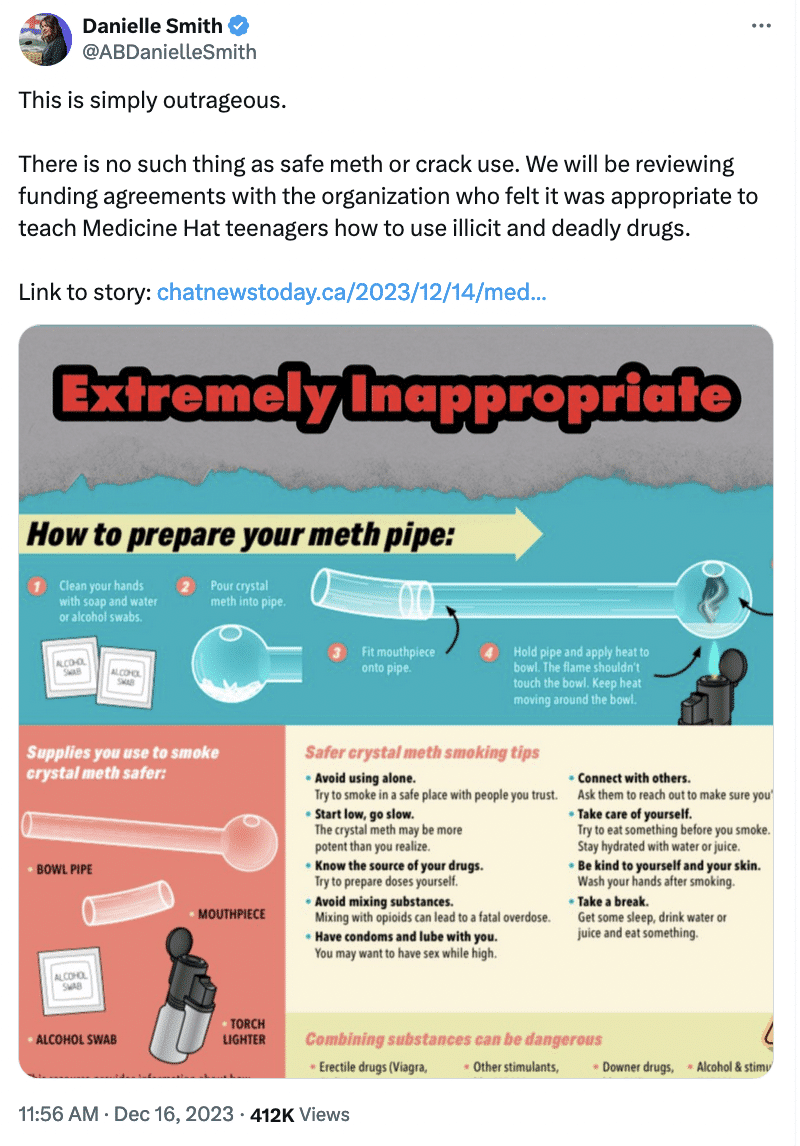
Eager to challenge this miracle of public health, in December 2023 Alberta Premier Danielle Smith threatened to review the contracts of an organization funded by her government to educate high school students on safer drug use.

A month after Smith’s declaration, the Saskatchewan Party took it a step further, cutting access to sterile needles and eliminating funding for the distribution of glass pipes.
Echoing Kenney’s earlier message, the Saskatchewan Party put out a statement asserting that “providing taxpayer-funded pipes for smoking illicit drugs and instructions for how to use them sends the wrong message to people who we want to help. Instead, the message coming from the health care system should be that there is hope for recovery, and there is help available through treatment.”
Upon further questioning by CBC, Saskatchewan’s Minister of Mental Health and Addictions Tim McLeod could not provide any evidence that helped them arrive at this decision.
Saskatchewan, which has the highest per-capita rates of HIV infection of all the provinces—and where the majority of new infections come from drug use rather than sexual contact—would clearly benefit from the wide availability of a proven, affordable program that could reduce the spread of this disease.
“Prairie Harm Reduction fought for years to get pipes distributed,” Demong said. “We did all the education posters and the training for how to use them and the training for staff. Everything’s moving back into the dark ages, and all the research that’s been done and all the best practices that have been designed don’t matter.
“I have met with ministers multiple times…there is no interest. Treatment is the only option.”
Public funds going to Christian organizations focused on abstinence
While the Saskatchewan and Alberta governments have been able to deny funding to essential harm reduction services under the guise of supporting “recovery,” both provinces are still facing a related, and worsening, housing crisis. Reducing harm reduction access aggravates drug toxicity in unhoused communities, a risk already heightened by enforced encampment displacement and drug confiscation.
As of yet, neither government has fully reneged on its responsibility for funding emergency shelter services for the homeless, but nor are they interested in operating badly needed shelters directly. A consequence of this is that many non-governmental shelter agencies are seeing their funding rise.
In western Canada, perhaps none have grown as visibly as the Christian, pro-abstinence non-profit The Mustard Seed, which runs a number of “dry” overnight shelters.
The Seed, as it’s colloquially known, was launched in 1984 by Pat Nixon, the father of current Alberta Minister of Seniors, Community & Social Services Jason Nixon and former Alberta MLA Jeremy Nixon, who oversaw the same portfolio his brother is now in charge of before being ousted in the 2023 election.
Through the 2000s, Jason served as executive director at the Seed and ran its addiction treatment centre. Around 2010, he parted ways with the organization after an alleged assault (which Nixon acknowledged in a peace bond, though he was never convicted).
The Seed’s tax filings describe it as a “Christian charitable organization that is servicing vulnerable citizens in Alberta and British Columbia.”

Nicole Luongo, systems change analyst at the Canadian Drug Policy Coalition, recently noted that excluding people who use drugs from shelter could deepen the “grotesque” and “dehumanizing” stigma that already exists toward unhoused individuals.
“There is such a strong correlation between material deprivation and high-intensity drug use,” Luongo said in an interview with The Bind. “When people are experiencing homelessness, there is so much incentive to stay intoxicated.”
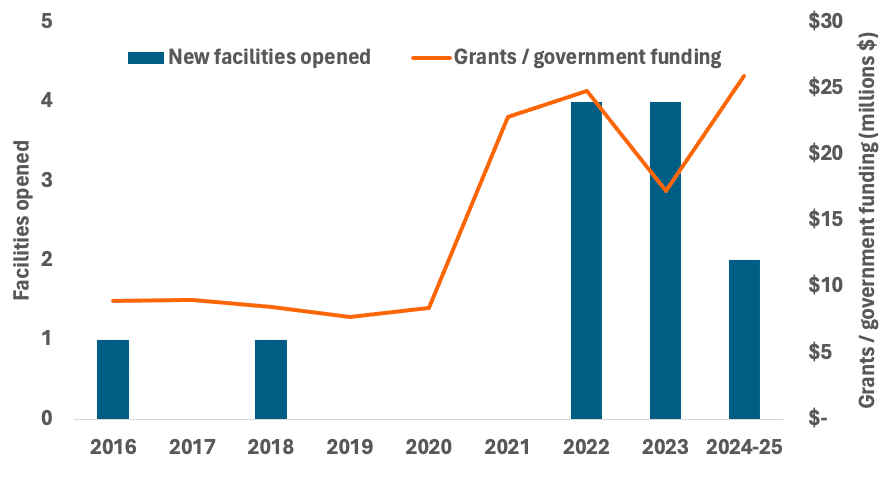
After the UCP took power, annual public funding to the Seed jumped from an average of $8 million per year from 2017 to 2020 to an average of $23 million per year from 2021 to 2024, according to the organization’s annual audits.
During that time, it has grown from four shelters and supportive housing facilities in three cities to 14 facilities in seven cities—growth that apparently supports salaries of $160,000 to $300,000 for its seven top-paid staff. In response to a request for comment, the organization’s Communications Manager Deon Watson stated that The Mustard Seed is “a space where individuals experiencing homelessness can receive the critical support they need to rebuild their lives,” including employment assistance, ID recovery, and mental health counseling. All of this is geared toward having people “transition into sustainable housing.”
Leading the social services ministry since 2019, the Nixon brothers have enthusiastically promoted the Seed. During the government’s announcement of a task force to address social issues in December 2022, Jeremy name-dropped the organization five times in seven minutes.
Meanwhile, Jason has posted about the Seed on X six times since being elected, to the apparent exclusion of other shelter agencies.
Gold rush for right wing disaster capitalists
It seems that wherever disaster strikes unhoused communities, the Seed appears to open a facility—Alberta, and soon Saskatchewan, government contract in hand.
After Wetaskiwin city council closed the local shelter and created a months-long tragedy by displacing homeless people shortly before the onset of winter, the Seed was funded to run a temporary trailer through the winter. While drug toxicity disproportionately surged among unhoused individuals in early COVID, the Seed was handed Alberta government contracts to operate COVID-19 emergency shelters in Calgary, Edmonton and Red Deer and an isolation unit in Calgary.
In 2023, after financial mismanagement closed the Lighthouse Supported Living facility in Saskatoon, the Saskatchewan government ushered in the Seed’s first foray into Saskatchewan. Kenneyism: meet disaster capitalism.
Marc Arcand, Tribal Chief of the Saskatoon Tribal Council that oversees 105 shelter beds in Saskatoon, is not pleased with how his organization was sidelined during arrangements to replace the Lighthouse.
In September, he told local radio station 650 CKOM, “I have no faith in Mustard Seed because they don’t know nothing about First Nations people. Their population when they work in Calgary is with newcomers. They don’t deal with what we’re dealing with in Saskatoon, which is the First Nations people, the mental health, addictions, violence. They have zero clue.”
This ignorance is likely to be of little concern to the UCP and Sask Party, along with their corporate allies, as they realign provincial governments with their abstinence model.
With the federal Conservative Party promising to adopt the model and involuntary treatment planned in BC and Alberta, a gold rush is underway for social agencies willing to toe the line.
As Marshall Smith instructed the nonprofit sector at the tech conference in May, “a lot of you feel compelled to go out and make strategy. Don’t do that. Just come on board with The Strategy.”
When they do, nonprofits hoping to thrive under Kenneyism—and, if Poilievre wins the next federal election, agencies across the country—will have to get accustomed to leaving people who use drugs out in the cold.
*Correction: The title for Mark Arcand has been corrected to reflect that he is the Tribal Chief of the Saskatoon Tribal Council.

‘The first video I ever made with The Breach was on why we need to support the movement for Land Back. Today, it’s being used in educational settings everywhere—in universities and colleges and children’s classrooms too. When I give talks, people will say, ‘I saw your video and it helped me understand the issue.’
That’s what we do at The Breach—reach people where they are at, with bold ideas, principled analysis, and critical investigations.” – Pam Palmater, scholar and author
Become a sustaining member of our work today.